

Do you see a pile of companies starting to hoard ETH as a treasury asset and immediately feel it’ll copy Bitcoin’s explosive narrative — and want to hop on fast?This piece won’t hype the story for you. Instead, it first helps you understand what the ETH treasury narrative is actually saying, how it differs from the Bitcoin version, and the thinking traps beginners fall into most, then gives you a framework for judging whether these companies are worth touching.
What is the ETH treasury narrative? And why does it remind people of Bitcoin
“A company buying ETH as a reserve — how is that any different from me buying the coin myself?”The difference lies in scale, leverage, and the layer where “the stock price tracks the coin price.” In this section we’ll first get the shape of this narrative straight and connect it to the familiar Bitcoin story, so that later we can judge whether it can actually copy that script.
The story of companies holding ETH as a reserve asset
The ETH treasury narrative, put plainly, is listed companies buying up large amounts of Ethereum and putting it on the company’s balance sheet as a reserve asset, turning their own stock into a kind of “proxy for holding ETH.”Buy its stock, and you’re indirectly betting on the value of that pile of ETH it holds.
Take BitMine as an example: in a relatively short span of time, it raised money through repeated stock issuances and used the proceeds to buy up large amounts of Ethereum, accumulating a position that approaches a fairly sizable slice of Ethereum’s total supply — and the company openly stated its goal of holding a very high proportion of ETH. It didn’t even let those coins just sit there; it staked most of them, hoping the position could generate a little yield each day.The core of this playbook is tying a company’s fate almost entirely to the price of a single crypto asset.So I’d remind beginners: when you look at this kind of company, don’t just see how many coins it bought — see that it has turned itself into a highly concentrated, undiversified bet, which, compared with an ordinary company that has multiple business lines, is a completely different risk structure.
What it’s trying to copy is MicroStrategy’s Bitcoin script
This play wasn’t invented by ETH treasuries; its prototype is MicroStrategy’s (MicroStrategy) story of continuously buying Bitcoin and turning the whole company into a “Bitcoin proxy stock.”To understand what ETH treasuries are up to, you first need to understand how this original script works.
MicroStrategy’s loop goes roughly like this: the company keeps raising money to buy coins; when the coin price rises, it lifts the company’s net asset value and stock price; a high stock price makes it easy to raise even more money on better terms and buy more coins, forming a positive loop that looks beautiful. The market’s story for it is that buying its stock equals holding Bitcoin in a leveraged way. What ETH treasuries want to copy is this entire loop, just swapping the target from BTC to ETH. I especially want to underline the word “loop,” because the other side of a loop is feedback — it self-reinforces when the coin rises, and can also turn on itself when the coin falls.Something that can fly upward on a positive loop usually also has symmetric downside risk; keep that in mind first.
On the surface it adds a “yield” selling point
Compared with simply holding Bitcoin, the ETH treasury stuffs one more tempting element into the story: staking yield.This is also its main talking point for convincing the market that “we’re more sophisticated than just hoarding coins.”
The logic goes like this: because Ethereum can be staked for rewards, these companies emphasize that the ETH they hold isn’t a dead asset but a reserve that earns staking income every day and generates yield on its own. It does sound far sexier than just locking coins in a vault — after all, who doesn’t love an “asset that makes money.” But I hold back that excitement first and ask a more practical question: is the magnitude of this yield actually enough to bear the risk it has to take on?A selling point sounding reasonable and whether it holds up under real volatility are two different things.Whether this staking yield is a genuine safety cushion or just one more pretty label on the packaging is what the next section will carefully take apart; for now, just remember it’s placed front and center in the story as the headline.
Don’t rush to be optimistic: how the ETH treasury differs from the Bitcoin version
“It’s also a company buying coins, so the ETH version adds staking yield — doesn’t that make it better than the Bitcoin version?” It’s not that simple.There are a few key differences between it and a Bitcoin treasury, and those differences are exactly where the risk is buried.Let’s look at them one by one first, then decide whether to believe the optimistic side of this narrative.
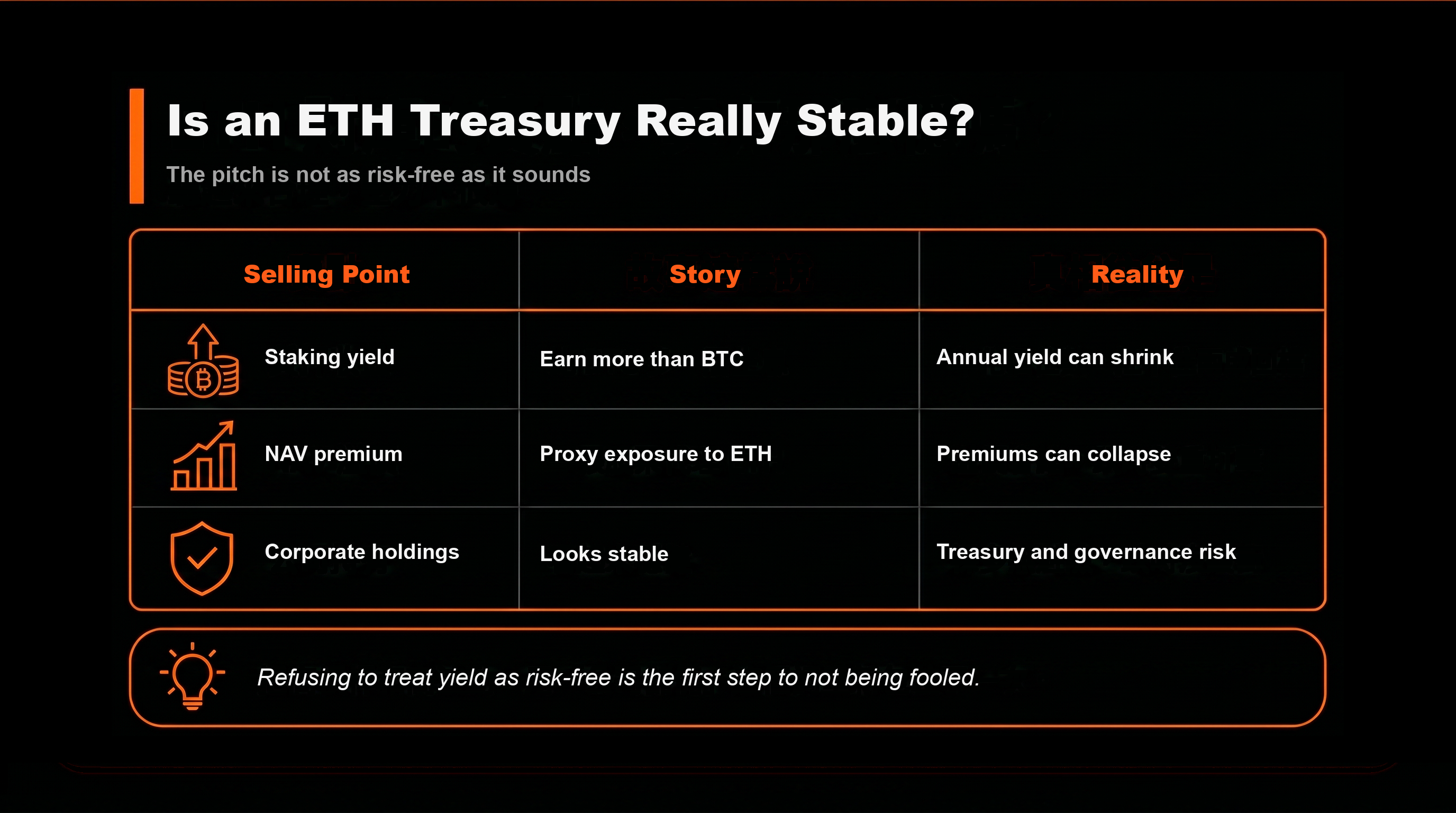
Can staking yield withstand the swings in coin price?
Let’s return to the question left from the last section: staking yield is the selling point ETH treasuries keep on their lips, but you have to put it on the same table as the coin price’s volatility to see its true weight.
The key is comparing magnitudes. These companies’ annual staking income, relative to the total market value of the ETH positions they hold, is actually a very thin layer. Staking yield is usually in the low single-digit percentages a year, but a decent pullback in the crypto market is easily 20%, 30%, or even deeper. In other words, once the ETH price drops sharply, the paper loss can easily be dozens of times the staking income over the same period. My view is blunt: staking yield is of course a plus, and without it the story would be even harder to tell, but whatever you do, don’t treat it as a safety cushion that can hedge a falling coin price. At most it’s a bit of pocket money in a tailwind; when a real downturn hits, it can’t block it, and it can’t hold it up.Treating a small yield as big insurance is the spot in this narrative most likely to mislead beginners.
NAV premium: the stock can be more expensive than the coins it actually holds
The second difference hides in the gap between the stock price and the coins it actually holds.These companies’ stock prices often show a phenomenon of being “more expensive than the value of the ETH they actually hold,” and this thing has a name: NAV premium.
A NAV premium means the market is willing to pay more than the company’s net asset value to buy its stock — the money you pay is more than the pile of ETH it holds on your behalf. The problem is that this premium isn’t fixed; it can shrink, or even vanish. When market enthusiasm ebbs, or the coin price itself is falling, the stock price easily gets squeezed by both forces — “the coin is falling” and “the premium is shrinking” — with the result that it falls even harder than ETH itself. This is a layer many beginners don’t account for: you think buying treasury stock equals holding ETH in disguise, but you’re actually taking on the extra risk of whether the premium evaporates. Buying this kind of stock, the risk structure you take on is far more complex than buying ETH directly, and this complexity is an amplifier in a bull market and an accelerator in a bear market.
Naked long, no hedge — it hurts on the way down
The third difference, and the one most easily buried by the hype, is these treasury companies’ position posture: they’re mostly “naked long” — hands full of ETH, with almost no hedging at all.This is, compared with a mature institution that hedges with derivatives, two completely different risk profiles.
Naked long means the company bets almost its entire net worth on ETH going up in that one direction, with no hedge on hand to cushion a decline. This means that as soon as the coin price falls, it has no umbrella at all, and paper losses expand directly and without any discount. This isn’t hypothetical — BitMine, during the stretch when ETH weakened, actually posted enormous paper losses and a capital drawdown, with net value dragged down along with the coin price. This reminds us of a very plain truth: a company buying coins doesn’t equal guaranteed profit; no amount of buying pressure and no strength of narrative can change the fact that it’s completely exposed on the way down.Put bluntly, the so-called ETH treasury is, much of the time, just high leverage and high volatility repackaged once more with the reassuring-sounding term “company reserve.”
The thinking traps beginners should most avoid when reading this kind of narrative
“So should I follow this narrative and buy or not?” In this section I won’t give you buy or sell advice — that’s not a decision I should make for you. What I’ll do is lay out the few thinking traps beginners fall into most when reading this kind of narrative.Dodge these pitfalls first, and only then are you qualified to talk about the next step of judgment.
Don’t take “a company buying coins” straight as a guarantee of a price rise
The first, and most common, misunderstanding is seeing a company buy heavily into an asset and instinctively concluding the price must go up.This inference doesn’t hold up on its own.
A company deciding to buy ETH heavily represents one strategic bet of its own — it’s wagering this direction will win, not the market guaranteeing it will win.MicroStrategy’s Bitcoin story is retold everywhere because it happened to bet right on a huge rally; but the same fully loaded, leveraged play, when the coin price falls, turns around and magnifies losses even more. Stories where the bet paid off get remembered; the parts where the bet went wrong or is currently bleeding usually go untold. So every time I see news like “some company bought another X amount of ETH,” I first ask myself: does this actually reflect any fundamentals, or is it just another leverage story dressed up by the hype?Erasing the equals sign someone quietly drew between “the company bought” and “so it’ll rise” is the first lesson in reading this kind of narrative.
Separate “buying ETH” from “buying a treasury company’s stock”
The second trap is treating “buying ETH” and “buying a treasury company’s stock” as the same thing.The risk structures of the two are actually very different, but beginners easily lump them together, thinking buying the latter is just holding ETH through a different channel.
Let’s lay out what each of these two paths makes you bear and compare them, and the difference becomes clear:
- Buying ETH directly: what you mainly bear is the coin price’s volatility itself — simple and direct.
- Buying a treasury company’s stock: you simultaneously bear coin price volatility, NAV premium contraction, the company’s financial condition, and the equity dilution caused by its constant stock issuance.
See it? The latter wraps the former’s risk inside and then piles on several more layers of risk that belong only to the “company” shell. It may rise more fiercely in a bull market thanks to the premium and leverage, but that fierceness cuts both ways. My judgment is simple: if what you truly favor is the asset ETH, then holding ETH directly is often simpler and cleaner than taking a big detour to buy this kind of stock.Unless you’re very clear that you’re betting on that extra layer of premium and leverage, don’t mistake complexity for an upgrade.
Watch the loop it sustains through “constant fundraising”
The third easily overlooked trap is this model’s lifeline — it depends heavily on the company being able to keep raising money on a high stock price and using it to buy more coins.Once that hand lets go, the foundation of the whole story shakes.
Recall the positive loop mentioned earlier: raise money, buy coins, coin rises, stock rises, raise more. When this loop turns smoothly it’s beautiful, but it has a premise — the market has to keep being willing to buy in and let it raise fresh money on good terms. Once market enthusiasm fades, or a weakening coin price makes investors hesitate, fundraising gets harder, the buying momentum slows accordingly, and the hand that was holding up the coin price and stock price loosens. Even more deadly, in extreme cases, this positive loop can reverse into a negative one — stock falls, premium shrinks, fundraising gets harder, buying weakens, stock falls again. So when I read this kind of narrative, I treat “can it still raise money, and is the market still buying in” as a very key point of observation, because that’s the real switch for whether this machine can keep turning.
What framework to use for examining an ETH treasury company
“So if I really want to understand whether a treasury company is worth watching, where do I start?” This section doesn’t hand you hot tips or draw conclusions for you; it just gives you a set of angles you can think through when looking at this kind of company, helping you set the hype aside and return to things that are more quantifiable and less likely to deceive you.
First look at where the premium sits
The first thing I’d look at is where its current NAV premium sits. As said earlier, this kind of stock is often more expensive than the coins it actually holds, and how much more expensive is a number that swings wildly with sentiment.
Simply put, the higher the premium, the more “story fee” you’re paying on top to indirectly hold that ETH. At the market’s most euphoric, this premium can be inflated large; once the enthusiasm ebbs, it contracts quickly again, and the contraction process is often exactly when the stock price hurts most. My own habit is to read the premium as a “market sentiment thermometer”: when it’s absurdly high, it usually means the margin of safety for buying now is very thin, and you’re taking the baton at an emotional peak; when it converges or even turns into a discount, it means the market’s story premium isn’t so heavy. This isn’t telling you to buy the dip or sell the top based on the premium — it’s reminding you that you should have a clear sense of how much of the price you pay is real assets and how much is emotion that will evaporate.
Then look at its debt and fundraising structure
The second angle is how it raises money to buy coins — that is, its debt and fundraising structure. Both are buying ETH, but buying with newly issued stock versus buying by borrowing or issuing bonds differ a lot in the hardness of the risk.
If a company mainly relies on constantly issuing new stock to raise money to buy coins, then existing shareholders face equity dilution — the slice of the pie in your hand has a growing denominator. If it also uses debt, the problem gets harder: debt has to be repaid, interest has to be paid, and once the coin price falls at the wrong time, it may be forced to sell coins at the lows to meet funding pressure, turning paper losses into real ones. So when I look at this kind of company, I care a lot about whether its coin-buying ammunition is “soft” equity or “hard” debt, and whether it risks being forced to sell assets when the coin price is depressed.A company that has cranked its leverage to the max and left little buffer runs fastest in a tailwind, and is also the first to blow up in a headwind.
Finally, look at whether it has anything beyond buying coins
The third thing worth thinking about is whether, beyond buying and hoarding coins, this company actually has a real core business that generates cash.This determines whether, during a long-term slump in the coin price, it can still support itself or can only wait for the coin price to come back and rescue it.
A pure treasury company is basically a “shell holding ETH,” and its value fluctuations essentially breathe in sync with the coin price, with no independent source of cash flow of its own. This kind of company is a pure amplifier in a bull market, but in a long bear market it has no other business to cushion it and can only tough it out. By contrast, if a company has a main business that reliably makes money, and buying coins is just part of its asset allocation, then its dependence on a single coin price isn’t so extreme, and its resilience is naturally different. I treat this as an important part of judging whether its “constitution is tough”: a company with its entire net worth riding on ETH’s ups and downs and no fallback is a completely different risk grade from a company with a core business as a base that buys coins only with spare capacity — don’t lump them together just because they both “bought ETH.”
Back to you: how to set the right mindset toward this kind of narrative
“After all this talk about risk, what mindset should I actually take toward this wave of ETH treasury hype?”You understand the reasoning, and in the end it still comes back to you. This section gets the mindset piece straight and gives you a framework to steady yourself when facing the next “some company bought another X amount of ETH” headline.
First confirm what you actually want to buy
Before being carried away by any narrative, stop and ask yourself the most fundamental question: what do I want to buy — the asset ETH, this company, or just this feverish story?These three things get mixed together in the news, but they’re completely different.
If what you favor is Ethereum’s long-term value itself, then the most direct move is to hold ETH — no need to take a detour and shoulder a company’s premium and financial risk. If you favor this company for a unique core business or strategy, then you should research it by the standards for a company, not just stare at how many coins it bought. But if you’re honest, you may find that what actually draws you is the thrill of the story that “follow the big company and you’ll win” — and in that case, the thing to do most is to step back. My experience is that when a decision’s reasoning can’t survive the question “what am I actually buying,” it’s usually a decision pushed by emotion.Thinking through the target first is the first step to setting the right mindset.
Read hype and fundamentals separately
The second thing to practice is reading the two signals “market hype” and “fundamentals” separately.A “company buying ETH like crazy” headline contains both of these at once, but they don’t necessarily point in the same direction.
Hype tells you that lots of people are watching right now, sentiment is high, and the price may spike short-term on attention; fundamentals tell you the long-term win rate of this bet and the real risk it bears. The most common mistake beginners make is misreading hype as fundamentals — seeing everyone chasing and the news reporting it daily, they assume this means it must be right and safe. But as this whole piece has unpacked, when the hype is high, that’s often exactly when the premium is thickest and the margin of safety is thinnest. So every time I encounter a fever-pitch narrative like this, I deliberately separate the two lines and ask: setting aside the fact that everyone’s excited, is the risk-reward of the bet itself actually reasonable?People who can read hype and fundamentals separately are less likely to make the most expensive decision at the hottest moment.
Use a few questions to hit the brakes for yourself
Finally, whether you decide to get involved or not after reading this, before you act I suggest quickly running through the following questions as a brake you hit for yourself in the face of hype, so you’re not pushed along by the news and community sentiment:
- What do I actually want to buy — ETH, this company, or just this feverish story?
- Am I clear on which extra risks (premium, dilution, finances) buying treasury stock carries beyond buying ETH directly?
- Is the current NAV premium high or low? Am I taking the baton at an emotional peak?
- If this company can’t raise its next round and the positive loop reverses, can I accept the decline that follows?
Once you can answer these questions, deciding how to act will be far steadier than chasing the “some company added another X amount of ETH” headline.Skill in reading this kind of narrative has never been about how accurately you guess the next wave of hype, but about whether you’ve asked yourself clearly before acting — separating what should be separated, and erasing the equals sign that should be erased, so you won’t take a leverage story and mishear it as a guaranteed-profit ticket.
Conclusion
This piece started from the real situation BitMine is in buying ETH, and walked you through how the ETH treasury narrative differs from the Bitcoin version — it does add the staking-yield selling point, but it also adds the several layers of risk of NAV premium, naked long with no hedge, and heavy dependence on the fundraising loop. Back to the question at the start: will ETH treasuries copy Bitcoin’s narrative? The point isn’t really whether it can hold up, but not to hear “a company buying coins” straight as “guaranteed to rise.” First separate whether you want to buy ETH, the company, or that feverish story; then see how fragile the loop it holds up with premium and fundraising is; then examine it through the angles of premium level, debt structure, and whether it has a core business; and finally hit the brakes for yourself before you act.Separate its long-term vision from its present leverage behavior, and you won’t, at the hottest moment, take a risk that’s been packaged very sexily as a guaranteed opportunity.


