

Solana really has seen nearly $1 billion in RWA money flow in over the past 30 days — are you already starting to wonder whether you should position around this chain as the next institutional settlement layer?This article won't dress up this capital flow as some magic sign of Solana's turnaround. Instead, it first untangles net inflows, total market cap, and trading-volume share — numbers that often get mixed together — before telling you whether this wave is actually worth following right now.
Has Solana Really Seen $1 Billion in RWA Money Flow In Over the Past 30 Days?
Headlines everywhere are saying Solana pulled in nearly $1 billion in a month — but which number is that sentence actually referring to: net inflows, total market cap, or trading volume?These are three completely different things, yet press releases often blur them together. This section first pulls these three layers apart, then tells you exactly where this capital flow stands in scale compared to other public chains.
$1 Billion in Net Inflows and RWA's Total Market Cap (Now About $3.62 Billion) Are Two Different Things
Let's get one thing straight first: net inflows and total market cap are two completely different measures. Net inflows refer to the net amount of money that came in over a given period (here, 30 days), already netted against outflows during the same period; total market cap is the stock size of RWA assets at a given point in time — the sum of everything still sitting on-chain. Solana's RWA net inflows over these 30 days were roughly $967 million, closing in on the $1 billion round-number mark — this is the “flow rate”; meanwhile, the total market cap of RWA assets on Solana has now hit a historic high of roughly $3.62 billion — this is the “stock.”Both numbers are growing, but they mean different things — net inflows tell you how much new money came in during this period, while total market cap tells you how big the overall pool currently is.
A lot of newcomers see a headline like “$1 billion” and instinctively assume Solana's RWA pool ballooned by a billion overnight, but the total market cap was actually only about $873 million at the start of the year, and has grown all the way to today's $3.62 billion — a gain of more than 4x — the result of over six months of accumulation, not something that appeared out of thin air in these 30 days.When I look at this kind of news myself, the first thing I ask is whether it's a flow number or a stock number. Getting that distinction straight keeps you from being swept up by one flashy month's figure and misjudging the actual growth rate.
Who's Actually Calculating This Number (The Stance and Methodology of On-Chain Analytics Tools Like SolanaSensei)
This kind of net-inflow figure isn't published by Solana officially — it's calculated by on-chain analytics tools like SolanaSensei. Their usual approach is to classify assets like stablecoins, tokenized funds, and tokenized US stocks as RWA, track every single on-chain transfer in and out, and then subtract total outflows from total inflows to get the net figure.That sounds rigorous, but the problem is that each tool's definition of what counts as RWA isn't identical — some include stablecoins, others only count narrower assets like tokenized securities and tokenized funds. For the same period on the same chain, the resulting numbers can differ by hundreds of millions of dollars.
Most of these analytics tools are run by attention-driven content accounts or startup teams chasing traffic — they're hardly neutral academic institutions, and they have an incentive to make the numbers look as flashy as possible. When you cite this kind of data yourself, it's worth checking the methodology notes to see whether the measurement scope is clearly spelled out.The safer approach is to pull the figures from two or three tools and cross-check them against each other, rather than trusting a single source's “nearly $1 billion” claim — that way you can at least spot whose methodology runs unusually loose.
How the Scale Compares Against Public Chains Like BNB Chain (About $292 Million) and Ethereum
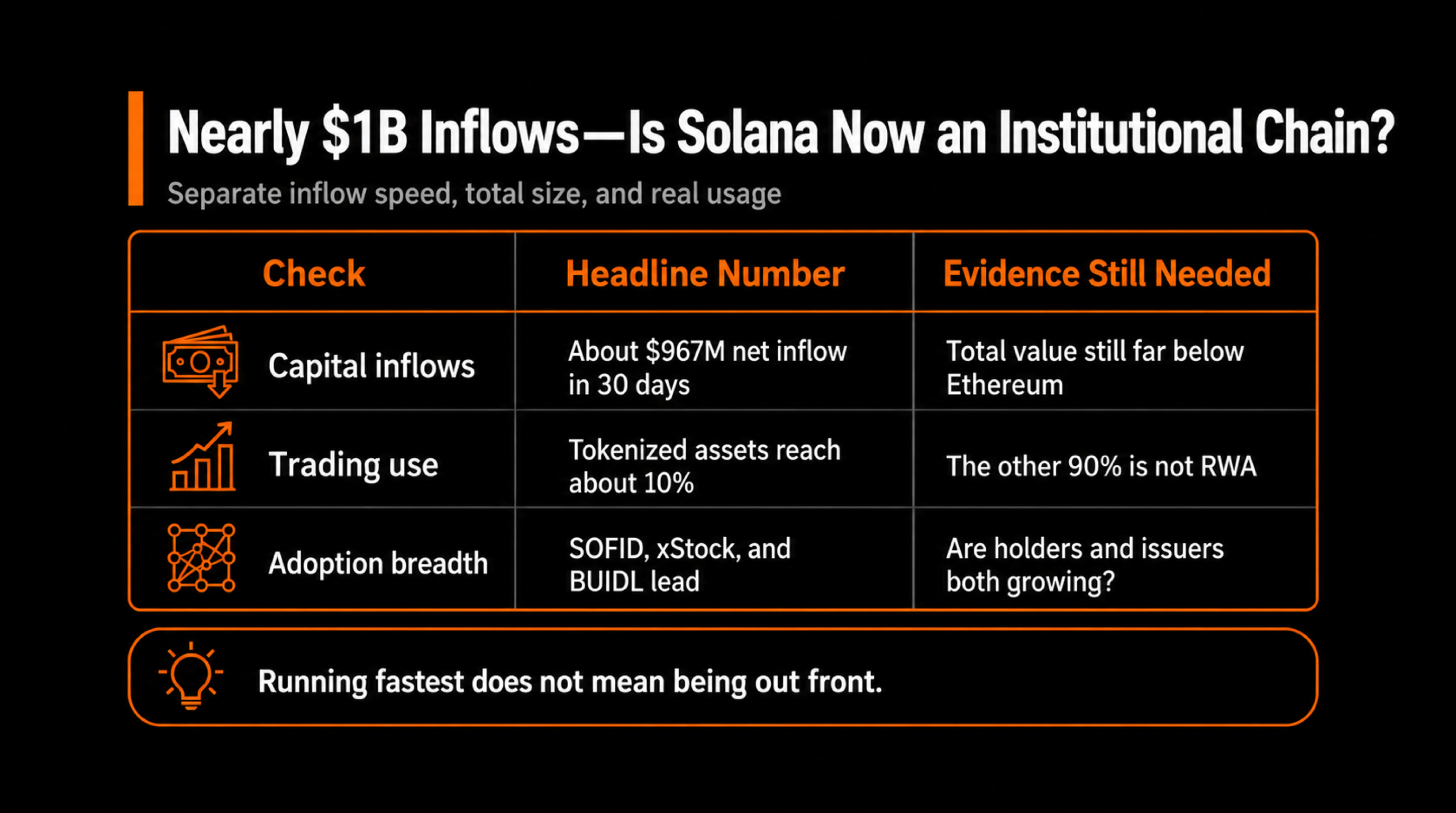
Comparing Solana's roughly $967 million in net inflows over these 30 days against BNB Chain's roughly $292 million over the same period, it's indeed more than 3x higher — and that's the main basis for headlines like “Solana's RWA boom.” But a faster net-inflow rate doesn't mean it's winning on stock size too.Solana's current total RWA market cap is about $3.62 billion, while Ethereum's RWA market cap alone comes in at about $15.9 billion — more than 4x Solana's. Even BNB Chain, which lost to Solana on inflow speed, has a total market cap of about $3.9 billion, slightly higher than Solana's.
What does this mean? It means Solana is the faster-moving newcomer in this RWA wave, but in terms of stock size, it still ranks behind Ethereum and even BNB Chain. To use a sprinter analogy: Solana is currently the one with the strongest acceleration, but it still has some distance left to the finish line compared to the runners ahead of it.It's fine to agree with a headline saying Solana's RWA growth is the fastest — just don't automatically translate that into Solana's RWA scale already being the largest. Those are two completely different things.
The Numbers Look Great — So Why Do Most People Still Think of Solana as a Meme-Coin Paradise?
If the RWA numbers look this good, why are the people you know who use Solana still talking about which meme coin just multiplied a few times over, with almost no one discussing how much yield some tokenized bond is paying out?This section separates capital inflows from what people are actually using the chain for, because the gap between the two is the most critical piece for understanding Solana's current situation.
Trading-Volume Share Is What Actually Matters — Meme Coins Are Still Solana's Most Active Category
Net-inflow numbers show the direction of capital, but if you want to see what people are actually doing on a chain, a more accurate metric is trading-volume share — that is, how much of the day-to-day trading volume each asset category accounts for.From this angle, meme coins are still by far the largest category of Solana's trading volume, way ahead of RWA-related assets.Open up any Solana DEX leaderboard, and the top dozen or so entries are almost entirely meme-coin pairs — RWA assets rarely make it onto the popular rankings.
This is also why news about institutional capital inflows looks completely different from the Solana you see day-to-day on social media — the former is a media headline, the latter is what's actually happening on-chain every day.Overlaying these two pictures gets you closer to the truth than just picking whichever side confirms your existing view: Solana is simultaneously a place where institutional money is starting to test the waters and still the most active playground for meme-coin trading volume. These two identities currently coexist — neither is replacing the other.
Tokenized Assets Account for Only About 10% of Trading Volume (Up From Just 1% at the Start of the Year) — Still Far From Being an Institutional Settlement Layer
The concrete numbers make the gap even clearer: tokenized assets (including RWA-related tokenized US stocks and funds) accounted for roughly only 1% of Solana's weekly spot trading volume at the start of the year, and have now grown to about 10% — that's not a slow growth rate, and a tenfold increase is worth noting.But even at 10%, that means the other 90% of trading volume is still happening on meme coins and other non-RWA assets.
If Solana were really becoming the settlement layer institutions talk about, you'd reasonably expect tokenized assets' share of trading volume to gradually flip, taking up the majority or even more than half — not just hovering around 10%.Right now, this number is better read as the institutionalization narrative starting to get some real trading-volume support behind it, rather than Solana already being an institutional settlement layer — there's still a long way to go between the two, and it's too early to draw a conclusion now.
A Common Newcomer Misconception — Seeing a Large Inflow and Assuming Solana Is Already Institutionalized
I've run into quite a few friends who are just starting to follow crypto who, upon seeing news that Solana pulled in $1 billion, jump straight to the conclusion that Solana has been institutionally validated and it's safe to go in heavy.That skips over way too many steps in between: net capital inflow doesn't equal a change in user behavior, and a change in user behavior doesn't equal this chain being accepted by the mainstream financial system as settlement infrastructure.
A more grounded way to read this kind of news is to treat it as one more signal worth adding to your watchlist, not yet a conclusion you can act on directly.To actually judge how far Solana's institutionalization has progressed, you still need to look back at trading-volume share, the number and quality of participating institutions, and the holder structure discussed in the next section. Betting based on a single inflow number carries more risk than you might think.
Where Exactly Is This RWA Money Actually Going?
Given that the net inflow is real, what exactly did this money buy, and whose pocket did it flow into?This section breaks the capital down into three concrete categories — bank-issued stablecoins, tokenized US stocks, and institutional money-market funds — so you know exactly which specific products the RWA inflow actually corresponds to, rather than letting a vague category label do all the talking.
SoFi's SOFID Stablecoin Lands on Solana — Bank Money Starts Moving On-Chain (Already Past $100 Million in Market Cap on Ethereum Alone)
One entry in this wave of capital that's particularly meaningful as an indicator is the stablecoin SoFi bank issued, called SOFID.SoFi is a fintech company with a US national bank charter, and on May 27 it launched SOFID simultaneously on Ethereum and Solana — signaling that stablecoin issuers are no longer just crypto-native companies; even licensed banks are starting to put money onto public chains.On the Ethereum chain alone, SOFID's market cap has already broken past $100 million.
One thing worth flagging: SOFID is deployed across multiple chains, and you'll occasionally see versions online that add up the market caps across all chains to produce an even more impressive-sounding number. But the only figure that's currently verifiable and backed by solid data is the Ethereum-only market cap breaking past $100 million — there's no official, clearly stated cross-chain total. I won't make up a nicer-looking sum on its behalf, and this is itself a live example of the kind of padded numbers you'll learn to spot later in this article.
The Truth Behind the Rising Trading Volume of Tokenized US Stocks (xStock)
Tokenized US stocks are the fastest-growing piece of this capital wave. Tokenized stock products, represented by xStock, generated $5.77 billion in trading volume on Solana in Q2 of this year alone, with cumulative transfer volume surpassing $10 billion by the end of June; June's trading volume alone exceeded $2 billion, a record for any chain's monthly tokenized-stock trading volume.Solana currently commands over 95% market share of tokenized-stock trading volume — it's practically synonymous with this category.
These numbers look impressive, but it's worth flagging that a surge in trading volume doesn't equal long-term capital staying put — the market cap of tokenized US stocks (that is, the positions actually still sitting on-chain and not redeemed) is only a bit over $500 million, far smaller than the trading volume.This suggests the market currently looks more like hot money moving in and out at high frequency — not really capital parking itself long-term, and the risks and implications of the two are different. When you're reading this kind of headline-grabbing number, remember to take a second look at the gap between market cap and trading volume.
The Role of Institutional Products Like BlackRock's BUIDL in the Solana Ecosystem
Another institutional-grade product worth watching is BlackRock's tokenized money-market fund BUIDL. This fund invests mainly in cash and short-dated US Treasuries, and has now expanded to seven public chains, with roughly $1.7 billion in total assets under management, capturing about a third of the market share in the tokenized-Treasuries niche.BUIDL's size on Solana has more than doubled since the start of this year, growing from roughly $255 million to over $500 million, Anchorage Digital's launch of Solana custody services being the main driver of this growth.
BUIDL-type products mean something a bit different from SOFID or xStock — they represent traditional asset-management giants moving existing institutional products onto the chain essentially unchanged, serving institutional investors, not products retail can directly buy.The role it plays in the Solana ecosystem is more like an institutional-credit endorsement for the chain, proving that one of the world's top asset managers is willing to choose it as infrastructure — but whether retail investors like you and me can actually participate is a separate matter, and the next section will unpack that gap further.
How Do You Tell Whether RWA Inflow Data Is Real Growth or Padded Numbers?
After seeing so many good-looking numbers, how do you tell which ones represent solid growth and which are just a flash-in-the-pan padding job?This section gives you three checking angles you can apply directly, so the next time you see a similar headline you can verify it yourself instead of rushing to accept it at face value.
Check Whether the Capital Is Concentrated in Just a Few Protocols or Institutions
The first checkpoint is whether the inflow amount is overly concentrated in a handful of protocols or institutions. The SOFID, xStock, and BUIDL names discussed in this article already account for a fairly large share of overall RWA inflows — take those names out, and the remaining growth story might not look so impressive.That doesn't mean the numbers are fake, but it does mean this ecosystem's RWA growth is currently highly dependent on a small handful of players carrying the scene.
Healthy growth usually comes with an increase in the number of participating protocols and issuers at the same time — you don't keep seeing the exact same names showing up in every single piece of news.When you see news that some chain's RWA figure hit a new high, it's worth clicking through to check the breakdown. If you find 90% of it comes from just one or two products, that new high's actual worth needs to be discounted — you shouldn't take it at face value as growth across the whole ecosystem.
Cross-Check Holder-Count Growth to Catch the “Lots of Money, Few People” Illusion
The second checkpoint is to compare capital scale against the growth rate of holder counts (or address counts). If total market cap has grown several-fold but the number of wallets actually holding these assets has barely moved, that suggests this money is very likely just a handful of whales or institutions moving funds around among themselves, not necessarily a large number of new users genuinely starting to participate.This kind of “lots of money, few people” situation looks intimidating in scale, but the actual penetration rate it represents is quite low.
Conversely, if holder counts climb alongside market cap growth, even if the growth rate looks less dramatic, that kind of growth actually rests on a sturdier foundation — it means a genuine group of users is steadily joining in, not just a numbers game built out of a few large transfers.Next time you see news about some asset's market cap hitting a new high, it's worth taking a moment to check holder count — a relatively obscure but more honest metric.
Use Trading-Volume Share to Verify Whether the Numbers Are Backed by Real Usage
The third checkpoint echoes the trading-volume-share logic mentioned earlier: if an asset has a large market cap but its day-to-day trading volume stays persistently low as a share of overall volume, that suggests most of that money is just sitting idle, not actually being used, traded, staked, or put up as collateral.Healthy growth should see market cap and trading-volume share climb together — you shouldn't have market cap skyrocketing while trading-volume share stays flat.
Put these three checkpoints together — concentration, holder count, and trading-volume share — and you can roughly sift out how much of the growth in an “RWA capital explosion” headline is the real deal versus a performance by a handful of players.This method isn't limited to Solana — the same logic applies when checking RWA news for any chain.
Is Narrow Adoption the Biggest Hidden Risk in This Wave?
No matter how nicely the capital-inflow story is told, if only a small group of people can actually participate, how much does it really mean for you as a retail reader?This section punctures an easily overlooked issue: the participation barrier for this RWA wave is currently far narrower than the headlines make it seem.
Institutional Products Are Currently Concentrated in a Handful of Fintech Companies
The RWA players you can currently name off the top of your head — SoFi and BlackRock, among a few others — are uniformly large financial institutions with existing brand trust; there's no sign yet of a wide field of startups flourishing.This kind of concentration has both upsides and downsides: the upside is that these institutions are already regulated and credible, so the products going on-chain carry relatively high trust; the downside is that if one of them runs into trouble, or decides to pull back, the impact on the overall narrative gets amplified.
This state of concentration among just a few players is completely different from the meme-coin ecosystem, where thousands of tokens routinely flourish side by side, and to some extent shows that the RWA category is still at a very early stage, without a thick enough layer of participants yet.It's only once more small and mid-sized financial institutions — even non-US ones — are also willing to bring products onto Solana that this category will have genuinely crossed the threshold. Right now, it's still waiting for more players to show up.
Retail Investors Actually Have Limited Channels to Participate in Solana's RWA
Even if you agree RWA is a real trend, the channels that actually let ordinary retail investors participate directly aren't many.SOFID-type bank stablecoins mainly serve SoFi's existing users — it's not as if just any Taiwan retail investor can open an account and subscribe directly;BUIDL-type institutional money funds have an even higher bar, typically restricted to accredited investors, leaving retail with fairly limited paths to participate.What retail investors can currently access more easily is instead things like tokenized US stocks, which can be bought and sold on an exchange or in a wallet.
That means if you see this news and think “RWA is an opportunity, I want in,” the options you can actually act on may be limited to that small slice of tokenized US stocks — and you'd still need to think carefully about the rights structure of this kind of product (what you're buying is usually a certificate tracking the stock price, not shareholder equity itself), which isn't the same thing as directly holding US stocks.The fact that the channels are this limited is itself evidence that this wave hasn't fully gone mainstream yet.
world.xyz Rushed to Migrate to Robinhood Chain Less Than a Week After Launch — Is That a Sign Solana's Ecosystem Lacks Stickiness?
While we're at it, worth mentioning an episode that went viral on social media the same week: the prediction-market app world.xyz had barely been live on Solana for a week when it dropped news that it was about to migrate to Robinhood Chain, briefly leading quite a few people to think yet another project was abandoning Solana.But there was no bridging record or new contract deployment to be found on-chain anywhere — the team later confirmed this was actually just a marketing stunt, and no move ever actually happened (further reading: corporate chains fighting for the settlement-layer business).
For the purposes of this article, this episode is actually a ready-made demonstration: a sensational headline doesn't mean something actually happened. When you run into news that some project is supposedly leaving, check whether there's actual on-chain activity first, then decide whether to get anxious about it — that's really the same habit as the RWA-number-checking logic taught earlier.
How Should New Investors View Solana's Dual Identity?
After going through all these numbers, how should you draw a non-extreme conclusion about Solana's current state?This section pulls together the previous five sections and gives you a concrete, portable set of judgment habits, rather than leaving you with just “it's complicated” and nothing else.
Don't Let a Single Data Point Lead You Around — Track RWA and Meme Coins Separately
The single most important reminder in this whole article is: don't let one data point make the decision for you. Solana is currently both one of the fastest-growing public chains for RWA capital and still the most active playground for meme-coin trading volume — both of these things are true, and they don't contradict each other.If you only pick out the “RWA is exploding” half of the story, you'll mistakenly think Solana has already transformed; if you only pick out the “meme coins are still the mainstream” half, you'll underestimate the significance of this institutional capital.
The more practical approach is to treat RWA and meme coins as two separate observation axes, each tracked with its own metrics — for RWA, watch net inflows, total market cap, and trading-volume share; for meme coins, watch heat and the speed of capital rotation. Don't blend the two lines together and apply the same logic to both — that will just leave you misreading both sides.
You Can't Judge Solana's Ecosystem Health From the SOL Price Alone
A lot of newcomers are used to treating SOL's price movements as the sole indicator of how well Solana is doing right now, but the price is heavily influenced by overall market sentiment and broader crypto capital rotation, and it doesn't necessarily move in sync with RWA or institutional-adoption progress.You might see SOL's price pulling back during the exact same period that RWA capital keeps flowing in — it's normal for the two to decouple, and that doesn't mean either data point is fake.
My own suggestion would be to treat SOL's price as just a sentiment thermometer. To actually judge whether the ecosystem is healthy, you still need to go back to the metrics this article has been discussing all along: trading-volume share, holder-count growth, and capital concentration.The price will go up and down, but these underlying metrics change much more slowly and are better suited for medium- to long-term judgment — they won't get swept along by a single day's market mood.
Build Your Own Checking Framework — Don't Blindly Follow the Institutionalization Narrative
By this point, you already have a full, reusable checking framework in hand: distinguish net inflows from total market cap, check trading-volume share to catch real usage, look at capital concentration and holder count to avoid the “lots of money, few people” illusion, and check on-chain activity before reacting to sensational news.This framework isn't only for Solana's RWA news — you can apply the same process to verify any public chain's announcement of a major institutional capital inflow.
As for Solana itself, at this stage it's better positioned as a fast-growing challenger in RWA with still very narrow adoption, not yet an institutionalized settlement layer.Whether you should adjust your position or focus because of this capital inflow depends on whether your original investment logic prioritizes long-term adoption progress or short-term capital momentum. This article's goal isn't to place a trade for you — the point is that next time you see a similar headline, you'll be able to break it down clearly yourself.
Conclusion
Solana genuinely did attract nearly $1 billion in RWA capital over these 30 days — that's real and worth noting; but it's also still the public chain with the most active meme-coin trading volume, with narrow adoption and limited participation channels — those are just as real.What this article wants to give you isn't an answer to whether you should go heavy on Solana right now — it's the ability to break apart net inflows, total market cap, and trading-volume share, so that the next time any chain drops similar capital-attracting news, you can use the same logic to judge for yourself whether the wave is worth taking seriously.


