

Have you ever wondered why a brokerage would suddenly launch its own chain — is it because it doesn't have enough to spend on the public chains it already uses?This article won't dress up Robinhood Chain as some disruptive innovation, but instead first breaks down exactly whose business it's really taking and where the difference between corporate chains and public chains lies, before telling you what this settlement-layer turf war has to do with your asset security.
Robinhood Chain Launched a Week Ago — Why Is It Shaking Up the Settlement Layer, Not the Stock Price?
When a new chain launches, people usually watch whether the token price rises or falls — so why is everyone this time talking about who controls the settlement layer instead?This section first walks you through the actual numbers, then breaks down exactly what problem Robinhood is trying to solve for itself.
The Actual Numbers Since the Mainnet Launched on July 1
Robinhood Chain's public mainnet launched on July 1, built on the Arbitrum Nitro tech stack as an Ethereum Layer2, rather than an independent L1 built from scratch. Within a week of launch, this chain's decentralized exchange trading volume surged to roughly $3.1 billion, pushing it into the network-wide top five; more than 65,000 users held roughly $13 million in tokenized stocks on-chain, along with roughly $300 million in stablecoin assets.
These numbers look pretty impressive for a chain that's only been live for a week, but the first thing I'd want to check is: how much of this trading volume and asset scale simply came from existing Robinhood App users migrating their assets over,rather than genuinely new outside capital being attracted in.That distinction will determine whether this wave of momentum can actually last.
What Problem Does This Chain Solve for Robinhood?
Robinhood has nearly 28 million funded accounts, and in the past, if these users wanted to touch tokenized assets or on-chain lending, asset settlement mostly had to run through an external public chain —users placed orders through Robinhood's interface, but asset ownership, fee flows, and liquidity depth all happened on someone else's network.For a company that wants to make “on-chain finance” a core business, this kind of “user on my platform, money on someone else's network” structure isn't ideal.
After building its own chain, tokenized stocks, USDG stablecoin lending (officially called Robinhood Earn, at roughly 7% APY), and future AI-agent trading can all run on its own settlement layer.In other words, what Robinhood wants isn't just to “sell products” — it wants to pull control over trading, settlement, collateral, and yield all back into its own hands.
How This Differs From Brokerages Traditionally “Plugging Into External Public Chains”
In the past, when brokerages or exchanges wanted to touch on-chain business, the common approach was to simply plug into an existing public chain — for example, deploying assets on the Ethereum mainnet or on some Layer2 — while focusing their own efforts on the front end and compliance.This approach gets you live quickly and you don't have to maintain your own infrastructure, but the downside is that the settlement layer's rules, fees, and even the direction of future upgrades are all at someone else's mercy.
This time, Robinhood chose to control the Nitro tech stack itself and decide for itself how the sequencer operates — effectively keeping the business it would otherwise have handed to an external public chain in its own hands.This shift isn't a choice unique to Robinhood alone — as you'll see later, Coinbase's Base and other institutions are doing similar things, which is exactly why the master narrative holds up.
What Is a Corporate Chain? How Is It Different From Consortium Chains and Private Chains?
The public chain / private chain / consortium chain framework has been around for years — so which category does Robinhood Chain actually fall into? This section breaks down why the traditional three-way split can't quite contain this new kind of player, then looks at what its actual technical choices reveal about its positioning.
Why the Traditional Public/Private/Consortium Chain Framework Can't Contain Robinhood Chain
In the traditional classification, public chains are fully open — anyone can participate in validation and submit transactions, with Ethereum and Bitcoin as the representative examples; private chains are fully controlled by a single entity, and outsiders can't get in; consortium chains sit in between, jointly governed by a handful of institutions.Robinhood Chain's positioning is awkward — it publicly claims anyone can build applications on it and anyone can transfer assets, which sounds like the openness of a public chain.
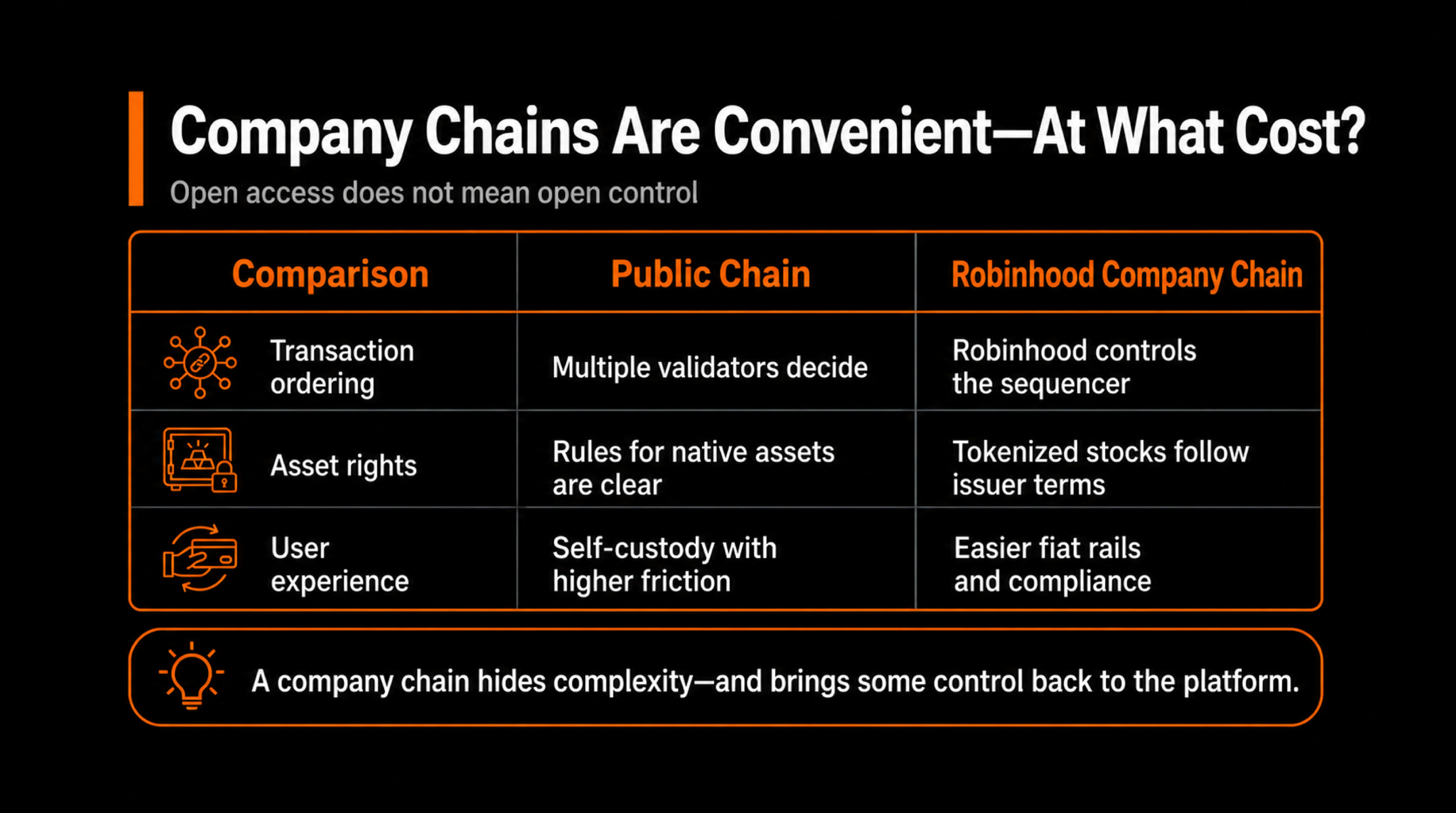
But the sequencer — the key role responsible for deciding transaction order and packaging blocks — is currently run by Robinhood itself, which is a private-chain control model.This combination of “open usage, closed governance” is hard for the traditional three-way framework to classify precisely — the term “corporate chain” has surfaced in discussion circles precisely because it's trying to describe this new form.
What Robinhood Chain's Technical Choices Mean
Robinhood Chain uses Arbitrum's Nitro tech stack and the Orbit framework to build its own Layer2, and the clever part of this choice is that it doesn't need to build a consensus mechanism and virtual machine from scratch — instead, it stands on the mature technical foundation of the Ethereum ecosystem and focuses its resources on what it actually cares about: control over the sequencer and product design at the application layer.
Using an off-the-shelf tech stack also means Robinhood Chain is natively compatible with the Ethereum ecosystem, making it easy for existing DeFi protocols and tools to migrate over — which is part of why it was able to generate such considerable trading volume within a week of launch,it's not fighting the entire Ethereum ecosystem — it's carving out its own separately governed territory within that ecosystem.
The Contradictory Position of Being “Permissionless” While Controlling Its Own Sequencer
Robinhood officially emphasizes that this chain is “permissionless” — anyone can connect, build, and transfer assets without going through an intermediary review.That claim is technically true — there's no whitelist mechanism blocking the door. But the sequencer is run by a single entity, which means that, in theory, that entity has the power to decide the order of transactions, and even to pause certain transactions from going on-chain in extreme cases.
I personally treat this “surface-level open, centralized at the core” structure as distinct from a traditional public chain's “full decentralization” — not because it's necessarily bad, but because these two models carry different risks and fit different use cases; lumping them together makes it easy to misjudge.
The Master Narrative That Every L1 Has a Corporate Chain Coming After It
This isn't an isolated move by Robinhood alone — what's happening across the whole sector? This section pulls the camera back to see how cases like Base and the world.xyz chain migration piece together the same picture.
What Was BaznoCap's Highly-Liked Thread Actually Saying?
A highly engaged piece of analysis has been circulating in the crypto space, and its core argument is that “every L1 has a corporate chain fighting for its settlement-layer business, and every perp DEX has a corporate CEX fighting for its order flow”. This means it's not just Robinhood — Coinbase's Base and other major platforms' self-built settlement layers are all doing the same thing: pulling back the share of profit that would otherwise go to the open ecosystem.
This framing resonates because it takes several seemingly separate events — Robinhood launching its chain, Coinbase already having Base, and other platforms one after another announcing self-built L2s —and strings them into a single logical thread instead of treating them as isolated news items.When you look back at these announcements through this lens, you'll find they're actually different instances of the same business strategy.
The Picture Formed by Base, Robinhood Chain, and the world.xyz Migration
Coinbase's Base chain is the earliest and most successful case of this strategy — it's built on Optimism's OP Stack, all transactions are processed by a sequencer that Coinbase runs, and its settlement layer is deeply tied to the Coinbase account system.Robinhood Chain is following a similar path, just with the Arbitrum tech stack instead.
Another noteworthy case pointing the other way is world.xyz announcing its migration from Solana to Robinhood Chain, which shows that a corporate chain's pull isn't limited to the issuer's own ecosystem — it can also draw projects that were previously active on other public chains to switch camps. For a public chain like Solana, this is a concrete example of settlement-layer business being siphoned away.Looking at these cases together, the outline is already quite clear: large platforms are no longer satisfied with “doing business on someone else's public chain” — they want to keep the settlement layer for themselves.
Why Institutions Choose to Launch Their Own Chain Instead of Building on Someone Else's
For a platform sitting on a large existing user base, launching its own chain unlocks several benefits that someone else's public chain can't offer: fee revenue stays within its own system, it decides transaction ordering itself, the direction of future upgrades doesn't depend on external governance votes, and it can deeply tie its own products (such as Robinhood's stock tokenization and USDG lending) into the on-chain ecosystem to boost user stickiness.
Looked at the other way, if a platform keeps its assets on an external public chain, it's just one of many applications, with limited bargaining power.Launching its own chain effectively redirects the profit from the “settlement layer” — which would otherwise go to someone else — back onto its own balance sheet. This is a solid business logic, not just a technical flex.
How Big Is the Real Threat to Existing Public Chains' Settlement-Layer Business?
Public chains like Ethereum and Solana have been earning money from the settlement layer for years — how much of that will actually get siphoned away this time? This section looks at capital flows, historical revenue patterns, and corporate chains' shortcomings from three angles to help you gauge the real scale of the threat.
Fees, MEV, and Liquidity Rewards Stay Wherever the Assets Sit
Blockchain's economic model, at the end of the day, is pretty straightforward: wherever assets are active, fee revenue, MEV-related gains, and the spread liquidity providers earn all basically stay within that chain's ecosystem.When Robinhood moves tokenized stocks and stablecoin lending — business that might otherwise have been deployed on Ethereum or its Layer2s — onto its own chain, that portion of economic activity disappears from the public chain's ledger and shifts onto Robinhood Chain's ledger.
This is also why the focus of this discussion lands on “settlement-layer business” rather than token price. For the public chain ecosystem, what actually gets hurt isn't some token's market cap, but the fee flow and ecosystem activity it can expect to receive over the long run.
Who's Now Taking a Cut of the Money Ethereum Used to Earn From Its L2 Settlement Layer
Over the past few years, a large share of the Ethereum mainnet's economic value has come from various Layer2s keeping the act of settlement — submitting transaction batches back to the Ethereum mainnet for final confirmation — on Ethereum, indirectly contributing to the mainnet's fee revenue and security budget.When corporate chains like Robinhood Chain and Base choose to keep using Ethereum-ecosystem tech stacks (Arbitrum and OP Stack are both Ethereum Layer2 frameworks), the Ethereum mainnet's settlement revenue won't be entirely lost, to some extent.
But looked at another way, these corporate chains keep a tight grip on the “application layer” and the “user entry point”,and the Ethereum mainnet gets reduced to purely underlying settlement infrastructure, with its bargaining power weakened.That's already a gap from the public chain's original ambition of being “the entry point users interact with directly”.
Who Has the Edge on Deposits, Withdrawals, and Regulatory Compliance — Public Chains or Corporate Chains?
Corporate chains have an advantage public chains can't easily replicate in the short term: the compliance pathway and the fiat on/off-ramp experience.Robinhood itself is a licensed brokerage, so the entire process — from depositing US dollars to buying tokenized stocks — happens within the same regulated framework, without needing to hop over to a decentralized exchange to swap tokens or hunt for a cross-chain bridge. For everyday users unfamiliar with crypto, the barrier to entry is clearly much lower.
In my view, this advantage is hard for pure public chains to replicate in the short term, because public chains themselves don't have brokerage licenses or compliance infrastructure.This is also why, in this settlement-layer turf war, corporate chains aren't just picking up a share of the technical pie — they're also capturing the entry-point bonus of “lowest compliance friction”.
The Centralization Tradeoff and Regulatory Boundaries
Behind the efficiency and compliance experience, what risk are users actually taking on? This section lays out three concrete issues: sequencer centralization, the rights gap in tokenized assets, and self-custody.
Sequencer Centralization Equals Censorship Risk
The sequencer being run by a single entity means that entity theoretically has the ability to decide the order of transactions, and even to pause specific transactions from going on-chain. This isn't a purely hypothetical risk — the crypto space has already seen similar cases spark debate over whether a centralized sequencer should be trusted, and critics' core worry is: once a platform's own interests conflict with users' interests, who guarantees the sequencer won't take sides.
Robinhood officially emphasizes that the chain itself is permissionless, but that claim answers the question of “who can use it,” not the question of “who can censor it”.These two things shouldn't be lumped together — when evaluating this kind of corporate chain, it's worth looking at them separately.
The Rights Gap in Tokenized Stocks
A lot of newcomers assume that buying a tokenized stock is the same as holding that company's actual stock, with the shareholder rights that come with it.The reality is usually more complicated — a tokenized stock is mostly a tracking instrument that represents a claim on tracking the underlying stock's value, and doesn't necessarily include voting rights or the right to participate in shareholder meetings — and even the redemption mechanism and where you rank in a bankruptcy claim all depend on the specific terms the issuer designs.
This gap isn't a problem unique to Robinhood — it's a gray area that exists across the entire tokenized-asset sector. Before touching this kind of product, taking the time to carefully read the part of the issuance terms that covers rights ownership matters far more than chasing the label that “on-chain equals innovation.”
The Self-Custody vs. Platform-Custody Risk Newcomers Easily Overlook
Assets on Robinhood Chain can, in theory, be held through a self-custody wallet, or left in Robinhood's platform custody.For convenience, many users habitually leave their assets in platform custody. The risk of doing so is that if the platform runs into operational trouble or regulatory intervention, the right to decide what happens to a user's assets ends up depending on the platform's decision at that moment, rather than being fully in the user's own hands.
I'd suggest at least figuring out whether the tokenized assets you hold are currently sitting in your own self-custody wallet or left in the platform's custody account — this basic question determines how much control you'd still have left in a worst-case scenario.
Where Crypto-Native Meets TradFi — How Should Everyday Users Judge This?
When this settlement-layer turf war finally plays out, who ends up benefiting — users, or the platforms themselves? This section pulls together the earlier analysis to give you practical angles you can actually use to judge.
When a Corporate Chain Is Actually More User-Friendly
If you're already an existing user of a platform like Robinhood, and what you value is convenient fiat on/off-ramps, a familiar interface, and solid customer support and compliance protections, then the corporate-chain model can indeed offer a smoother experience than a pure public chain — you don't need to learn how to use a cross-chain bridge, and you don't have to worry about private-key management, which tends to be a high-barrier step for newcomers.
For this type of user, a corporate chain essentially packages away the complexity of the crypto world in exchange for an easier entry point — that's not inherently a bad thing, you just need to be clear about what you're trading away for it.
When You Should Stay Wary of Corporate Chains
If what you care about is asset portability, censorship resistance, or you're already a crypto-native user who values private-key sovereignty and decentralized governance, then a corporate chain's “centralized sequencer, rights terms set by the issuer” model deserves an extra dose of caution.Especially when larger asset allocations are involved, it's worth confirming up front how much centralization risk you're willing to take on.
What I want to flag here isn't that you should avoid this kind of product entirely — the point is to think clearly about the fact that what you're participating in is a system protected by a regulated framework but with centralized control, which inherently carries a different risk structure than a traditional “fully decentralized” public chain.
Watching This Settlement-Layer Turf War — What Metrics to Track Next
Signals worth continuing to watch include: which other large platforms will follow suit and build their own settlement layers, whether existing public chains will roll out countermeasures to keep these applications and assets, whether regulators will set clearer rules for this kind of “permissionless but sequencer-centralized” corporate chain, and whether the rights terms of tokenized assets are moving toward being more transparent and more protective of users.
I'd remind myself that this turf war has only just begun — it's still too early to conclude that public chains will be completely replaced by corporate chains, or conversely that this is just a flash in the pan. The more practical approach is to treat these metrics as a watchlist for the coming months, rather than rushing to pick a side.
Conclusion
Robinhood Chain surged into the top five in trading volume within a week of launch, the numbers are certainly impressive, but what's really worth remembering is the business logic behind them — large platforms are no longer satisfied with just residing on public chains — they want to keep the settlement-layer business for themselves.This turf war between corporate chains and public chains won't end in a winner-takes-all outcome any time soon. What you can do is see clearly which risks you're trading away for the efficiency and compliance experience you're enjoying, then decide how much of your assets to put into this kind of system.


