

Have you also heard that "once an asset is tokenized, it can flow freely around the world," without anyone explaining exactly what gets an asset stuck on a single chain in the first place?For RWAs to scale, they'll eventually need to cross chains, and cross-chain bridges just happen to be crypto hackers' favorite target.This piece won't dress up CCIP as some invincible solution — instead, it first walks you through the mechanism, the misconceptions, and the risks, and finally tells you whether this narrative fits your investment logic.
What Is CCIP, and Why Can't RWA Cross-Chain Avoid It?
Have you ever wondered why a fund that's already been tokenized still can't just move to whatever chain you want? The answer is straightforward: blockchains simply don't talk to each other — assets, data, and logic are all locked inside their own walled gardens.CCIP (Cross-Chain Interoperability Protocol) exists to build a standardized communication layer between those walls, which is a foundational problem that has to be solved before RWAs can scale.
What Problem Does Cross-Chain Actually Solve (the Predicament of Assets Stuck on a Single Chain)
I often tell beginners that every public blockchain is its own independent ledger — records on Ethereum can't be seen by Solana, and Avalanche can't see them either.For an ordinary DeFi user, that's at most an annoyance of switching wallets or paying different fees. But for institutional-grade RWAs, it's a structural obstacle. If a tokenized bond issued on Chain A has its settlement counterparties, liquidity pools, and exchanges all existing only on Chain B, that asset is effectively locked up — no matter how good it is, it's useless.
The old solution was crude: lock the asset up on its original chain, mint a corresponding "wrapped" token on the target chain, and rely on a set of validators to vouch that both ledgers match. The moment those validators get compromised or collude to do something bad, the wrapped token instantly turns into wallpaper — the record-breaking cross-chain bridge hacks of 2021-2022 nearly all followed the same script.What CCIP needs to solve isn't just whether you can cross chains, but how to do it reliably enough that institutions are willing to put real assets on it.
CCIP's Three Core Functions (Arbitrary Messaging, Token Transfer, Programmable Token Transfer)
CCIP isn't a single-function bridge — it offers three capabilities at once. The first is "arbitrary messaging," letting a contract on Chain A send data for a contract on Chain B to execute, not limited to the asset itself. The second is "token transfer," burning or locking a token on the source chain and minting or unlocking the corresponding amount on the destination chain according to a standard. The third is "programmable token transfer," combining the first two — the asset gets sent along with instructions, and the destination chain automatically executes the follow-up action the moment it receives the token.
Stack these three capabilities together, and it becomes clear that CCIP's core target audience is actually complex institutional-grade financial processes, not retail coin-swapping. A cross-chain fund handling subscriptions and redemptions needs more than just token transfer — it also needs to synchronize its share-registry data, and that's where "programmable transfer" comes in. The SBI and Pharos cases mentioned later both rely on exactly this function.
The Two-Layer Verification Mechanism (the Decentralized Oracle Network DON + the Risk Management Network RMN)
CCIP's core selling point is splitting verification into two mutually independent networks. The first layer is the "Committing DON" (Decentralized Oracle Network), which observes events on the source chain, organizes them into a Merkle tree, and submits the root hash to the destination chain. The second layer is the "Risk Management Network" (RMN), which independently recomputes the same tree using different programming languages, teams, and non-overlapping node operators, then compares the results.
The design is meant to keep a single code bug from being able to breach both layers at once.If the two results match, the RMN casts a "blessing" vote, and the transaction can only execute once the threshold is reached; if it detects an anomaly, the RMN can instead cast a "cursing" vote, and once that threshold is reached the lane gets paused — a built-in active brake rather than after-the-fact monitoring.This architecture lets CCIP claim to be defense-in-depth, but DON+RMN is ultimately designed by people and run by node operators — it's not a guarantee of zero risk — the next section breaks this down in more detail.
Does CCIP Equal an Absolutely Safe Cross-Chain Bridge? Understand These Misconceptions and Risks First
Does CCIP having dual-layer verification mean it's an "officially certified, absolutely safe" cross-chain bridge?I've come across plenty of people who think this way, and this is exactly where it's easiest for beginners to misjudge risk. CCIP is indeed harder to breach than the old single-layer-verification bridges, but "harder to breach" and "zero risk" are two different things, especially when you see big names like SWIFT and SBI, which makes it even easier to mistake brand trust for a technical guarantee. This section lays out the common misconceptions and the actual risks.
Misconception #1: CCIP Is an Official Bridge, So There's No Trust Risk
A lot of people hear the words "official Chainlink product" and instinctively assume it's the safest option. But CCIP isn't a fully permissionless protocol — opening a new cross-chain lane still requires Chainlink Labs' gatekeeping; a developer submitting code doesn't automatically get it live.That means CCIP's current level of decentralization still carries a flavor of centralized governance.
This isn't to say CCIP is worse than its competitors — it's a reminder that as long as an organization behind the scenes holds the power to open, pause, and upgrade lanes, trust risk hasn't disappeared, it's just moved somewhere else. When evaluating a project that claims "CCIP makes us absolutely safe," you should ask: who holds the lane permissions? How long is the timelock on contract upgrades? This information is usually available in the official documentation — no need to rely solely on marketing talk.
Misconception #2: SWIFT and Banks Adopting CCIP Guarantees Profit
In July 2026, SWIFT's blockchain ledger officially went live, with 17 banks running a cross-border payment pilot using CCIP — news like this easily makes people think "LINK is about to moon."But there's still a gap between an institutional pilot and full commercial rollout — most of SBI, ANZ, and DTCC's involvement is still at the pilot or evaluation stage, not a fully live production environment, and whether transaction volume and fees can support the token's value is a separate-level question.
Translating "a well-known institution shows up on the partner list" into "the token price is guaranteed to rise" is one of the easiest traps for beginners to fall into. Institutional adoption takes time, the regulatory framework is still evolving, and cross-border RWA circulation involves securities definitions across different jurisdictions — far more complex than the technical integration itself. CCIP's visibility among institutions has genuinely increased, but that's narrative reinforcement, not a profit guarantee.
The Real Risk Points: Governance Attacks, Single-Point Latency, and Regulatory Uncertainty
Having debunked two misconceptions, let's talk about CCIP's actual risks.The first is the governance attack surface: even though DON and RMN are designed to be non-overlapping, the list of node operators is still limited — if key nodes end up controlled by the same group of people, or if Chainlink Labs' lane-opening permissions get abused, the risk becomes concentrated. The Kelp incident in the LayerZero ecosystem in April 2026 is a living lesson — the problem wasn't a protocol bug, but that the validators were configured as "one-to-one," resulting in roughly $292 million being drained. CCIP does enforce two layers, but if it gets sloppy on parameters like rate limits and allowlists, similar risks could still show up.
The second is single-point latency: the RMN's "cursing" mechanism only takes effect once the voting threshold is reached, so there's a time gap in between — it's not millisecond-level real-time interception. The third is regulatory uncertainty: RWA cross-chain activity touches securities law, cross-border fund movement, and anti-money-laundering rules, and different countries move at different paces. These three risk points are the checklist you should actually keep in mind when evaluating CCIP — not switching off your skepticism the moment you see a big institution's name.
How Do You Tell If an RWA Project Genuinely Relies on CCIP, or Is Just Riding the Name?
There's no shortage of projects out there flying the banner of "Chainlink ecosystem" or "CCIP integration," but how many actually use CCIP in their core process, and how many are just borrowing the name for credibility?This section teaches you three checkpoints to verify this, breaks down common marketing tactics, and finally lines up verified case studies so you know where to dig next time.
Three Checkpoints: Official Documentation, On-Chain Records, and the Source of Partnership Announcements
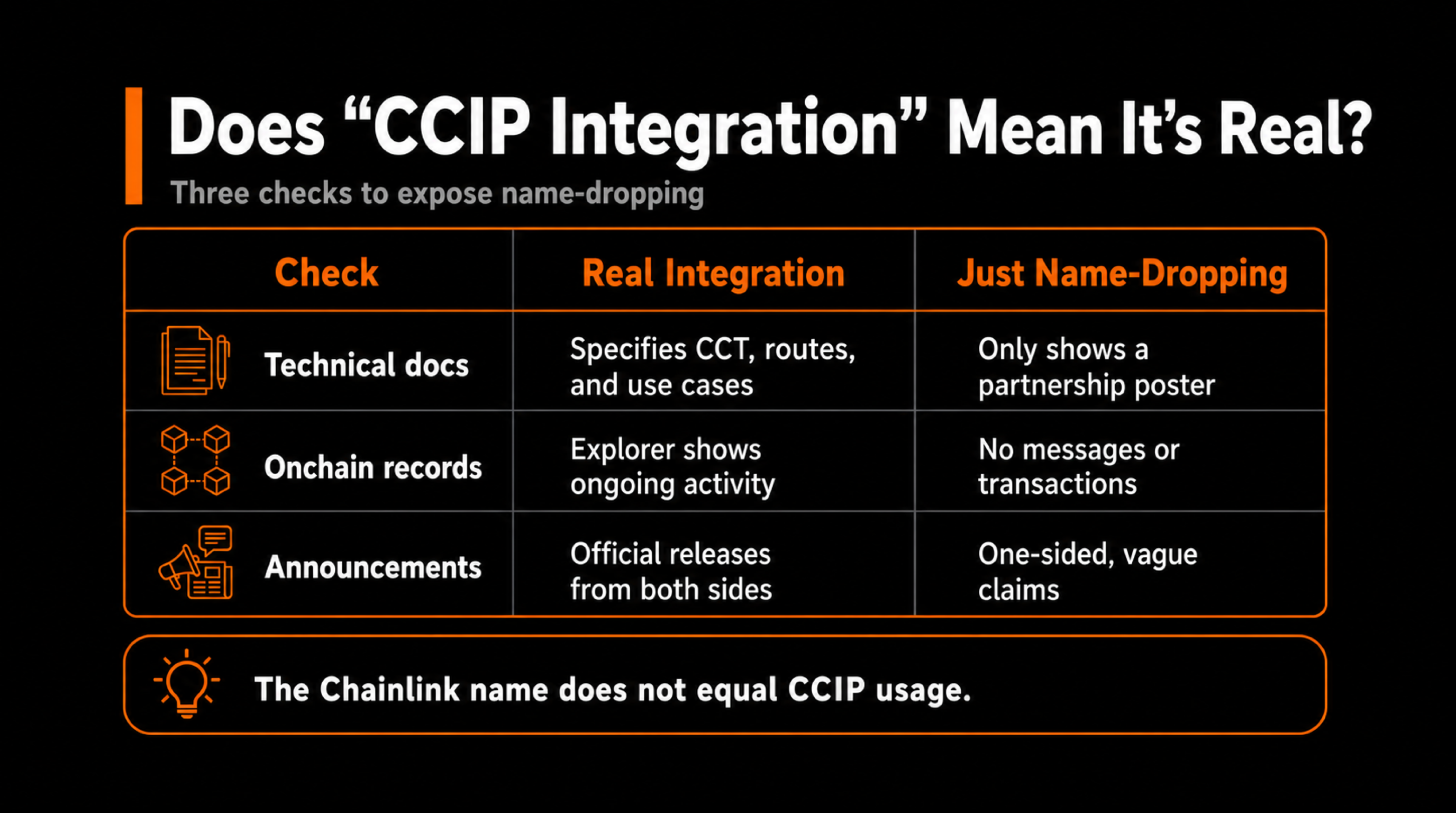
When I verify a project myself, the first checkpoint is the official documentation. A project that has genuinely integrated CCIP usually spells out clearly which standard it uses (like the CCT cross-chain token standard) and which lanes it runs on, rather than just posting a partnership graphic. The second checkpoint is on-chain records — the official CCIP Explorer (ccip.chain.link) lets you check the actual transaction volume and status for every message and every lane.If a project claims to have integrated CCIP but you can't find corresponding activity on the Explorer, that should raise a question mark.
The third checkpoint is the source of the partnership announcement. A serious integration usually comes with a formal press release from both parties, rather than a vague one-sided mention on social media. You can cross-check Dune Analytics' CCIP dashboard against DefiLlama's bridge category — this third-party data isn't influenced by any single party's stance, making it a more neutral verification channel.Using all three checkpoints together makes it much harder to be misled.
Identifying Common Marketing Language That Rides on the CCIP Name
The most common tactic is swapping "using Chainlink oracle price feeds" for "integrated CCIP cross-chain," these are two completely different things — the former is just pulling price data, while the latter is the cross-chain infrastructure itself.The second tactic is vague phrasing like "partnering with the Chainlink ecosystem" that never specifies which product is actually used — it sounds like an endorsement but actually commits to nothing.
The third tactic is holding a single event or writing a single blog post with the CCIP logo slapped on it, with no follow-up on-chain activity to verify — once the buzz fades, it disappears. The key to telling these apart isn't whether CCIP gets mentioned — it's whether there's independently verifiable technical documentation and on-chain data backing it up. Without those two things, even the loudest name is just marketing material.
Real-World Case Comparisons: How SBI, Mantle, and Pharos Use CCIP
SBI Digital Markets announced in November 2024 that it had designated CCIP as its "exclusive cross-chain interoperability solution," specifically using the CCIP Private Transactions feature to hide sensitive data like amounts, counterparties, and settlement details from third parties, while also evaluating Chainlink's Automated Compliance Engine (ACE).This is an integration backed by a formal press release and specific feature names — a verifiable case.
Mantle migrated its cross-chain bridge, Super Portal, from LayerZero's OFT standard to CCIP's CCT standard in July 2026, handling cross-chain transfers of MNT tokens worth roughly $2.5 billion in market cap. Pharos is a Layer 1 network focused on RWA tokenization, founded by the former Ant Chain team; it announced in October 2025 that it had designated CCIP as its canonical cross-chain infrastructure, paired with Data Streams for real-time price feeds. All three cases come with formal announcements and specific product names, clearly distinct from name-riding.
Who Are CCIP's Competitors in the Cross-Chain Race? Is Its Moat Deep Enough?
CCIP isn't the only cross-chain interoperability solution on the market — you may have also heard of LayerZero, Wormhole, and Axelar, whose architectural logic is completely different from CCIP's. So why does CCIP get mentioned so often specifically in RWA contexts? This section first compares the differences in each one's verification model, then covers CCIP's differentiating advantages, and finally honestly lists the challenges it still hasn't solved.
Comparing the Main Competitors: LayerZero, Wormhole, and Axelar
In my view, LayerZero V2 hands verification power to the market, adopting a "Decentralized Verifier Network" (DVN) model where applications can freely choose and combine multiple DVNs. It currently has dozens of active DVNs (including Google Cloud and Polyhedra), and the number of connected chains grew to over 160 between 2025 and 2026 — highly flexible, but its verification strength depends entirely on how it's configured.
Wormhole has a committee of 19 "Guardians" sign off on cross-chain messages, requiring a threshold of 13 votes to pass, with all Guardians being named institutional nodes. Axelar is an independent proof-of-stake chain where the top 75 validators stake AXL to participate in verification, using quadratic voting to dilute the influence of large holders, and connects roughly 70 to 78 chains.What all three share in common is that verification power is concentrated in a single network, unlike CCIP's dual-network design.
CCIP's Differentiating Advantages: Dual-Network Verification and Institutional Relationships
CCIP's most obvious difference is the DON+RMN dual-network architecture mentioned earlier — each network verifies independently using different programming languages, teams, and non-overlapping node operators, which in theory makes it harder for a single bug to breach both. This dual-safeguard design plays especially well in RWA scenarios that emphasize institutional trust, because institutions care not just about efficiency, but about where accountability and the stop-the-bleeding mechanism are if something goes wrong.
Beyond architecture, CCIP also holds the institutional relationships Chainlink has built up over years — SWIFT, DTCC, UBS, ANZ, and Euroclear were already using Chainlink oracles, so switching to the same vendor's cross-chain solution comes with a relatively low switching cost. In July 2026, SWIFT's blockchain ledger went live with 17 banks running a cross-border payment pilot on CCIP — and this kind of trust inertia is a moat competitors will find hard to replicate anytime soon.
Potential Challenges: Disputes Over Its Degree of Decentralization, and Its Fee Structure
CCIP isn't without weaknesses either. The most commonly questioned point is the one mentioned earlier — new lanes still need Chainlink Labs' gatekeeping — which falls short of the decentralization ideal, and it's the favorite line of attack for supporters of competing protocols: touting a dual-layer verification system as decentralized enough, while the entry permissions still sit in the hands of a single organization — a bit of a logical contradiction.
On the fee side, CCIP uses a "gas cost plus premium" billing model, payable in either LINK or the source chain's native token, but paying with anything other than LINK adds a roughly 10% premium, which effectively encourages people to stockpile LINK. There's currently no rigorous third-party study directly comparing CCIP's absolute fees against its competitors', so if someone flatly claims "CCIP is more/less expensive," I'd recommend asking where that claim comes from first.
Want to Track CCIP's Real Adoption? What Data Should You Watch?
After all this talk about mechanics and case studies, let's come back to the most practical question: if you want to verify for yourself whether CCIP is actually being used, where should you look? This section lays out several verifiable data sources, teaches you to tell the difference between real usage and a one-time announcement, and flags a common judgment error beginners tend to make.
Where to Check CCIP's Cross-Chain Transaction Volume and Number of Connected Chains
The most direct primary source is the official CCIP Explorer (ccip.chain.link), which lets you check the message count, status, and fee details for every lane — the fastest place to verify a partnership announcement. The second channel is a community-maintained dashboard on Dune Analytics that tracks CCIP fee revenue and the ratio of LINK to native-token payments, giving you a more granular financial breakdown.
The third channel is DefiLlama's bridge category, which places CCIP within the overall cross-chain bridge landscape so you can see the scale gap between it and its competitors. The Chainlink ecosystem also maintains a CCIP Metrics page that has published figures like cumulative cross-chain token value and cumulative transfer volume.Cross-referencing these channels together is far more reliable than just reading a single press release.
How to Tell Real Usage Apart From a One-Time Announcement
On the day of an announcement, transaction volume often spikes once due to test or symbolic transfers, then quickly falls back within a few days — that kind of number can't represent real adoption. The more reliable approach is to stretch the timeline out and look at data across several consecutive weeks or even months, observing whether a lane's message volume and unique address count are growing steadily, rather than just looking at a single-day peak.
Another way to judge is by looking at the "repeat-usage rate" — whether the same batch of addresses keeps using the same CCIP lane, or whether there's no follow-up after the announcement. Infrastructure that institutions genuinely rely on should show a steady, ongoing trickle of transactions, not a one-time fireworks show, but very few people actually click into the Explorer to check; most people draw conclusions just from the headline.
Common Mistake: Judging Based Only on News Without Checking On-Chain Data
CCIP figures published by different sources often don't match each other — one report says the average weekly transfer volume over the past six months is roughly $90 million, while another says the cumulative transfer volume for a single year reached $7.77 billion, up nearly 20-fold year over year. The two sets of numbers use different sampling periods and different methodologies, and taking them at face value to cross-confirm each other easily leads to the wrong conclusion.
The mistake beginners make most often is seeing a report saying "CCIP transaction volume has surged," without checking the number's time range, methodology, or even whether it includes a single large test transfer, and treating it directly as evidence of a massive explosion in CCIP adoption.The correct approach is to first confirm the source and the sampling period, then go back to the Explorer or Dune to verify — not treat a press release's adjectives as on-chain fact.
How Should You Rationally View LINK's "Picks and Shovels" Investment Narrative?
If CCIP really keeps growing, does that mean the LINK token is a sure thing? This is the question a lot of people eventually ask after getting into CCIP, and it's also the easiest one to oversimplify. This section starts with the "picks and shovels" narrative itself, breaks down the actual mechanism by which LINK captures CCIP's value, and finally flags a common mistake that's easy to overlook.
What Is the "Picks and Shovels" Logic (Value Capture at the Infrastructure Layer vs. the Application Layer)
The "picks and shovels" metaphor comes from the gold rush — rather than mining for gold yourself, you sell picks and jeans to everyone else who's mining, and no matter who strikes gold, the shovel business always makes money.Applied to crypto, this logic is often used for infrastructure-type tokens: no matter which RWA application or which chain wins out in the future, as long as they all need to use an underlying channel like CCIP, LINK should in theory benefit across the board.
This logic sounds appealing, but it has a precondition to hold up: the infrastructure must actually be widely adopted, and the token must have a clear mechanism that converts usage into token value. In other words, the picks-and-shovels narrative isn't an automatic guarantee — whether it holds up depends on going back and checking whether the transmission chain from usage to token value is actually connected, not just accepting it as fact because it sounds reasonable.
The Link Between LINK's Value-Capture Mechanism and CCIP Adoption (or the Risk of Decoupling)
Currently, CCIP fees can be paid in either LINK or native tokens, but regardless of which one is used, node operators ultimately get paid in LINK, so protocol usage indirectly translates into demand for LINK.The "LINK Reserve" mechanism, launched in August 2025, converts a portion of service revenue into LINK and removes it from circulation — a genuinely verifiable buyback mechanism.
Worth noting, though: the current Staking v0.2 mainly provides a security backstop for Data Feeds. A CCIP-specific staking and slashing mechanism is on the roadmap but hasn't fully launched yet, meaning that "CCIP adoption" and "LINK staking demand" aren't tightly coupled at this stage, and there's a real risk of decoupling.Institutional research reports do position LINK as a picks-and-shovels asset, but there's no rigorous statistical analysis proving a stable correlation between transaction-volume growth and LINK's price — this still remains at the narrative level.
Common Mistake: Treating a "Boring but Critical" Narrative as a Guaranteed Reason to Profit
The biggest appeal of the picks-and-shovels narrative is that it sounds "boring but critical" — not chasing hot applications, betting instead on the underlying channel, which feels steadier. But boring is boring — it doesn't mean that automatically translates into a rising token price. Infrastructure-type tokens are still just as subject to market sentiment, liquidity, and regulatory news.
I'd suggest treating the picks-and-shovels narrative as an angle for screening projects, not as the reason to buy in itself. The homework you should actually do is regularly check CCIP's actual fee revenue, LINK Reserve's buyback progress, and whether the staking mechanism is tied to CCIP — using data to verify whether the narrative is actually delivering, rather than betting because it sounds reasonable. Equating "the story makes sense" with "guaranteed profit" is one of the most common misjudgments made about infrastructure tokens.
Conclusion
Whether CCIP can carry the future of RWA cross-chain activity doesn't depend on how loud the marketing talk is, but on whether DON and RMN can hold up under ever-larger amounts of capital, and on when Chainlink Labs' governance permissions will actually be released. SBI, Mantle, and Pharos prove that CCIP has genuinely made its way into real institutional processes, but there's still a gap between a pilot and full-scale commercial rollout, and LINK's picks-and-shovels narrative hasn't been verified by rigorous data either. Rather than treating CCIP as a reason for mindless bullishness, it's better to write down the checkpoints in this article, verify them yourself, and then decide whether this narrative fits your investment logic.


