

Do you often see a coin crash hard the moment its "token unlock" hits, without understanding why or knowing how to avoid it?This piece won't paint unlocks as some monster. Instead, it starts with PORTAL's crash to show you why unlocks tend to bring sell pressure, how to read the two numbers — circulating supply and FDV — how to tell how big the risk is, and finally how to check the unlock schedule before entering so you dodge the peak of the sell pressure.
What Is a Token Unlock? Why Prices Tend to Drop When One Hits
"What exactly does an unlock unlock, and why is it tied to price drops?" The logic is actually simple: coins that were locked and couldn't be sold get released at the agreed time, so there are more tradable tokens on the market.In this section I'll first lay out how unlocks work from start to finish, because it's the foundation for everything that follows — if that foundation isn't solid, no amount of numbers later will read right.
Unlocking: Releasing Locked Coins Into Circulation
First, what does an unlock actually unlock? When a project launches its token, it usually doesn't dump all of it onto the market at once — it splits it into several chunks: some for the team, some for early investors, some set aside as an ecosystem fund or community rewards. The coins handed to insiders usually come with a "vesting period," during which they can't be sold until the agreed date arrives, the point being to lock in the team and early backers so they can't just run the moment trading opens.
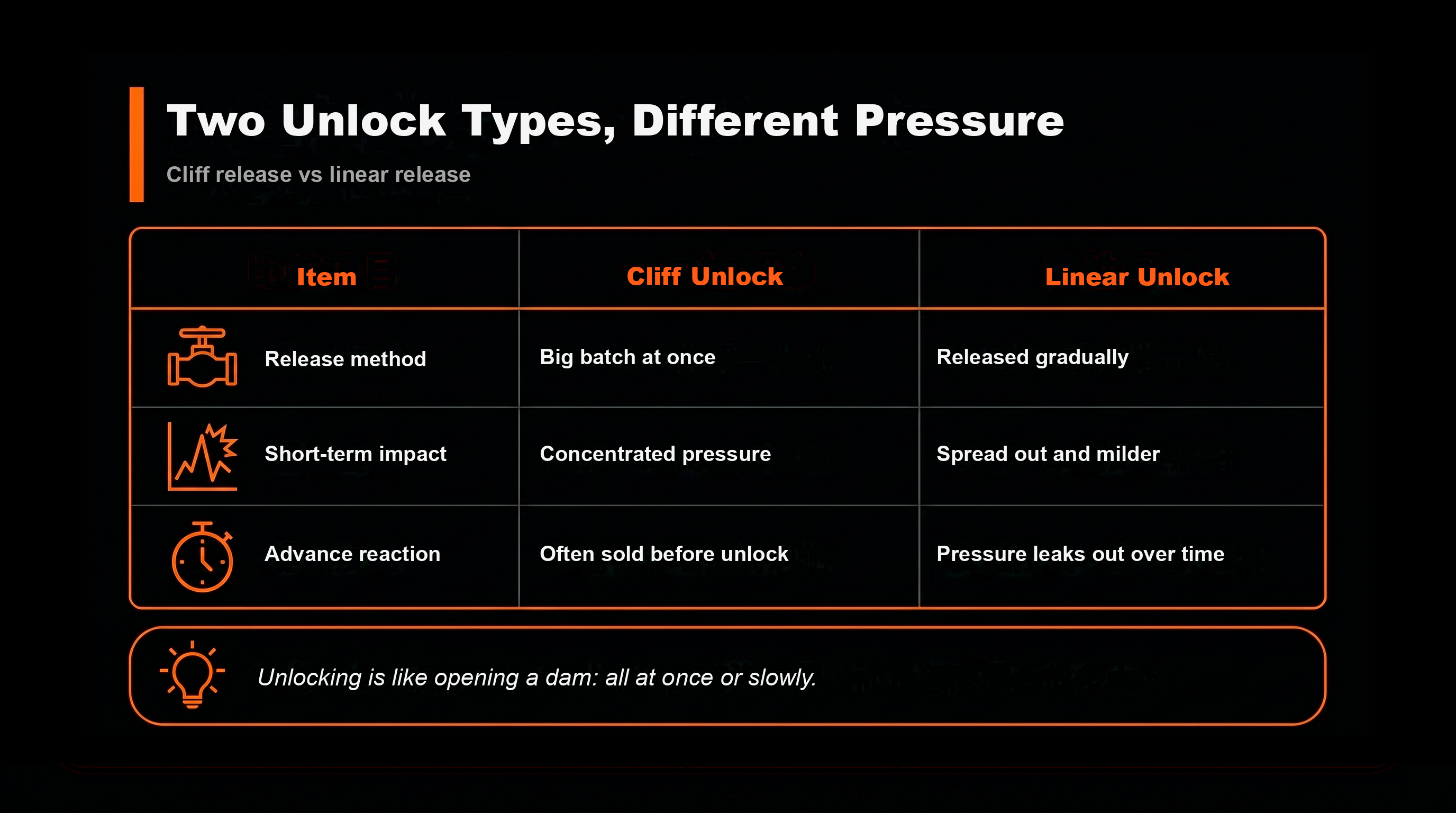
An unlock, then, is when these previously locked coins reach their time point, get released, and can be taken to an exchange and sold. There are two common arrangements: one is unlocking a big batch all at once on a specific date; the other is releasing in tranches, linearly month by month or quarter by quarter.Either way, the end result is the same — there are more coins that can actually circulate and be sold on the market.You can think of the whole token supply as a reservoir: vesting is keeping the floodgate shut, and unlocking is opening it on schedule to let water out. Beginners often only see the water level on the surface (the current price), without noticing when the upstream gate will open, or how much water it'll release at once.
When Supply Grows and Demand Doesn't Keep Up, Price Comes Under Pressure
Price is ultimately the result of supply and demand, and an unlock's most direct effect is suddenly adding a batch of goods on the supply side.If not enough new buying comes in at the same time to absorb it, these extra tokens will push the price down — it's about as basic as it gets.
But there's a more practical reason unlocks are especially prone to triggering drops: the early investors and team who receive unlocked tokens usually have an extremely low cost basis — some got in very early, when the price was a fraction of what it is now. For them, even dumping at what looks like a modest price is already several times their money on paper, so their sell pressure is especially real and they're especially willing to dump. Retail traders who chased in on the secondary market, by contrast, have a high cost basis and are reluctant to take the loss, so their buying power falls far short of the unlockers' selling power.Supply is heavy and urgent, demand is light and hesitant — the price heading down is almost inevitable.So before I even look at a coin, I ask one thing first: is there a large unlock lined up and waiting to be released next?
Reading the Actual Playbook Through Cases Like PORTAL
Beyond the theory, let's look straight at a script that actually played out in the market.PORTAL is a frequently cited teaching example — it saw a pretty noticeable crash around its unlock, with the price kept down by batch after batch of released supply.I won't nail down exactly what percentage it fell here, because the specific number changes over time; the point is the pattern itself.
And this script is by no means unique to PORTAL. Coins like WLD, STRK, and Aptos have all seen clear drops during their unlock phases. Put them side by side and you'll find the common thread isn't that some project suddenly went bad or that some bad news dropped — it's the same thing playing out over and over: supply gets amplified, the unlockers' sell pressure floods out, and the market's buyers can't catch it.Once you understand this pattern, the next time you run into one of those coins that "bleeds lower with no news," your first reaction won't be to panic and hunt for bad news — it'll be to check whether it's stuck right at an unlock crunch. A lot of drops that look inexplicable turn out to be no surprise at all once you lay out the token structure.
Circulating Supply and FDV: The Two Numbers You Should Check First
"So how do I judge ahead of time whether a coin's unlock risk is big?" The key is two numbers: circulating supply and FDV. You can look up both on almost any charting tool, but a lot of beginners either don't check them, or check them without knowing how to read them.Get them straight and you can see through the phrase "it's so cheap right now" to whether it's actually cheap, or just an illusion because the supply hasn't flooded in yet.
Circulating Supply: How Many Coins Are Actually on the Market Right Now
Circulating supply first. It refers to the number of tokens actually circulating on the market right now and available to be bought and sold — not counting the portion still locked in the hands of the team and investors.Multiply circulating supply by the current price and you get what we usually call "market cap" — the standard number for gauging the coin's current market size.
Here's a trap beginners fall into easily. When a coin's circulating supply is small, its calculated market cap looks low, and a lot of people see "market cap is only a few tens of millions" and instinctively feel "it's still tiny, still cheap, lots of room to run."But that cheapness may be fake — a low market cap doesn't mean the coin is truly small; it very likely just means the vast majority of coins are still locked and haven't been released yet.What really determines future price pressure isn't the small slice circulating now, but that huge batch lined up behind it waiting to unlock. So drawing conclusions from circulating market cap alone is like seeing only the corner of the reservoir poking above the water.
FDV: Counting In All the Coins Not Yet Unlocked
That brings us to the second number, FDV, which stands for "fully diluted valuation." It's calculated by counting in all of the coin's tokens — including that huge batch still locked and not yet unlocked — to get a total valuation.In other words, market cap looks at "now," while FDV looks at what things would be like "once everything has unlocked."
FDV and the gap between it and market cap is where future sell pressure hides.The bigger this gap, the more tokens are still unlocked and will slowly flood into the market. I use a very simple way to compare these two numbers and judge whether a coin's token structure is clean or dangerous:
- Low market cap, FDV also low: the gap between circulating and total supply is small, the token structure is relatively clean, and future unlock pressure is limited.
- Low market cap, but FDV absurdly high: it means a large amount of tokens are still locked behind it, and future supply will keep flooding in wave after wave.
When you see the second type, raise your guard.Its current low market cap is very likely just a "not yet diluted" illusion; as the coins behind it unlock batch by batch and circulating supply keeps swelling, the coin's price will slowly get diluted down.So when I look at a new coin, I never just look at how small its market cap is now — I always pull up FDV to compare alongside it.
Why Low Float and High FDV Is a Trap
Put the two numbers together and you run into the most typical pit of this cycle — the one beginners step in most easily: low float paired with high FDV.This structure is practically a chronic problem for many newly listed tokens in recent years, and understanding it can help you dodge a whole slew of coins that look ferocious but are actually dangerous.
Here's how it works: the project only releases a small circulating supply at first, and a small supply easily creates a sense of scarcity; combined with concentrated early buying, the price can often be pumped up beautifully with a fierce rally, FDV getting pushed to a scarily high number along with it. The problem is, this beautiful price is built on the premise that "most of the tokens haven't come out yet."Once the unlock schedule kicks in and the locked coins release wave after wave, circulating supply keeps expanding while the market simply doesn't have that much new, real demand to absorb the goods — so the price gets diluted and ground down through unlock after unlock. So when I see a coin rip especially hard in a short time, I don't rush to chase it; instead I first compare its circulating supply and FDV to see how much unreleased supply is weighing under this rally, rather than just fixating on how much it's already gone up.
Unlocking Doesn't Always Mean a Drop:How to Tell How Big the Risk Is
"So should I just dodge everything the moment I see an unlock coming?" Not really. If you bolt the instant you hear "unlock," you'll miss a lot of small unlocks that actually have little impact. Let's be clear in this section: unlocking doesn't always mean a drop — what really determines the size of the impact is how much unlocks, who it goes to, and whether the market reacted first. Learn to tell these apart and you won't jump at every shadow.
Unlock Ratio: How Much Unlocks Is What Matters
The first and most crucial one is the unlock amount as a proportion of circulating supply, not whether an unlock is happening at all.For the same unlock, a release that's only one percent of current circulating supply versus one that equals twenty or thirty percent of it — the two are on completely different scales of price impact.
The logic is intuitive: if the released tokens are just a small slice of current circulation, the market absorbs them easily and the price may barely feel it; but if a single unlock means the market has to swallow sell pressure equal to thirty or forty percent of current circulation, then no matter how strong the buying is, it's hard to catch. So when I check unlocks, I never just jot down "unlocks on such-and-such date"; I always take one more look: what proportion of current circulating supply this unlock represents.The bigger the proportion and the closer the timing, the higher the short-term risk.Get this ratio clear and you'll have a sense of how nervous to be about a given unlock, instead of hacking away wildly at the first rustle of wind.
Who It Goes To: Early Investors Are More Dangerous Than Ecosystem Funds
The second thing to distinguish is who this batch of unlocked coins actually goes to.The same unlock amount, landing in different hands, means very different degrees of real sell pressure.The part to watch most is what goes to early investors and the team.
As mentioned earlier, early investors usually have an extremely low cost basis; once unlocked, all they have to do is sell to book a big gain, so their incentive to cash out is strong and this kind of sell pressure is the most real. By contrast, if the unlocked coins go into an ecosystem fund, a community rewards pool, or are meant for staking and liquidity incentives, these tokens won't necessarily be dumped on the market for cash right away — they may be tied up in longer-term uses, and the short-term selling is relatively mild. So when I find a large unlock, I try to figure out where these coins are headed: to early backers ready to take profit at any moment, or into ecosystem uses that won't be dumped immediately.Get this layer straight and you won't misjudge a "goes to a fund, won't really be sold" situation as "the sky is falling."
Whether the Market Reacted Early: The Time Gap Between News and Price
The third thing is whether the market digested this unlock in advance.Unlock schedules are mostly public, checkable "known future events", which means that a lot of the time, sell pressure doesn't suddenly appear on unlock day — it gets priced in bit by bit as the news spreads and smart money positions ahead of time.
This creates a common phenomenon: some coins drop a bit before the unlock officially arrives, and then don't fall much on the actual unlock day — some even bounce slightly as the bad news clears. Conversely, if a large unlock goes completely unnoticed by the market ahead of time, its impact when it actually lands is often the most brutal.So I don't just fixate on unlock day; I feel out whether the market reacted early: has the price already softened for a stretch, is the community discussing this unlock. Looking at "how much unlocks, who it goes to, and whether there was an early reaction" together is far more rational — and far more accurate — than bolting the moment you hear "an unlock is coming."
How to Check Unlocks and Dodge Sell Pressure Before You Enter
"I get the logic — so what exactly should I check before placing an order, and how do I factor unlocks into my judgment?"This section gives you a checklist you can follow directly, so you factor unlock timing in before entering, instead of realizing only after you're stuck that you caught the hand right before the supply flood.
Use an Unlock Tracker to Check the Schedule
Step one: learn to use an unlock tracker.There are quite a few websites and data tools dedicated to tracking token unlocks now. Just enter the coin's name and you can find its future unlock schedule: which day it unlocks, how much, and which category of holders it goes to — usually laid out clearly, with charts mapping out the unlock rhythm over the coming months.
Before I enter, I always check two things first: whether there's a large unlock lined up in the near term, and how big that unlock is as a proportion of current circulating supply.If I find that a high-proportion unlock happens to be waiting right around the time I plan to enter, I'll be extra careful — I may even choose to wait until it's unlocked and the sell pressure has cleared before considering entry. This step actually takes only a few minutes, but it can save you a ton of money wasted on getting "inexplicably stuck." Many beginners don't fail to check — they simply don't know these tools exist, and haven't built the habit of taking a look before entering.
Match the Unlock Rhythm to Your Entry Timing
Step two is to line up the unlock rhythm you found against your own entry timing.Just knowing "this coin will unlock in the future" is useless; what you need to judge further is: during the window I plan to enter and hold, will I happen to run into a big unlock.
If you're a short-term trader who only plans to hold for a few days to a few weeks, then a large near-term unlock is a real, tangible risk to you — you may well spend your entire holding period fighting unlock sell pressure, in which case you should either avoid it or lower your expectations. But if you're bullish on the project and plan to hold long-term for several months or more, then the short-term drop from a single unlock may actually be a chance to build a position in tranches at a better price, and isn't necessarily something to dodge.The same unlock schedule means completely different things to people with different holding horizons.So after checking the schedule, remember to look back and match it against your own plan — don't treat a long-term event as a short-term disaster, and don't treat a short-term risk as nothing.
Don't Chase the High When Unlocks and News Are at Their Hottest
Step three, and the last reminder: never chase the high when unlocks or bullish news are at their hottest and the price is at its most euphoric.The most common beginner mistake is to see a coin surge on some piece of news, with the community in a frenzy, and not be able to resist jumping in — and that spot is often exactly the most dangerous place in the short term.
String together what we've covered and it clicks: an unlock is a "known future event," unlike sudden bad news that you can't guard against — it's something you can fully check and dodge in advance.Rather than waiting until after the crash to ask, bewildered, "why did it drop," you're better off checking the unlock timing before entering, clear-eyed about whose sell pressure you might be betting against next.My own habit is: the more euphoric the market gets and the more everyone's shouting to buy, the more I calmly look back at the token structure to see whether a big batch of unlocks is lurking ahead. Taking that one extra look while others are in a frenzy already gives you one more layer of protection than most people chasing the high.
After Understanding Unlocks, What Else Should Beginners Remember
"Beyond knowing how to check unlocks, what mindset traps should I avoid?"Beyond tools and methods, what matters more is not letting yourself be led around by factors other than the token structure.This section wraps up by spelling out a few ideas beginners should most internalize, so that "reading the token structure" truly becomes a reflex before you enter.
A Crash Doesn't Always Mean the Fundamentals Went Bad
The first idea to internalize is: many crashes actually have little to do with whether the project is good. When beginners see a coin they hold suddenly crater, their first reaction is often to panic and hunt for bad news, suspecting the project is in trouble — and they end up cutting their tokens at the most panicked low, only to realize afterward that nothing was wrong.
But after reading this piece you'll know that a whole category of drops is purely a token-structure issue — supply amplified by unlocks, sell pressure flooding out, buyers unable to catch it for a while — which is a separate matter from whether the team is delivering or the product is good. Of course, this isn't telling you to comfort yourself with "it's just an unlock, no big deal" every time it drops; it's about giving you one more dimension of judgment: when it drops, first sort out whether this is the fundamentals actually turning bad, or simply token supply being released.The former warrants a serious look at whether to exit; the latter may just be a stretch of supply digestion you can ride out, or even buy into. Being able to tell these two kinds of drops apart will make your trading much calmer.
Checking Circulating Supply and FDV Should Become a Reflex
The second habit to build is making checking circulating supply and FDV a reflex before you enter. All the methods in this piece — if you just nod along while reading and then forget them completely when you actually place an order — are wasted.What really protects you is turning it into a fixed routine.
Concretely, next time you get tempted by any coin and are about to buy, force yourself to spend a minute or two on three things: check the current circulating supply and market cap, pull up FDV to compare and see how big the gap is, then go to an unlock tracker to see whether there are large unlocks ahead.These three things add up to under five minutes, yet they run through all the token-structure risks covered in this piece.At first it may feel like a hassle, but do it a few times and it becomes a habit — and once the habit is set, those dangerous "low-float, high-FDV, tons of unlocks behind it" coins are ones you can spot problems in at a glance, with no one needing to remind you.
Factor Token-Structure Risk Into Your Overall Judgment
The third and final idea: unlocks and token structure are just one dimension of judging a coin — don't treat them as the only criterion.Understanding unlocks helps you dodge the "crash with no bad news" pit, but whether a coin is worth buying ultimately still comes down to the project itself, its sector, the team, and your own risk tolerance.
Here's how I position the role of token-structure analysis: it's a very effective risk filter that screens out coins with obviously problematic supply structures first, but a coin passing through this filter doesn't mean it's necessarily a buy or will necessarily go up.So the correct order is: first use unlocks and FDV to clear out the obvious token-structure landmines, then go back and seriously look at the project's fundamentals and your own plan.Make unlock risk one part of your overall judgment — rather than, having learned this one trick, using it everywhere to dismiss every coin — and your understanding of the market will grow more complete, instead of jumping from one extreme to the other.
Conclusion
Using PORTAL and similar cases of post-unlock crashes, this piece walks you through something many beginners never sort out: the drops caused by token unlocks often aren't because the fundamentals turned bad, but because previously locked supply gets released, sell pressure floods out, and buyers can't catch it for a while.Remember the two numbers, circulating supply and FDV, to see through the future sell pressure hidden behind low-float, high-FDV; when you run into an unlock, don't just ask "is it unlocking," but look at "how much unlocks, who it goes to, and whether the market reacted early." Spend a few minutes with an unlock tracker before entering to check the schedule and the ratio, put token-structure risk front and center, and you can dodge a lot of unfair "crash with no bad news" traps — knowing exactly whose sell pressure you're betting against.


