

Are you also wondering — another chain claiming to be "MEV-resistant," is this one actually different?This piecewon't dress Cadence up as some magic fix — instead, it'll walk you through what the MCP consensus mechanism, the BTX encrypted mempool, and that 219-millisecond number actually mean, then tell you how far this breakthrough still is from your actual trading experience.
Why did the official line "Claude, explain Cadence to me" pull in nearly 50,000 views, with the technical deep dive climbing to 60,000?
Why did a tweet that sounds like customer-service copy pull in nearly 50,000 views, followed immediately by a formal technical deep dive that climbed to 60,000?Behind this is Category Labs (the R&D team most closely tied to Monad) delivering a long-awaited answer on its consensus protocol. Let's first walk through why this discussion is worth ten extra minutes of your time.
This Isn't Just a Routine Version Update
For most chains, so-called "upgrades" are about boosting throughput, cutting fees, or swapping out the virtual machine. Cadence is about how the consensus layer itself works — how nodes agree on what the next block looks like.This layer is the deepest skeleton of the entire chain — touching it affectsnot just some feature, but the whole chain's block cadence and resistance to attacks.
I personally look first at whether the team positions something new as a "feature" or a "protocol," because that determines how much weight it carries.Category Labs calls Cadence a new consensus protocol outright, not some plugin or middleware. That positioning alone signals the team intends to treat it as a long-term underlying standard, not a one-off marketing topic.
Why Developers and Funds Are Both Following This Thread
Views in the 50,000-to-60,000 range aren't astronomical for crypto, but compared to other technical announcements posted the same day, Cadence's engagement is noticeably higher. It's not just retail following this thread — infrastructure analysts and funds holding positions are watching too.The reason is simple: MEV (maximal extractable value) has plagued the Ethereum ecosystem for years, and to dateno major public blockchain has dared to claim it has fully solved it at the protocol layer.
If Cadence can really push the MEV problem forward, the beneficiaries aren't just traders in the Monad ecosystem — they include any team looking to run high-frequency strategies, prediction markets, or perpetual contracts on this chain.That's also why the discussion has burned past purely technical circles and into the investment crowd that tracks narratives and capital flows.
How This Differs from the Expectations Set at Mainnet Launch
When Monad's mainnet launched, market attention mostly focused on parallel execution and throughput — the "runs fast" narrative. MEV resistance wasn't the main selling point back then.This Cadence announcement, in a sense, fills in that missing piece — telling the market that beyond "running fast," this chain now has a concrete plan for trading fairness too.
It's worth noting that the mainnet's performance numbers back then also went through a period where "actual experience fell short of the marketing."The 219-millisecond finality Cadence is presenting now will similarly need time to be verified — we'll break this down in detail later. For now, keep one line in mind:an official announcement is a starting point, not the finish line.
What Problem Does MCP (Multiple Concurrent Proposers) Actually Solve?
A chain where only one person can propose the next block at a time — that rule sounds obvious enough, but what does it actually get stuck on?This section breaks down the bottleneck in the traditional single-proposer mechanism, then looks at how MCP uses the seemingly simple change of "letting multiple people propose at once" to improve both block speed and latency.
Where the Traditional Single-Proposer Consensus Bottleneck Lies
In most blockchain consensus designs, only oneproposer (leader) is designated per round to package transactions and propose the next block, while other nodes are responsible for voting to confirm it.The upside of this design is simple logic; the downside is that if the proposer drops offline, hits network latency, or deliberately slows down, the whole chain's block speed has to slow down with it.
What's worse, when there's only one proposer, that person holds complete power over "deciding which transactions get packaged first" — and this is exactly one of the sources of the MEV problem.To shorten the block interval, you could in theory just force the timing down, but push it too hard and the proposer can't keep up communication with the network — that tends to produce side effects like forks or slower confirmation.
What "Multiple Proposers Submitting at Once" Actually Means, in Plain Terms
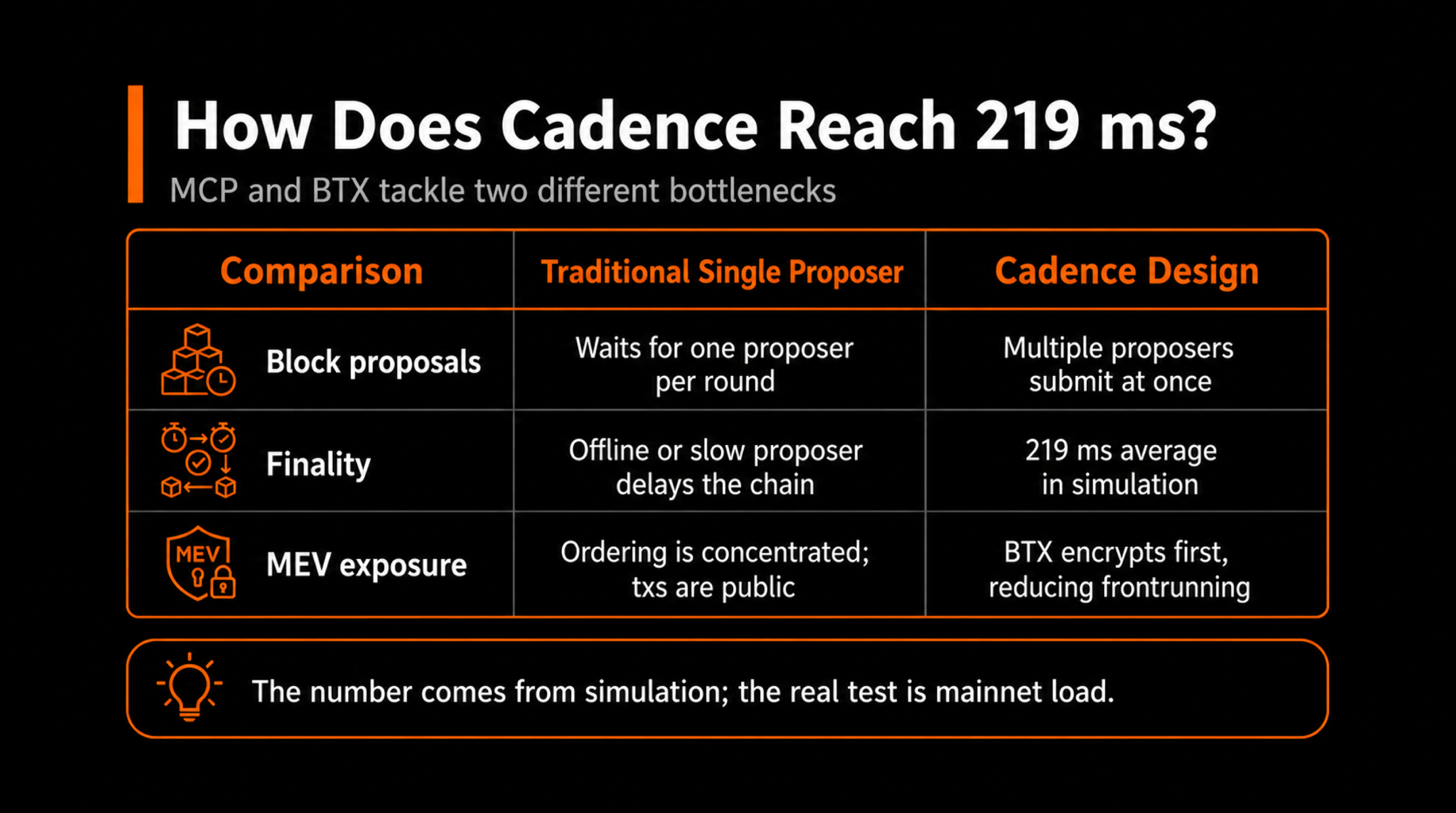
MCP's approach lets several proposer candidates exist simultaneously within the same time slot, each putting forward its own version of the block. The consensus mechanism then quickly converges on a final result among these versions, instead of waiting endlessly for one person to make the call.Think of it this way: instead of one counter with a long line, you open several counters to take submissions at once, then have the back office quickly cross-check and pick the best one.
The clever part of this design is that it doesn't have to sacrifice the low-latency advantage the single-proposer mechanism originally had. The paper puts it as "matching the best-case latency of single-proposer consensus" while still holding up under extremely short block intervals.In other words, what MCP wants is both speed and stability, not trading stability for speed.
What Do the 100-Millisecond Block Time and 219-Millisecond Finality Numbers Each Mean?
100 milliseconds refers to the target interval between blocks — how often the chain produces a new block; 219 milliseconds is the average finality time — how long it takes for a transaction to go from entering the network to being considered "irreversible."These two numbers are not the same thing — a fast block time doesn't mean confirmation is equally fast, since voting and synchronization time between nodes is also involved.
The test data comes from a simulated environment with 200 nodes and 5 proposers per time slot,speculative finality averaging 167 milliseconds, with final finality averaging 219 milliseconds — a transaction only needs to wait about 50 milliseconds on average before entering a proposal.These numbers are already quite impressive by public blockchain standards, butpay attention to the words "simulated environment" — the next section will dig into this specifically.
BTX Encrypted Mempool — Why Does the Protocol Layer Kill MEV?
How exactly does MEV skim a cut out of your transaction?This section starts with the two preconditions that make MEV possible, then looks at how the BTX encrypted mempool makes transactions "invisible" before they're packaged, cutting off the arbitrage space at its root.
MEV's Two Preconditions — Exclusive Packaging Power Plus Information Asymmetry
MEV exists because two conditions hold at the same time: first, the proposer has exclusive power over "which transactions get packaged first and in what order"; second,the mempool — transactions waiting to be packaged there have publicly visible contents before they're finally put on-chain.As long as both conditions hold, arbitrage bots can see your transaction ahead of time, cut in line ahead of you, or sandwich your transaction between two of their own, eating the price difference you should have gotten.
Many beginners assume MEV is just a matter of "paying higher fees." It's actually closer to a structural loophole — your trading intent gets seen through by someone else before it's officially executed, and that someone has the ability to act on it before you do.This is also why public blockchains have spent years looking for ways to suppress it, yet no major chain has ever fully solved it at the protocol layer.
How the Encrypted Mempool Makes Transactions "Invisible" Before Packaging
BTX is Category Labs's proposed batched threshold encryption scheme. The core idea is that transactions get encrypted the moment they enter the mempool, and only at the moment a block is about to be packaged does a group of validators jointly decrypt them and decide the final order.In other words, no matter how closely arbitrage bots stare at the mempool, all they see is a pile of encrypted content — they can't figure out ahead of time what transactions are inside, or whether it's worth front-running.
The technical difficulty of this scheme lies in efficiency. If the decryption process is too slow, it drags down the block speed that MCP worked so hard to achieve.BTX claims to achieve "server-to-server communication required for decryption that grows sublinearly with batch size, and independently of total mempool size" — in plain terms, no matter how large the mempool gets, the decryption burden won't scale up linearly with it. That's what gives it the confidence to pair with MCP.
The Real Impact of MCP Plus BTX Combined on Sandwich Attacks and Front-Running
Looking at MCP and BTX together, the logic goes like this: MCP first makes "who has the power to decide the packaging order" more decentralized, then BTX makes "the content before packaging" invisible.With both conditions weakened at the same time, traditional sandwich attacks (inserting an order before and after yours to eat your slippage) and pure front-running should, in theory, lose their room to operate.
I'd sum up the ambition of this design in one line: what it's trying to doisn't "punishing MEV after the fact", but "preventing MEV from ever forming in the first place."This is a different path from what many chains currently use — private transaction channels, after-the-fact profit-sharing mechanisms, and so on. Those approaches largely accept that MEV will happen and try to route the gains back to users; what Cadence plus BTX is trying to do is make the whole front-running economic model unviable from the root.
Paper Simulation Numbers vs. Mainnet Reality — Where Might the Gap Lie?
219 milliseconds, 200 nodes — how many hurdles still stand between these pretty numbers and you actually opening your wallet and sending a transaction?This section spells it out plainly, reminding you to distinguish "the best case in the paper" from "what you'll actually encounter on mainnet."
A 200-Node Simulation Is Not the Same as the Real Network Environment of a Full Mainnet Validator Set
The currently public 219-millisecond figure comes from a 200-node simulated test set up by the research team, not real-world results measured after mainnet has formally launched with its full validator set participating.Simulated environments can usually control variables like node geographic distribution and network latency, keeping test results in a relatively ideal range; in the real world, validators are scattered across the globe, and network congestion, hardware differences, and even interference from malicious nodes will all discount actual performance.
When I look at announcements like this, I habitually ask one question first: is this number from the whitepaper stage, from testnet, or has it already run on mainnet for a while?Cadence is currently still at the protocol design and simulation validation stage, still some distance from large-scale mainnet stress testing. That gap is worth keeping in mind, rather than treating the paper's numbers as a guarantee of your future trading experience.
A Common Beginner Misunderstanding — Assuming Protocol-Level MEV Resistance Equals Zero MEV in Trading
Protocol-layer design can shrink the space for MEV to occur, butno mechanism can bring MEV down to exactly zero.The encrypted mempool can block the most common tactic — "seeing the content, then front-running" — but if an attacker coordinates with validators through off-chain channels, they could in theory still find new arbitrage paths. Technology is always chasing arbitrageurs' tactics in a back-and-forth; there's no once-and-for-all finish line.
Many readers new to this topic see the phrase "protocol layer solves MEV" and easily jump to "trading will be completely fair from now on, no more front-running." That expectation is set way too high.A more realistic way to understand it: Cadence plus BTX substantially raises the bar for MEV to occur, not eliminating it entirely.
What Signals Are Worth Watching for Real-World Deployment
Rather than fixating on whether the paper's numbers look good enough, focus on a few observation points that will surface over time: when the protocol actually gets deployed to testnet, whether there's a third-party audit report during the testnet stage, how much the confirmation time of the first batch of real transactions after mainnet launch differs from the paper's numbers, and whether independent researchers have verified BTX's security assumptions.
These signals will reflect real progress far better than any official tweet.The safer attitude is to treat an upgrade like this as an observation project spanning several months, or even more than half a year, rather than reaching a conclusion after reading one thread.After all, historically, very few protocols have gone straight from a paper to stable mainnet operation in one step.
What Does This Mean for the Monad Ecosystem and the MON Narrative?
TVL is up 86%, weekly perpetual contract trading volume has nearly septupled — how much do these numbers actually have to do with Cadence?This section helps you separate ecosystem data from narrative hype, so you avoid conflatingtwo things that aren't entirely relatedinto one.
How to Read the TVL +86% and ~7x Weekly Perpetual Volume Numbers
According to public data, Monad's total value locked grew about 86% in 2026, weekly perpetual contract trading volume grew to roughly seven times its original level, and stablecoin market cap also grew more than 30%. These numbers do reflect rising ecosystem activity, but it's worth noting that this growth period doesn't necessarily line up exactly with the timing of the Cadence announcement.The ecosystem's growth may come more from existing applications accumulating users, not a direct effect of this protocol announcement.
When I look at on-chain data growth, I habitually break it down into "is this short-term capital inflow driven by narrative" or "is this a user base that's been steadily built up at the application layer."If it's the latter, the numbers won't easily collapse overnight even as the hype cools; if it's only the former, the numbers can easily fall back once the topic cools off.
What This Means for High-Frequency Scenarios Like Perp DEXs and Prediction Markets
If the Cadence plus BTX design can genuinely cut down front-running room, the most direct beneficiaries will be perpetual contract exchanges and prediction markets — high-frequency, extremely price-sensitive use cases. These are exactly the scenarios MEV attackers love to target, since a large opening order seen ahead of time can result in substantial slippage losses.
For teams building these kinds of applications, protocol-level MEV resistance will be a practical criterion when choosing which chain to deploy on, not just a technical highlight on paper.If Cadence's future real-world performance can actually deliver, the Monad ecosystem's case for attracting these applications will get noticeably stronger.
MON Narrative Heat vs. Fundamentals — How to Tell Them Apart
Every time there's a major protocol-layer update, market sentiment tends to surge with narrative hype first — that's the norm in crypto, not something unique to Monad.To judge whether this wave of hype has fundamental support, I look at a few concrete indicators: whether developers are actually starting to adapt applications based on Cadence, whether high-frequency trading applications in the ecosystem have actually migrated in or grown, and whether independent analysis reports have verified the real-world data — not just looking at how loud the community discussion is.
At the end of the day, protocol-layer technical breakthroughs and token price performanceare two lines that don't move in perfect sync — technology takes time to deliver, while market sentiment can react in a matter of days.Being clear on whether you're chasing narrative or evaluating fundamentals determines the pace at which you should follow this topic, rather than being pulled along by one high-engagement thread.
Conclusion
What Cadence is trying to solve is an old problem that has plagued public blockchains for years — MEV.MCP delivers faster confirmation speed, BTX makes transactions invisible before packaging, and the logic of combining the two holds up — but for now, only the simulated data can actually be verified,not real mainnet performance.Rather than rushing to draw a conclusion for the MON narrative, treat this announcement as a starting point for observation: over the next few months, testnet data, independent audits, and actual deployment progress will be far more worth your time than any high-engagement thread.


