

Do you watch crypto prices swing wildly every time nonfarm payrolls or CPI come out, without understanding what these U.S. numbers have to do with crypto? This guide won't teach you to predict the market. Instead, it first helps you understand why crypto prices follow U.S. data, what nonfarm payrolls, CPI, and FOMC each track, who Kevin Warsh is, then debunks misconceptions like "a rate cut is always bullish," and finally teaches you to turn macro week into an edge instead of a fear.
Why Do Crypto Prices Have to Follow U.S. Data?
"Isn't crypto decentralized — what does it have to do with the Fed?" This is the most common confusion for beginners, and the answer really comes down to one keyword: money. Whether money in the market is loose or tight, plentiful or scarce, is ultimately decided by the Fed's rate policy — and assets like Bitcoin are especially sensitive to how loose or tight the money environment is. Get this transmission chain straight first, and all the data that follows will start to make sense.
Rates Decide How Loose or Tight Money Is, and Where It Flows
The source of the whole transmission chain is the interest rate the Fed holds in its hands. Through rate hikes and rate cuts, it adjusts the amount of money circulating in the market — in effect pricing dollar liquidity for the entire world. When the Fed hikes rates and shrinks its balance sheet, borrowing gets more expensive and there's less money around, so people naturally tend to park their money somewhere relatively safe, like fixed deposits or government bonds. Conversely, when it cuts rates and opens the taps, money gets cheaper and more plentiful, and only then does a large pool of idle capital go looking for higher returns, flowing toward riskier assets.
You can think of it like a faucet: when the Fed opens the tap wide, there's money everywhere in the market, and even the high-risk corners get flooded; when it turns the tap down, the first pools to dry up are usually the most fringe, most speculative ones. The cost and quantity of money directly determine how much capital is willing to take on risk — this is the most fundamental reason macro can move crypto prices, and why a rate decision made far away in the U.S. can make the prices on your phone swing up and down.
Bitcoin Currently Behaves More Like a "Risk Asset"
This point is especially important for beginners, so please lock it in: although Bitcoin is often given the label of "digital gold," at this stage its price action behaves more like the typical risk assets such as tech stocks, rather than a safe haven that protects you in a crisis. The label is a marketing narrative; the price action is the market's real vote.
The actual data supports this judgment too: Bitcoin's correlation with tech-stock indexes like the Nasdaq has stayed high, jumping the same way whenever the market sells off hard. This means that when the macro environment turns toward tightening and the market switches into risk-off mode, Bitcoin tends to get sold alongside stocks, rather than rising against the trend the way gold does. So rather than treating it as a hedging tool, it's better to understand it as "a risk asset that's especially sensitive to the money environment and swings even harder." Once you accept this positioning, you'll understand: the moment macro tightens, it's not just U.S. stocks under pressure — Bitcoin gets swept up too, and often falls even harder.
Nonfarm Payrolls and CPI: What They Move Is the Expectation of "Cut or No Cut"
So why do nonfarm payrolls (the jobs data) and CPI (the Consumer Price Index — that is, inflation) matter? Because they are precisely the two most core inputs the Fed uses to decide the direction of rates. Boiled down, the Fed's job is to watch inflation with one hand and employment with the other — and these two reports are exactly the thermometers it uses to judge whether to tighten or loosen.
Simply put: when inflation is high and employment is strong, it means the economy is still running hot, and the Fed has more reason to keep rates high or even turn more hawkish; but when the data starts to weaken, the market begins to expect it might cut rates to rescue the economy. The key is that financial markets "react to expectations in advance" — they don't wait for policy to actually land before moving. So the moment these numbers come out, as long as they differ from what the market originally expected, the bets on future rates get reshuffled instantly, and crypto prices move first. Those spikes and crashes you see are, much of the time, not a reaction to the number itself, but the market repricing one thing: from here, will money get looser, or tighter?
How to Read the Three Big Data Points? The Roles of Nonfarm Payrolls, CPI, and FOMC
"So how exactly should I understand these three terms individually?" Rather than lumping them together into one blob of macro data, it's better to take them apart one by one and see each clearly. This section helps you pin down the roles of nonfarm payrolls, CPI, and FOMC, so you'll know what to watch for on each of these days.
Nonfarm Payrolls: The Employment Thermometer for the Economy's Heat
The nonfarm payrolls data — full name "nonfarm employment" — is usually released on the first Friday of each month and is one of the market's most real-time indicators for gauging how hot or cold the U.S. economy is. It tells you how many jobs the U.S. added last month and whether the unemployment rate is high or low; what the numbers reflect is whether the whole economic engine is still running smoothly.
For crypto prices, the significance of nonfarm payrolls lies in how it moves rate-cut expectations. Intuition says strong employment is a good thing, but in the market's eyes that's not necessarily so: if employment is too strong and wages rise too fast, it may instead make the Fed worry about inflation pressure and lean toward keeping rates high, which isn't necessarily good for risk assets; conversely, if employment weakens noticeably, though it signals the economy is cooling, it may lead the market to start betting on rate cuts, which can actually be a spark for crypto prices. It's precisely because of this "good isn't necessarily good, bad isn't necessarily bad" quality that beginners most easily read the direction wrong the moment nonfarm payrolls come out. Rather than gambling on how to interpret it, it's better to simply know that volatility will be amplified on this day.
CPI: The Price Mirror That Reveals Inflation
CPI is the Consumer Price Index — in plain terms, it measures how much the everyday things ordinary people buy have gone up, and it's the single most important report for observing inflation. The reason inflation moves everything is that it directly determines whether the Fed can — and dares to — cut rates: if inflation can't be brought down, it's hard to rashly open the taps even if it wants to rescue the economy.
So each time CPI comes out, what the market is really watching isn't the absolute number of how many percent prices rose, but the gap between it and prior expectations. If inflation falls faster than expected, the market will immediately light up with hope for rate cuts, and risk assets tend to bounce along with it; if inflation is stubborn, won't come down, or even rebounds, the original hopes for rate cuts fall through, capital tends to retreat to safety, and assets like Bitcoin easily come under pressure. The moment CPI is released is often one of the most volatile points in macro week, because it almost single-handedly shapes the market's imagination of the rate path over the coming months.
FOMC: The Meeting That Actually Holds the Steering Wheel on Rates
If nonfarm payrolls and CPI are the "clues," then FOMC is the "reveal of the answer." FOMC is the Federal Open Market Committee under the Fed, which meets at fixed intervals to decide whether to adjust rates, and afterward the chair holds a press conference to explain the thinking — this is the occasion that actually holds the steering wheel on rates.
For the market, FOMC's focus is often not just whether it hikes or cuts this time, but its "guidance" for the future — that is, how the Fed describes the upcoming policy path. Many times the rate itself doesn't move, but a single sentence at the chair's press conference, or a subtle tweak in wording about inflation or employment, is enough to flip market sentiment. For beginners, FOMC meeting days and the chair's remarks can almost be treated as the highest-alert moments of macro week, because these are when the market digests a large amount of policy information all at once and is most prone to two-way wicks.
Who Is Warsh? Why He's a New Variable for the Market
"Does swapping out the Fed chair really make that much difference?" Yes — a lot. A new person holding the steering wheel on rates is a big deal in itself, and on top of that the new chair Kevin Warsh's style brings some fresh uncertainty. This section helps you understand who he is and why he's worth keeping an extra eye on during this period.
A New Chair Means a New Policy Style
First, the background: the Fed chair has a decisive influence on rate policy, and whether their stance is more hawkish (leaning toward tightening, prioritizing suppressing inflation) or more dovish (leaning toward easing, prioritizing protecting employment) directly moves the whole market's expectations for the future money environment. You could say that who sits in this seat and what kind of policy philosophy they hold decides the broad direction of money for the next several years.
Now this seat has changed hands, taken over by Kevin Warsh, which is like a new driver taking the wheel. He served as a Fed governor years ago, so the market isn't unfamiliar with him, but "having served as a governor" and "personally steering as chair" are ultimately two different things. Before his true stance and decision-making rhythm in this term are fully understood and fully priced in by the market, every public remark and every press conference he gives could become a new source of volatility. For crypto prices, this "not yet read" stage is itself a risk worth watching.
His Communication Style May Amplify Short-Term Volatility
Kevin Warsh's taking office brought one point of attention: his attitude toward the market's customary way of communicating policy seems to differ from his predecessor's. Over these past years the market has grown used to the Fed providing relatively clear forward guidance, which amounts to having an "anchor" to reference; and the outside reading of Warsh is that his communication style may be more concise and less inclined to spell things out, leaning toward preserving more room for on-the-spot judgment.
A special reminder here: how exactly he'll adjust his communication style is, for now, mostly still at the level of market interpretation and speculation, not an ironclad fact — you don't need to treat any single claim as a conclusion. Even so, the logic is clear: once the "anchor" the market is used to becomes blurry, people tend to overreact in the short term from losing their sense of direction, capital tends to deleverage and move to safety first, and this naturally creates pressure on risk assets like Bitcoin. My own view is that before the new chair's style has been read by the market, rather than guessing whether he leans hawkish or dovish, it's better to take care of your own risk first.
Rather Than Guessing His Stance, Watch the Market's Reaction
Facing a new chair whose style the market is still feeling out, the thing beginners should most avoid is spending a lot of energy predicting whether his next move leans hawkish or dovish. Honestly, even professional institutions are repeatedly revising their read of him, and for a beginner to gamble on this, the odds aren't much better than rolling dice. The more practical approach is to shift your attention from "guessing what he thinks" to "watching how the market reacts".
How? It's simple: at moments like his public remarks and FOMC press conferences, don't rush to draw conclusions about his words — instead, observe the votes the market casts with real money: is the dollar strengthening or weakening, where are U.S. Treasury yields heading, are risk assets being bought up or sold off. The market's real-time reaction often tells you, earlier and more honestly than any textual interpretation, how capital is repositioning itself. The uncertainty the new chair brings objectively exists, but the way you deal with it shouldn't be to join the guessing contest — it's to step back, see clearly which way the money on the table is flowing, and then decide whether you want to move.
Before Macro Week, the Risk Prep Beginners Should Do
"So when macro week really comes, what exactly should I do?" This section doesn't predict ups and downs, nor tell you whether to buy or sell — it only gives you a few things to prepare before the data comes out. There's just one core goal: don't put yourself in the most fragile, most easily-swept-out position at the moment of high volatility.
First, Mark the Key Days on Your Calendar
The most basic — yet most easily overlooked — step is to know in advance which major data points are being released this week and this month. Many beginners only go back to check what happened after the market has already erupted, and by then it's usually too late to react. Do your homework up front, and you'll have room to respond with composure.
What exactly should you watch? Lock in three categories: the nonfarm payrolls jobs data, the CPI inflation data, and the FOMC rate decision and chair's press conference. Around these days, market volatility and the odds of a wick both rise noticeably. You don't need to remember every little detail — just build one habit: before each week starts, spend two minutes glancing at whether the week has any of these big days. Just marking these moments into your calendar can keep you from piling in heavily and defenseless at the moments most prone to violent swings. Knowing when the storm arrives is what gives you the chance to reef the sails early.
At High-Volatility Moments, Cut Leverage, Don't Go In Heavy
The instant the data is released, prices often wick violently in both directions — plunging one way first, then snapping back in an instant — and this is exactly when leveraged traders are most easily liquidated and swept out. Many people don't read the direction wrong; they die because "the direction was right in the end, but the wick in the middle blew them up first."
Before such moments arrive, I proactively do a few things: reduce leverage, shrink my position, and when the data is especially uncertain, I'll even wait on the sidelines with no position until the dust settles. The reason is very practical: at times like these the market often isn't there to give you a chance to be right or wrong — it first sweeps through the high leverage on both the upside and downside, manufacturing maximum panic before picking a direction. For beginners, rather than thinking about catching a burst of huge profit in this kind of market, it's better to set your mindset to "I'd rather miss out on a stretch of gains than get liquidated and knocked out in a wick." Staying alive at the table matters more than betting right on any single hand.
Understanding "Expectations" Matters More Than Predicting the Number
The thing beginners most often do during macro week — yet the least efficient — is desperately trying to guess what the number will actually be. But in reality, compared with gambling on the number itself, understanding what the market "has already expected" is far more useful. Because financial markets are a machine that reacts in advance, much of the time the mainstream expectation has already been digested into the price before the data even comes out.
The key concept is: the market often reacts not to "how absolutely good or bad the number is," but to "the gap between the number and expectations." A number that looks terrible, if it's a bit better than what the market originally feared, may instead push the price up; and vice versa. So rather than gambling that you can guess the specific number, it's better to treat every macro data day as a warning light reminding you that "risk is especially high today," and then put your focus on managing your position size and controlling risk. Once you see this layer, you'll slowly turn from a gambler chasing numbers into someone who knows to buckle up before the storm arrives.
Is a Rate Cut Always Bullish? Debunking a Few Common Misconceptions
"As long as the Fed cuts rates, crypto prices are bound to go up, right?" This is one of the intuitions beginners most often cling to — and one that most easily gets them hurt. The relationship between macro and crypto prices is far more complex than a one-size-fits-all formula like "rate cut = bullish, rate hike = bearish." This section helps you dismantle a few of the most common misconceptions.
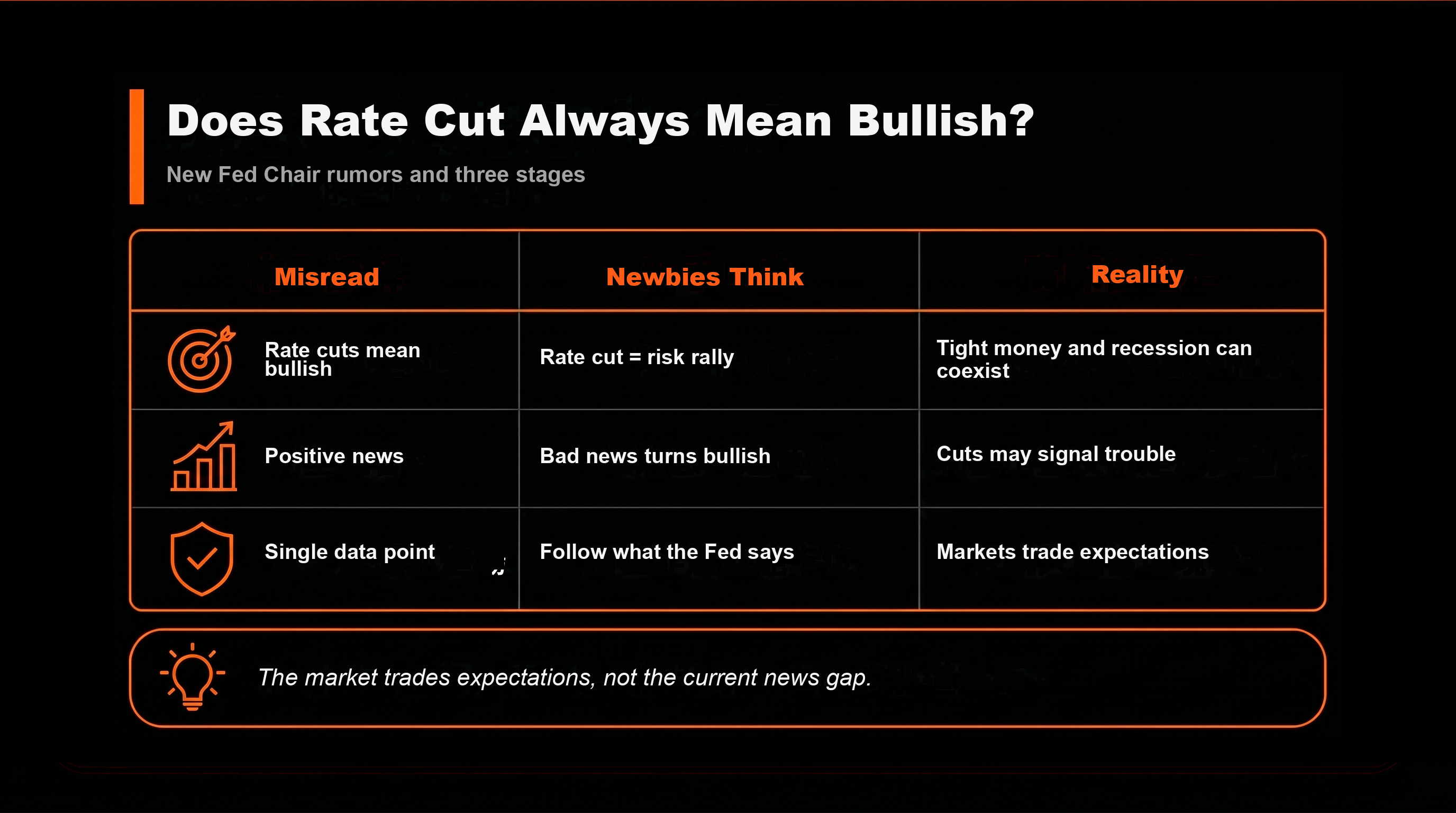
A Rate Cut Isn't Necessarily Immediately Bullish — It Depends on "Why It's Cutting"
Many people equate a rate cut directly with a bullish signal, but this ignores a more important question: why exactly is the Fed cutting rates? If it's because inflation is mildly easing and the economy is achieving a soft landing, and the Fed is calmly adjusting policy, then this kind of rate cut is usually indeed friendly to risk assets, because it means the money environment is about to loosen without any big trouble.
But there's another scenario: the Fed cuts because something has gone wrong with the economy and recession risk is rising, forcing it into an emergency cut to put out the fire. This "bad-news-style" rate cut may instead be read by the market as "things are worse than we thought," so it panic-sells risk assets first, and crypto prices fall instead of rising. So next time you see a rate cut, don't rush to celebrate — ask one more question first: is this a smooth adjustment under a healthy economy, or an emergency rescue because something broke? The same rate cut can mean vastly different things for crypto prices under these two backdrops.
When the Bad News Is Fully Out, It Can Instead Be the Start of a Bounce
Another common misconception is to see bad data and instinctively assume crypto prices are bound to fall. But the market often doesn't follow this script, and instead a so-called "bad news fully priced in" situation appears — that is, after the bad news is released, the price rises instead of falling. The logic behind this still comes back to the "expectations" mentioned earlier.
If a piece of bad news was already widely expected — or even feared to be worse — by the market before it was released, then when the data actually comes out and the result isn't as bad as imagined, the block of uncertainty that had been weighing on the market instead disappears, the shorts positioned in advance take profit, sidelined capital re-enters, and the price may bounce with the momentum. This is also why veterans often say "buy the rumor, sell the news." For beginners, the biggest takeaway from this phenomenon is: don't draw a simple equals sign between how good or bad a single data point is and whether crypto prices rise or fall — what the market is really trading is the gap between expectation and reality.
Don't Treat a Single Data Point as the Holy Grail for Entry
The last one to debunk is the obsession with catching the perfect entry point off some single macro data point. Beginners often fantasize: as long as I understand nonfarm payrolls or CPI, I can position precisely before the data comes out and grab a run. But the reality is that the impact of macro data on crypto prices is full of multiple variables and emotional noise, and it's almost impossible to reliably use it as a Holy Grail for short-term entry.
The more pragmatic attitude is to treat macro data as "environmental reference" rather than an "entry signal". What it helps you judge is whether the money environment is broadly loose or tight right now, and whether risk is high or low during this period — not which way the next candle will go. What truly lets you survive long-term has never been one uncannily accurate reading of the data, but steady position management and risk control. Treat macro as a tool that helps you read the weather clearly, rather than a crystal ball for predicting every wave, and your relationship with the market will be much healthier and last much longer.
Turn Macro Week Into Your Edge, Not a Fear
"After all this talk of risk, is macro week just a nerve-wracking disaster for beginners?" Of course not. Look at it from another angle: when most people are panicking and making bad moves during macro week because they can't make sense of it, all you need is a bit more preparation and understanding than they have, and this period can instead become your edge. This section helps you set your mindset straight.
Understand the Mechanism and Half Your Anxiety Disappears
People panic most easily about things they don't know. A lot of beginners' anxiety during macro week doesn't come from the losses themselves, but from that sense of being out of control — "I have no idea what's happening or why crypto prices are moving like this." And the transmission chain this guide has laid out from start to finish is precisely there to help you turn this unknown into the known.
Once you understand how rates decide whether money is loose or tight, how nonfarm payrolls and CPI move rate-cut expectations, and how the market reacts in advance, then when you see violent swings after the data comes out, you'll have an extra layer of grounding — "oh, the market is repricing the upcoming money environment" — rather than pure panic. This understanding won't make you guess the direction right every time, but it will greatly lower the odds you make an impulsive move. Just lowering your anxiety from "I have no clue what's going on" to "I roughly know what's happening" already puts the quality of your macro-week decisions ahead of most people.
Treat Volatility as a Reminder, Not an Invitation
Macro week's high volatility means completely different things to people with different mindsets. To the gambling-inclined, it's like an invitation reading "come place your bets, this is a rare opportunity"; but to those who want to last for the long haul, it should instead be seen as a reminder to "buckle your seatbelt". These two interpretations will lead you to entirely different outcomes.
My advice is to always choose the latter. When you default every data release and every FOMC to a reminder that "risk is elevated today," your instinctive reaction becomes to tighten your defense rather than add to the attack. This sounds conservative, but the cruelty of the crypto market lies exactly in this: whether you can survive long matters far more than whether you can bet big. Those who get swept out round after round by macro volatility are mostly not the ones with the worst judgment, but the ones who treat every swing as an invitation and pile in heavily to gamble again and again. Treat volatility as a reminder, and you'll have the chance to stay around until the opportunity that's truly yours shows up.
The One Checklist to Take Away From Macro Week
After all these principles, I'll finally condense them into one checklist you can pull out to quickly run through every macro week. Before you place an order — or simply before each week's open — spend a minute running through these questions; it's more useful than staring at any candle:
- Does this week have major data like nonfarm payrolls, CPI, or FOMC? Have I marked the days?
- During the high-volatility windows when data is released, am I stacking leverage? Can I bring it down first?
- Can my current position withstand a two-way wick? Can I bear the worst case?
- Am I guessing the number and betting on direction, or understanding what the market has already expected?
If you can honestly answer all four of these questions before deciding whether and how to move, you'll be far steadier than chasing pumps and dumps off the data headlines. What macro week truly tests has never been how accurately you predict, but how thoroughly you prepare. Do the prep up front, and you can slowly turn this period that others fear most into a relatively composed edge of your own.
Conclusion
This guide helps you make sense of the relationship between macro and crypto prices from the ground up: rates decide whether money is loose or tight, and Bitcoin at this stage behaves more like a risk asset that's sensitive to the money environment and swings even harder — which is why U.S. data like nonfarm payrolls, CPI, and FOMC move its price. The change in communication style brought by the new chair Kevin Warsh may amplify short-term volatility before his stance is read by the market, but the way you respond shouldn't be to join the guessing game — it's to watch the market's real reactions closely. The point of watching macro week has never been to make you guess numbers and bet on direction, but to first mark the major days, cut leverage and control position size during high volatility, and understand that reading expectations matters more than making predictions — doing your risk prep up front. When most people are still panicking, this extra bit of understanding and preparation lets macro week instead become your edge, rather than a fear.


