

Before you drop an order into Lighter, have you ever paused with a nagging question — matching clearly doesn't happen on-chain, yet the site calls itself a decentralized exchange, so who's actually being misleading here? This piece won't dress Lighter up as a perfect decentralization fairy tale, but instead first walks you through exactly where matching, sequencing, and settlement each happen, then tells you whether this architecture fits your current position and risk tolerance.
What Does 'Matching Not Happening On-Chain' Actually Mean? First, Understand What This Debate Is Really About
Matching, sequencing, and settlement — these three terms sound similar, but they're three completely different things. Can you tell them apart?A lot of the arguing over whether Lighter is decentralized is actually happening at completely different levels of the question.This section first breaks exchange operations down into three pieces, so you'll actually be able to tell what the architecture diagram coming up is talking about.
Where Do Matching, Sequencing, and Settlement Each Happen
Matching pairs up buy and sell orders into a filled trade; sequencing decides which of the many orders arriving at the same time gets processed first; settlement writes the final asset ownership into a ledger that's visible and can't be altered. Lighter's approach is to run both matching and sequencing off-chain on a single server, and only the settlement step — in other words, whose balance goes up and whose goes down — gets written to Ethereum mainnet.
This means that when your order actually gets matched, it's Lighter's own system doing the calculation — not a vote among a bunch of distributed nodes.The difference is that once matching is done, the result isn't final just because the platform says so — it has to pass a ZK-SNARK proof showing that the match followed the hard-coded rules exactly, before the on-chain contract will accept that settlement result.That's also the basis for Lighter's claim that it isn't a purely centralized exchange.
Why Do Exchanges Move Matching Off-Chain? (The Real-World Limits of Speed and Latency)
If every single match really had to be calculated on Ethereum mainnet, the gap between clicking “order” and getting a fill could be several seconds or longer. For a trader used to millisecond-level fills on a centralized exchange, that speed simply doesn't work for short-term trading. This limitation isn't Lighter cutting corners — it's a physical limit of on-chain consensus itself. Nodes have to confirm with each other, so the speed can never match a single, purpose-optimized server.
So most Perp DEXs, Lighter included, choose to move the most computationally expensive part — matching — off-chain, and only keep the result proof and asset ownership on-chain. That way, asset custody doesn't require fully trusting the platform, while matching speed can get close to the centralized-exchange experience.Think of it as a trade-off: sacrificing some transparency in exchange for usable order speed, not the “best of both worlds” the marketing often claims.
What Architecture Did the Term “Decentralized Exchange” Originally Mean
In the early days, “decentralized exchange” actually referred to automated-market-maker models like Uniswap, where matching and clearing all happen on-chain, and even sequencing is handed off to miners or validators — no single company can unilaterally block your order. Under that definition, a decentralized exchange was essentially one with zero centralized components.
But the order-book matching speed that perpetual contracts require far exceeds what early on-chain AMMs could handle. So the Perp DEXs that emerged later generally gravitated toward off-chain matching with on-chain settlement, splitting that original single definition into several hybrid architectures.Understanding this evolution means you won't judge today's Lighter by a ten-year-old standard, won't get swept along by marketing language, and will be better able to follow every piece we're about to break down.
The Three Most Commonly Misunderstood Points — Lighter Isn't a Fake DEX, But It's Not Fully Decentralized Either
When you see the words “single sequencer,” does your mind jump straight to your funds being locked up, ready for someone to run off with them at any moment?That worry isn't baseless, but it may also be misjudging which part actually deserves the concern, putting your attention in the wrong place.This section breaks down the three most common misunderstandings, so you know which ones are real risks and which ones are just scaring yourself.
Misunderstanding #1: Matching Not Being On-Chain = Your Money Is in Someone Else's Hands
A lot of beginners hear that matching is calculated by Lighter's own system and immediately jump to the conclusion that “my money must be held by Lighter and could be misused at any time.” But matching and asset custody are actually two separate things. Lighter's asset ledger is recorded on Ethereum mainnet — your position and margin balance are managed by an on-chain contract, not sitting in some internal Lighter database that anyone can edit.
Every matching result has to come attached with a ZK-SNARK proof before the on-chain contract will accept it. If Lighter secretly altered the matching logic or miscalculated your profit and loss, the proof wouldn't pass verification, and the on-chain contract would block that settlement.So fund security and whether matching happens on-chain are actually two questions you can evaluate separately — there's no need to lump them together.
Misunderstanding #2: Having a ZK Proof = 100% Decentralized
Another common misunderstanding runs the opposite direction — seeing the words “ZK-SNARK proof” and assuming it means full decentralization with zero single-point risk. What the proof actually guarantees is that the matching logic executed according to the hard-coded rules and the result wasn't tampered with. What it can't guarantee is the separate question of who has the authority to decide which orders get processed first.
The power to decide ordering currently still sits with Lighter's single sequencer — we'll break that apart further below.You can think of the ZK proof as an after-the-fact auditing tool that keeps the ledger clean, but it doesn't address the structural problem of sequencing power being overly concentrated — the two can't substitute for each other.In other words, when you're evaluating a Perp DEX, you can't give it full marks just because it has a ZK-SNARK proof — you still need to ask who holds the sequencing power. Check the two questions separately, so you don't get fooled by a false sense of half-complete security.
Misunderstanding #3: It's Fundamentally No Different From a Centralized Exchange
Some people go the other way and think that since matching doesn't happen on-chain at all, Lighter is basically no different from a regular centralized exchange — just with an extra layer of blockchain wrapping. This view ignores a fundamental difference in how assets are held: on a centralized exchange, assets sit in the platform's internal ledger, and withdrawals depend on the platform's willingness and solvency. On Lighter, asset ownership is written into an on-chain contract, which in theory lets you bypass the team and execute an exit mechanism directly.
Of course, whether this exit mechanism is actually usable in practice depends on the Exit Hatch design covered further below — it's not automatically fine just because it's talked about.But treating Lighter as directly equivalent to a centralized exchange ignores the difference that on-chain settlement and proof mechanisms actually make — that's just as much an oversimplified, one-sided judgment.
Single Sequencer Risk — Who Actually Has the Final Say on Your Order?
If the entire Lighter platform relies on a single server to decide whose order gets processed first, have you ever thought about what happens to your position if that server goes down, gets hacked, or the team behind it suddenly changes its mind?This section breaks down exactly what the sequencer can and can't do, plus what fallback you actually have if something goes wrong.
What Lighter's Sequencer Can and Can't Do
The power that Lighter's sequencer holds is deciding, among a batch of orders arriving at the same moment, which one gets sent into the matching process first. In theory, that means it could deliberately let certain orders cut the line or hold others back, creating a fill order that favors or disadvantages specific users. This is also why “single sequencer” is so often cited as the core evidence that Lighter isn't sufficiently decentralized.
But what the sequencer can't do matters just as much — it can't conjure up an order you never placed, and it can't tamper with the result that needs to be verified on-chain after matching, because the matching logic is hard-coded into the circuit. Any result that deviates from the rules gets blocked at the ZK-SNARK verification stage.In other words, the only lever the sequencer can pull is “ordering,” not “fabricating out of thin air”.
What Happens to Your Position If the Sequencer Goes Down or Gets Attacked
Let's start with the most realistic scenario: if the sequencer simply goes down, the most immediate consequence is that you can't submit new orders. The profit and loss on your existing position still moves with the market price — you just temporarily lose the ability to actively close or adjust it. In a fast-moving market where you're holding a leveraged position, this kind of watch-it-happen-but-can't-act window is a real risk in itself, not just a theoretical hypothetical.
A more serious scenario is the sequencer being attacked or maliciously manipulated. Even though the matching logic itself is gated by a ZK proof, if the ordering is tampered with by someone with intent, certain orders could in theory still be deliberately delayed from entering the matching process — creating a gap where you think your order has been filled but it's actually still stuck in the queue. In this scenario, what you can rely on is the Exit Hatch mechanism discussed next.
Can the Exit Hatch Mechanism Really Guarantee You Get Your Money Back?
The Exit Hatch is designed so that when the sequencer fails for an extended period or stops updating state, users can bypass the sequencer entirely and, based on the last confirmed state on-chain, forcibly withdraw their own assets from the contract. In theory, this is the zk-rollup architecture's last line of defense against a team disappearing or a server going down permanently for good.
But whether this last line of defense actually works when needed depends on several real-world conditions: how recent the last confirmed on-chain state is, whether the contract design provides a clear enough trigger threshold, and whether the user actually knows how to operate the process. If you haven't looked into how to trigger the Exit Hatch beforehand, cramming at the last minute when the sequencer actually runs into trouble usually won't be fast enough — I'd recommend confirming all this before you ever deposit funds.
Compared to Hyperliquid, Who's More Decentralized? One Table to Understand the Architectural Differences
Both fly the same “decentralized perpetuals” banner, yet Hyperliquid and Lighter take completely different technical routes — do you know where they actually diverge?This section lays the two side by side on matching location, verification method, and fund flow, so you can see that very different trade-offs are hiding underneath the words “decentralized.”
How Does Hyperliquid's On-Chain Matching (HyperBFT) Actually Work
The route Hyperliquid chose is to build its own dedicated Layer 1 blockchain, paired with its in-house HyperBFT consensus mechanism, so that matching itself happens directly on-chain, jointly completed by multiple validator nodes rather than being handed off to a single server. That means order sequencing and matching results reach consensus across multiple nodes right from the start, instead of being verified with a proof after the fact.
Pulling this off requires that the communication speed and consensus efficiency among validator nodes be optimized to near-centralized-system levels — that's also why Hyperliquid has poured so many engineering resources into HyperBFT.As of early July, Hyperliquid's trailing 30-day trading volume has already surpassed $210.5 billion, accounting for roughly 70% of the entire decentralized perpetuals market — to some extent proof that this hard-mode route actually works.
Lighter vs. Hyperliquid: Comparing Matching Location, Verification Method, and Fund Flow
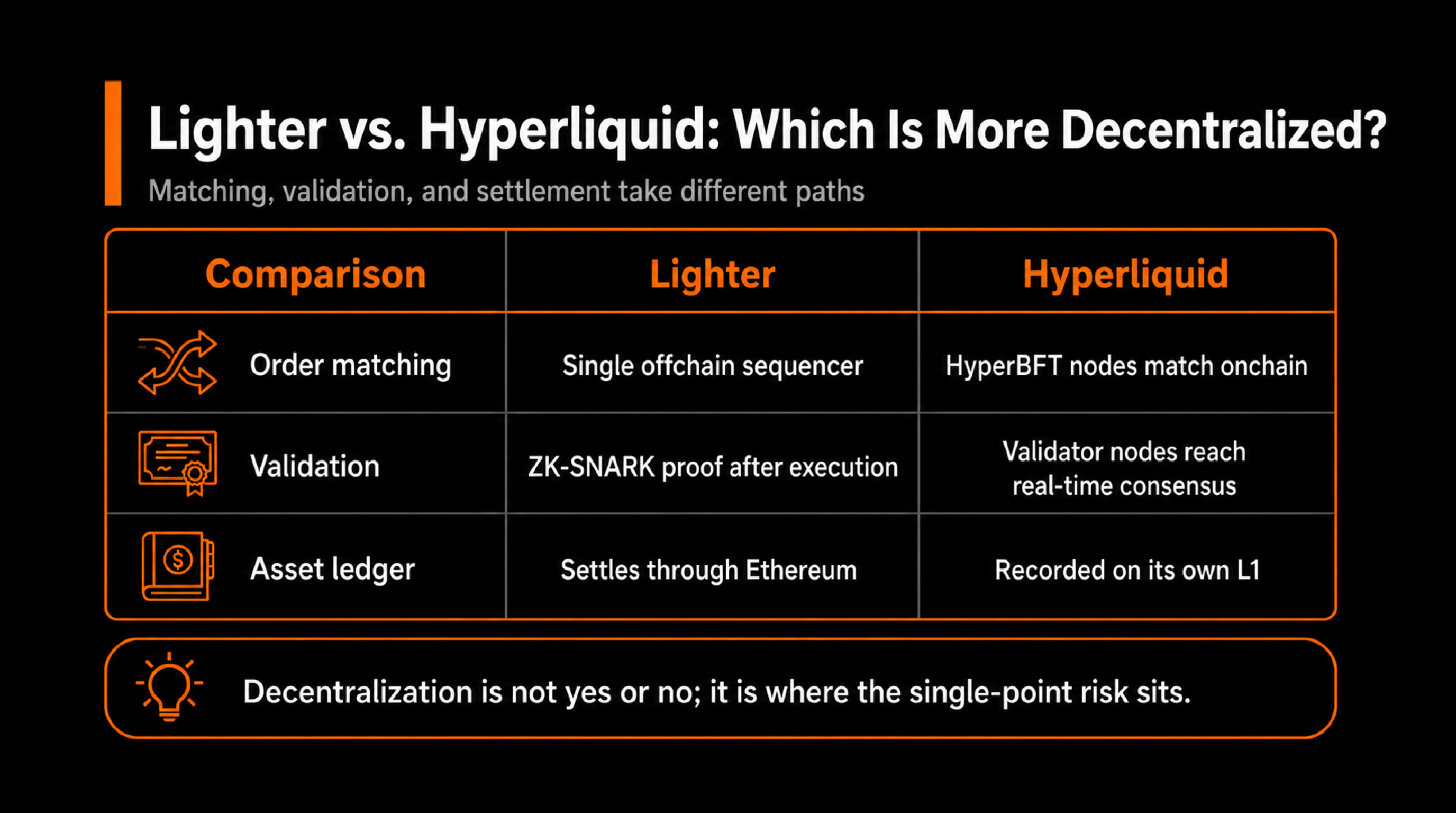
Laying the two side by side, the differences mainly concentrate in three areas: where matching actually happens, what verifies the matching result, and which ledger layer ultimately records the funds.
- Matching location: Lighter processes it off-chain, concentrated in a single Sequencer; Hyperliquid completes it directly on-chain via HyperBFT validator nodes.
- Verification method: Lighter relies on a ZK-SNARK proof after the fact to confirm the matching logic was correct; Hyperliquid relies on real-time consensus among validator nodes, with no separate proof required.
- Fund flow: both platforms write asset ownership into their own on-chain ledgers, but Lighter relies on Ethereum mainnet, while Hyperliquid runs its own independent L1.
The most direct takeaway from this comparison is that Lighter puts its decentralization emphasis on verifiable settlement, while Hyperliquid pushes decentralization further forward, to matching itself being distributed. Neither approach is absolutely better — but the single-point risk each one carries is genuinely different.
Decentralization Is a Spectrum, Not a Binary Choice — How to Place Yourself on the Risk Scale
By now you should be able to sense that whether something is decentralized was never a simple true-or-false checkbox, but rather a spectrum running from fully centralized to fully on-chain. Lighter and Hyperliquid each sit at different points on that spectrum, and even a centralized exchange isn't outside the spectrum — it's just standing at the other end of it.
Rather than fixating on which one is the single “truly decentralized” Perp DEX, try asking a different question instead: if something goes wrong with sequencing or verification, can you get your funds back yourself, bypassing the team? What percentage can you actually recover, and how much technical know-how does it take? Work through that question, and you'll have a concrete basis for judging each platform's risk level, instead of being led around by marketing language or misjudging the risk you're actually carrying.
This Isn't a Choice Unique to Lighter — Extended and Polymarket Perps Are Playing the Same Card
Zoom out a little and you'll notice that choosing off-chain matching with on-chain settlement isn't something only Lighter does — it's actually the mainstream approach across the entire Perp DEX space in 2026.This section takes you through how Extended and Polymarket Perps play by the same logic, and why almost no one chooses fully on-chain matching.
Extended (on Starknet) Uses Nearly the Same Off-Chain Matching, On-Chain Settlement Logic as Lighter
Built on Starknet, Extended uses order-book-style matching, with matching, risk controls, and sequencing likewise all handled off-chain, and only the final settlement result confirmed on-chain — an architectural approach cut from almost the exact same mold as Lighter. The differences lie mostly in implementation details and ecosystem integration, not in the underlying degree of decentralization.
Looking at recent data, Extended ranks roughly 8th among all Perp DEXs, with cumulative trading volume reaching $29.31 billion.Its scale may not match Lighter's or Hyperliquid's, but its existence proves that off-chain matching with on-chain settlement isn't just a stopgap unique to Lighter — it's a shared solution the entire sector arrived at after repeatedly weighing speed against decentralization.
What's Hidden in the Fee Structure of Polymarket's Cross-Over Into Perps
Polymarket, which originally built its name on prediction markets, crossed over to launch leveraged perpetual contracts in April 2026 — an unexpected pivot for a lot of longtime users. It uses a tiered fee structure, where the rate isn't identical across different trading pairs or different user categories. At first glance, this design looks like a good deal, but it also means you need to figure out which category you fall into before you know what it's actually going to cost you.
From a decentralization standpoint, Polymarket's move into the Perps market has to face the same trade-off between matching speed and on-chain verification — it doesn't automatically get a higher degree of decentralization just because it started out as a prediction market.Whether the fee structure is a good deal and whether the architecture is genuinely decentralized are two completely different questions — don't score them together when you're evaluating a platform.
Why Almost No One in the 2026 Perp DEX Wars Is Doing Fully On-Chain Matching
Looking back at the choices made by later entrants like Lighter and Extended, you'll notice a common pattern: almost no new Perp DEX dares to bet on the fully on-chain matching route. The reason is practical — Hyperliquid has already proven that path can work, but it has also proven that it requires an extremely high engineering cost to build your own L1 and optimize a consensus mechanism, a scale that isn't something just any team can replicate.
For later entrants, off-chain matching with on-chain settlement is a middle path with relatively controllable cost, while still offering the selling point of verifiable on-chain assets.That also explains why Lighter has been able to climb to a 30-day cumulative volume of $39 billion in such a short time, with single-day volume briefly ranking among the top three in the market. The market has clearly bought into this compromise — and looking at the numbers, I find that hard to argue with.
The Evaluation Process You Should Run Before Trading — 4 Questions to Check a Perp DEX's Real Degree of Decentralization
Instead of re-reading a new platform's whitepaper from scratch every single time, have you considered building yourself a reusable checklist instead?This section lays out 4 questions. The first three check the platform's fund custody, verification mechanism, and how concentrated its sequencing power is; the fourth question turns back to ask how much single-point-failure risk you yourself can actually tolerate.
Step One: Where Are Funds Held, and Can You Get Them Back Directly Without Going Through the Team?
The first question to ask is the most direct one: which ledger ultimately records your margin and your position's profit and loss?If the answer is the platform's own internal database, then no matter how nicely worded its marketing is, it's fundamentally no different from a centralized exchange's way of holding funds.What you should be looking for is a design where asset ownership is written into a public on-chain contract that anyone can verify.
One step further, you should confirm: if the team disappears or the platform stops operating, do you have a way to withdraw your assets directly through an on-chain mechanism, without going through official support or waiting for the team's approval? Designs like Lighter's Exit Hatch exist precisely to answer this question, and before using any Perp DEX, you should first find out whether it has an equivalent mechanism.
Step Two: Is There a Verifiable Proof for the Matching Result, or Does the Platform Just Say So?
The second question targets the matching step: can the fill results the platform publishes be independently verified, or does it come down purely to a one-sided official announcement? If it's just the platform's word, you're effectively trusting a black-box system — if the matching logic were quietly altered, you'd have no way to notice.
A design like Lighter's, which uses a ZK-SNARK proof for the matching logic, has the benefit that anyone can, in theory, verify the matching result hasn't been tampered with — that's a quantifiable form of transparency. When comparing different platforms, you can ask directly: does this platform's matching result come with a corresponding cryptographic proof, or is there only an official statement?If a platform can't explain at all how to check the matching-verification step, and all it gives you is “trust us”, that answer alone should raise your guard.
Step Three: Who Holds the Sequencing Power, and Is There Any Possibility of Censorship or Line-Cutting?
The third question focuses on sequencing power: who decides when your order gets processed? If sequencing power is concentrated in a single team's hands, then even if the matching logic itself is clean, there's still, in theory, room to let orders cut the line or delay specific users' orders. This is a step you shouldn't skip when evaluating any Perp DEX.
You can specifically check whether the platform has published technical documentation on its sequencer, whether it has explicitly promised the sequencer won't treat specific accounts differently, and whether users have any recourse if the sequencer runs into trouble.Once you've asked these three questions, you'll have a roughly quantifiable initial judgment of a platform's degree of decentralization, instead of just an impression score based on marketing copy, and you won't have to start researching from scratch every single time.
The Mistake Beginners Make Most Often — Equating Zero Fees With Safety
When you see phrases like “zero fees” and “backed by a major exchange,” do you just let your guard down and figure that since everyone's using it, nothing bad could happen?This section lays out the three judgment mistakes beginners make most often, reminding you that a good fee deal and a big-name reputation are completely different questions from whether a Perp DEX is actually safe.
Mistake #1: Sizing In Heavily Based Only on Fees and TVL, Without Looking at the Architecture
For a lot of people, the first criterion for choosing a Perp DEX is whether the fees are low enough and the TVL is big enough. Those two numbers really do reflect market popularity, but they tell you absolutely nothing about how funds are held or how concentrated the sequencing power is.You might save a few percentage points on fees, only to put most of your position into a platform whose sequencing risk you never actually researched — and only realize when something goes wrong that you never seriously looked at the architecture from the start.
A more practical approach is to confirm the key architectural questions first, then decide what portion of your capital to commit — rather than doing it backward, sizing in heavily the moment you spot an attractive fee rate. The money you save on fees can easily fall far short of covering the loss if you run into a sequencer outage window — when you do the math, it usually isn't worth it.
Mistake #2: Treating Backing From Major Listed Exchanges, eToro, or Jump as an Endorsement of Decentralization
Seeing a well-known centralized exchange or institution invest or provide liquidity, a lot of beginners directly read that as meaning the platform must be safe enough and decentralized enough — but the two things actually have no necessary connection.Institutional backing usually reflects a business partnership and capital investment — it doesn't mean the platform's technical architecture has become any more decentralized as a result.
No matter how many prominent institutions back a Perp DEX, the decentralized design its sequencer needs doesn't automatically fill itself in just because the backers are wealthy, and the ZK proof piece it needs doesn't materialize out of thin air either. When you're assessing risk, you should evaluate who invested in the platform separately from what its technical architecture actually looks like — don't let the latter get overshadowed by the former's halo effect. This is one of the easiest cognitive traps for beginners to fall into.
Mistake #3: Ignoring Single-Point Sequencer Failure and Putting Your Entire Position on One Platform
The last common mistake is concentrating all of your leveraged positions on the same platform even after already knowing that a given Perp DEX carries single-sequencer risk.Single-point sequencer failure isn't just a theoretical talking point — any system relying on a single-server architecture has to face this realistic possibility, and once it actually happens, the choices available to you in that moment will be extremely limited.
My recommendation is simple: don't put all your leveraged positions into a single platform still running on a single-sequencer architecture. Heavily sized, high-leverage positions in particular need to be spread across platforms with different architectures and different risk profiles. This isn't telling you to avoid platforms like Lighter entirely — it's a reminder that what you diversify shouldn't just be coins, it should also include each platform's own architectural risk.
Conclusion
From matching to sequencing to settlement, Lighter moves the most computationally expensive parts off-chain, and props up its decentralization baseline with ZK-SNARK proofs and Ethereum-mainnet settlement — that's a pragmatic compromise, not a perfect answer. Put alongside Hyperliquid, Extended, and Polymarket Perps, you'll see that the entire Perp DEX sector is finding its position on the same spectrum — no one is the single correct answer.What you should remember is those 4 questions: fund custody, matching verification, how concentrated the sequencing power is, and how much single-point-failure risk you yourself can tolerate. Work those through clearly before deciding whether to put your position in.


