

Did you hear that perpetual contracts are now "live and compliant in the U.S." and assume that means they're safer and beginners can trade them without worry? This piece won't endorse the word "compliant." Instead, it first walks you through exactly what's being opened up this time, how it differs from Binance perps point by point, and why being compliant doesn't mean your position is safe. Finally, I'll tell you how a beginner should think about platform choice and which risk checks to run before entering.
What Are Compliant Perpetuals? What Exactly Is the U.S. Opening Up This Time?
"Haven't perpetuals been tradable for ages? Why is this time treated as such a big deal?"The difference is that this time they're going live through a regulated, legal channel on U.S. soil, no longer just the gray zone of offshore exchanges.To understand this, you first have to separate two concepts, "perpetual contract" and "compliance." One is about the nature of the product, the other is about the regulatory framework; mix them together and you'll misjudge things.
First, Understand Perpetual Contracts: No Expiry Date, Run on Funding Rates
A perpetual contract (perpetual futures) is one of the most mainstream derivatives in the crypto market. The word "perpetual" in the name points to its biggest feature: there's no settlement or expiry date like traditional futures have. With traditional futures, the moment you buy there's a countdown clock; when time's up, you have to settle or roll over. Perpetuals, on the other hand, let you theoretically hold a position indefinitely as long as your margin holds up, with no need to move it periodically.But don't hear "perpetual" as "safe and steady"; the fact that it can exist forever doesn't mean you can safely leave it alone forever.
What makes it work is a mechanism called the funding rate. Because there's no expiry date as an anchor, the contract price easily drifts away from spot, so the market designed a rule: when there are too many longs and the contract price is above spot, longs periodically pay a fee to shorts, and vice versa. This back-and-forth fee keeps dragging the contract price back in line with spot. Beyond that, perpetuals almost always come with leverage, meaning you can open a larger position with less margin — you make more when you win, and lose faster when you lose. Personally, I lock this nature into memory first: a perpetual is a leveraged derivative that can be liquidated and that charges funding rates. It's not spot, and this is exactly the same regardless of which platform you're on or whether it's compliant.
What Does "Compliant" Mean This Time
Now that you understand the product, let's look at "compliance." The compliant perpetuals everyone is talking about this time don't refer to some new product appearing. Rather, it's that perpetuals, an existing product, are for the first time being brought onto U.S. soil to trade on a regulated, legal track.The big picture goes like this: around mid-2026, licensed platforms represented by Coinbase are gradually rolling out regulated crypto perpetual products under the framework of the U.S. Commodity Futures Trading Commission (CFTC), letting U.S. investors trade through domestic, licensed, regulated exchanges instead of having to route through overseas ones.
There's a key point to keep straight here: what's changing is "where you trade and who regulates it," not the fundamental design of the perpetual product itself.In the past, U.S. retail investors who wanted to trade perpetuals mostly had to use offshore exchanges registered abroad, effectively putting their money where their own country's regulators couldn't really reach; now there's an additional legitimate channel watched over by a domestic regulator. One caveat: the specific scope of these products, the tradable coins, and the leverage arrangements are all still evolving, and the details differ from platform to platform. For the actual situation, refer to the official announcements from each platform and regulator, and don't treat a version you saw on one day as a rule that never changes.
Why This Is Treated as a Milestone
So what exactly is the big deal, and why is the whole market talking about it?The key is that it formally pulls perpetuals, something that long lingered in a gray zone, into a regulated framework.For a long stretch, the U.S. — the world's largest capital market — offered retail investors almost no way to touch perpetuals except through offshore platforms, with the system always missing a legitimate entry point. This compliant launch is like giving perpetuals an official ID card in the U.S.
For the market as a whole, this means more institutions and traditional capital that previously stayed away over compliance concerns now have a legal, comfortable way in, which over the long run could bring deeper liquidity and more participants — a structural change worth watching. But for the beginner reading this, I have to say another thing plainly: legal and regulated speaks to institutional-level protection, easing your worry about whether the platform itself will run into trouble. It's an entirely separate matter from "whether this product is safe or whether you'll lose money." Whatever you do, don't take the market cheering for the system and mishear it as a guarantee for your trades.In the next section, we'll line it up side by side with the Binance perps you're more familiar with and see where the real differences lie.
How Do Compliant Perpetuals Differ From Binance Perps? A Point-by-Point Look at the Key Differences
"They're both perpetuals — so where exactly is the difference between the compliant ones and Binance's?" Let me boil the answer down to one line: the difference isn't "whether you can trade perpetuals" — both sides can. The real difference hides in the regulation behind them, who can use them, and how the products are designed.In this section we'll take them apart one item at a time, so that by the end you'll have a clear comparison table in your head.
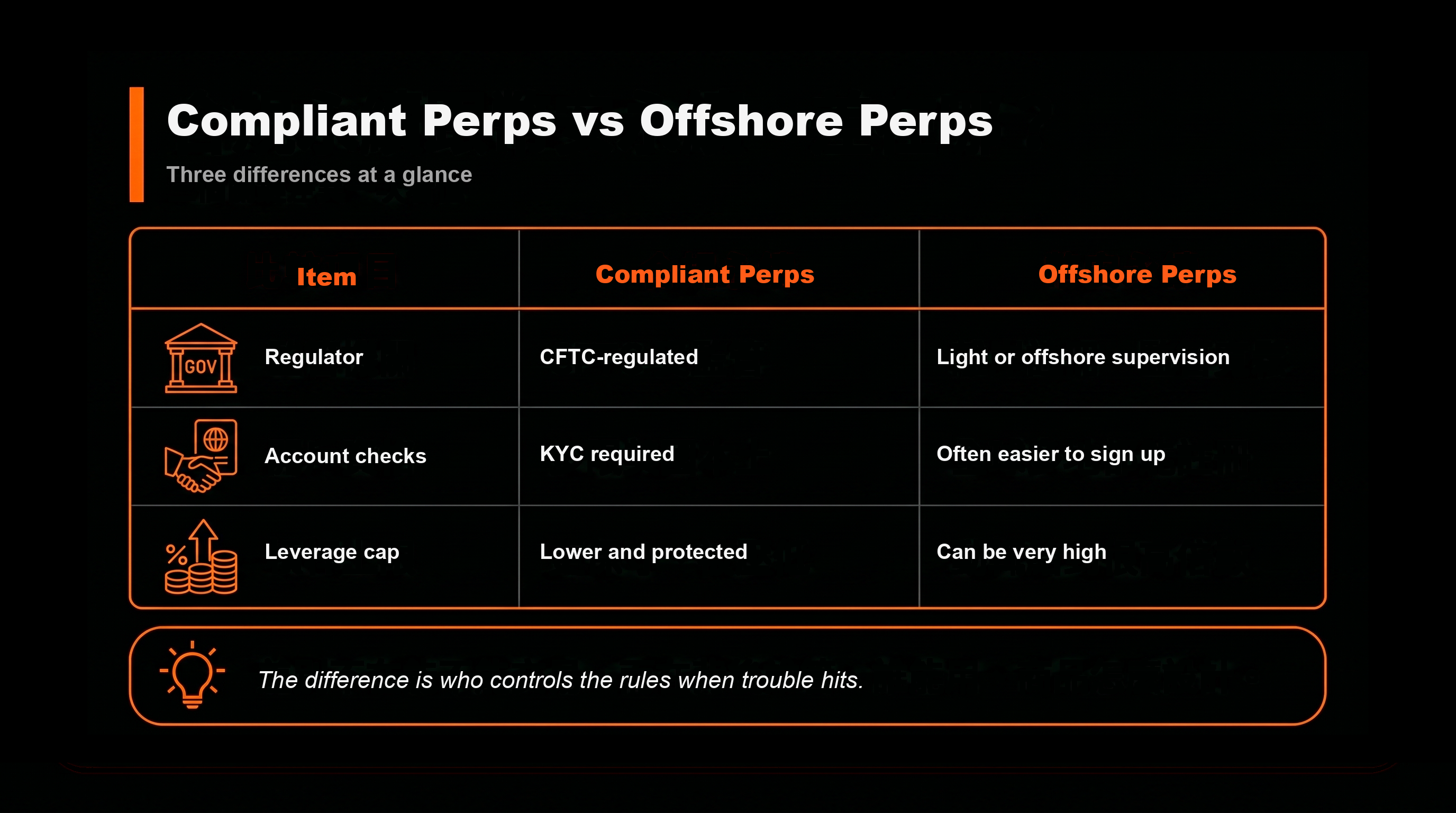
Regulation and Protection: Who Regulates It, and Who You Turn To When Things Go Wrong
This is the most core difference between the two, and the one you should understand first. Compliant perpetuals operate within a regulated framework, with a clear regulator watching over them, and the platform must meet certain operating standards, disclosure requirements, and rules for handling customer assets. If a dispute arises, you know which agency to turn to and which complaint channel to follow.Perpetuals on offshore exchanges are a different story: the degree of regulation depends heavily on where they're registered. Some are registered in loosely regulated jurisdictions, and if something goes wrong, your protection and ability to seek recovery become relatively uncertain — you might even have nowhere to file a complaint.
But let me cut in with one point here so you don't misread it again: regulation governs the "platform as an operator" — its compliance and operations. It governs whether the platform will misappropriate your money, run shady operations, or disclose too little; these are platform risks. What it doesn't govern, and won't bear on your behalf, is "the profit and loss of your own trade." Being regulated doesn't mean someone is insuring your position, and it certainly doesn't mean someone will reimburse you when you call the direction wrong.The way I see it: compliance filters out one kind of risk — the credibility of the platform itself — but handing your money to a more credible platform and whether you'll lose money on that platform are two entirely separate lines.
Who Can Use It, How You Deposit, and Differences in KYC Requirements
The second difference falls on "who can use it and how you get in." To meet regulatory requirements, compliant perpetuals are usually far stricter than offshore exchanges on account eligibility, deposit methods, and identity verification. The most direct one is regional restrictions: these compliant products are often only open to specific regions (for example, the U.S. mainland), and investors in Taiwan or other non-U.S. regions may not be able to apply directly. So when you see the headline "the U.S. opens up compliant perpetuals," don't get excited too fast — that word "U.S." might be exactly what shuts you out.
Next comes KYC and source-of-funds checks. A compliant platform's identity verification process is usually more thorough, requiring clearer proof of identity and even an explanation of your source of funds, and deposit methods may lean more on bank transfers and fiat — regular money flows — rather than letting you top up and get in easily with crypto the way some offshore platforms do. For people used to offshore exchanges' "quick sign-up, easy deposits," the barrier will feel noticeably higher. Here's what I'd suggest to beginners: before you get swept up by the news and want to try, the first thing to do isn't to research how to place an order, but to first confirm whether your own region can even use it and which documents you need to prepare. Figure out "whether I'm eligible to use it" first, then talk about "whether I want to use it" — don't get the order backwards.
Product Design and Maximum Leverage May Differ
The third difference hides in the design of the product itself. Within a regulated framework, compliant perpetuals tend to be designed more conservatively and with more restraint. The most obvious point is the maximum leverage: the highest leverage a compliant product allows is usually a notch lower than at offshore exchanges that readily offer very high multiples; the range of products may also be leaner at first, starting with the most mainstream coins, rather than the dazzling everything-goes menu of offshore platforms. The specific numbers and offerings differ by platform and will adjust over time, so I won't pin them down here — the point is to grasp the directional sense of "more conservative."
For beginners, a lower maximum leverage is actually a good thing, not a restriction. The higher you set leverage, the more a small move against you can sweep you out; a lower cap is like a guardrail that keeps you from playing too big. But I have to finish this thought so you don't get complacent again: lowering the leverage cap only pushes "extreme risk" down a bit — it never means liquidation is off the table. Even if the platform only gives you single-digit leverage, as long as you've used leverage and call the direction wrong, you'll still get force-liquidated and can still lose your margin.So don't hear "lower leverage" as "less likely to get liquidated"; the former is a guardrail the platform gives you, the latter is the discipline you have to keep yourself — you need both to actually be safe.
Don't Treat "Compliant" as "Safe": The Risks Are All Still There
"Since it's compliant now, does that mean I'm less likely to lose money and can trade with more peace of mind as a beginner?" This is the most dangerous and most widespread misconception among beginners, and it's the very place in this whole article where I most want to hold you back. Let me stress that main thread one more time: what compliance changes is regulation and protection; the high risk of the perpetual product itself hasn't been reduced one bit.In this section we'll clearly separate "what compliance takes off your worry list" from "what compliance does nothing to solve for you."
Compliance Changes the Regulation, Not the High Risk of Perpetuals Themselves
First, the part compliance genuinely improves for you. It puts the platform under regulation, makes your trading legal at an institutional level, gives you a proper channel to file complaints when disputes arise, and holds the platform to clearer rules on custody and disclosure of customer assets. These are all real, tangible benefits. What they reduce is the risk that the "platform side" might bring you — such as the platform suddenly running off, malicious manipulation, or misusing your assets.For those who've been burned by an offshore platform, or who constantly worry the platform isn't trustworthy, this layer of protection genuinely matters.
But this next part is the crux. What compliance hasn't changed, and can't change, is the underlying risk of the perpetual product: it still carries leverage, it can still trigger forced liquidation from price swings, and you can still lose all your margin when you judge wrong. These risks come from the design of the product itself and have nothing to do with which platform it's on or whether it's regulated. Quietly translating "compliant" into "principal-protected" or "low-risk" in your head is often the starting point where someone begins to let their guard down and then dares to enter with a heavy position — and a heavy position is exactly where beginners most often crash.I've seen too many people fall into this psychological mismatch: it's not that they don't know perpetuals are risky, it's that the word "compliant" lulled them into thinking this time was different.
Leverage, Forced Liquidation, and Funding Rates — All Three Mechanisms Keep Running
To put it more concretely, perpetuals' three most core risk mechanisms keep running exactly the same on a compliant platform as on an offshore one, and not one of them will go easy on you just because the platform is compliant.To let you see it at a glance, here they are in a list — but remember, these three aren't for you to memorize, they're for you to genuinely think about before you enter:
- Leverage: it amplifies your gains proportionally, and it amplifies your losses proportionally too. It magnifies both wins and losses — it never just magnifies the good side.
- Forced liquidation: when the price moves against your position to a certain degree and your margin can't hold, the platform will forcibly close out your position, and your margin can go straight to zero.
- Funding rate: when you hold a position long-term, this back-and-forth fee will continuously and quietly eat into your returns. You think you're just holding and waiting, but you're actually paying a toll the whole time.
Not one of these three mechanisms disappears on a compliant platform. Prices swing however they were going to swing, the liquidation line sits wherever it was going to sit, and the funding rate gets charged just the same. What I want you to remember is this: the whole risk logic you face trading perpetuals on Binance carries over exactly the same to a compliant platform, the only change is that there's now a regulator overhead — and that regulator governs the platform, not your position.
A Compliant Platform Can Still Let You Lose All Your Margin
To wrap up, I want to say this even more bluntly and without pulling any punches, because it's the truth most easily buried under the news hype: on a regulated, fully compliant platform, as long as you've used leverage and called the direction wrong, you'll lose all your margin just the same, and you won't lose one cent less just because the platform is compliant.The word "compliant" won't jump out to shield you at the moment you get liquidated.
Personally, I split risk into two kinds to look at it, which is the least confusing way. One is platform risk — problems like the platform running off, running shady operations, or misappropriating assets — and regulation really can drastically reduce this. The other is market risk — problems like you calling the direction wrong yourself and getting swept out by volatility — and regulation can't govern this kind at all; you can only shoulder it with your own risk management. Compliance solves the first kind for you, taking one worry off your plate, and that's a good thing. But what actually makes most beginners lose money has always been the second kind.So instead of relaxing because "it's compliant now," flip it around and remind yourself: since someone's already got the platform gate covered for you, you've got to guard the market gate even tighter yourself. In the next section, I'll hand you the checks to keep before entering, one by one.
After Compliant Perpetuals Go Live, How Should Beginners Think About Platform Choice
"So does that mean I should hurry and move my money from Binance to a compliant platform?" Not so fast. Compliant perpetuals going live does add an option, but it doesn't mean offshore platforms are worthless or that a compliant platform suits everyone.In this section, we'll think through "whether to switch and how to choose" properly, from a beginner's angle.
Whether You Can Even Use It Is the First Question to Answer
Before comparing which platform is better, there's an even earlier question you have to answer: can you, in your region, even use it at all? As mentioned earlier, this round of compliant perpetuals is mostly open to the U.S. mainland first, and investors in Taiwan or other non-U.S. regions may not be able to apply directly. If you're not even eligible to open an account, then agonizing over whether it's safer than Binance or whether it suits you is wasted effort, because that door may never have been open to you in the first place.
So I'd advise beginners to get the order right: first confirm the availability status in your own region, which documents are needed, and whether you can pass KYC. These are the hard conditions for "whether you can use it," and they must be based on the official announcements of the platform and regulator — and they're still constantly changing, so don't treat something you heard six months ago as final. Confirm that you can use it, then move on to whether you want to; if you can't use it, then the meaning of this news for you is more about understanding the industry's direction than a choice you can act on right away.Put the "eligibility" gate first, and you won't spend a ton of time researching something you can't touch at all.
Don't Blindly Relocate for the Sake of the Word "Compliant"
Suppose you really can use it — does that mean you should immediately move all your positions to a compliant platform? My view is: don't blindly relocate just for the words "compliant" themselves.The value of a compliant platform lies in lowering platform risk, and that matters to you; but it may also come with higher account barriers, stricter fund checks, lower leverage caps, and fewer tradable coins. For a beginner who just wants to practice with small amounts and understand how perpetuals work, these limits are sometimes actually a good thing, and sometimes may feel like they're tying your hands.
More importantly, whether or not you switch platforms has never been the key variable in whether you lose money. I've seen plenty of people assume that switching to a "better, safer" platform would make their trading smoother and cut their losses, only to carry the same bad habit of high-leverage heavy positions over intact and get liquidated all the same. The platform is just the venue; what really decides whether you win or lose is the risk-management discipline you bring in with you.So instead of rushing to relocate for the sake of compliance, first ask yourself: on my current platform, have I already managed my position and leverage well? If the answer is not yet, then it's just as dangerous wherever you move to. Get past your own gate first, and only then does the choice of platform mean anything.
Pick a Platform Based on "Needs," Not "Hype"
So how should you actually choose? My principle is simple: pick based on your own real needs, not on the hype in the news.Before choosing a platform, get a few things straight before you decide:
- Can I legally use this platform in my region, and are deposits smooth? This is the baseline — if it fails, there's no point reading further.
- Are its regulation and asset custody transparent enough? When I put my money in, do I feel at ease?
- Do its leverage caps, coin selection, and fee structure fit a beginner like me who's focused on "small amounts, low leverage, mainly practicing"?
Think these questions through and you'll find the answers vary from person to person — there simply is no single platform that's best for everyone. A compliant platform suits people who value institutional protection, can use it, and are willing to accept stricter barriers; for those who can't use it for now or only want to test the waters with tiny amounts, the focus should instead be on their own position control, not the platform's brand name. Remember, choosing a platform is a means, not an end; the one that helps you slowly learn this market under controllable risk is the one that suits you.Don't let a single piece of news make a decision that should have been yours to think through.
Before a Beginner Touches Perpetuals, the Risk Checks to Do First
"So should I even touch it, and if I do, how do I do it without blowing up?" In this section I won't talk about entry signals or call the direction; I'll only cover a few basics you should get right before entering. These checks don't care whether the platform is compliant — as long as you intend to touch perpetuals, they're the homework you should run through before every single order.
Calculate the Worst Case First: At What Price Do You Get Liquidated
The first thing before opening a position isn't to think about how much you could make, but to first work out clearly what the worst case looks like: given the leverage you plan to use and the margin you put in, at what price level will your position get force-liquidated? That number is your liquidation price, and it determines the most you can lose on this trade.Many beginners skip this step outright, feeling it's too much trouble and too much of a buzzkill to calculate — they'll open first and figure it out later — and the result is often that a single move against them sweeps them out before they even understand how they got knocked out.
My own habit is the reverse: before opening a position, I always work out the liquidation price first, even set a stop-loss in advance, and then ask myself one thing — if the price really gets there and this money is really lost, can I take it, will it throw my life into disarray? Not even working out the worst case is the same as doing no risk management at all, and that's not trading, it's gambling.For beginners, this step looks like a hassle, but it turns "how much I could lose" from a vague fear into a concrete number you have a handle on — and having a handle on it is itself the first line of defense against panic-driven moves.
Practice First With Small Positions and Low Leverage
The most common and most fatal mistake beginners make is going in with high leverage and a big position right away, hoping to turn their fortunes around in one shot. My advice is the exact opposite: at the start, always practice with small positions and low leverage.The reasoning behind this is simple; here are two points to make it clear:
- Small position: start with an amount that won't affect your life even if it's all lost, and treat it as tuition, not a one-shot bet of your entire net worth.
- Low leverage: the lower you set leverage, the farther your liquidation line sits from the current price, the more room the price has to move back and forth, and the more time you have to react and adjust.
As mentioned earlier, a compliant platform's leverage cap may already be pushed relatively low, which is actually a layer of protection the platform sets up for beginners. But you can't rely on the platform's guardrail alone — you should proactively push your leverage even lower yourself, rather than maxing out whatever the platform allows. Here's how I see it: the goal of the practice phase isn't to make money at all, but to first learn, amid real volatility, to control your position, understand how liquidation happens, and feel how the funding rate chips away bit by bit.Once you can stay alive steadily under small positions and low leverage, without your emotions getting carried off by a single candle, there's still time to talk about whether to scale up.Survive first, and then you have a future.
Understand the Hidden Cost That Is the Funding Rate
The last item is the cost beginners most often overlook but that can quietly drag down returns — the funding rate. It's a fee unique to perpetuals; the price barely moves, yet it keeps getting charged in the background. Many people watch the ups and downs closely but completely fail to factor in this toll, and by the time they notice, a chunk of their returns has already been eaten away.
Its logic isn't hard to grasp: when there are noticeably more longs than shorts in the market, longs periodically pay a fee to shorts, and conversely when there are more shorts, shorts pay longs — this mechanism nudges the overheated side back a bit. The practical impact on you is this: if you hold a position in the same direction as the current market sentiment for a long time — say everyone's long and you're long too — then you're very likely the one continuously paying, and this money will drain out of your principal bit by bit. So I'd remind beginners: before entering, spend ten seconds glancing at whether the current funding rate is positive or negative and roughly how much, and factor it into your holding cost — don't fixate on that one number, the price.Trading in and out on the short term may not feel like much, but as long as you plan to hold a bit longer, this hidden cost is absolutely worth getting clear on first.
Conclusion
This piece has laid out, layer by layer, what compliant perpetuals are, how they differ from Binance perps, and what compliance actually changes — and what it doesn't. Back to that opening question: are compliant perpetuals safer and more suitable for beginners? My answer is that they make the platform gate more trustworthy and give you one more legal channel, and that's genuinely a good thing. But it hasn't changed one word of the leverage, forced-liquidation, and funding-rate risks inherent to perpetuals themselves.So the real point has never been which platform is better, but rather to not hear "compliant" as "safe" — what will make you lose all your margin is always you calling the direction wrong while using leverage, and no matter how strict the regulation, it can't block that kind of market risk. Work out the worst case clearly first, practice with small positions and low leverage, and get clear on the hidden cost that is the funding rate, then decide whether to take part and whether to touch it — that's far steadier, and takes you far further, than being pushed into a rush entry by the hype of a single news headline.


