

Have you seen USDT, USDC, USD1, and RLUSD all called stablecoins and assumed that being pegged to the dollar means they're all equally safe to hold?This guide won't just hand you an answer. Instead, it first helps you understand what actually holds a stablecoin up, who issues each of these four, and how their reserves differ, then clears up a few common beginner misconceptions, and finally gives you a method for judging "safety" plus a step-by-step process to follow before you convert your money into a stablecoin.
Why Can a Stablecoin Stay "Stable"? First Understand What Holds It Up
"What gives it the right to stay equal to one dollar, instead of swinging wildly like Bitcoin?"Before comparing which stablecoin is safer, you need to understand the mechanism that keeps it stable.This section lays that foundation, because every risk judgment that follows grows out of it — without understanding the foundation, no amount of comparison is more than memorizing names.
The Basic Principle of the 1:1 Peg: There Must Be Equivalent Reserves Behind It
Let's start with the most core principle. The way mainstream fiat-backed stablecoins work isn't actually complicated: for every stablecoin the issuer puts into circulation, it deposits an equivalent one dollar of assets behind it as reserves — usually cash, bank deposits, or short-term U.S. Treasuries, things that are both safe and easy to liquidate. In theory, as long as the reserves are fully funded and redeemable at any time, this coin can stay firmly equal to one dollar, because you know there really is a dollar backing it up.
This is also the fundamental difference from Bitcoin. Bitcoin's price rests on market supply, demand, and sentiment, with no asset behind it guaranteeing what it's worth; a stablecoin's price is anchored by this reserve mechanism. Understanding this matters, because it tells you directly: whether a stablecoin is stable was never about whether its name contains "USD," nor about how nice its price looks on an exchange, but about whether the reserves behind it are actually real.Whenever I look at any stablecoin, the first thing I ask is always about its reserves, not its slogan.
Whether It's Stable Comes Down to Three Things
Since a stablecoin is held up by its reserves, checking whether it's stable naturally means examining the quality of those reserves.I break it into three questions to ask — and these three points are the standard we'll keep coming back to when we compare the four coins later.
These three things are interrelated and none can be missing; leave out any one of them, and the so-called peg may be nothing but window dressing.Before you convert your money into any stablecoin, it's worth running it through these three points first:
- Are the reserves truly fully funded: however many coins are issued, there should be that much dollar-equivalent asset behind them — no shortfall.
- Are the assets safe and easy to liquidate: if the reserves are all cash and short-term Treasuries, they can hold up when people suddenly want their dollars back; if they're mixed with a lot of hard-to-liquidate stuff, a bank run spells trouble.
- Is there transparent auditing and regulation: whether the issuer is willing to publish reserve reports regularly and whether it's regulated determines whether you can verify the two points above, or can only take its word for it.
You'll notice these three points are really three sides of the same thing: is the money there, is the money usable, and can you check it.The more completely a stablecoin answers these three questions, the lower its chance of de-pegging in extreme market conditions.Remember this framework, and when we break down the four coins later, you'll have a shared ruler to measure them all.
A Stablecoin Isn't a Fixed Deposit, and a Peg Isn't a Guarantee
Let me give you a preventive shot here, so your mindset doesn't drift off track when you read the comparisons later: no matter how stable a stablecoin is, it is not a bank fixed deposit, and a dollar peg doesn't mean any official guarantee that you'll never lose money.Its stability rests on three premises — an honest issuer, sufficient reserves, and market confidence — and if any one of them loosens, the price can drift away from one dollar.
Many beginners imagine a stablecoin as an absolutely safe harbor, parking large sums in it and sleeping soundly — which actually underestimates the risk. History has seen well-known stablecoins de-peg sharply within a short time, some even wiping people out entirely, usually because their reserves ran into trouble or trust collapsed.So the correct mindset is: a stablecoin is a relatively stable, convenient tool for moving money around, not a zero-risk deposit.Keep this premise in mind, and you'll actually take the trouble to compare how safe different stablecoins are, instead of grabbing the most familiar-looking name and going all in.
Who Issues the Four Stablecoins? How Do Their Reserves Differ?
"USDT, USDC, USD1, and RLUSD — what's the real difference between them? Is picking any one of them the same?"They differ a lot, and the difference lies in the most critical place — the issuer's background and reserve structure.In this section I break down all four one by one, so you can see clearly which kind you're actually holding and what temperament each has.
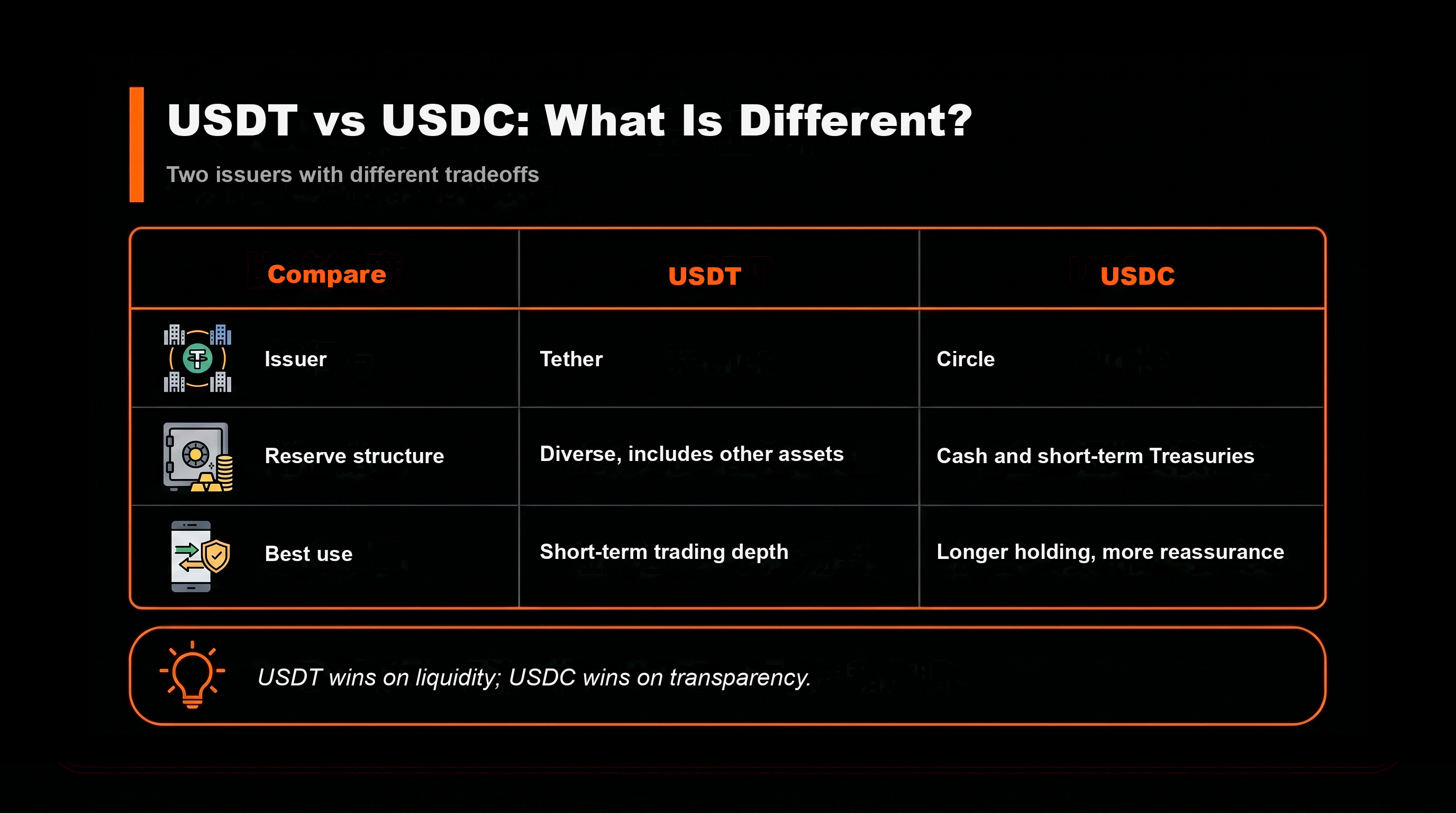
USDT and USDC: The Market's Two Giants, Different Styles
Let's start with the two largest and most widely used in the market. USDT is issued by Tether, the most liquid and widely accepted stablecoin — you'll find it on virtually every exchange and trading pair you can think of; its catch is that its reserve structure is relatively diverse, holding other types of assets beyond cash and cash equivalents, and combined with years of only periodic reserve attestations rather than full accountant audits, its transparency has been debated for years. USDC, on the other hand, is issued by Circle and takes a different path: it's regulated in the U.S., publishes reserve audit reports regularly, holds reserves mainly in cash and short-term Treasuries, and treats compliance and transparency as its biggest selling points.
You can remember their division of labor like this: USDT wins on ubiquity and liquidity — for moving money around in all kinds of places and finding trading pairs, it's the most convenient; USDC wins on compliance and transparency — if you want to know what's actually behind it, it's more willing to lay it out for you.These two aren't absolutely better or worse than each other; it's more of a trade-off between convenience and peace of mind.My own habit is that for pure short-term shuffling, moving in and out of exchanges, USDT's ubiquity really does save hassle; but if I'm parking money for a while and care more about whether the backing is real, I lean toward the kind whose audit reports I can actually see. Get the personalities of these two giants straight first, then look at the two newcomers, and you'll have a benchmark to compare against.
USD1: A Fast-Rising Newcomer Built on Compliance and Transparency
USD1 is a new face that only emerged in the past couple of years, launched by World Liberty Financial, which only officially went live in 2025 — yet its growth has been astonishing, with its circulating supply shooting near the top in a short time, making it one of the fastest-growing fiat stablecoins of its period. It touts being backed 100% by cash equivalents like short-term U.S. Treasuries and dollar deposits, and has brought in BitGo as its issuance and custody partner, along with monthly reserve attestation reports; on paper, on reserve quality and transparency, it's walking the compliance path.
But for beginners, there's a point here you must face honestly: being new is itself a kind of risk. A stablecoin with a short track record means it hasn't been through enough extreme markets, run pressure, and the test of time; you can't verify whether it can hold up the way you can with veteran coins that have several bull-and-bear cycles behind them. On top of that, USD1's issuer has a somewhat unusual background and relatively concentrated ownership — factors beyond the reserve ledger that also affect its stability. I'm not telling you to avoid it, just reminding you: you can't relax just because it emphasizes the word "compliance," a new coin's compliance claims still need much longer to prove out, and that's a consideration to factor in before you put your money in.
RLUSD: Made by Ripple, Tied to Payment Use Cases
RLUSD is a dollar stablecoin from the blockchain payments company Ripple, issued on both the XRP Ledger and Ethereum.Its positioning clearly takes the institutional route: fully backed by dollar deposits and cash equivalents, built around trust, liquidity, and compliance, with traditional financial institutions serving as reserve custodians and a relevant license issued by New York State's financial regulator — placing itself inside a fairly strict regulatory framework, then moving into cross-border payments, the use case it knows best.
This background makes RLUSD look quite solid, but you still need to recognize where it actually stands: just like USD1, it's a relatively new asset, and its ubiquity and the places you can move it around still don't match USDT and USDC, the two big brothers.In other words, even if its reserve and regulatory claims look great, in actual use you may run into problems like limited acceptance and less liquidity than expected. I understand RLUSD as a player that's in good shape on paper but still growing up — its institutional pedigree is a plus, but its short track record and still-expanding ecosystem must also be counted into your considerations; you can't equate it with the most mature stablecoins just because a well-known company is behind it.
The Three Misconceptions Beginners Fall for Most — Clear Them Up Before Choosing
"I roughly get the difference between the four coins, but when it's actually time to choose, my head is still full of plausible-sounding but shaky ideas — what do I do?" Before I teach you how to judge, I want to sweep away a few of the most common myths, the ones most likely to make you choose wrong, all at once, because a wrong premise makes you misuse even good tools.
Myth One: The Most Famous Must Be the Safest
The first myth is equating fame with safety, assuming that the one the most people use and that you've heard of the most must be the most stable. The intuition is understandable — after all, everyone's using it, so it feels like there must be a reason — but fame actually reflects liquidity and market habit, which isn't quite the same as reserve quality and transparency.
A stablecoin that many people use means it's easy to move around and easy to find trading pairs — a genuine advantage — but it doesn't automatically guarantee that its reserves are the most fully funded and most transparent.To judge safety, look at the ledger, not the volume of noise. I remind beginners to keep these two things separate: fame determines how usable it is, while reserves and regulation determine how safe it is — two different questions.You can perfectly well use a coin for daily shuffling because it's widely accepted, but never infer that its reserves must be fine just because it's famous — there's no necessary causal link between those two steps.
Myth Two: A Dollar Peg Means Guaranteed Profit
The second, and most dangerous, myth is believing that a dollar peg means your principal is absolutely safe and the price will always stay obediently at one dollar.As mentioned earlier, a stablecoin can de-peg, and here I want to nail it into your head more bluntly, because it bears on whether you lose your principal.
A peg is a goal and a mechanism, not a law of physics. When the market is in extreme panic, reserves are questioned, or trust in the issuer collapses, the price can absolutely drop below one dollar, briefly or even for a long time — this has genuinely happened in history, more than once. So treating a stablecoin as a guaranteed-profit deposit is an illusion that leaves you off guard. The correct understanding is that it's very stable most of the time, but its stability is conditional, and once the conditions break, it will fall just the same.Recognize this, and you'll naturally diversify and pick assets with more solid reserves, instead of foolishly converting your entire net worth into a single stablecoin and leaving it unattended.
Myth Three: High-Yield New Coins Can Be Taken at Face Value
The third myth is seeing a new stablecoin launch high yields, airdrops, or subsidies and thinking it's free money you'd be silly to pass up, so you rush to convert your cash in.New coins do often use these sweeteners to draw in your deposits as they fight for market share, and the temptation is real — but you need to think first about what that sweetener is bought with.
The rule I set for myself is simple: yield and subsidies are marketing costs, while reserves and regulation are safety itself — never confuse the two.A stablecoin willing to pay you a high return doesn't mean its reserves are more stable; often it's precisely because it isn't well-known enough and needs to spend money buying users — and in that case the risk is actually masked by the high yield. So with a new coin that leads with high yields, the order must be right: first check whether its reserves and transparency hold up, confirm it's safe, and only then evaluate whether the little sweetener it offers is worth it.Check whether it's safe first, then look at how much candy it's handing out — once you reverse this order, you can easily expose your principal, for the sake of a little subsidy, to risks you never got a clear look at.
Which Is Safer? What to Look at Isn't the Name, but This Method
"Now that the myths are cleared up, which one is actually safest to park my money in — can you give me a definite answer?"Honestly, there's no standard answer that fits everyone, but there is a method for judging.In this section I lay out the indicators I use to judge a stablecoin's safety; learn this and you won't have to ask others every time — you can evaluate for yourself whether the coin in front of you is worth putting money into.
First Priority: Reserve Transparency and Regulation
When judging whether a stablecoin is safe, I put reserve transparency and regulation as the first priority, because these two directly determine whether you can verify the three things discussed earlier.Reserve transparency is about whether it has regular, credible audit or attestation reports that let you confirm reserves are fully funded and made up mainly of safe assets; regulation is about whether the issuer is regulated and where — the higher the level of compliance, the more complete the protection you can usually get in extreme situations.
Run the four coins through this ruler and the picture gets clear: USDC, USD1, and RLUSD all lean toward the compliance-and-transparency route, each with audit reports or regulatory licenses as its calling card; USDT, meanwhile, wins on liquidity and ubiquity, but its reserve structure is relatively diverse and its audits less complete. This doesn't mean USDT will definitely run into trouble — it's enormous in scale and has held up over all these years — it's just that, from a verifiability standpoint, it asks you to take more on faith. My attitude is: if you can read the reports, don't just go by fame; an issuer willing to open its ledger regularly and to be bound by regulation is itself a signal of being more accountable to you.
Second Priority: De-Pegging Risk and Diversified Holdings
After examining reserves and regulation, the second thing to keep in mind is de-pegging risk and the corresponding diversification strategy. As I've stressed repeatedly, a dollar peg doesn't mean it will always equal one dollar; even the most compliant stablecoin can briefly deviate in extreme market panic or a black swan event — that's the nature of this kind of asset, not that any particular one is especially bad.
Since de-pegging risk can't be fully eliminated, what you can do is not put all your eggs in one basket. When I park stablecoin funds myself, I tend to spread them across one or two assets whose reserves and regulation I trust more, rather than going all in on a single one, so that even if one really runs into trouble, my overall funds won't take a fatal hit all at once. This move is simple, yet it's the self-protection beginners most often overlook. You don't need to overthink it; the core is one sentence: the more stable something looks, the less you should stake your entire net worth on it alone — because the one that actually blows up is often the very one everyone thought couldn't.
Third Priority: Let Your Purpose Decide Where and How Long to Hold
The last dimension of judgment is not forgetting to factor in your own purpose, because how safe something is actually depends on what you plan to do with it and how long you'll hold it.For the very same stablecoin, the safety standard you should demand is different for short-term shuffling versus parking a large sum long-term.
If you're only parking money briefly between trades and moving in and out at any time, then ubiquity and liquidity can carry more weight — after all, you won't hold it long, so using the most convenient asset to convert money quickly is reasonable. But if you plan to park a sizable sum for a while, then reserve transparency and regulation should weigh far more heavily, because you're exposed to risk for longer, and any small reserve or trust problem does more damage as it accumulates. Before you act, I'd suggest asking yourself: how long will this money sit, and could I handle it if something went wrong — then go back and check against the two priorities above.Think about purpose, amount, and safety requirements together, and the one you pick will be the one that truly fits you, not the one you park in just because someone else said it's good.
A Practical Process to Follow Before Converting Money into a Stablecoin
"I get all the reasoning, but at the moment I actually go to convert my money into a stablecoin, what order should I follow to avoid slipping up?"This section condenses all the earlier principles into one process you can follow before you act, turning you from understanding it to actually using it, instead of forgetting it the moment you finish reading.
A Self-Check Checklist to Run Through Before You Act
No matter which one you end up choosing or how much you convert, I strongly recommend quickly running through the following questions before you hit confirm. They take only a few minutes, yet they can block more than half of the decisions made on impulse or swept along by marketing:
- Are this stablecoin's reserves transparent? Can I find its regular audit or attestation reports?
- Is its issuer regulated, and is its background solid? Is it a veteran or a new coin that only launched recently?
- How long will this money of mine sit? Is it short-term shuffling, or will it stay put for a while?
- If it unfortunately de-pegs, have I diversified, or would it hurt all of my funds at once?
- Was I drawn in by its high yield or subsidies? If so, does its safety hold up to that return?
If you can answer all five of these questions before acting, you'll be far steadier than someone who converts straight in on seeing a familiar name or hearing it pays well. The quality of a decision often doesn't come from how many terms you know, but from whether you questioned yourself clearly before you acted.
After Choosing: Where and How You Store It Matters Too
Choosing the right stablecoin is only the first step; where you store it after converting also affects your overall risk — something many beginners miss.Simply put, your stablecoin can sit on an exchange or be withdrawn to your own wallet, each with trade-offs: keeping it on an exchange is convenient for trading anytime, but you take on the exchange's own risk; withdrawing it to a wallet where you hold the private keys puts control in your hands, but the responsibility for safekeeping and operation is entirely yours too.
My habit is to judge this together with amount and purpose. If it's just a small, frequently traded working balance, keeping it on a commonly used exchange is a reasonable and convenient choice; but if it's a larger sum I plan to leave mostly untouched, I lean toward spreading out custody and reducing single-platform risk.The key is don't concentrate all your money in one place, whether that place is a single coin or a single platform.Think of choosing the coin and storing it as two halves of the same thing, and only then have you truly gotten your overall stablecoin risk under control.
Using a Stablecoin Is a Means, Not an End
Finally, I want to remind you of an easily overlooked mindset issue: converting your money into a stablecoin has always been only a means, not an end in itself.You use a stablecoin usually because you want to temporarily dodge price volatility, park funds between trades, or move money around conveniently — these are all processes, not the destination.
I've seen plenty of beginners research for ages which stablecoin is safest, only to forget to ask why they wanted to hold it in the first place. If your purpose is short-term hedging and parking, then pick a transparent, sufficiently ubiquitous asset and just let the money sit steadily — no need to take on extra risk for a tiny bit more yield; if you're aiming for long-term allocation, all the more reason to put the stablecoin back in its place as a tool, rather than treating it as an investment to chase subsidies with.Figure out first what you actually want it to accomplish for you, then go back and use the method above to choose, so you don't get lost in a pile of names and yield numbers. Choose the stablecoin well, store it properly, and use it with purpose, and it's a handy tool; conversely, treat it as a guaranteed-profit deposit and bet big on it, and even the safest coin can't save a wrong mindset.
Conclusion
This guide has helped you sort out USDT, USDC, USD1, and RLUSD — the issuers, reserve structures, and regulatory differences of these four stablecoins all at once. Back to the question at the very start: which is safer?The answer was never whichever is most famous, but whichever has more transparent reserves, more regulation, and holds up better when you verify it against audit reports.Be sure to remember: a dollar peg doesn't mean zero risk, and a stablecoin isn't a fixed deposit, its stability is conditional. Next time you face the temptation of a new name or a high yield, run through this order — check reserves, check regulation, diversify instead of going all in, and look at safety before yield — before deciding whether to put your money in. Treat a stablecoin as a tool that needs to be chosen and managed, not a safe harbor where you can park your net worth with your eyes closed, and you'll walk steadier and sleep sounder than those who pick stablecoins by gut feeling.


