

Do you think Bitcoin is "digital gold" — that buying it as a hedge when war or a major crisis hits can't go wrong? This piece won't endorse that idea. Instead, it first walks you through what safe-haven assets and risk assets really differ on, how Bitcoin actually performed during the U.S.-Iran conflict, why digital gold fails the moment a crisis hits, and finally how beginners should judge during geopolitical turmoil and where to place Bitcoin and gold in their allocation.
First things first — what's the real difference between safe-haven assets and risk assets?
"Safe-haven assets and risk assets — you hear these two terms every day, but what do they actually mean?" Many beginners agonize over whether Bitcoin is worth buying or easy to sell, without first figuring out which side it stands on. In this section we'll fully explain this most basic distinction, because it's the foundation for every judgment that follows — get the foundation wrong, and no amount of data later will read straight.
Safe-haven assets: what everyone rushes to buy when panic hits
Let's start with safe-haven assets. Hedging refers to this: when the market starts to panic and everyone's only thinking about protecting their principal, these are the things people rush to buy instead — most classically gold, the U.S. dollar, and U.S. Treasuries. What they share is a long enough history, deep enough liquidity, and the backing of a nation or thousands of years of consensus. So when stocks crash, war breaks out, or a financial crisis strikes, money pulls out of high-risk places like a receding tide and floods into these assets, pushing their prices up instead of down.
You can remember it with a simple picture: when the TV is all bad news and the people around you are asking whether they should pull their money out now, whatever holds its price, or even keeps rising, is the one that looks more like a safe-haven asset. That's why the moment this Middle East conflict escalated, gold went straight to an all-time high — the market told you in hard cash which safe haven it trusts. Keep this feature — rising against the trend when panic hits — in mind, and when you compare it against Bitcoin in a moment, you'll see where the problem lies.
Risk assets: what everyone scrambles to sell when panic hits
Risk assets are exactly the opposite. They're the things that get sold first when the market panics and everyone wants to survive — stocks, especially high-growth tech stocks, plus all kinds of high-volatility speculative assets, all fall into this category. They rise the hardest when times are good and people dare to take risks, but the moment the wind shifts and the market turns to hedging, they also fall the fastest, because investors first cash out these positions — the ones that earn the most and lose the most easily — converting them into cash or safe-haven assets.
Here's a key point many beginners overlook: whether an asset is a risk asset is a separate question from whether it has value or a promising future. Tech stocks may rise a lot over the long run, but their behavior in a crisis is exactly that of a risk asset. So when you judge Bitcoin's role, don't get sidetracked by whether it's a good asset. The question we're answering right now is more specific: when the market panics and the bullets are actually flying, is it rushed to buy, or scrambled to sell?
Judge by real reactions, not by labels
So how do you tell which category an asset really belongs to? The most reliable method isn't listening to what label it's given, but watching how it reacts in a real moment of crisis. Labels are marketing and narrative; reactions are the market's real vote.
"Digital gold" is exactly the label reality has tested again and again over the past few years. Every geopolitical conflict, every stock crash, the market runs an identity check on Bitcoin: if it really were digital gold, it should rise alongside gold when panic hits; if it falls with the stock market every time, then its true identity right now is actually closer to a risk asset. Whenever I look at any asset, I first separate what it's called from how it actually moves — the former is the story, the latter is what you actually face after you place the order. Next, let's use the U.S.-Iran conflict as a mirror that reveals the truth, and look at Bitcoin's real reaction.
How did Bitcoin actually perform during the U.S.-Iran conflict?
"So how did Bitcoin actually move in a real moment of crisis?" Rather than listen to slogans like "digital gold," just look at the data. In this section I use the actual performance during this latest round of Middle East conflict to give you an answer that may run counter to your intuition.
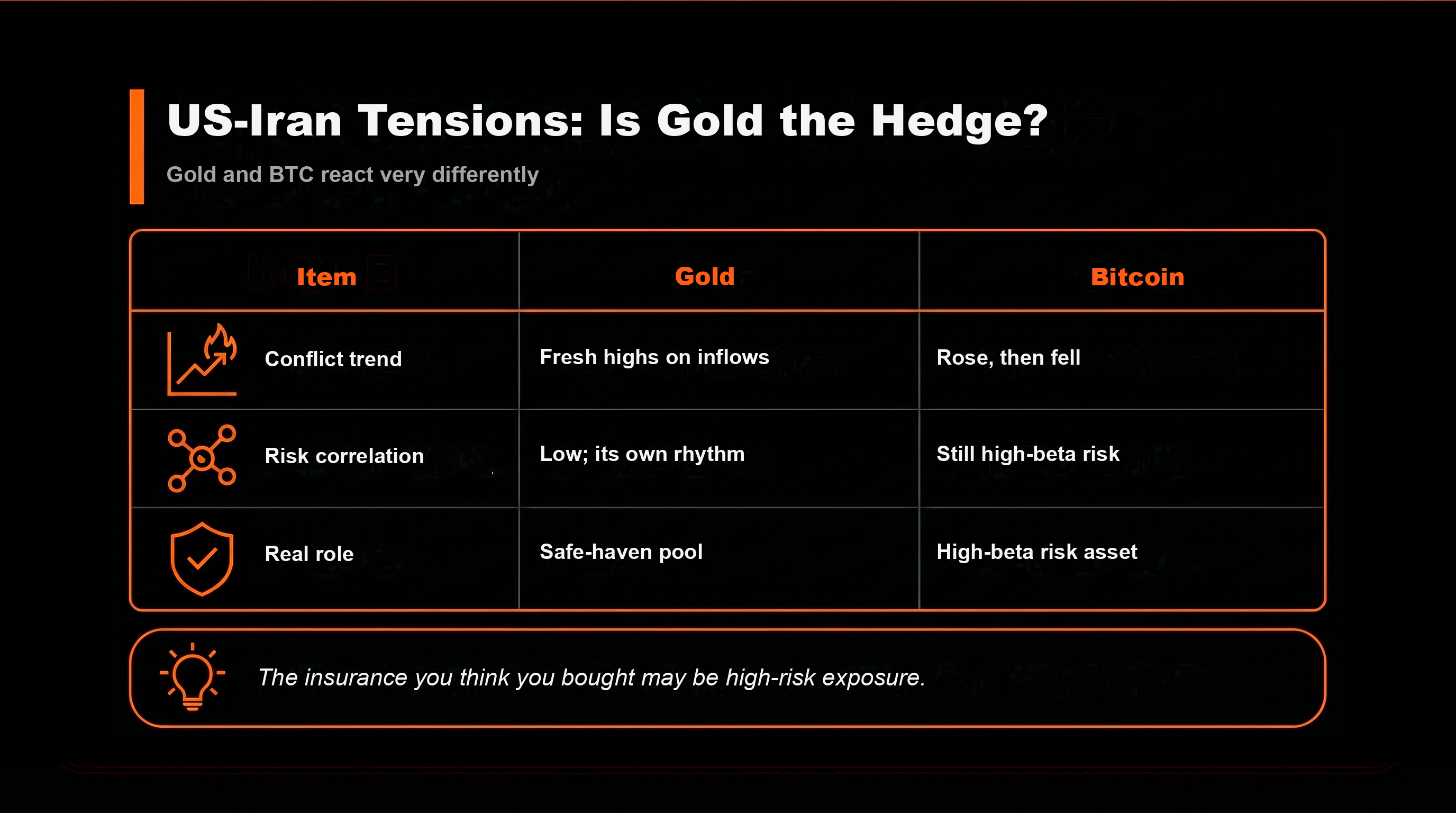
Gold hit an all-time high, while Bitcoin fell instead of rising
Look first at the most direct contrast this time. In the latest round of Middle East conflict, triggered by the U.S. and Israel taking military action against Iran, traditional safe-haven assets reacted very consistently: gold surged and set a new all-time high, and crude oil spiked too on Middle East supply risk. The market's safe-haven money flowed clearly into them.
But what about digital gold Bitcoin? Far from playing safe haven, it fell instead of rising, briefly dropping below the key level of just over $100,000. From the escalation of the conflict to the time I'm writing this, its cumulative decline at one point neared 20%. This contrast is almost a textbook counterexample: when a real crisis arrives, safe-haven money chooses gold, not Bitcoin. If you went in at the time with the idea of "war means buy BTC as a hedge," the outcome likely ran completely opposite to your expectation: you thought you were buying insurance, but what you actually got was a high-risk chip depreciating even faster amid the panic.
Bitcoin and tech stocks look more and more alike
Why does this happen? Because Bitcoin's price action right now is highly tied to risk assets, tech stocks especially.
The data speaks plainly: entering 2026, the correlation between Bitcoin and tech-stock indices like the Nasdaq spiked to around 0.75 at one point, while the rolling correlation over the past two years mostly sat between 0.35 and 0.6, jumping higher every time the market sold off hard. This means that when the market switches into hedging mode and money pulls out of risk assets, algorithms and leveraged traders cut a whole basket of correlated positions at once — Bitcoin often gets sold alongside tech stocks, while gold gets snapped up at the same time. In other words, at this stage, understanding Bitcoin as a more volatile tech stock is far more accurate than treating it as a hedging tool. That's why I remind beginners: when you buy Bitcoin you're taking on risk-asset-level volatility, don't hold it with a safe-haven mindset.
Zoom out across several crises, and it always falls the most
Zoom out and look at several crises big and small over the past years, and Bitcoin's role has actually been very consistent — consistently the most volatile one.
One set of data makes the point well: over the past ten years, in the ten worst months for the S&P 500, Bitcoin fell about 6.4% on average, while gold actually edged up about 0.8% over the same periods; and in the ten best months, Bitcoin soared more than 22% on average, leaving gold's 1.5% far behind. Put these two sets of numbers together and Bitcoin's true role is clear: it's a high-beta risk asset — it rises the most when the market is good and falls the hardest when the market is bad.It amplifies market sentiment rather than hedging it for you. This doesn't mean Bitcoin has no value or isn't worth holding long-term; it's just that you need to recognize that in the specific scenario of a crisis, expecting a hedging function from it is itself a misjudgment.
Why does "digital gold" fail in a crisis?
"Since it's sometimes treated as a tool against inflation and risk, why does it fail the moment a real crisis hits?" In this section we dig one layer deeper to see the three structural reasons behind the failure of Bitcoin's hedge properties. Understand these, and you won't repeat the same misjudgment with every conflict.
Market structure: dominated by retail and short-term traders who sell first, ask later
The first reason lies in the market's participant structure. Compared with gold's mature market, where central banks, sovereign funds, and insurers hold for the long term, the Bitcoin market is still dominated to this day by retail and short-term speculators.
This structure determines its behavior under stress. When sudden geopolitical risk lands, these mostly short-term participants' first reaction usually isn't to calmly assess long-term value, but to sell first, secure cash, and then wait and see. A flood of same-direction sell orders pours out in a very short time, the market's buyers can't absorb it, liquidity contracts fast, and the price takes a fast, deep dive. The gold market swings too, but the long-term, low-frequency, deep-pocketed holders behind it provide a cushion Bitcoin doesn't yet have. So this is how I understand it: it's not that Bitcoin can't become a safe-haven asset — it's that its holder structure isn't yet mature enough to act as a stabilizer during panic.
High leverage and forced liquidations amplify selling pressure
The second reason is the high leverage and forced-liquidation mechanism unique to the crypto market, which pours fuel on the fire during a decline.
Compared with traditional markets, contract leverage in crypto is used aggressively and widely — many people are long with several times their money borrowed. That feels great on the way up, but once the price falls to the maintenance-margin floor, the exchange's forced liquidation automatically cuts these leveraged longs. The problem is that this forced selling pushes the price down further, and once it's lower it triggers the next batch of people's liquidation levels, forming a chain of decline, liquidation, greater selling pressure, and further decline. That's why you often see Bitcoin fall far more on bad news than the news itself warrants — that extra leg is usually driven out by cascading leverage liquidations. It's also why, when geopolitical risk heats up, the first thing I always do is check whether I'm using leverage, rather than rushing to guess direction.
Institutions and central banks vote with their feet: buying gold, not coins
The third reason is that the big money voting with hard cash hasn't actually treated Bitcoin as a true reserve-grade safe-haven asset.
A very plain comparison: according to statistics, global central banks bought a total of about 863 tonnes of gold in 2025, while their official reserve additions of Bitcoin were essentially zero. When a nation looks for a safe haven for its people's foreign-exchange reserves, it still chooses gold. Even large institutions bullish on Bitcoin, such as BlackRock, tend to position it as a unique diversification tool rather than a survival asset when crisis strikes. This gap matters — it tells you that Bitcoin's hedge narrative currently stays mostly at the level of vision and marketing, without the backing of the most conservative, most safety-conscious big money. For beginners, rather than believe the slogans, watch this money that lies the least — and see where it actually puts its money.
When geopolitical conflict heats up, how should beginners judge and respond?
"So when war or geopolitical tension hits, what exactly should I do?" In this section I won't predict the course of the war or hand out hot tips — I'll just give you a few principles that help you avoid major misjudgments in these highly uncertain moments.
Don't treat "digital gold" as a reason to hedge
The first, and the one most worth dispelling, is the myth of the "digital gold" label.
"Digital gold" is a long-term vision about Bitcoin's future possibilities; it describes how one day Bitcoin might mature enough to hold gold-like safe-haven status, but it isn't a fact right now. From the real performance above, you've already seen that in a crisis Bitcoin more often behaves like a risk asset. So the inference "because it's digital gold, you should buy it as a hedge when war breaks out" does not hold at this stage — you're using an unrealized vision to justify a present-day trading decision. I strictly separate these two things: I can believe in Bitcoin's vision long-term while knowing full well that the market this very week will treat it as a risk asset to sell. You're placing an order in the present, so you should look at its real reaction in the present, not the future it's been promised.
Think "volatility rises" first, not guessing direction
The second principle: when a geopolitical event arrives, think first that volatility will rise, rather than rushing to guess whether it'll go up or down.
The most certain impact of geopolitical conflict isn't direction, but the amplification of uncertainty itself. The news changes by the minute — a ceasefire rumor or a single official's remark can whip the price violently in both directions within minutes. In this environment, even professional traders struggle to guess direction consistently, and for beginners betting on direction is more like rolling dice. So instead of asking whether I should buy or sell, ask first whether my current position can withstand this level of volatility. In these highly uncertain windows I proactively shrink my position and cut or even fully avoid leverage, shifting the goal from catching a move to surviving first, so a single long lower wick doesn't sweep me out. When things are unclear, controlling your own position is always more practical than predicting the market.
Use a long-term lens, do less event trading
The third principle: black-swan events like geopolitical shocks are inherently extremely hard to predict and extremely hard to trade, so it's all the more important to respond with a clear sense of your own role.
You need to figure out first which kind of person you are. If you're long-term bullish on Bitcoin and plan to hold for many years, a short-term drop caused by one geopolitical conflict won't necessarily change your long-term view — no need to panic-sell at the lows over a war headline, and no need to chase the rebound. Times like these are better suited to building in tranches at a set pace rather than being led by the news. But if you're a short-term trader, you should recognize all the more that this is an extremely difficult window, where controlling risk and protecting principal ranks far above getting this one directional bet right. Confirm which role you play first, and only then will you know whether, for you, this piece of news means opportunity or noise.
How should you allocate? The division of roles among Bitcoin, gold, and cash
"After all this, how should I actually allocate?" Understanding the logic is one thing, but in the end it has to come down to your positions. This section sorts out the roles of Bitcoin, gold, and cash, giving you a framework to think through before you act.
If you truly want to hedge, gold, the U.S. dollar, and cash are still the mainstays
First, the most central point: if the purpose of this money is truly to hedge — that is, your top concern is not losing your principal in a crisis — then traditional safe havens like gold, the U.S. dollar, and cash should still be your mainstay at this stage.
This isn't looking down on Bitcoin — it's respecting its real nature right now. A hedge position's job is to be steady, to help you hold your ground when everything is falling, and even to provide the ammunition to buy in later. From the data above, what can play this role steadily is still gold and cash, not the Bitcoin that dives alongside tech stocks. When I plan my assets, I clearly carve out a chunk of survival money that won't move no matter what the market does, and that money won't go into Bitcoin. Let the hedge be the hedge — this is the part of the whole allocation you should least compromise on.
Put Bitcoin in the "offensive position," not the "survival position"
So where should Bitcoin go? I put it in the offensive position, not the survival position.
By offensive position, I mean the chunk of money you use to chase higher returns while clearly accepting that it may swing wildly or even draw down deeply. Bitcoin's high-beta nature destines it to be an explosive offensive weapon in a bull market, but only if you use the right mindset and put it in the right place. More concretely, keep this money's share within a range where, even if it gets cut in half, it won't disrupt your life or other plans, and try not to stack high leverage on this position, because as said earlier, leverage sweeps you out exactly when you least want to be swept out. Manage Bitcoin as an offensive position that grows on its own but also swings violently, rather than as a safe haven in a crisis, and both your expectations of it and how you handle it will fall into place.
A self-check list to run through before you act
Finally, whether you ultimately decide to buy or not, and how much, I recommend running through the following questions quickly before you place the order, so you don't get swept along by a moment's news or community sentiment:
- What is this money's role? Is it survival money that can't be lost, or offensive money that can withstand big swings?
- If it gets cut in half right after I buy, will my life and other plans be disrupted?
- Am I stacking leverage in this high-volatility window? Can I bring the leverage down first?
- Am I a long-term holder or a short-term trader? Is this piece of news opportunity or noise for me?
If you can answer all four questions, then decide how to act — it'll be far steadier than staring at a single candle and chasing pumps and dumps on war headlines. The quality of your judgment often comes not from how accurately you predict, but from whether you questioned yourself clearly before you acted.
Conclusion
This piece uses the real performance during the recent Middle East conflict — gold hitting an all-time high while Bitcoin fell instead of rising — to help you understand one thing: Bitcoin right now is more like a high-volatility risk asset, and is nowhere near being the crisis-proof digital gold that keeps you safe. From market structure and leverage liquidations to central banks voting with their feet, the reasons all point to the same conclusion. So when geopolitical conflict heats up, the thing to do is not to treat digital gold as a reason to enter, but to think first that volatility will rise, bring leverage down, view short-term shocks through a long-term lens, leave the hedging to gold and cash, and put Bitcoin back where it belongs — the offensive position. Separate its long-term vision from its present behavior, and you won't, in the next crisis, once again buy what you meant as a hedge only to get burned.


