

Do you often hear that RWA and real-world asset tokenization are the next big thing, yet you can't quite explain what they actually do or where the opportunities and risks are?This guide won't just hype the trend. Instead, it first helps you understand RWA — what it puts onto the chain, where the 2026 opportunities are, the collateral, custody, and regulatory costs behind tokenization, and finally how you as a beginner should fit it into your portfolio and which hidden risks you shouldn't ignore.
What Is RWA? Putting Real-World Assets Onto the Chain
"real-world asset tokenization — what exactly is being turned into what?" Many beginners hear this several times and still can't grasp the point. The core, really, comes down to one sentence: turning real-world assets into tokens on a blockchain. This section first explains this concept thoroughly and what problem it's trying to solve — the foundation for judging every opportunity and risk that follows.
Understanding What RWA Does in One Sentence
Let's break down the term first. RWA stands for Real World Assets. Tokenization means taking assets that actually exist in the real world — U.S. Treasuries, a piece of real estate, a batch of commodities, a loan — and converting their ownership or income rights into digital tokens on a blockchain.In plain terms, it turns assets that used to sit only in banks, brokerages, or property registries into something you can hold, transfer, and even split into small pieces to trade on-chain.
There's a concept you as a beginner must establish first: the RWA token you buy doesn't create value out of thin air — it corresponds to a real-world asset or right behind it, which is completely different from many tokens propped up purely by narrative and consensus. It's more like a digitized certificate of rights, and whether that certificate has value depends on the real asset locked behind it.So the first habit I have when looking at RWA is this: not to look at how much the token has gone up, but to ask what's tied behind it and whether that thing is reliable.
What Pain Points of Traditional Assets It Aims to Solve
RWA is favored because it targets pain points that have long existed in traditional assets but have never been properly solved. The most direct ones are high barriers to entry and poor liquidity.Many quality assets — like commercial real estate, private credit, and equity in private companies — used to either require a large sum to participate in, or be nearly impossible to sell once bought. Ordinary people simply couldn't touch them.
What tokenization tries to do is tackle these pain points one by one. It slices a large asset into many small tokens, so something that used to require millions to get into might now cost a few thousand for a small slice — that's lowering the barrier. Once the asset is on-chain, it can be traded 24 hours a day across borders, no longer bound by market open and close times — that's improving liquidity. That's also why RWA is often described as a bridge connecting traditional finance and the crypto world. But let me pour some cold water first: the bridge is built, but the quality of both ends and how sturdy the ropes in the middle are decide whether you cross it safely — which is the focus of the risk sections later.
How RWA Differs From Ordinary Cryptocurrencies
Since RWA is also a token on-chain, how does it differ from Bitcoin or those meme coins? Once you're clear on this, your expectations for RWA will be properly set.Ordinary cryptocurrencies, especially narrative coins and meme coins, are largely driven by market sentiment, supply and demand, and consensus. They don't necessarily correspond to any physical asset behind them, so they can surge — and just as quickly go to zero when sentiment fades.
RWA tokens work differently. Their value is anchored to a real off-chain asset, so they're less likely to surge out of nowhere — but also less likely to vanish into thin air — provided that real asset actually exists and the link is solid. Because of this anchor, many RWA products emphasize relatively steady yield rather than doubling in price. I often remind beginners: if you look at RWA expecting to buy the next 100x coin, you'll mostly end up disappointed.Think of it as moving traditional finance's steady products onto the chain, and your expectations and moves will fall into place.
Which Assets Are Being Put Onto the Chain?
"I keep hearing about tokenized Treasuries and tokenized real estate — what does RWA actually cover?" In this section I lay out the main mainstream categories of RWA today.With this map, whenever you come across a project later, you can quickly tell which category it falls into and roughly what its risk profile looks like.
Tokenized Treasuries and Money Markets: The Most Mature Piece
The most mature and most beginner-accessible category right now is tokenized U.S. Treasuries and money-market products. The logic is simple: package short-term U.S. Treasury bonds or similar low-risk yield-bearing assets and issue them as on-chain tokens, so holders can earn a relatively stable yield tied to the bond interest.For people used to crypto's wild swings, this kind of product's biggest selling point is, ironically, how boring and stable it is.
This is also why large asset managers enter from here. Treasuries are widely recognized as one of the most liquid, highest-credit assets in the traditional world, so tokenizing them carries relatively controllable risk and a clear compliance path.That said, steady doesn't mean zero risk — the yield on these products moves with the benchmark interest rate, and whether the issuer's compliance and custody are in place matters just as much.I personally treat it as the entry-level template for understanding the whole RWA space, because it's the cleanest and best shows you how a token is pegged to its underlying asset.
Tokenized Real Estate and Private Credit: Fastest-Growing but More Complex
The second big category is real estate and private credit — assets ordinary people used to struggle to access. Private credit is exactly a standout growth engine in this round of RWA.Tokenized real estate splits property rights into tokens, letting you use small amounts of money to take part in real estate investment that once had extremely high barriers. Tokenized private credit, meanwhile, packages corporate or personal loans into on-chain products, letting holders earn the interest income from that lending.
These two sound tempting because their traditional yields are usually higher than Treasuries, but higher returns come with more complex risks behind them. Real estate has valuation and liquidation issues — a building can't be sold and cashed out instantly. Private credit's core issue is whether the borrower repays — once they default, the asset loses value and your token shrinks with it. So even within RWA, tokenized Treasuries and tokenized private credit are not on the same order of risk.Jumping in the moment you see high yield, without understanding whether it's backed by a building or a loan that might never be repaid, is a mistake beginners easily make.
Other Assets: Commodities, Stocks, and More Experiments
Beyond these two big categories, RWA's reach keeps extending to more assets.In commodities, for example, tokenizing gold or raw materials lets you hold rights to the corresponding physical goods on-chain. In equities, traditional exchanges have announced blockchain-based tokenized stock plans, trying to bring stock trading on-chain, and some institutions have applied to regulators hoping to bring tokenized assets into a formal trading framework.
These experiments show that RWA's room for imagination is still huge, but the newer and more fringe a category is, the more it tends to mean immature rules and more variables.Especially for something like tokenized stocks that involves shareholder rights — whether the token in your hands equals the stock, and whether it carries voting and dividend rights, varies a lot between schemes. My attitude is to trust mature categories a bit more and keep a bit more skepticism toward brand-new experiments — figure out what rights it actually gives you before deciding, rather than assuming everything is the same just because it says "tokenized."
Where Are the RWA Opportunities in 2026?
"Why does everyone say 2026 is RWA's breakout year?"Because three things have come together: rapid growth in scale, traditional institutions seriously entering, and regulation in various countries gradually becoming clearer.This section helps you see how real this momentum actually is, but I'll also remind you at the same time that a big opportunity never means there's no risk.
Rapid Growth in Scale, With Private Credit Leading
Let's start with the hardest metric: scale. RWA's total on-chain size reached the tens of billions of dollars by early 2026, growing noticeably faster than in previous years. This growth wasn't built on a single wave of hype — it's the result of real assets being moved onto the chain piece by piece.Among them, private credit is an especially standout growth engine this round, reflecting real market demand for on-chain yield-bearing assets.
Why should scale matter to you as a beginner? Because it represents real money flowing in, not just community buzz. A space with lots of discussion but no actual capital coming in is mostly still stuck at the story stage. When the amount of real assets settled on-chain keeps climbing, it means it has started to solve real needs for some people. Of course, a reminder: the numbers move with the market, and any scale figure you see is a snapshot at a point in time. What matters is grasping the trend direction, not memorizing a fixed number.
Traditional Institutions Are Seriously Entering
More noteworthy than the growth in scale is who's entering.This round of RWA's momentum comes in large part from traditional financial institutions, not just crypto insiders hyping themselves up. We've seen traditional exchanges announce tokenized stock plans, seen large asset managers issue on-chain tokenized funds and Treasury products, and even seen institutions apply to regulators hoping to formally bring tokenized assets into a compliance framework.
The significance of these moves is that they're backed by real money and brand reputation. Big traditional institutions usually won't put their name on a purely hype-driven theme, because the compliance and reputational costs are too high. So when this most conservative, most risk-conscious big money starts investing seriously, it at least shows that RWA as a direction has real substance — more solid than a narrative that lives only in community slogans. But to be clear: institutional entry is bullish, but it doesn't mean you'll profit by buying with your eyes closed — institutions are bullish on the long-term direction, which doesn't mean every project wearing the RWA label is trustworthy.
The Long-Term Dividend of Regulation Gradually Becoming Clearer
The third driver is that the regulatory environment is getting clearer bit by bit. For the past few years, tokenized assets have been stuck in an awkward gray area — no one could say for sure whether they count as securities, commodities, or something else, and that uncertainty kept a lot of big money from going all in.Heading into 2026, countries have begun rolling out laws and frameworks for tokenized assets one after another. Progress varies, but the direction is toward clearer rules.
Clearer rules are a long-term structural dividend for RWA. When a project knows what it has to comply with, traditional financial institutions dare to bring assets and clients in at scale, and only then does this space have a chance to grow from an early niche experiment into infrastructure connecting traditional finance. But for beginners this is also a double-edged sword: in the process of regulation clarifying, whether a project is compliant directly decides its life or death, and projects that can't clearly explain their compliance status are actually higher-risk.So I treat regulation as both an opportunity and a filter, prioritizing projects that take compliance seriously.
Don't Ignore This: Tokenization Doesn't Equal No Risk
"Since there's a real asset backing it, isn't it much safer than ordinary coins?" This is exactly the misconception beginners most need to break.Tokenization solves the matter of moving an asset onto the chain, but it can't solve the risks the asset itself will face.In this section we'll see through this misunderstanding, so you don't get fooled by the words "real-world assets."
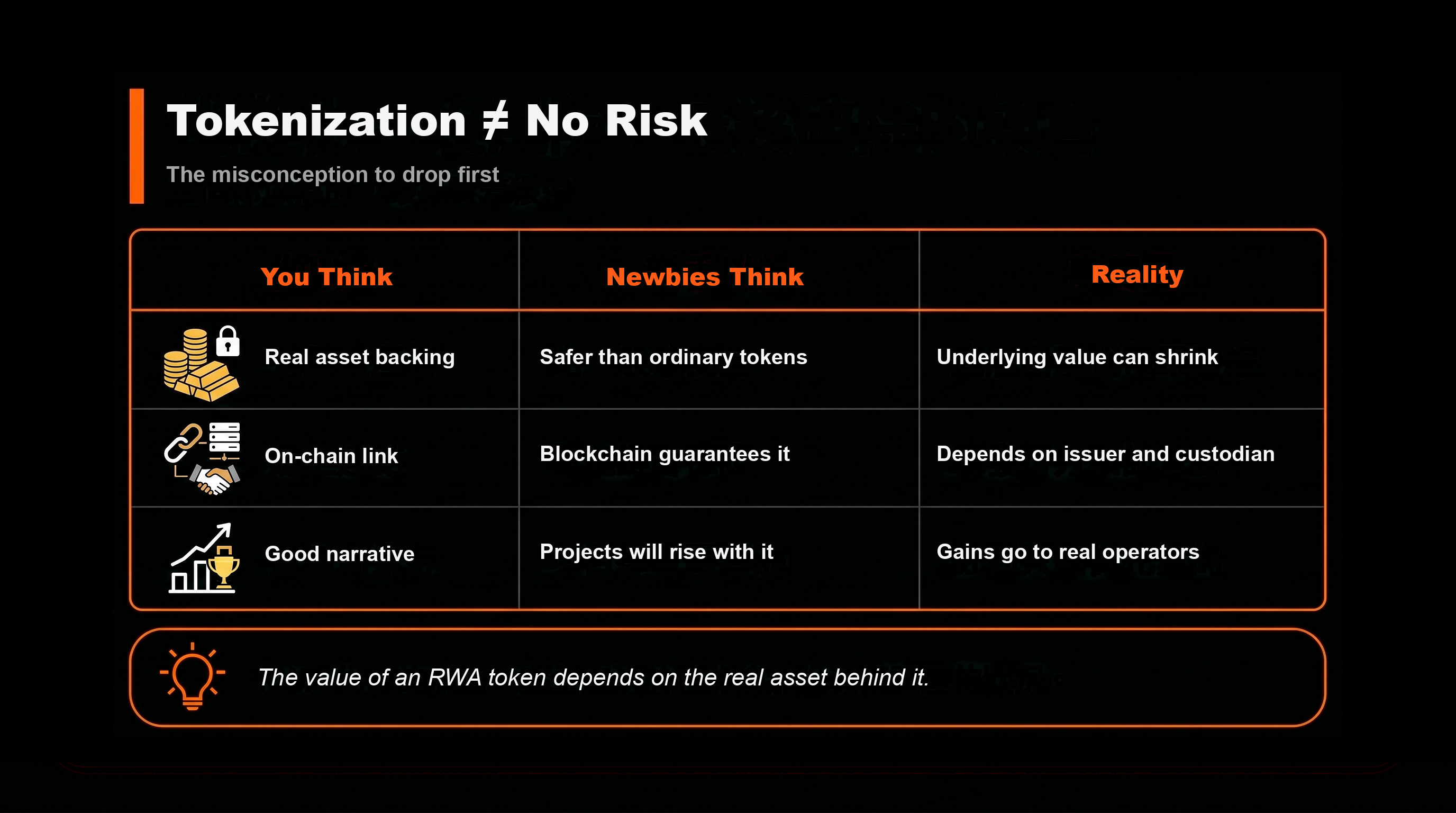
A Token's Value Depends on the Real Asset Behind It
The most essential sentence: RWA token's value depends entirely on the condition of the real asset behind it.If the asset itself runs into trouble, the token naturally runs into trouble too — there's no magic in between to insulate you. Tokenization only changes the form of holding and trading, moving the asset from the traditional world onto the chain, but it doesn't and can't eliminate the credit, price, and liquidity risks the underlying asset already carries.
Take tokenized private credit, for example: behind it are loan after loan, and if a borrower defaults and can't repay, the asset loses value and the token in your hands shrinks accordingly — regardless of how advanced the token's on-chain technology is. Tokenized real estate is the same: if property prices crash in the area where the underlying building sits, your token depreciates with it.So instinctively assuming your principal is safe just because you see the words "real-world assets" is a fairly dangerous misconception.My order of judgment is always to look through the token first and examine the quality of the underlying asset.
The Link Between the On-Chain Token and the Off-Chain Asset Can Break
The second layer of risk is more hidden, lurking at the junction between on-chain and off-chain. RWA's entire logic rests on one key assumption: that the token on-chain truly corresponds to a real, fully-backed asset off-chain.But this correspondence itself is held up by the issuer, the custodian, and a whole set of legal arrangements — it's not something the blockchain itself can guarantee.
This means that if the issuer misreports the backing assets or something goes wrong in custody, the link between the on-chain token and the off-chain real asset can break. Once it breaks, the token in your hands that looks well-backed may actually be nothing more than a promise with no real support behind it. So buying RWA isn't just about the pretty numbers on-chain — you need to look at whether the off-chain asset actually exists and who guarantees it.The blockchain can ensure the token's transfers and records are real, but it can't police whether the off-chain asset is real — and this seam between on-chain and off-chain is exactly where RWA is most likely to go wrong.
Don't Mistake the Narrative for Fundamentals
The third pitfall you can easily step into is mistaking RWA's grand narrative for the fundamentals of a specific project.RWA connecting traditional finance and the crypto world is indeed an imaginative big-picture direction, but a promising space and whether the specific project you buy is trustworthy are two completely different things.No matter how hot a space is, it will always contain plenty of projects riding the hype — full of grand talk but with little real substance.
I've seen too many beginners lose money this way: what they believe in is RWA's big story of taking off as a space, but what they actually buy is a project that just slaps the RWA label on its name while being unable to explain its collateral or compliance.A space's dividends ultimately land only on the projects that genuinely build solid assets and compliance — not scattered to everyone riding the theme.So when judging RWA projects, I deliberately separate my optimism about the space from my assessment of the single project, so that optimism about the future doesn't cloud the scrutiny of the project in front of me.
What You Most Need to Check in RWA: Collateral and Custody
"So how do I judge whether the assets behind an RWA project are real and reliable?" This section is the part of the whole article you should most remember. As mentioned earlier, RWA is most likely to go wrong at the on-chain/off-chain link, and collateral and custody are the core of that link.Get these questions straight and you avoid most of the landmines.
First Check Who the Issuer Is and Whether It's Regulated
When evaluating any RWA project, I first ask the most basic questions: who issued this, and is the issuer regulated?The issuer is the source of the entire collateral structure. If you can't even get the source straight — it's an anonymous team of unknown origin — then every subsequent promise about the asset's authenticity deserves a big question mark over its credibility.
Regulation matters not because it guarantees profits without loss, but because an issuer willing to be regulated and transparent puts itself in a position to be scrutinized and held accountable — it has to disclose information regularly and submit to audits, making fraud far more costly. Conversely, an issuer that deliberately stays outside regulation and is vague about everything makes me very cautious, no matter how attractive the yield sounds. For beginners, rather than studying complex on-chain data, confirming the issuer's identity and compliance status first is actually a more fundamental and more effective first filter.
Confirm the Underlying Asset Really Exists and Has Third-Party Proof
After checking the issuer, the next step is to look through to the underlying asset itself: does the real asset supposedly backing the token actually exist, and is it fully sufficient? This sounds obvious, yet it's exactly the step most easily skipped. A responsible RWA project usually keeps the underlying asset with a third-party custodian and provides regular, independent audits or attestations, so outsiders can verify that the on-chain token really corresponds to a fully-backed real asset off-chain.
I specifically look for a few things: is there a credible third party custodying the assets, are there regular and independent audit reports, and is this information publicly verifiable? If a project hedges on these questions, repeatedly stressing that it has real assets behind it while producing no verifiable proof, then its so-called real assets exist only in words. Remember, in the RWA space, verifiable matters far more than sounds credible — a project that can produce independent proof is always more trustworthy than one that only shouts slogans.
Understand Where Your Claim Rights Are When Things Go Wrong
The third question, and the one most people ignore: if something really does go wrong, does the token in your hands actually have any claim on that real asset?This is the key that separates a tokenized asset from an empty promise.In an ideal structure, when the underlying asset runs into trouble or the issuer defaults, token holders should have clear, enforceable rights over that asset.
But in reality, many RWA projects have quite vague legal structures — whether the token in your hands represents ownership, a debt claim, or just a claim against the issuer is often unclear. Once the structure is murky, you may find that when trouble actually hits, you can't recover anything at all. So when evaluating an RWA project, I use "what can I recover in the worst case" as a stress test. If the answer is vague, or no one can even give you a clear reply, then no matter how tempting the yield looks, it's too dangerous for me.Who provides collateral, who custodies it, and who I can go after when things go wrong are the first gate in how I evaluate RWA — bar none.
Regulatory and Operational Friction: RWA's Hidden Costs
"Besides collateral and custody, RWA what else do beginners easily overlook?"The answer is regulatory uncertainty, and the friction created when the traditional world and the blockchain world are forced together.These things aren't as eye-catching as price swings, but they genuinely affect whether a project can survive long-term.
Whether It's Compliant Directly Decides a Project's Life or Death
RWA has one foot in traditional finance and one in the crypto world, so it inherently faces compliance problems far more complex than a pure on-chain project.It involves securities law, asset custody, investor protection, and a whole raft of traditional financial rules — and these rules differ by country and by type of tokenized asset, while the whole environment is still evolving rapidly.
This means whether it's compliant almost directly decides an RWA project's life or death.No matter how good the technology or how attractive the yield, once it's deemed to have crossed a compliance red line in a major market, at best it's forced to delist or restrict services, and at worst it's shut down outright — and the ones hurt most are the retail holders left holding the tokens. So when I look at RWA projects, I treat its attitude toward compliance as an important signal: a project willing to spell out its compliance path and proactively accept regulation has a far higher chance of long-term survival than those making quick money off gray areas.
Friction Where Traditional Systems Meet On-Chain Systems
The second kind of friction comes from two systems colliding head-on. The world of traditional assets runs on a whole system of banks, brokerages, and registries with their own pace and rules; the blockchain is another logic entirely, running around the clock and across borders.When RWA joins these two together, various operational frictions inevitably arise at the junction.
An example makes it clear: an on-chain token can be transferred instantly, 24 hours a day, but its underlying asset — say, settling a bond or transferring title to a property — usually still has to follow the timing and processes of the traditional system, which creates time lags and integration costs. Add in KYC, deposits and withdrawals, cross-border compliance, and other steps, and all of it makes RWA's actual operation more complex than it looks on the surface. These frictions don't make headlines every day, but they're real costs and risks that can affect how fast you redeem your assets — and, in extreme cases, even lock up your funds. Understanding this, you won't naively assume that RWA being on-chain means you can cash out anytime, painlessly.
How Beginners Should Use Regulation as a Filter
After all this talk of regulatory and operational headaches, how should a beginner actually use it? My advice is simple: treat regulation and compliance as a positive filter, not an annoying obstacle.At this stage where the rules are still taking shape, the more seriously a project takes compliance and the more transparent it is, the more it usually signals it wants to do this for the long haul, rather than harvest one round and leave.
In practical terms, I prioritize projects with a clear issuer identity, that are regulated and transparent, and I keep my distance from those full of grand talk but evasive on key questions like collateral and compliance. This isn't to say a regulated project will never run into trouble, but in a market with severe information asymmetry, proactively ruling out the opaque and non-compliant options is itself a form of effective risk management.For someone just getting started, rather than chasing the highest-yield, sexiest-sounding targets, it's better to build the habit of using compliance and transparency as your first round of screening — it'll help you avoid the vast majority of the most obvious pitfalls.
How Should Beginners Take Part in RWA, and Where Does It Fit in a Portfolio?
"I get the theory, but as a beginner how exactly should I take part, and where should I place RWA in my portfolio?"This section pulls the earlier judgments into a framework you can follow, helping you get your mindset, positioning, and pre-purchase checks right before deciding whether to act.
First Set Your Mindset Right: It's a Portfolio Option, Not a Get-Rich-Quick Tool
Before taking part in RWA, the first thing to adjust is your mindset. RWA's biggest value to beginners is that it adds another channel to access traditional assets and another option for asset allocation, not yet another get-rich-quick tool that turns your life around overnight.As mentioned earlier, products like tokenized Treasuries emphasize relatively steady yield and were never on the same wavelength as fantasies of doubling in price.
If you enter RWA with a coin-gambling mindset, expecting it to surge in a short time like a meme coin, you'll likely be disappointed — and might even chase riskier, supposedly high-yield, dubious projects out of that disappointment, pushing yourself into a bigger pit. Think of it as moving traditional finance's steady products onto the chain, treating it as an allocation tool rather than a lottery ticket, and your expectations will match reality better and your moves will be steadier.
A Reasonable Place for RWA in Your Portfolio
Once your mindset is right, the next question is positioning: RWA what role should it play in your overall portfolio? My view is that different types of RWA suit different places in a portfolio and can't be lumped together.Something like tokenized Treasuries — a relatively steady product with clear yield — is better suited as the more stable slice of your portfolio, holding a portion of the funds you want to earn interest relatively safely.
Tokenized real estate and private credit, products with higher returns but also higher risk and complexity, are closer to an aggressive allocation — you should participate with the portion of funds whose volatility and loss you can bear, and keep the proportion under control. My own principle is that no matter which type of RWA it is, I never treat it as a life-saving hedge position, because it ultimately carries the risks of the underlying asset and the on-chain/off-chain link.Treat steady-type RWA as part of your stable allocation, and high-yield types as an aggressive position whose proportion needs careful control, and your expectations and risk tolerance will line up better.
A Self-Check Checklist to Run Before You Buy
Finally, no matter which type of RWA you end up choosing or how much you put in, I'd advise you to quickly run through the following questions before placing an order, so you don't get carried away by a high-yield number or the buzz of a hot space:
- Who is this project's issuer? Is it regulated, and is its information transparent enough?
- What exactly is the real asset behind the token? Is there third-party custody and independent proof?
- If something goes wrong, do I have a clear, enforceable claim on that real asset?
- Am I treating it as a stable allocation, or as an aggressive position I can afford to let swing? Is the proportion too heavy?
If you can answer all four of these questions and the answers put you at ease, then deciding whether to act will be far steadier than jumping in at the sight of a pretty yield figure. RWA is a direction worth watching long-term, but whether it's safe was never in the words "real-world assets" themselves, but in the collateral, custody, and compliance behind it — the details you can't see but must actively check.The quality of your judgment often comes not from how fast you chase, but from whether you asked these questions clearly before you bought.
Conclusion
This guide has walked you through understanding RWA from scratch — real-world asset tokenization is about putting real-world assets like Treasuries, real estate, and private credit onto the chain, so they can be held and traded at a lower barrier. In 2026, on the back of rapid growth in scale, traditional institutions seriously entering, and regulation gradually becoming clearer, it became one of the most favored narratives — and this part of the opportunity is real.But a big opportunity never equals no risk: tokenization doesn't eliminate the underlying asset's risk, and the link between the on-chain token and the off-chain real asset can break. Collateral, custody, and compliance are what truly decide whether a project is reliable.So rather than getting carried away by the words "real-world assets," treat it as one more asset-allocation option, prioritize regulated and transparent projects, and before you buy, check who provides collateral, who custodies it, and who you can go after when things go wrong. Separate its long-term vision from the fundamentals of the project in front of you, and only then can you, in this wave of RWA grand narrative, seize the opportunity without stepping into the overlooked pitfalls.


