

Do you see DeFi’s high yields and want to jump in, but also fear that one day the protocol gets hacked, your money is just gone, and you can’t get it back? This piece won’t scare you away from DeFi. Instead, it first uses Radiant’s shutdown as a case to show you what usually happens after a protocol is hacked, why the money is so hard to recover, and which risks to check before putting money in — and finally helps you get your mindset straight, so you know whether this kind of yield is really worth carrying.
After a DeFi hack, what usually happens?
“Isn’t it just a chunk of money getting stolen — can’t the team patch things up and pay people back?” That’s many beginners’ first instinct, but reality is often far crueler than that. DeFi getting hacked usually leads to assets hard to recover, trust collapsing, and the protocol beyond saving — three things happening one after another. In this section I’ll first walk you through this typical chain reaction, because only by understanding how the worst case unfolds will you see why the risk checks that follow are non-negotiable.
Once assets are moved out, they’re usually very hard to recover
Let’s start with the most direct impact. DeFi’s most core traits — on-chain, permissionless, and irreversible — are normally its strengths, but during a hack they instantly become a double-edged sword. Once the hacker succeeds, the funds can be moved, mixed, and split across chains on-chain at blazing speed. By the time you notice something’s wrong, the money may already be chopped into countless small pieces and flowing into all kinds of anonymous addresses.
At this point, what the team can do is usually to bring in a blockchain security firm to help trace the money flow and to contact exchanges and law enforcement to try to freeze it — but the share actually recovered tends to be very low. Radiant is a bloody example: they marshaled the resources of U.S. law enforcement and professional security firms to chase it down, and after a year and a half there was still no real progress. I treat this as one of DeFi’s iron rules to remember — once the money leaves the contract and lands in the hacker’s hands, how much you can get back is, most of the time, no longer within your or the team’s control.
The protocol may not just pause — it may shut down for good
The second, often underestimated consequence is that the protocol itself may not survive. Many beginners assume a hack means at most some downtime for repairs, reopening once the bug is patched, but a single major attack is enough to directly end a project that was running just fine.
What’s lost in a hack isn’t just the stolen funds; more fatal is the collapse of trust: long-time users start panic-withdrawing, new money is afraid to enter, and partnerships and investments that were already agreed pull back too. When the protocol can’t plug the hole, can’t raise rescue funding, and can’t keep burning cash on day-to-day operations, the final outcome is often a wind down — an orderly shutdown. Radiant ultimately concluded, after assessment, that it saw no viable path forward, and so switched to a maintenance state that only lets users withdraw and repay. That’s why I remind beginners that DeFi’s hack risk is never just price volatility — it can mean the entire protocol vanishing right in front of you.
The users who deposit are often the ones left holding the bag
The third thing you must recognize: in this chain reaction, the retail users who deposit money are often standing at the very end, the group left to bear the outcome.
As a protocol gets hacked and heads toward shutdown, the team, the investors, and even the hacker each have their own calculations and exits, but the choices available to an ordinary user are actually very limited. Even if the protocol later switches to a maintenance state and opens withdrawals, how much you ultimately get back depends entirely on what’s left in the treasury, not on how much you deposited in the first place. One thing I’ve taken from cases like this is: DeFi’s worst case isn’t a 30–50% drop on paper, but your principal taking a severe hit, or even the protocol going straight to zero. Think this premise through clearly, and when you size your positions later, you won’t bet big on an “it’ll definitely be fine” mindset.
Walking through one complete collapse with Radiant Capital
“How exactly does a lending protocol that was running perfectly well end up shutting down, step by step?” Rather than listening to abstract risk explanations, let’s lay out Radiant’s real case and look at it once. From how the attack happened, to how the team chased it, to why they gave up in the end — this complete timeline will teach you where DeFi’s risks really hide, better than reading ten risk explainers.
The attack didn’t break the contract — it broke the “people”
Radiant’s attack this time was described by many analysts as one of DeFi’s most sophisticated hacks in history, and where it was sophisticated is exactly what shatters many people’s assumptions about DeFi risk. We often assume a hack must mean the smart contract was coded wrong and someone exploited a bug in the code, but this time the breach wasn’t entirely in the code.
According to post-incident analysis, the hacker first used malware to compromise the hardware wallets of at least three developers, getting those developers to sign, on a multisig wallet, transactions that “looked completely normal on screen but were actually malicious.” In other words, what got breached was the people and the signing process, not just the contract itself. The lesson here for beginners is very important: DeFi security depends not only on whether the contract has been audited, but also on whether the team behind it has solid operational security. A protocol with a beautiful audit report can still blow up because the team’s devices got compromised.
After roughly 18 months of chasing, they still chose to shut down
The attack happened in October 2024, and afterward the team didn’t just give up — they immediately launched a recovery effort. They brought in Web3 security firms to help trace the money flow, and proactively contacted U.S. law enforcement to try to freeze and recover the assets that had been moved out — using nearly every legitimate channel available.
But effort is one thing and results are another. After about eighteen months of investigation, the team reached a rather brutal conclusion: no meaningful asset recovery, no new rescue funding willing to step in, and finances that couldn’t hold on. Finally, in June 2026, Radiant DAO officially announced its shutdown. From the hack to the shutdown, this timeline spanning a year and a half is itself the strongest evidence — in the DeFi world, recovering hacked assets is far harder than you imagine, and even with everything you’ve got, there may be no result in the end.
What this means for the users who deposited
Let’s bring the lens back to ordinary users. For those who kept funds in Radiant to earn interest, the most direct impact of this whole process is that asset risk and trust collapsed at the same time.
Even after the protocol switched to a maintenance state and let everyone withdraw whatever was left and repay their loans, how much you ultimately get back depends on what remains after the attack and its aftermath — this is no longer the normally functioning protocol you could deposit into and withdraw from at any time. After reading this case, the line I remember most firmly is: in DeFi, the worst case isn’t a paper loss, but the protocol simply disappearing and your principal taking a severe hit. This risk isn’t a one-in-ten-thousand long shot; Radiant is a living example, so it must be honestly factored in before you deposit.
Why is money so hard to recover after a DeFi hack?
“We already know who did it and where the money went — so why still can’t we get it back?” This is the biggest question many people have after reading the Radiant case. In this section we’ll dig one layer deeper and get clear on the DeFi structural reasons behind why assets are so hard to recover after a hack. Understand these and you’ll stop naively assuming “if something goes wrong, someone will get my money back for me anyway.”
On-chain irreversibility is both a strength and a trap
The first reason hides in DeFi’s proudest trait: transactions are irreversible. In the traditional financial system, if your card is used fraudulently or you send money to the wrong account, the bank or payment provider often has mechanisms to freeze, reverse, and recover it, because there’s a centralized administrator behind it holding ultimate control.
But in the on-chain world, once a transaction is confirmed and written into a block, almost no one can reverse it — including the protocol team itself. This design safeguards the decentralized principle that “no one can arbitrarily confiscate your assets,” but it also means that once a hacker moves your assets out through a series of seemingly normal transactions, there’s no god’s-eye administrator who can hit an undo button. The way I understand it: you enjoy DeFi’s freedom from any central censorship, and at the same time you give up the safety net of someone reversing transactions for you when things go wrong — the two are two sides of the same coin.
Funds can be quickly mixed and bridged across chains, scattering the money trail
The second reason is that hackers have very mature money-laundering tools that can thoroughly scramble the trail of stolen funds in a short time. After the funds are stolen, the hacker usually doesn’t foolishly leave them sitting in place, but immediately uses mixers, decentralized exchanges, and cross-chain bridges to split, obscure, and move the money onto different chains.
After this chain of operations, the once-clear money trail is like a cup of water poured into the sea, and the difficulty of tracing it shoots straight up. Although the blockchain itself is public and transparent and every transaction can be looked up, “being able to see the trail” and “being able to freeze and recover it” are two different things — as long as these funds don’t pass through a cooperative centralized institution (such as an exchange with KYC), law enforcement and security firms have a hard time actually stopping it. Radiant marshaled legitimate resources and chased it for a year and a half with no real progress, and a big part of the reason is that this mixing-and-bridging laundering path is simply too hard to crack.
Cross-border and anonymous, keeping law enforcement’s reach out
The third reason is that attacks like this are often carried out across borders and anonymously, and the power of traditional law enforcement struggles to actually reach them. The hacker could be in any country, hidden behind layers of proxies and anonymity tools, with even their identity hard to confirm — let alone the drawn-out process of cross-border investigation, prosecution, and recovery.
This is also why, even when a team like Radiant seriously contacts U.S. law enforcement, all it gets in the end is a result of “no real progress.” It’s not that law enforcement doesn’t try, but in a borderless, anonymous, irreversible environment, the tools available to them are inherently limited. For ordinary users like us, this brings out a very practical mindset shift: don’t pin your hopes of recovery on after-the-fact law enforcement — what really protects you is not putting in more money than you can bear to lose in the first place.
The risks you should check most before putting money into DeFi
“So should I just steer clear of DeFi entirely?” You don’t have to go that far. The point isn’t to stay out completely, but to finish the checks you should do before entering and get your mindset straight. This section gives you a few key points I honestly follow myself, to help you filter out the high-risk protocols whose problems you can spot at a glance.
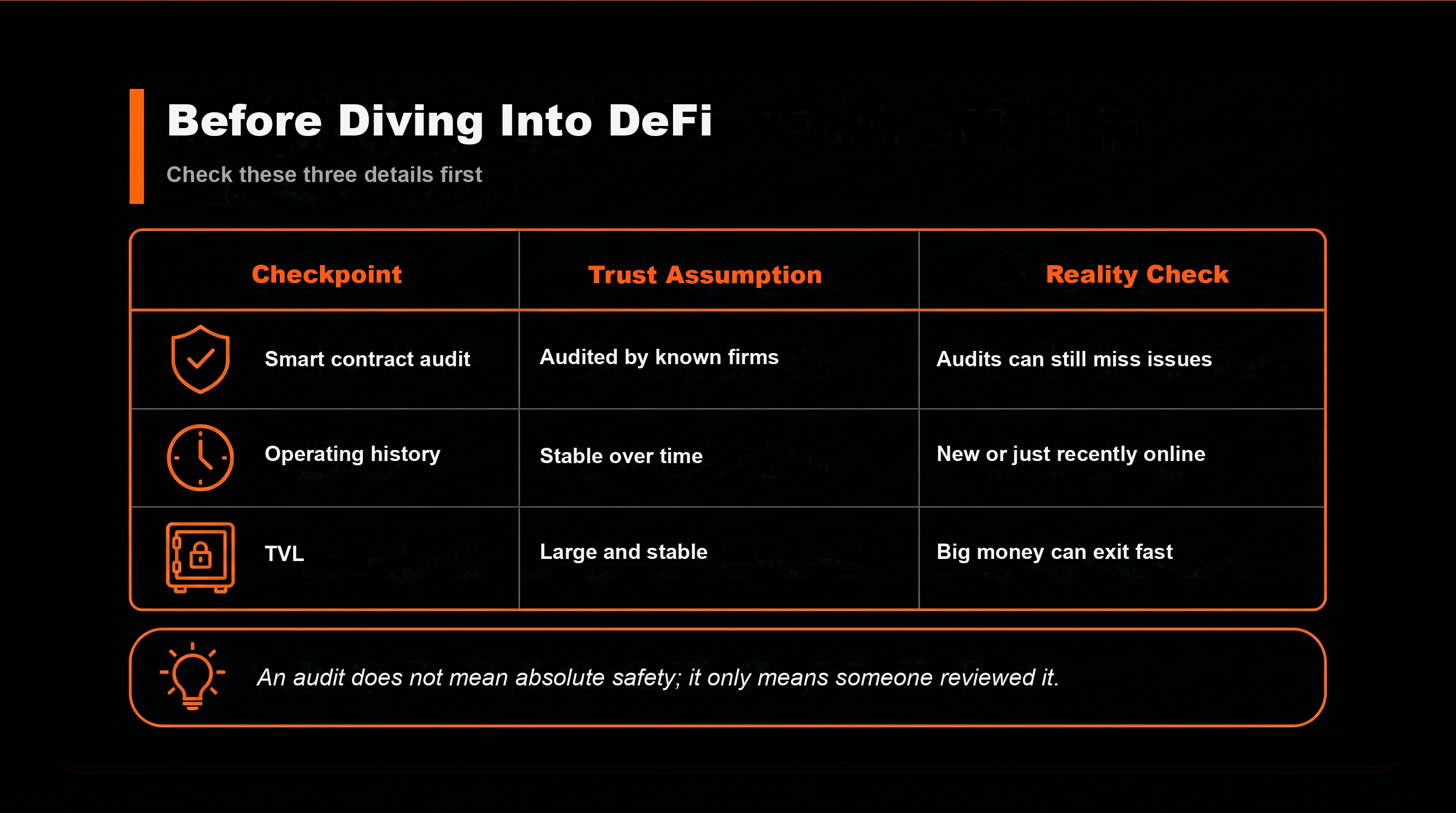
First look at audits, how long it’s been running, and the size of the funds
Before putting money into a DeFi protocol, I first spend time looking at a few of the most basic aspects as a first rough screen. Finding no problems in these doesn’t mean it’s absolutely safe, but if even one of them is clearly off, that’s usually enough for me to skip it entirely.
- Whether it has had a smart contract audit by a well-known security firm — but remember, being audited doesn’t equal being absolutely safe; Radiant’s failure happened in a human link outside the audit.
- How long the protocol has been running and whether it has been through a full bull-and-bear market cycle — time is the most honest stress test.
- The size and historical trend of total value locked (TVL) — be more cautious with protocols that are too new, too small, or have abnormal inflows and outflows.
Going through these three won’t make you 100% safe, but they help you filter out a large batch of high-risk projects whose problems are visible at a glance. I treat this as basic homework before entering; if you can’t even be bothered to do this much, you have even less business putting money in.
Don’t put all your assets on a single protocol
DeFi investing, the most dangerous approach in my view is putting your entire net worth into a single protocol and betting it will never go wrong. Radiant’s case has already told you that even the most respectable protocol carries the possibility of shutting down outright and your principal taking a severe hit.
Facing this “could go straight to zero” level of risk, the most solid — and the least technical — line of defense is diversification. Spread your funds across protocols of different types and different teams, and even deliberately keep a portion untouched in a wallet you control. That way, if one protocol really does get hacked and shut down, you’re at most wounded rather than wiped out. My own principle is simple and conservative: every sum I put into DeFi I decide the amount with a “this might not come back” mindset. Being able to sleep at night matters far more to me than earning that little bit of extra interest.
Understand the source of risk behind the yield
The last reminder, and the one most easily drowned out by high APY numbers: DeFi those tempting high yields usually correspond to risks you haven’t yet seen clearly. There’s no free lunch: an abnormally high rate of return is usually paying interest on some risk you haven’t noticed.
So before being drawn in by the yield, I force myself to answer a few questions first: where does this interest actually come from, what model does the protocol use to make money, and do its smart contracts and team operations have obvious weaknesses? Thinking these through is far more important than simply comparing whose APY is higher. Rather than asking “how high is the yield here,” first ask “behind this yield, what risk am I actually taking on.” A protocol that can’t even explain where its yield comes from, or whose yield is unreasonably high, I’ll skip no matter how pretty the numbers — because the risk you can’t understand is the most expensive risk.
After living through a hack, how should you adjust your DeFi mindset?
“After all this, should I keep DeFi at arm’s length?” My answer isn’t to run away, but to face it with a more mature mindset. Beyond the technical checklist, what really protects you over the long run is a correct understanding of risk. In this section we’ll round out the mindset piece, so you don’t overcorrect out of a single panic, nor forget the lesson out of a moment’s greed.
Treat DeFi yield as a “risk premium,” not free money
The first mindset to correct is not to treat DeFi’s high yields as some windfall falling from the sky that others don’t know about. Compared with traditional finance, DeFi can offer noticeably higher returns essentially because you take on more, and newer kinds of, risk — smart contract risk, team operational risk, protocol-collapse risk, none of which exist with a traditional deposit.
In other words, that extra interest is actually the risk premium the market pays you — compensation for bearing the possibilities above, not a perk for nothing. When you look at it this way, you won’t get carried away by an exaggerated APY number; instead you’ll naturally think: for this return, what extra risks am I carrying, am I willing to take them, and can I afford them? Shift your mindset from “earning free money” to “charging a fee for bearing risk,” and every decision you make will be a notch more cautious.
Work backward from the “worst case” to decide how much to put in
The second mindset is learning to work backward from the worst case, rather than charging forward from the best case. When many people decide how much to put in, what’s on their mind is “if the APY is this high, then if I put in a bit more, how much extra can I earn in a year” — a classic case of sizing bets backward from a happy ending.
But Radiant teaches us to do exactly the opposite: first ask yourself, “if this protocol gets hacked tomorrow just like Radiant and then shuts down, and none of the money I put in comes back, can I handle it?” If the answer is that it would severely disrupt your life and financial plans, that means you put in too much and should scale down. For every allocation I make in DeFi, the amount is worked backward from this worst case — first make sure I can withstand it even if it goes to zero, then go enjoy the yield it brings when it’s running normally. This order lets you survive a bit longer in this high-risk space.
Don’t let a single event scare you off, but don’t forget its lesson either
The third mindset, and the one that most needs balance: don’t, over a single event like Radiant, completely write off DeFi, but also never let this lesson slip your mind completely after a few months. Both extremes will actually hurt you.
If a major hack scares you off so thoroughly that you never touch it again, you may miss the genuinely valuable parts of this space; but if you forget it a few days later and once more get lured by high yields into piling into a single protocol, you’ve learned nothing. The more mature approach is to treat events like this as material for calibrating your own understanding of risk: it reminds you that audits aren’t a cure-all, recovery is nearly impossible, and that diversifying and controlling the amount are the real talismans. Internalize these principles into habits, and you can keep participating in DeFi while keeping the damage you’re exposed to in the worst case within a range you can bear.
Conclusion
This piece used Radiant Capital’s real case — hacked, chased for about a year and a half, and still shutting down in the end — to help you see the reality after a DeFi hack clearly: assets are often hard to recover, the protocol may shut its doors outright, and the ones standing at the very end to bear the outcome are often the retail users who deposited. Back to the question at the start — can you still recover your assets after a protocol is hacked? The answer is mostly that it’s very hard, or even impossible. But I wrote this piece not to scare you away from DeFi, but hoping you’ll see the worst case in advance: first check the audit, how long it’s been running, and the size of the funds; don’t put your whole net worth on a single protocol; understand the source of risk behind high yields; and decide the amount of every investment with a “this might not come back” mindset. Putting these principles into your allocation is the more grounded — and more lasting — way to face DeFi risk.


