

Are you thinking that since you can see every on-chain whale position, just copying them means you'll profit alongside them? This article won't teach you to copy everything blindly — instead it first helps you understand where the appeal of copying whales really comes from, then exposes three traps: you're always a step behind, what you see isn't the full picture, and whales lose money too — and you may not be able to afford to, then tells you how to use on-chain data the right way and when to walk away.
Why does everyone want to copy whales? First understand the appeal
"I can see the big players' trades — it'd be silly not to follow, right?" This is pretty much every beginner's reaction the first time they discover on-chain positions are transparent. But the most fascinating thing about copy trading is often exactly its most dangerous thing. In this section we won't rush into the traps yet — instead we'll get clear on why copy trading is so appealing, because only by first understanding where that appeal comes from can you spot which corner the trap is hiding around.
Transparent on-chain positions make people feel they've found a shortcut
Let's start with the most direct appeal: transparency. On Hyperliquid and similar on-chain perpetual contract platforms, positions are publicly queryable — who opened how big a long or short at what price, in theory you can dig it all up on-chain. For retail traders used to the information asymmetry of traditional finance, this is like suddenly getting a pair of x-ray glasses that let you see the cards in the big players' hands at the table.
So naturally, a group of people emerged who specifically watch those big wallets worth millions or tens of millions of dollars, wanting to copy every single move. That feeling of "I can finally see the inside info too" is itself very easy to get carried away by. But let me pour some cold water on it first: being able to see the cards, understanding the cards, and even winning alongside them are three completely different things. Transparency gives you the data, but it doesn't give you the ability to interpret that data at the same time, and the gap in between is the breeding ground for every trap that follows.
The gut feeling that "big players are smarter" doesn't necessarily hold up
The second appeal is a very instinctive kind of trust: big players have so much money and have been around so long, their win rate must be higher than mine, right? Following someone who knows more than me has got to beat guessing on my own. This gut feeling sounds perfectly reasonable, and it's indeed the argument the copy-trading narrative most often uses to convince you.
But there's a premise here that's easy to skip: there are many reasons someone accumulates whale-level capital, and not all of them are "they trade especially accurately." Some got in early and traded time for their chips, some came in with big capital to build allocations from the start, and some just got especially lucky during a certain stretch that you happened to see. In other words, "he has a lot of money" can't be directly extrapolated into "every trade of his is worth copying." When I see an impressive big wallet, I first ask myself: is this track record of his a replicable skill, or unrepeatable luck or a head start? If you can't think this question through clearly, copy trading is just outsourcing your trust to a stranger you don't actually understand.
You see the result, but you can't see the reason
The third point, and the one to remember most from this whole section: the real blind spot of copy trading is that what you see is always just the "result," not the "reason." You can see he opened a 10x leverage long, but you can't see why he did it, how long he expects to hold, or whether he has other arrangements lined up behind it.
It's like watching someone shove all their chips onto the table without having any idea whether the cards in their hand are good or bad, whether they're genuinely confident or purely bluffing. The same move might be part of a plan for him, but the start of a disaster for you if you blindly follow. This is how I remind myself, and remind you: on-chain, seeing a position doesn't mean understanding a position, let alone that this position is suitable for you to copy. Keep this premise in mind, and next we'll take the traps apart one by one, to see where exactly copying the answers goes wrong.
Trap one: you always enter a step late, and your cost is inherently worse
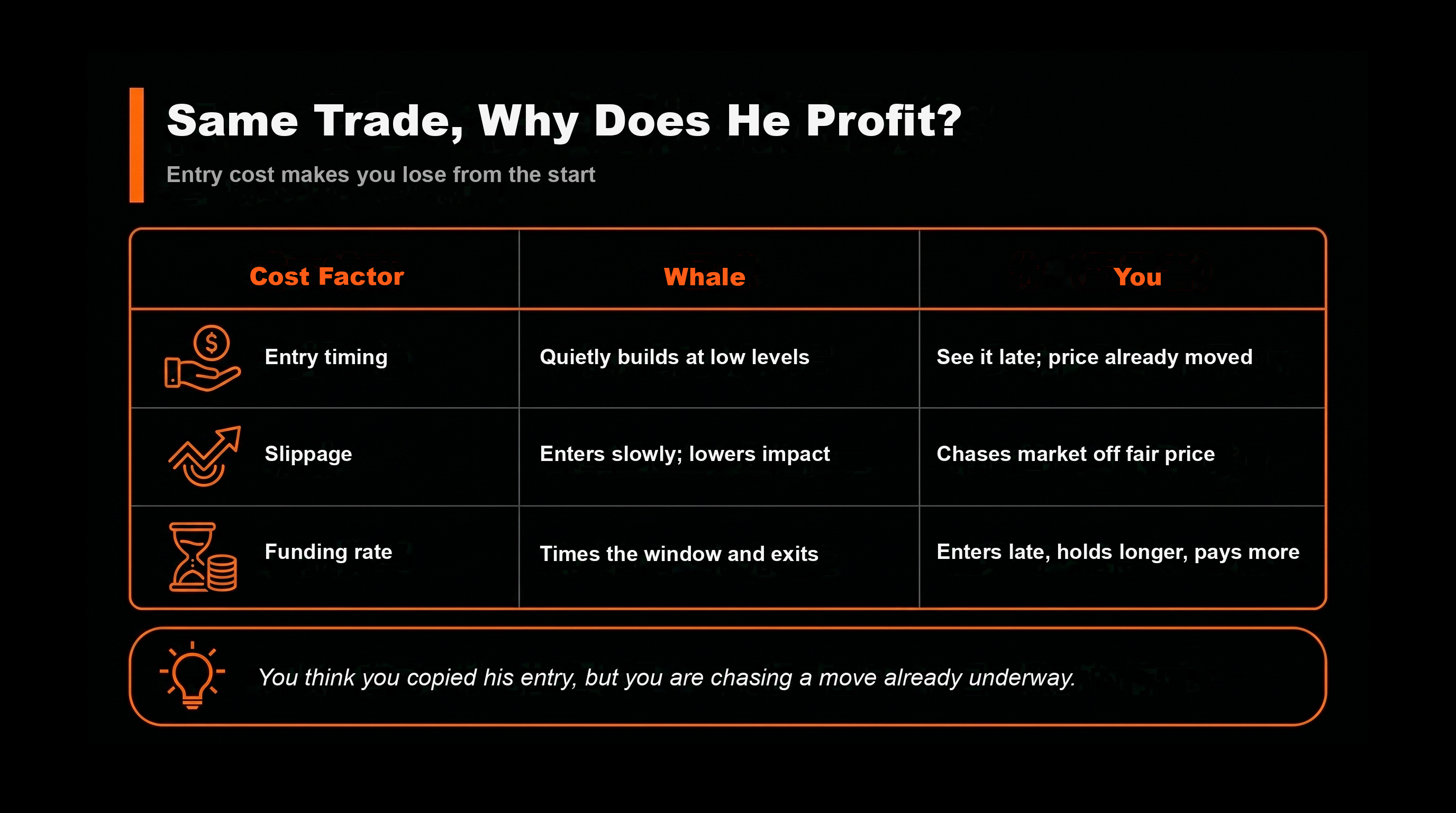
"On-chain data is so real-time now — how bad can copy trading really be?" The answer is, the difference is that you and the whale simply aren't entering at the same time or the same price. This section covers the first and most technical trap: from the time lag, slippage, to funding rates, your entry cost loses at the starting line from the very beginning, and this invisible gap is enough to make the same trade one where he profits but you don't.
By the time you see it and get filled, the price has long moved
The first cost is hidden in the time lag. You first have to spot his position on-chain, confirm the direction, then switch back to the trading interface to place the order and wait for the fill — no matter how fast this chain of actions is, it takes seconds to minutes. And in a violently volatile contract market, a few minutes is enough for the price to run a long way.
Even more realistically, whales often quietly build positions at relatively low, relatively quiet levels, and by the time you see it on-chain and think the trade has potential, the price has very likely already been pushed up a good bit. You think you're copying his entry price, but you're actually chasing a move that's already underway. When I look at big on-chain orders, I just assume "everything I see is in the past tense," because by the time the info reaches me, the best entry point is usually already gone. Factor in this lag and you won't picture copy trading as too rosy.
Slippage and liquidity quietly eat into your profit
The second cost is slippage. Whales have big capital, but they usually know to pick moments of good liquidity and to enter slowly by splitting orders and other methods, minimizing their own impact on price as much as possible. Retail traders in a hurry to copy, on the other hand, often chase in at market price the moment they see a signal, and especially with low-liquidity small coins, a single order can push the price to an obvious deviation.
What does this mean? Same direction, same asset, your actual fill price may be a good bit worse than his, and this gap is deducted directly from your future profit. You might not care when the move goes your way, but as long as this trade ends up a small gain or small loss, this bit of slippage is enough to turn you from a gain into a loss. I treat slippage as a fixed tax on copy trading — first admit it definitely exists, then assess whether the trade is worth copying at all, rather than naively assuming you can get the same price as the big players.
Funding rates and holding time — you can't copy them accurately
The third often-overlooked cost is the perpetual contract funding rate, along with the mismatch in holding time between you and the whale. Perpetual contracts have no expiry date, but longs and shorts periodically pay each other the funding rate, and when the market is hot and everyone is rushing to go long, this fee can be noticeably high.
The whale may have timed the funding window and plans to hold only briefly before leaving, but by the time you see the position you're often half a beat late, so you end up holding longer than he does and paying more funding rate than he does — he already took profit while you're still there carrying unrealized losses and paying fees. This double mismatch of "entering late and exiting out of sync" makes your real return drift further and further from the position you copied. So before I copy a trade I always get clear on this: do I have his entry and exit rhythm? If I don't even know how long he plans to hold, then what I'm copying is really just a momentary snapshot, not a complete trade.
Trap two: what you see isn't the full picture — he may be hedging or offloading
"An on-chain order is crystal clear — what could there possibly be that I can't see?" And yet the most fatal things are exactly the ones not on that order. This section covers the second trap: the one leg you see on-chain is often just part of the whale's entire setup, and his real hedging — even his motive to offload onto you as the counterparty — is all hidden outside your line of sight.
He may be hedging in the opposite direction elsewhere — you only copied half
The first thing you can't see is hedging. A mature pool of big capital rarely bets all its risk on a single naked position. He could well have opened an opposite short in another wallet, on another chain, or even at another centralized exchange to lock in the risk.
What does this mean? That beautiful long you see on Hyperliquid may be just one leg of his entire hedging strategy — his other leg already hedged away the downside risk. But you only copied the visible half, which is like taking the risk he carefully avoided and pouring the whole bowl over your own head. When I look at any on-chain position, my default stance is "this is just the tip of the iceberg," not his full hand. What you can't see doesn't mean it isn't there — it just means it happens to not be in your x-ray glasses.
Sometimes a big player's order is shown for the copycats to see
The second thing to be more wary of is motive. When a big player knows his position is public and will be watched and copied by a crowd, he could well turn around and "exploit" this transparency. In other words, the order he shows you isn't necessarily the direction he genuinely wants to take — it may be put on for the copycats to see.
A common script goes like this: he quietly builds his position at a low level first, then uses one conspicuous large order to whip up market sentiment, and once the copycats pile in and push the price higher, he uses that wave of liquidity to dump his own chips onto you. You think you're getting on board with smart money, but you're actually holding up the sedan chair for him and taking the last bag. I'm not saying every big player is scheming against retail, but as long as this possibility exists, you can't treat an on-chain position as pure, unadulterated honesty. A public order may be intel behind the scenes, or it may be a trap — you have to tell them apart yourself.
On-chain data has delays — what's in the frame is the past
The third layer you can't see comes from the lag and noise of the data itself. On-chain looks real-time, but from when a transaction happens, gets confirmed on-chain, to being tagged, organized, and pushed to you by various analytics tools, there's a time gap at every step; and the tools that label things as "famous whales" for you may also mislabel, miss, or split one person's multiple addresses apart.
This means what you see is often past-tense data that has passed through many hands, and may even have been misread. You think you've got real-time intel, but what's in your hands is actually a photo focused on the past. I treat on-chain data as a clue that needs cross-verification, not an instruction you can follow directly. Data that you can't see fully and that comes with a time lag is by nature only suitable for supporting your judgment — the moment you treat it as the sole basis for placing an order, that's when the real danger begins.
Trap three: whales lose money too, and you may not be able to afford it
"Say what you will, a big player has got to understand more than me and be able to take more heat than me, right?" This is probably the myth that most needs to be broken. This section covers the third and most hurtful trap: on-chain whales are not gods who always win — they get it wrong and get liquidated too, and even if he really is wrong and can withstand it, the same drawdown can knock you — with far less capital — straight out of the game.
Whales taking huge losses is something that has really happened
Let's start with a fact many people would rather not face: on platforms like Hyperliquid, cases of famous whales taking huge unrealized losses over an entire round, or even being force-liquidated, are hardly rare news. The leverage these big wallets use is often not low, and once they get the direction wrong, losses easily run into the millions of dollars, and the process is just as ugly.
What this punctures is exactly the illusion that "following big players is safe." That high-win-rate god-tier wallet in your eyes may just have caught a favorable stretch of the market, or you only saw the few trades where he profited and happened to miss the round where he blew up. Treating a stretch of impressive positions as a guarantee of long-term steady winning is the biggest illusion in copy trading. The way I remind myself is simple: anyone, no matter how big their wallet, will have moments when they get it wrong — the only difference is whether you happen to see it. Since he loses money too, then copying him naturally has no guarantee of winning either.
A 30% loss is a minor scratch for him — you might go straight to zero
Even taking a step back — say he really got it right this time, and say he can withstand it even when he occasionally gets it wrong — there's still a harder gap to cross between you and him: capital size and risk tolerance. For a whale with enormous principal, a position down 30% on paper may only be a flesh wound, not a broken bone — he can withstand a deep drawdown and can afford to wait for the rebound that follows.
But that same 30% drawdown, landing on you — betting heavily with small capital and stacking on leverage — may end completely differently: your margin might hit the liquidation line and go to zero one step earlier, while he's still calmly waiting for the rebound. By the time the price really bounces back, he makes a killing, but you've long been swept out of the game, without even the qualification to stay at the table. The same position is a small slice of his allocation, but may be your entire net worth for you. This inequality in risk tolerance turns blind copy trading into taking your own little boat and trying to learn how an aircraft carrier turns.
With unequal tolerance, copy trading is essentially amplifying risk
Put the previous two points together and you'll find that when it comes to risk, copying whales is a structurally unequal game. He has overall allocation, ample principal, and hedging tools — this one trade is just a single move on the chessboard for him; while you often treat the order you see as the whole thing and bet in at a ratio you can't afford.
This is why the same operation is one part of risk management for him, but may be the source of risk for you. Copy trading doesn't shrink your risk — on the contrary, because you have less information, thinner capital, and lower tolerance, it quietly amplifies the risk. I'll put it bluntly: before the gap in conditions between you and the whale is leveled, blind copy trading isn't hitching a ride — it's using your most fragile position to take on risk that others have long since diversified away. Once you see this inequality clearly, your expectations for the word "copy trading" will come back down to earth.
So is on-chain whale data still usable? How to use it the right way
"After all these traps, is on-chain whale data completely useless and should I just ignore it?" Not at all. It's actually a very useful piece of market intel — the problem was never about "looking at" big-player data, but about treating "seeing" directly as "doing". This section gives you a few principles for using it the right way, putting on-chain positions back where they belong: a reference, not an instruction.
Treat whale positions as intel, not as trade instructions
The first and most core shift in mindset is to position on-chain whale data as "intel," not "instructions". Intel means it can help you sense market sentiment, observe roughly which direction big capital is moving, and which assets have been getting attention lately — all of this helps you build market feel.
But the biggest difference between intel and instructions is that intel is meant to support your judgment, with you still making the final call; instructions mean you do whatever someone tells you, which is like handing over the steering wheel entirely. When I look at big players' moves, I treat it as a signal that "someone in the market thinks this way," not a command that "I should do this too." Once you separate the two clearly, on-chain data goes from a source of pressure forcing you to chase trades back to being a good tool that adds perspective for you. Looking is meant to help you think more clearly, not to copy faster.
Come back to your own plan and decide your own entries and exits
The second principle is that no matter how tempting a big player's position looks, the final entry and exit decision must come back to your own trading plan. After seeing a signal, don't rush to act — instead turn around and ask yourself: does this direction match my original judgment? Is this asset within my circle of competence? If this big player's order didn't exist today, would I make this trade on my own?
These few questions will help you filter out a huge number of impulsive trades that are "purely because someone else did it, so I want to do it too." People who really survive long-term rely not on copying accurately, but on having a judgment framework of their own that can be repeatedly tested. Big-player data can be one input in this framework, but it should never replace the entire framework. Hold the power of judgment firmly in your own hands, and you won't lose money alongside a big player when he gets it wrong someday — while unable to even explain why you entered.
Set stop-losses, control position size, always use your own yardstick
The third principle comes down to the most practical position management: no matter whether you finally decide to follow or not, you must use your own risk yardstick, not the big player's yardstick to act. Before placing an order, get clear on two things — the most this trade is willing to lose, and the point at which I'll take the loss and exit — then set the stop-loss; next, use an amount you "can afford to lose" to size the position, rather than going all-in just because you saw a big player bet heavily.
The following simple self-check list is the one I quickly run through before using on-chain data — thinking it through this way can block most impulsive copy trades.
- What's the role of this money? Is it principal I can't afford to lose, or risk capital that can withstand big swings?
- If this trade goes deeply underwater right after I enter, where is my stop-loss set, and what's the most I can accept losing?
- Could the position I'm seeing be just half of the other side's strategy, or deliberately put on for the copycats to see?
- Did I enlarge my position and stack up leverage just because he bet heavily? Can I dial the ratio down first?
Once you can answer all four questions, then deciding whether to act and how much will be far steadier than staring at someone else's wallet and chasing pumps and dumps. The real problem with copy trading was never looking at big-player data, but outsourcing your judgment to someone else. Being able to see others' positions is a good thing, but the hand that actually presses the order button has to be your own.
Conclusion
Starting from the real situation where even Hyperliquid whales take huge losses, this article helps you see clearly the three traps of copying on-chain whales: you always enter a step late and your cost is inherently worse; what you see is only a fragment, and he may be hedging elsewhere, or even offloading onto you as the counterparty; and whales lose money themselves, with risk tolerance on a different level than yours, so the same drawdown is enough to sweep you out first. On-chain positions are useful intel, but they shouldn't be treated as a guaranteed-win trade instruction. Treating it as a reference, coming back to your own plan, setting stop-losses, and controlling position size with your own affordable yardstick is far safer than blindly copying big players. Being able to see others' cards is great, but the hand that places the order always has to be your own.


