

Have you seen Zcash, Monero, and other privacy coins getting a lot of attention again lately and felt a little tempted to follow the wave? This article won't add fuel to the hype. Instead, it first helps you understand what privacy coins really are, how Zcash and Monero differ, and what a Shielded address is, then points out the regulatory and delisting risks every beginner should understand, why its price swings are so violent, and finally helps you decide whether to touch it at all.
What Are Privacy Coins? And Why They're Being Talked About Again Lately
"Isn't Bitcoin anonymous too? What exactly makes privacy coins special?" This is the most common beginner misconception. The difference is that Bitcoin is actually "semi-transparent," while privacy coins are the ones that actually hide your transactions. Once this distinction is fully clear, all the regulatory risks that follow will make sense.
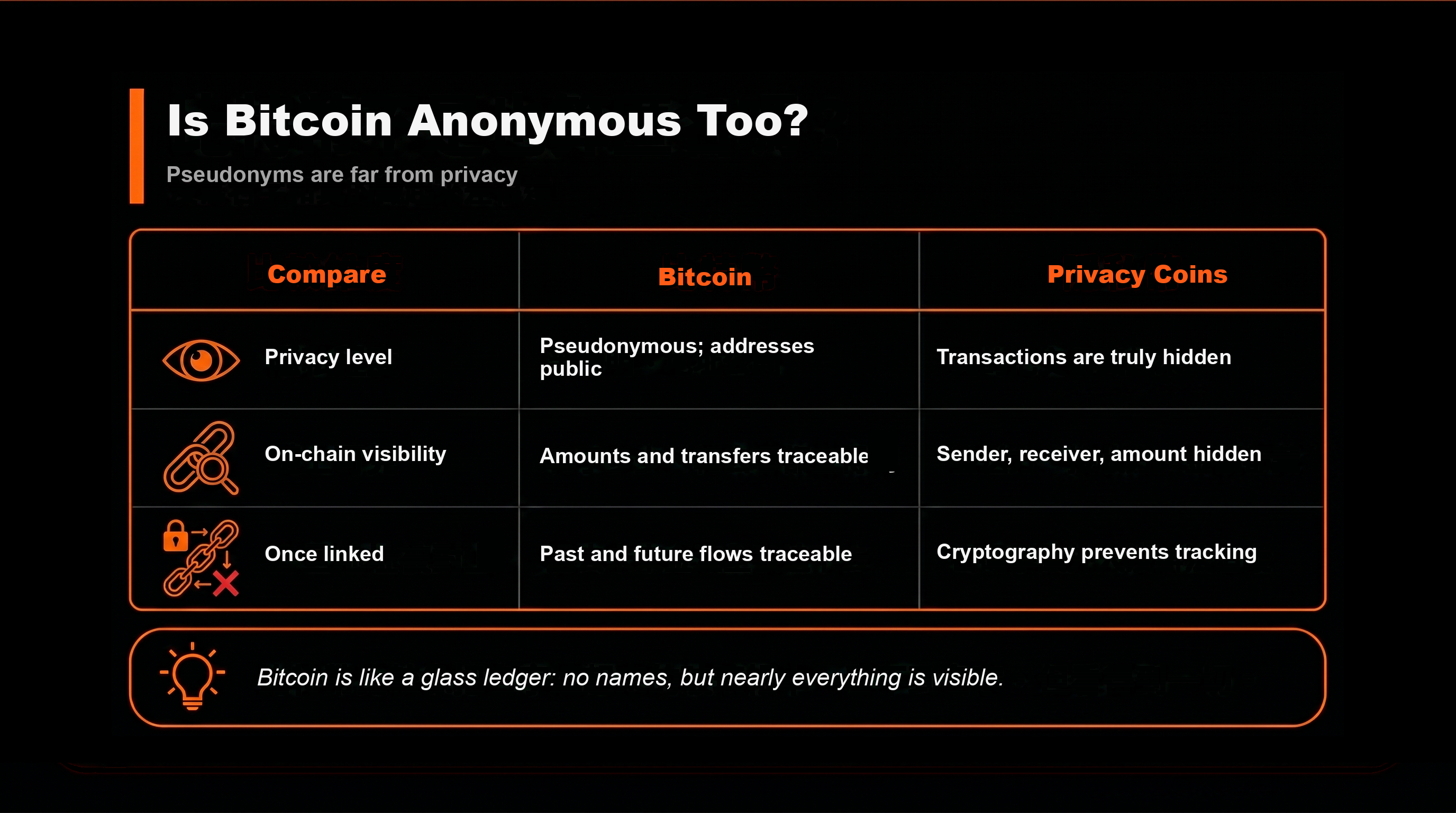
Bitcoin Just "Doesn't Write Your Name" — It's Not Truly Anonymous
Many people assume Bitcoin is anonymous, but that's a lovely misunderstanding. Every Bitcoin transaction is recorded publicly on-chain — which address, how much was sent, and where it went can all be looked up by anyone who opens a block explorer, it just doesn't have your real name written on it directly. It's more like "a public ledger kept under aliases" than a truly invisible set of transactions.
This difference is deadly in practice. As soon as someone can link one of your addresses to your real identity — say, you withdraw crypto from an exchange that holds your KYC data — then in theory, every past and future money flow on that address can be traced all the way through. I'd remind beginners not to treat Bitcoin as a privacy tool. When it comes to privacy, at best it's a glass ledger with the name covered up: you can't see the name, but you can see everything else.
Privacy Coins: Genuinely Hiding "Who Sent What to Whom"
What privacy coins set out to solve is exactly this "you can see everything" problem with Bitcoin. Using cryptographic techniques, they genuinely hide the most sensitive information in a transaction — the sender, the receiver, and the amount, so that outsiders on-chain can't trace where the money goes. The two most representative projects in this space are Monero (XMR) and Zcash (ZEC).
On the demand side, privacy coins answer something very real: financial privacy. Not everyone who wants to hide a transaction is doing something wrong — some people simply don't want their salary, spending, and assets laid out on a public ledger to be analyzed. The problem is that this "outsiders can't see it" trait collides head-on with exactly what regulators want most: "traceable and auditable."So from the day they were born, privacy coins were destined to walk a path in constant tension with regulators — and this is the source of all their later risks. Remember this, and everything that follows becomes easy to grasp.
Why Are They Being Hyped Up Again This Round?
The buzz around privacy coins is almost always tied to two things: price volatility and regulatory news. This round is no exception. On one side, privacy coins recently put in a notable price run that pulled capital's attention back to them; on the other, regulatory news keeps coming — some exchanges have relisted them, while some regions have rolled out stricter new rules — turning "can privacy coins even survive?" into a hot topic.
When I personally see an asset where "narrative hype" and "regulatory pressure" are brewing at the same time, I get especially cautious, because these two are often two sides of the same coin: it's precisely because it sits on the regulatory red line, with a future full of uncertainty, that it has such huge room for imagination and volatility, attracting short-term money in and out.In other words, the hype that draws you in and the risk that could burn you often come from the same source. Beginners easily see only the former and rush in, without realizing they've also taken on the latter. Let's get this mindset straight first, then look at the technical details.
How Do Zcash and Monero Differ? And What Is a Shielded Address?
"They're both called privacy coins — aren't Zcash and Monero the same thing?" Actually, their privacy designs differ a lot, and this difference isn't just a matter of technical preference — it directly determines their different fates under regulation. In this section, I'll make Monero's "mandatory anonymity," Zcash's "optional privacy," and the Shielded address everyone hears about but can't quite explain, all clear at once.
Monero: Fully Anonymous by Default, No Choice About It
Monero's biggest feature is "mandatory privacy" — every single one of its transactions is anonymous by default, users have no option to turn privacy on or off, because privacy is simply its underlying setting. It uses several cryptographic techniques at once to hide the sender, the receiver, and the transaction amount all together, leaving almost no traceable clues on-chain.
This design makes Monero's privacy just about the strongest among mainstream coins, but "strongest" is also its biggest headache. Precisely because it achieves near-total untraceability, it has become the asset regulators fear most, and a regular on exchange delisting lists around the world. This is Monero's most paradoxical trait: its core strength and its biggest risk actually come from the same source — you love its total anonymity, and regulators want to push it out of regulated markets for exactly that same total anonymity. Beginners need to recognize first that buying Monero means buying not just privacy, but also the compliance baggage that privacy brings.
Zcash and Shielded Addresses: Privacy Is "Optional"
Zcash takes a completely different route: it makes privacy an "option," letting you decide for yourself whether to hide each transaction. Specifically, Zcash has two kinds of addresses. One is the transparent address, where transactions are publicly viewable just like Bitcoin's and relatively friendly to regulators; the other is the Shielded address everyone hears about, which uses a technique called zero-knowledge proofs to hide transaction contents and achieve privacy.
Zero-knowledge proofs sound mysterious, but the concept can be understood like this: they let you "prove to someone that something is true without revealing any details about it." Applied to a transfer, Zcash can prove to the whole network that "this transaction is valid and no money was printed out of thin air," while at the same time not disclosing who sent to whom or how much.Precisely because Zcash keeps the flexibility to switch into transparent mode, it has one more fallback than Monero when facing exchanges and regulators. The comparison below helps you quickly remember what each of the two address types does:
- Transparent address: transactions are publicly viewable, similar to Bitcoin, the least controversial for compliance, and suited to situations where you need to prove your money flows to others.
- Shielded address: uses zero-knowledge proofs to hide transaction details and achieve real privacy, but it's also the part regulators care about most.
In other words, though both carry the "privacy coin" label, Zcash is more flexible on compliance than Monero — it can switch between "I want privacy" and "I'll cooperate with regulators," while Monero only has the former option. This flexibility is exactly the key to how their fates diverge next.
This Difference Directly Determines Their Fates
Why spend so much space breaking down this detail? Because the difference in privacy design shows up very directly in one very practical thing: whether exchanges dare to list it, and whether they're willing to keep it listed. Monero's always-on, mandatory anonymity leads many regulated exchanges to simply avoid it or delist it outright, because they can't account to regulators for these coins' money flows; Zcash, because it can switch into transparent mode, is relatively easier for platforms to accept and keep listed.
For beginners, this difference concretely affects your experience: the channels to buy and sell Monero may be fewer and less stable than Zcash's, and the day you want to exit, the number of usable exchanges may already have been cut in half. So choosing which privacy coin is never just about comparing which tech is stronger — you also have to think about "will I still be able to conveniently turn it back into cash in the future." When I look at this kind of asset, I put "can get in, can also get out" ahead of "how strong the privacy is," because for the vast majority of beginners, liquidity affects your real risk far more than that little bit of extra privacy strength.
What Beginners Really Need to Understand Is Regulatory and Delisting Risk
"I get the tech roughly now — so what should I actually be worried about?" The answer may not be what you think: what you really need to fear isn't whether it will drop, but that you can't sell when you want to. Privacy coins' biggest risk comes from regulation, and the impact of regulation lands very concretely on the coins in your hands through exchange delistings. Let's make this clear in this section.
Exchange Delisting Is the Most Direct, Most Personal Risk
Privacy coins' most realistic and most common risk is exchanges delisting them for the sake of compliance. This isn't hypothetical — it's a script that has played out repeatedly over the past few years. Platforms like Kraken, OKX, and ShapeShift have all delisted privacy coins like Monero and Zcash under regulatory pressure, and some later relisted them — but this back-and-forth itself shows just how high the uncertainty is.
The consequences of delisting are very direct and hit you on two levels at once. First, liquidity instantly worsens — a channel that used to let you buy and sell suddenly disappears, the remaining market depth is thin, and you may have to sell at a terrible price; second, you may be forced to withdraw or convert the coin within a deadline, and if you don't handle it in time, things get even more troublesome afterward. So I treat "is this coin still stable on the mainstream exchanges I use, and are there any delisting rumors" as the number-one risk indicator for holding privacy coins, rather than only watching its price go up and down.If the price drops you can still wait, but once the channel is gone, you don't even have a place to wait.
Tightening Regulation Across Countries Is a Long-Term Trend Hanging Over Your Head
The bigger backdrop beyond any single exchange delisting is that global regulators' attitude toward privacy coins is tightening overall, and in a fairly consistent direction. Take the EU: the relevant anti-money laundering (AML) rules are moving toward "banning anonymous accounts and requiring regulated platforms to delist strongly anonymous coins," and the market broadly expects such rules to come into force over the next year or two; in the US, regulators are also keeping up the pressure on privacy coins, and some exchanges have already adjusted their listings as a result. Putting all this together, the room that regulated mainstream exchanges are willing to give privacy coins is shrinking overall.
But there's a crucial nuance here that beginners must get straight: an exchange delisting mostly reflects "the platform's compliance policy," and doesn't necessarily mean "holding it personally is illegal." In many regions, privately holding privacy coins, or moving them between wallets you control, is still legal; what's mainly affected is "whether you can conveniently buy and sell on large regulated platforms." So the real damage of this long-term trend isn't turning your coins into worthless paper overnight, but making them harder and harder to buy, harder and harder to sell, and more and more marginalized. Whether you touch it depends on first thinking through this "it'll get less and less convenient" long-term direction, rather than feeling reassured just because you can still buy it right now.
Before Buying, Think Through "How to Exit" First
Based on all these risks, my basic attitude toward privacy coins comes down to one line: before you enter, plan your exit first. This sounds like a cliché, but it's especially important for privacy coins, because their exit channels are themselves a high-risk variable that shrinks as regulation shifts — unlike mainstream coins, which you can sell almost anytime.
If, after weighing it, you still decide to hold, I'd suggest at least doing a few things first: confirm whether you can currently buy and sell it normally on the exchanges you use, keep an eye out for related delisting announcements or regulatory news, and never lock a large sum into an asset whose liquidity can change at a moment's notice. The privacy coin story is genuinely fascinating, and there's real technical value to it, but for beginners, "whether you can sell smoothly, and whether you'll one day be stuck immobile on a compliance issue" should always take priority over "how much it's gone up this year". Think about the exit up front, and you won't discover you're trapped at the very moment you most need to cash out.
Why Are Privacy Coin Prices So Violent? And How to Think About Their Volatility
"Since there are so many risks, what's the deal with the price — why does it swing wildly up and down at the drop of a hat?" Understanding privacy coins' volatile temperament helps you hit the brakes when a rally lights up your fear of missing out (FOMO). In this section we'll talk about a few forces behind its price, and the mindset beginners should use to view this volatility.
Regulatory News Is Its Biggest Price Switch
What most sets privacy coins apart from ordinary mainstream coins is that their price is unusually sensitive to "regulatory news." A single report that a major exchange has relisted it can send it shooting up in a short time; conversely, a single report that some country is preparing restrictive legislation, or that some platform is announcing a delisting, can crash it a long way in an instant.For privacy coins, regulation isn't just a background risk — it's the single biggest switch on the price.
This means that holding a privacy coin is equivalent to also betting on a variable you can barely predict — policy. You have no way of knowing which regulator, on which day, will drop what kind of news, yet that news can decide your paper profit or loss within minutes. I'd remind beginners this way: when an asset's price is mainly driven by policy news you can't control and can't know in advance, it's essentially closer to a gamble of information asymmetry than an investment where you can gain an edge through research. See this clearly, and you won't mistake a short-term surge for good judgment on your part.
A Small Market and Concentrated Holdings Amplify the Swings
Beyond the news side, privacy coins' market structure itself also amplifies their volatility. Compared with huge mainstream coins like Bitcoin and Ethereum, most privacy coins have far smaller market caps and daily trading volumes, and on top of that they're excluded from many large regulated platforms, so the market that can trade them is actually narrower and shallower.
A small, shallow market means a relatively modest buy or sell order is enough to push the price a long way. When a narrative heats up and money pours in all at once, the thin sell side gets swept up quickly and the price shoots up; but once the hype fades and people start taking profits, the equally thin buy side can't catch it, and the price gives it all back fast.This "rises fast and falls hard" temperament comes in large part from its inherently small market. I'd file this kind of asset in the "volatility amplifier" drawer: it can give you outsized excitement in good times, but also outsized damage in bad ones. The point is whether you've prepared for the latter in your mind before you enter.
Treat It With a "Risk Capital" Mindset
Precisely because privacy coins are driven by two forces at once — regulatory uncertainty and small-cap volatility — I think that if beginners really want to touch them, the healthiest mindset is to treat them as standard "high-risk speculative capital," rather than as a core holding in your asset allocation. It's not the kind of thing you can leave alone with your eyes closed and comfortably hold for many years.
In concrete terms, this means strictly controlling the proportion you put in — only participate with spare money that, "even if it all goes to zero, won't affect your life and other plans," and accept in advance that it may pull back sharply, or even stay depressed for a long time because of some regulatory event. Never move money that should sit in your survival position over to chase it just because it's been rallying hard lately, and definitely don't stack leverage on this kind of asset — its volatility is already big enough, and leverage will only sweep you out at the worst moment. Put it in the right drawer — a drawer you can afford to lose — and your expectations and actions around it will fall into place.
Think Through These Questions Before Deciding Whether to Touch Privacy Coins
"That's a lot to take in — so should I buy or not?" In this section I won't make the decision for you, and I won't give you a hot tip. Instead, I'll condense all the earlier risks into a decision framework you can run through yourself before acting, to help you separate impulse from reason.
First Confirm "Why You Want to Buy"
Before you hit buy, the question you should most honestly face first is: why exactly do you want to buy this privacy coin? The answer to this question almost determines all of your later risk tolerance. If your reason is "lots of people are talking about it lately and it's rallying hard, I'm afraid of missing out," then be especially careful, because that's a classic entry driven by hype and FOMO — and privacy coin hype is especially prone to coming fast and leaving fast.
Conversely, if you genuinely agree with the value of financial privacy, understand and accept the regulatory risk that comes with it, and are willing to participate with a small position over the long term, that's a different matter — at least you know what you're taking on and why. My own standard is simple: if I can't state a reason for "even if it drops hard next, I won't regret it," then I probably shouldn't place the order. Get your motive straight, and you won't find yourself, when the price moves against you, unable to even answer why you got in in the first place.
Put "Compliance and Exit" Ahead of "Upside"
The decision-making difference between privacy coins and ordinary coins is that you have to put "compliance and exit" ahead of "how much it can rise." For most assets, you care about returns; but for privacy coins, what you should care about first is: the day I want to leave, can I actually get out? Because its exit channels are themselves an uncertain variable that shrinks with regulation.
So before acting, I'd suggest concretely thinking through the exit question, rather than vaguely feeling "I'll just sell when the time comes." The following questions are, in my view, the ones most worth stopping to ask yourself before touching privacy coins:
- Can the exchange I plan to use to buy and sell it still trade this coin normally right now? Are there any delisting rumors or announcements?
- If it gets delisted from the platform I usually use, do I have any other reliable, compliant channel to sell it or convert it into a mainstream coin?
- Is the amount I'm putting in kept within the range of "even if it's locked up long-term, or even goes to zero, it won't affect my life"?
- Is my reason for buying it that I agree with its value and accept the risk, or purely that it's gone up a lot lately and I'm afraid of missing out?
If you can give clear answers to all four of these questions before deciding whether to act and how much, that's far steadier than watching a sharply rising candle and rushing in with the crowd's emotions.The quality of your judgment is never about how accurately you predict, but about whether you asked these most practical questions clearly before placing the order.
Not Buying Is Also a Perfectly Reasonable Option
Finally, I want to specifically point out something many beginners overlook: for privacy coins, "deciding not to buy" is itself a perfectly reasonable, and often even smarter, option. There are plenty of profitable assets in the market, and you have no obligation to touch every hot narrative — especially one whose risk sources are largely beyond your control.
Privacy coins' core risks — the direction of regulation, policy news, exchange delistings — are almost all outside your control, and no matter how hard you research, you can't predict whether some country will suddenly act next month. When an asset's fate is mainly decided by external forces you can't reach, choosing to stand on the sidelines and watch, waiting until the picture is clearer, isn't cowardice — it's a discipline of being responsible for yourself. When I face this kind of highly uncertain narrative, the decision I often make is simply not to participate — leaving my capital for opportunities I understand better and can sleep more soundly with. Choosing not to step in after understanding the risks, and stepping in cautiously after understanding them, are two equally respectable kinds of maturity.
Conclusion
This article has helped you understand why privacy coins are being discussed again, and made clear the key difference between Zcash and Monero — Monero is fully anonymous by default, with the strongest privacy but also the highest risk, while Zcash uses Shielded addresses and zero-knowledge proofs to achieve optional privacy, giving it more flexibility on compliance. But for beginners, what you should remember is never which tech is stronger, but rather that privacy coins' biggest risk lies not in the tech, but in tightening regulation and exchange delistings, along with the violent volatility that comes from its inherently small market. So before you buy, thinking through "how to exit" first, confirming whether the buy-and-sell channels are stable, and keeping the amount within what you can afford to lose is far more rational than being drawn in by the narrative hype and rushing in. And don't forget: choosing not to touch it after understanding these risks is itself a perfectly reasonable decision.


