

Do you also think of a “flash-loan attack” as some hacker scene that only happens in movies, completely unrelated to you depositing money in a vault to earn interest?Summer.fi's $6 million net loss this time, of all things, started from a series of perfectly legal deposit and redemption operations. This article won't dress it up as some mysterious black-box tech — it first untangles the misconceptions, the accounting bug, and the attack flow, then tells you whether the money you've put in a vault is actually something to worry about.
Is a Flash-Loan Attack a Hacker Breaking Into Your Wallet? The 3 Most Common Newcomer Misconceptions
Doesn't a flash-loan attack sound like something straight out of a movie — a hacker staring at your wallet, cracking the private key in seconds, and emptying it out?In Summer.fi's incident this time, nobody's wallet was ever breached — the attacker used the protocol's completely open, normal functions, and simply inflated the accounting data until the system miscalculated.Understanding these misconceptions is what lets you follow the attack flow described later — and it's also where I've seen the most newcomers get it wrong.
Misconception One: Assuming a Private-Key Leak Is the Only Way to Get “Robbed”
A lot of people, upon hearing “a protocol got attacked,” instinctively assume a private key got stolen or a wallet got hacked. That instinct usually makes sense for phishing scams or fake wallet apps, but it doesn't hold up when applied to a vault protocol like Summer.fi. The attacker never got hold of anyone's private key from start to finish, and never used any admin privileges — the flash loan they borrowed, the deposit they made, and the redemption they executed were all normal functions Summer.fi makes available to every user.
In other words, this vulnerability isn't about “whose key got stolen” — it's about how the protocol calculates the assets sitting inside the vault.No matter how carefully you guard your private key, if the accounting logic itself has a flaw, your assets can still get inflated into being worth less than they should be. This is also why guarding against phishing and fake links isn't enough on its own — the vault's own design risk is the real lesson to take away from this incident.
Misconception Two: Thinking a Flash-Loan Attack Is Just Like a Regular Loan Scam
Another common misconception is imagining a flash-loan attack as a scaled-up version of a bad-debt scam — as if someone borrows a huge sum, does something malicious, then skips town leaving a pile of debt behind. But flash-loan rules work completely differently: borrowing and repayment must be completed within the same block, in the same transaction. If the loan isn't fully repaid, the entire transaction simply fails, as if it never happened.
This means the attacker simply can't afford the risk of “defaulting” — they have to operate the borrowed $65.4 million within an extremely short window and come out with more than the principal, or there's no way to walk away clean.What this type of attack really tests is whether you've found a flaw in the accounting logic, not how much nerve you have.Newcomers who focus only on “how much was borrowed” end up missing the actual manipulation technique that matters, and underestimate the preparation behind this kind of attack.
Misconception Three: Assuming a Protocol Pausing Withdrawals Means the Funds Have Already Been Recovered
After the Summer.fi incident broke, the protocol quickly paused withdrawals across all its vaults — a move newcomers often misread as “the money's already safe” or “the bleeding has already stopped.”In reality, pausing withdrawals only prevents the vulnerability from being exploited further, stopping more users' assets from being drained by the same technique — whether the funds have actually been recovered is a completely separate matter.
The stolen $6 million has already been swapped through Curve into DAI, and routed into Tornado Cash-type mixing tools, with no publicly disclosed recovery progress to date. When you see words like “paused” or “under investigation” in a protocol announcement, that only tells you the protocol is stopping the bleeding — it doesn't mean your money is already coming back. In other words, pausing withdrawals protects users who haven't yet been affected, which is a completely different matter from the money that's already been stolen. Don't lump the two together.
Why Is Vault Accounting So Easy to Inflate? Understand totalAssets() — The Attack's Point of Entry
A vault is supposed to just pool everyone's money together to earn yield — so why is its accounting so easy to break?The core of the problem is “how the protocol calculates what your holding is worth right now,” not a problem with the way the money itself is held.Once you understand share conversion and the key function totalAssets(), you'll be able to see exactly which step Summer.fi's vulnerability was in.
How a Vault Converts Your Assets Using Shares
The protocol doesn't keep a line-item ledger of the money you deposit into a vault — instead, it converts it into a certain number of “shares.” The vault's total assets divided by the total shares in circulation gives you the value of each share; when you redeem, your shares are multiplied back by this per-share value to calculate how much you get back. This design is efficient and composable, but the trade-off is that the entire system relies on a single number — exactly how large the vault's total assets are.
As long as the total-assets figure gets miscalculated or manipulated, no matter how careful you were when you deposited, the amount you get back on redemption will be distorted too. In Summer.fi's architecture, this calculation is handled by the FleetCommander contract, which is connected underneath to multiple strategy modules called Ark, which deploy funds into different lending protocols to earn yield.The share-conversion logic itself isn't the problem — what's wrong is the total-assets number that gets fed into that conversion.
What Is totalAssets(), and Why Could Someone With Bad Intentions Inflate It
totalAssets() is a function inside the vault contract whose job is to report in real time “how many total assets this vault currently holds” — the per-share price is calculated from this number. When I first read the description of this vulnerability, I was surprised too that the problem came from something this fundamental: when Summer.fi's Ark module did its calculation, it counted “assets deposited directly into the contract address” as part of total assets too, without distinguishing whether that money came in through the normal deposit process.
This design effectively left a backdoor open: as long as someone was willing to donate assets directly to Ark, bypassing the normal deposit channel, totalAssets() would still count that money in, pushing up the value of every share.The attacker's method was simple: cheaply stockpile shares first, then donate assets in to push up the per-share price, and finally redeem the stockpiled shares for the inflated amount — without ever needing to steal a single cent that was originally in the vault.This point of entry is the very core of the entire incident.
Why a Flash Loan Can Pull Off the Entire Manipulation Within a Single Block
Without a flash loan, this manipulation method would be hard to pull off, because the attacker would need to first raise a large sum of principal to stockpile shares and inflate assets — expensive and risky in terms of capital. That's exactly the problem a flash loan solves: instantly borrowing a huge sum, completing the share stockpiling, asset donation, and cash-out redemption all within the same block, then repaying the loan with interest — the entire flow completed in one seamless motion.
This is also why this kind of attack is often over within seconds, within a single block — you simply don't have time to react.For an everyday user, the point isn't understanding how to launch a flash loan — it's understanding one thing: any vault design that relies on real-time total-asset calculation and also allows external parties to donate funds directly in is, in theory, exposed to the same technique.This is also why auditing firms in recent years have paid particular attention to this kind of “single-block arbitrage” attack pattern.
How Did the Summer.fi $6 Million Incident Actually Happen? Breaking Down the Full Flash-Loan Attack Flow
Now that you understand the mechanics, how did Summer.fi's attack actually unfold step by step? Looking back at the whole process, you'll find every step maps precisely onto the vulnerability described above —this was a fully planned scheme with the payoff of every step calculated in advance, from borrowing and inflating to cashing out and laundering the funds, almost seamlessly executed, not something improvised on the spot.Breaking down these three steps will make it much clearer why this kind of attack is so hard to defend against.
Step One: Borrow a $65.4 Million Flash Loan to Stockpile Silo Shares First
The attacker's first step was to borrow $65.4 million through a flash loan. This money wasn't used directly to attack the vault — it was first used to buy into an asset called Silo: Varlamore USDC Growth, building up a certain number of shares.This step looked like nothing more than ordinary market activity — it didn't exploit any vulnerability and didn't trigger any alerts, because the protocol itself fully permits users to buy this asset.Looking at the on-chain record, this step was entirely compliant on its own — its connection to the later manipulation was only pieced together afterward, when the attack flow was reconstructed.
This step laid the groundwork for the manipulation that followed — only by first holding enough shares would the attacker have enough leverage to capture the maximum benefit once the asset value was inflated. Without this stockpiling step, even a successful inflation of totalAssets() wouldn't have gotten the attacker much of a payoff, and the whole scheme wouldn't have worked.
Step Two: Donate Into Ark to Inflate FleetCommander's totalAssets()
After acquiring the shares, the attacker then donated the stockpiled assets directly to the Ark contract, bypassing the normal deposit process. As mentioned earlier, FleetCommander's totalAssets() calculation didn't distinguish between “regular deposits” and “direct donations” — the donated assets were immediately counted into the vault's total assets.
The vault's total assets were instantly pushed up, but the number of shares in circulation didn't increase along with it — the result was that the asset value each share could be redeemed for was artificially inflated.This step was the single most critical manipulation of the whole incident — the earlier share-stockpiling was only preparation; this is where the actual tampering with the accounting figure happened.The number of depositors, market conditions — none of that had anything to do with this inflation process, and the entire process didn't use any backdoor privileges either. It was purely a flaw in the calculation logic that got spotted and exploited at scale.
Step Three: Redeem for $70.9 Million in Cash, With Funds Swapped to DAI Via Curve and Routed to Tornado Cash
Once totalAssets() was inflated, the shares the attacker held instantly became worth more. They redeemed the shares they'd stockpiled earlier, converting them into $70.9 million in assets.After subtracting the $65.4 million flash-loan principal and fees, plus the $64.8 million in operating costs deployed earlier, the net profit came to $6 million — pocketed directly, and all of it happened within the same block, in the same transaction.
After pocketing the profit, the attacker didn't leave the funds on the original chain — they immediately swapped the assets into the stablecoin DAI through Curve, reducing the risk of being tracked or frozen by an exchange, then deposited the DAI into a mixing tool like Tornado Cash to cut off the trail. As of now, the whereabouts of this $6 million still has no publicly disclosed recovery progress.
BONK DAO Also Ran Into Trouble Around the Same Time — Are Vault/Treasury-Type Protocols Especially Dangerous?
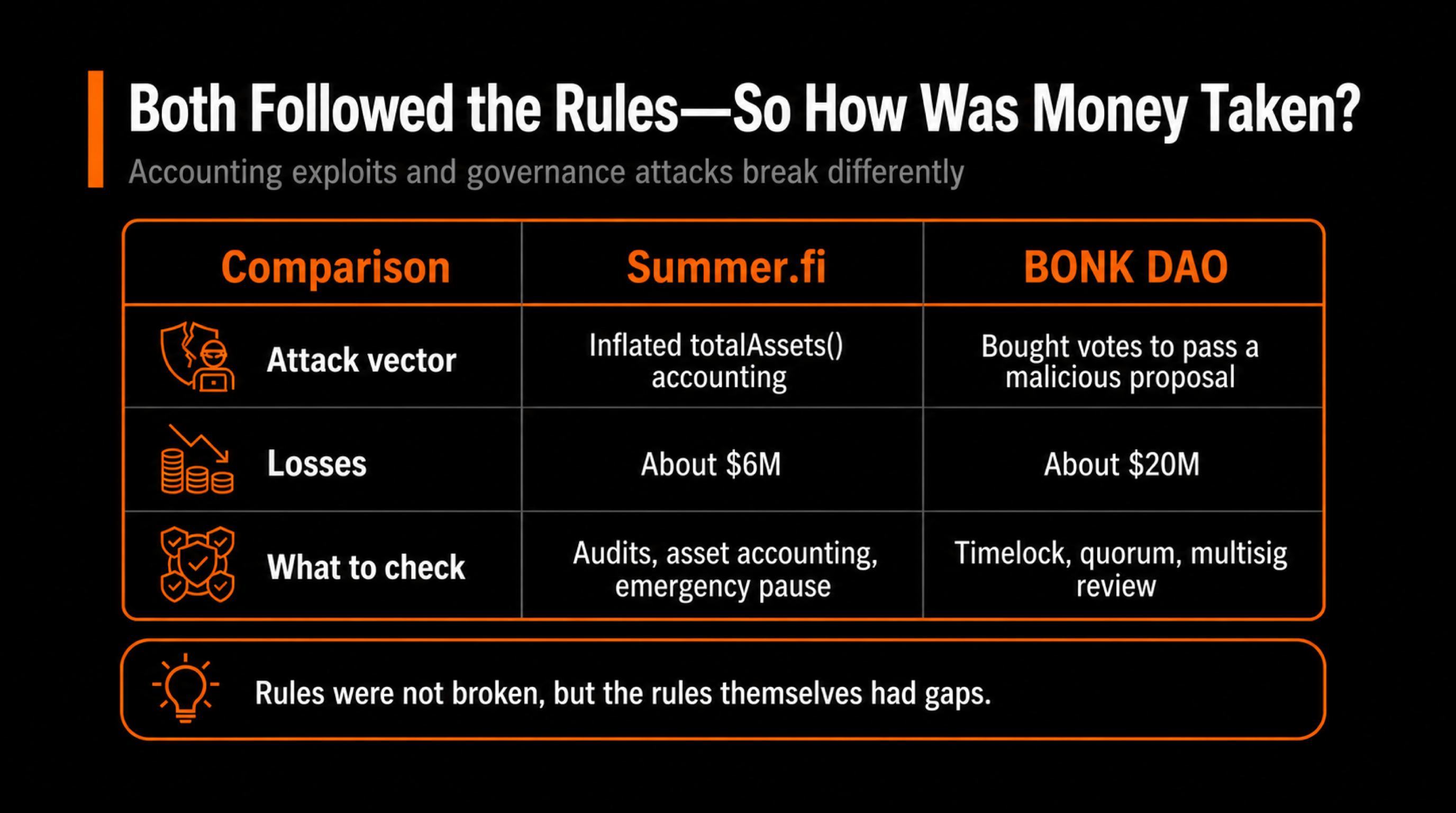
Around the same time the Summer.fi incident broke, BONK DAO's treasury was also reported drained of roughly $20 million — do these two incidents mean vault and treasury-type protocols are especially prone to trouble?The answer isn't that simple: the attack methods behind the two incidents were completely different — one was an accounting bug, the other was a loophole exploited in the governance mechanism.Understanding the difference is what tells you where to look when assessing a protocol's risk.
How BONK DAO's Governance Attack Differs From Summer.fi's Attack Method
Summer.fi's problem was in how its smart contract calculated assets. BONK DAO's problem wasn't in a code vulnerability at all — it was in the governance voting mechanism itself.The attacker spent only about $4 million buying up BONK tokens, accumulating enough voting weight to back a malicious proposal that transferred roughly $20 million worth — equivalent to as much as 4.426 trillion BONK tokens — from the treasury into a wallet under their own control.
The entire process went through the voting flow exactly according to protocol rules — no system was hacked into, and no private key was ever used. The problem was that the proposal itself was never blocked. This is similar to Summer.fi's pattern of “legal operations, inflated numbers” — both exploited loopholes in the rules themselves, just that Summer.fi exploited the accounting logic, while BONK DAO exploited the voting threshold.
Which Is Harder to Defend Against — Governance Attacks or Smart Contract Bugs?
In terms of defense difficulty, smart-contract bugs can at least be caught through audits, testnet simulation, and code review — the flaw is baked into the code, so in theory it can be caught as long as someone is willing to spend the time checking.The trouble with governance attacks is that the voting mechanism itself isn't wrong — what's wrong is the absence of designed-in safety brakes like a time lock, a minimum quorum threshold, or multisig review.
In BONK DAO's case, there was no time lock — the proposal executed immediately once it passed, leaving no one any room to react; there was also no minimum quorum threshold, letting someone who spent only $4 million sway a $20 million treasury decision. By comparison, governance attacks are much harder to fix with an after-the-fact patch — the problem lies in the entire design philosophy of the decision-making mechanism, not something a few lines of code changes can handle.
How to Judge Whether a Protocol's Vault/Treasury Design Has Any Risk Buffer
When you come across a vault or treasury-type protocol, you can start by checking three things: first, whether the asset-calculation logic can be affected by outside funds donated directly in; second, whether major operations have a time lock that gives the community time to react; third, whether governance proposals have a minimum quorum and multisig review to prevent a small number of people from swinging where huge sums of money go.
If none of these three things are in place, that means the protocol puts “efficiency” ahead of “safety brakes”, and once someone finds a flaw, there's no buffer left to buy any time.You don't need to understand the code details, but I'd suggest at least building the habit of checking the protocol's governance documents and contract-design notes before depositing to see whether these mechanisms are mentioned — it's the most direct, and least effortful, way to judge whether a protocol is fundamentally sound.
After the Incident — Where Do Affected Users' Funds Stand, and How Far Has the Follow-Up Response Gotten?
After money gets stolen, a protocol will usually issue an announcement right away saying it's been handled or is under investigation — but what progress does that wording actually represent?This section lays out exactly where Summer.fi and BONK DAO each stand, so you know whether actions like “paused,” “frozen,” and “reported” can actually get your money back.
Summer.fi's Current Response Progress (Vault Pause and Fund-Flow Tracking)
Summer.fi's protocol guardian paused every vault under the entire Lazy Summer Protocol immediately after the incident, to prevent the vulnerability from being exploited repeatedly and the losses from growing. Independent researchers have since published analysis confirming the attack was carried out entirely through legitimate functions — normal deposits, redemptions, and Ark withdrawals — with no private-key leak or admin privileges involved.
As of now, Summer.fi has not officially issued a formal statement on this incident; tracking of the fund flow has come mainly from ongoing observation by the on-chain analytics community, which confirmed the stolen $6 million was swapped into DAI via Curve and ultimately flowed into Tornado Cash.Pausing the vaults solves the problem of “no longer continuing to bleed,” it doesn't mean any asset has actually been recovered.
BONK DAO's Follow-Up (Exchanges Freezing Deposits/Withdrawals, Reporting to Law Enforcement)
BONK DAO's response has been comparatively proactive — the team has publicly said it's coordinating with the Solana Foundation and several exchanges to track and freeze stolen funds flowing to exchanges, while also moving to report this governance attack to law enforcement. Some of the stolen BONK tokens have already been observed starting to move to exchange addresses, suggesting the attacker may be preparing to cash out.
Exchanges freezing deposits and withdrawals, and law enforcement stepping in to investigate — these actions can slow down how fast the attacker can cash out, and raise the odds of recovering some funds down the line, but none of them are a guarantee that “the money is already back”.BONK dropped roughly 8% to 10% in response to this incident — for anyone holding the token or who had funds involved in treasury governance, that's a real, tangible loss, and it doesn't automatically disappear just because an official statement was issued.
Why Funds Being Frozen or Flagged Doesn't Guarantee You Get the Money Back
An exchange freezing an account, or an on-chain analyst flagging an address — these actions sound like real progress, but whether the funds can actually be recovered depends on several conditions: whether the attacker moved the assets to an exchange willing to cooperate with an investigation, whether the trail was already cut through a mixing tool first, and whether the local law-enforcement agency has the capability and willingness to cooperate across borders.
Summer.fi's $6 million has already gone into Tornado Cash — the whole point of a tool like this is to make fund-flow tracking fail, which drastically raises the difficulty of any later recovery. By contrast, BONK DAO's situation gives it a genuinely higher chance of being caught by an exchange, since some of the funds haven't fully been offloaded yet.Even when the same words like “frozen” or “under investigation” appear, the actual recovery odds behind them can be worlds apart, and newcomers shouldn't lump them all together.
The 3 Most Common Judgment Mistakes Newcomers Make Before Depositing Into a DeFi Vault
After going through both incidents, you might be thinking it's simply safer to avoid vault-type products altogether. Actually, the point isn't whether to touch them or not — it's whether you made the right call before depositing.What trips a lot of people up isn't being careless with their money — it's that the way they evaluated the protocol used the wrong yardstick from the very start.This section lays out the three most common judgment mistakes, to help you recalibrate your mindset.
Mistake One: Looking Only at APY, Not the Vault's Underlying Asset Mix and Leverage Design
A pretty-looking APY number is the first — sometimes the only — thing many people use to decide whether to deposit.But APY only tells you “how much you're expected to earn” — it tells you nothing about where that yield actually comes from — whether it's from underlying lending spreads, leveraged positions, or some mechanism that only holds up as long as new money keeps flowing in.Different yield sources carry wildly different risks.
Summer.fi's vault itself allocates funds across multiple Ark strategy modules to earn yield — the more strategy modules there are, and the more complex the lending protocols they're connected to, the larger the system's attack surface, which has nothing to do with how high the APY is. Spending ten minutes checking a vault's asset-allocation documentation before depositing will help you judge the risk far more than watching the APY number tick up.
Mistake Two: Assuming a Well-Known Protocol's Backing Equals Zero Smart-Contract Risk
Summer.fi isn't some obscure small protocol nobody's heard of — it has a reasonable level of name recognition and scale of funds, which is also why quite a few users were willing to deposit money into it in the first place.But this incident proves that a protocol's name recognition and team background don't equal zero bugs in the code — even the most experienced team can leave an undiscovered flaw in its asset-calculation logic.Large scale and a big user base actually make people more likely to let their guard down and forget to do the most basic security homework.
Treating “everyone uses it” or “it's been live for a long time” as the sole guarantee of safety is the easiest mindset trap to fall into. A more practical approach is to check whether the protocol undergoes regular audits, how transparent the audit reports are, and whether there's a track record of bug bounties. When I evaluate a new protocol myself, I always look for the audit report first — if I can't find one, I skip it entirely.
Mistake Three: Ignoring That an Emergency Pause Switch Is Itself the Protocol Admitting There's Risk
Almost every mainstream DeFi protocol has an emergency pause mechanism, letting the guardian call a halt the moment something abnormal is detected, to keep losses from spreading. This design is actually telling you something: the protocol team itself believes the system could go wrong, which is exactly why it built in this brake. Looked at another way, if a system truly could never go wrong, there'd be no need to design this kind of emergency switch at all.
A lot of people actually feel reassured when they see “there's a pause mechanism,” mistakenly assuming it means someone is watching at all times and the funds are absolutely safe, while overlooking that the very premise of a pause mechanism existing is that the risk was already there in the first place.Before depositing, it's worth flipping the question around: if even the protocol itself built in an emergency brake, have you set aside a brake of your own for your funds — like spreading your allocation across different protocols, or setting up monitoring alerts on your assets?
A Self-Protection Checklist Everyday Users Can Follow to Minimize Risk
After all this talk of misconceptions and vulnerabilities, back to the most practical question: what can you actually do to bring the risk down to a level you can live with?This section lays out what to do at each of three stages — before depositing, while your funds are deposited, and the moment an incident happens — turning abstract risk awareness into concrete actions you can follow. Let's walk through them in order, step by step.
How to Check a Protocol's Audit Report and Bug-Bounty Track Record Before Depositing
Before putting money into any vault, take the time to check three things first: whether the protocol has ever had an audit done by a reputable auditing firm, whether the audit report is publicly viewable, and whether there's a long-running, actively maintained bug-bounty program. This information can usually be found on the protocol's official website or documentation. If a protocol can't even produce an audit report, or its bug-bounty program is a hollow gesture, that should raise your guard — and it's also worth checking whether the bounty amount reasonably reflects the scale of funds the protocol manages.
An audit isn't a cure-all — Summer.fi's vulnerability wasn't entirely unreviewed before the incident either, but at least an audit and bug-bounty track record reflect whether a protocol team is willing to put resources into finding flaws.This kind of verification doesn't take much time, yet it can help you filter out a whole batch of protocols that haven't even done the basic homework.
While Your Funds Are Deposited — Diversify and Set Up Asset-Monitoring Alerts
Even after you've vetted a protocol, it's still not advisable to put all your funds into a single vault. Spreading your allocation across different protocols and asset types effectively lowers the risk of a single vulnerability wiping out all your funds at once — this follows exactly the same logic as the traditional investing principle of “don't put all your eggs in one basket,” just with the basket swapped out for a smart contract in DeFi.
It's also worth setting up monitoring alerts on your own assets — for indicators like an abnormal change in a vault's totalAssets() or a single transaction being unusually large — so you get notified the moment something triggers.These kinds of monitoring tools are usually something you can set up yourself on on-chain analytics platforms. They can't stop an attack from happening, but they let you know about anomalies the moment they occur, instead of finding out you were one of the victims only after reading about it in the news.
The 3 Things to Do Right Away the Moment an Incident Happens
If the protocol you've deposited money into really does run into trouble, panicking won't help — following a fixed sequence of steps is what keeps your losses to a minimum and preserves the evidence you'll need later for any claim or to assist an investigation.Here are three things I'd recommend doing, in this order:
- Immediately confirm the state of your own assets: check the official announcement and your wallet's transaction record on a block explorer to confirm whether your funds were actually affected — this avoids needlessly scaring yourself and also avoids missing any affected position.
- Screenshot and save all transaction records and official announcements: including the time and amount of the attack, and your own deposit and withdrawal records. This information will be necessary supporting evidence later, whether for cooperating with the protocol's investigation or filing a report with law enforcement.
- Follow official channels, not community rumors: during a protocol pause, secondary scams like fake customer support or fake compensation links tend to pop up. Make sure you only confirm the latest progress through verified official channels, and don't click any “we can help recover your funds” link sent to you in a private message.
Only after you've done these three things should you move on to assessing whether to keep holding your other positions or adjust your asset allocation.The worst thing to do in the moment is to panic and grab at any solution, trusting some shady “fund recovery” service, which only ends up victimizing you a second time.
Conclusion
From start to finish, not a single step of the Summer.fi incident used any of the intrusion techniques familiar from hacker movies — it relied entirely on functions the protocol itself made open, plus an accounting bug that went uncaught. The lesson from BONK DAO is the same: the problem wasn't code being cracked, it was a flaw left in the rules themselves.The point of this article isn't to make you steer clear of DeFi vaults from now on — it's to remind you that spending an extra ten minutes checking the audit and governance design before depositing is far more worthwhile than trying to find your own money in a Tornado Cash record after the fact.


