

Do you see the letters “AI” and immediately feel that buying an AI Agent coin lets you ride the AI wave — maybe even make money on autopilot?This piece won’t dress up AI Agent coins as a money printer. Instead, it first helps you separate the completely different things the label lumps together, whether trading Agents can actually make money for you, and how to tell projects that do real work from pure hype-chasers, and finally tells you which ones are worth researching and which ones you’re better off leaving alone.
What exactly are AI Agent coins? And why did they suddenly get so hot
“Are AI Agent coins about AI or about the coin? And what does this have to do with the AI I usually hear about?” Many beginners first notice it pumping and being talked about, then circle back to figure out what it actually is. In this section we’ll get the concept straight first, then break down what’s real and what’s just narrative behind this wave of hype, because this distinction is the starting point for every judgment you’ll make later.
First, let’s get the term “AI Agent” straight
To understand AI Agent coins, you first need to understand what an AI Agent is. An Agent isn’t the kind of chatbot that answers one question at a time; it’s an AI program that can perceive its environment, make decisions, and then actually carry out tasks on its own. The key word is “autonomous”: you give it a goal, and it can break down the steps, call tools, and get the job done step by step, without you watching over it the whole time.
Put this into the crypto world and it gets interesting. A blockchain is by nature a system that settles automatically through code, with no human approval needed, and an Agent is a program that can act on its own. Combine the two, and in theory an AI could manage its own wallet, interact with smart contracts on its own, and complete permissionless on-chain settlement on its own. That’s the core story the AI Agent coin sector wants to tell: letting AI not just think, but actually get things done on-chain by itself. Keep that picture in mind — in a moment you’ll see that different projects are each taking one small slice of this big story to work on.
This wave is half technology, half narrative
The next question to face: why did it suddenly get so hot? The way I see it, this wave was pushed up by two forces stacked on top of each other — one real, one emotional.
The real force is that AI technology itself has genuinely advanced fast over the past couple of years — autonomous agents keep getting more capable, and connecting them to blockchains for real applications is a direction with genuine room to imagine, with teams doing serious work. But the other force is that the market badly needed a new story, and “AI + crypto” happened to smash two hot buzzwords together, so a flood of money and attention piled in, pumping the price of many projects that only have a concept — or that just renamed themselves to ride the hype. When I look at this sector, I deliberately separate these two forces: whether the technology has actually made progress is one thing; how high the coin price has been hyped is another, and the two are often out of sync. Build this habit of telling them apart, and you won’t mistake market emotion for a project’s value.
Hype isn’t a reason to chase
First, let me help you build a very important mindset: whether a sector is hot and whether you should buy into it right now are two completely different questions.
All hype tells you is that “lots of people are watching and buying right now.” It doesn’t tell you “whether the current price is reasonable,” and it definitely doesn’t tell you “whether what you’re picking up after entering is someone else’s bags they want to offload.” Many beginners read hype straight as opportunity — they see everyone chasing and fear missing out, and often end up holding the last bag at peak emotion. I remind myself of the opposite: the hotter it gets and the more the discussion is everywhere, the calmer you need to be, because the people entering at times like that usually take on the highest price and the most intense emotion. Everything later in this piece is built on this premise: understand first, tell things apart first, then decide whether to get involved, rather than being pushed along by the hype.
Don’t lump them together: the three narratives of AI Agent coins
“Aren’t these AI coins all pretty much the same, since they’re all AI + blockchain anyway?” They differ a lot, and lumping them together is the most common — and most costly — mistake beginners make. In this section I break the sector into three main narratives, spelling out what each one does, where its value comes from, and where the risk hides, so you know which category the coin you’ve got your eye on actually belongs to.
AI infrastructure: the underlying projects selling shovels in a gold rush
The first type is AI infrastructure, which builds “underlying tools” like decentralized compute, data, and model services — they don’t face you, the retail investor, directly; instead they provide the basic resources the whole AI ecosystem needs to run.
Take Fetch.ai (FET), Bittensor (TAO) — projects like these position themselves more like the people selling shovels in a gold rush — they don’t guarantee who strikes gold, but as long as someone comes to dig, they’ll need the shovels. In other words, its value isn’t about whether “AI” is in the name, but about whether the network it built is actually being used and whether real demand is running through it. So when I look at this type, I focus on hard things like network usage and developer activity, not on how beautifully the story is told. These projects are relatively foundational and longer-term, but don’t mistake that for safe — infrastructure gets over-hyped too, and value and coin price can just as easily drift apart.
Trading Agents: the kind that claims to trade for you (or claims to)
The second type is the trading Agent, which pitches using AI to analyze the market for you, give you signals, and even place orders automatically, and this is also the type in the sector most likely to tempt beginners.
Why is it the most tempting? Because it ties directly to “making money.” The other two ask you to think it through a bit, while this one puts “let AI make money for you” right in front of your face. But precisely because it hits the pain point beginners care about most, it’s also the type with the most over-the-top packaging and the one you should be most wary of. For many of these projects, the selling point is less about technology than about sales talk, spinning a market that’s inherently full of uncertainty into an ATM that reliably prints money as long as you hand it to the AI. This type makes me especially uneasy, so I’ll devote a whole section later to taking apart “can trading Agents actually make money for you.” For now, just remember this: the more directly something guarantees you’ll make money, the bigger the question mark you should put on it.
Wallet Agents: they handle your on-chain chores, but you have to hand over permissions
The third type is the wallet Agent, which wants AI to handle those tedious on-chain operations for you, like automatically interacting with protocols, managing your assets, and executing complex multi-step operations, freeing you from a pile of manual clicks.
Its selling point is “convenience,” and this direction has real value — on-chain operations really are tedious and error-prone. But you need to see clearly what convenience costs: to let an AI program move things on-chain for you, you have to hand it a certain amount of operating permission. Approvals and asset security are tied together — the more convenience you grant, the bigger your potential risk exposure. So when I see this type, I first suppress my craving for convenience and ask a very practical question: exactly how much permission does it want, and how much of my assets can it move? The answer to that matters more than how flashy its interface is or how loud its slogans are. I’ll unpack the approval landmine later too; for now, please keep it in mind.
Can trading Agents really make money for you on autopilot?
“If I let AI trade for me automatically, can’t I just make money lying down and never even watch the charts?”This is the spot in the whole sector that most deserves a bucket of cold water, and it’s also the entrance where the most beginners fall in. In this section I won’t beat around the bush — I’ll take apart whether trading Agents can make money, tell you what they can and can’t do, and what usually hides behind those high-return ads.
No matter how smart the AI, it can’t change the uncertainty baked into the market
Let’s start with the most core point, the one most worth remembering: no matter how smart the AI, it can’t change the fact that the market itself is inherently uncertain.
Trading, at bottom, is a negative-sum to zero-sum game: the money you make is mostly money someone else loses, and the whole market gets skimmed by fees and friction costs first. What AI tools can help with here is assisting you in analyzing data, enforcing discipline, and avoiding some emotional moves — all of which have value, but it has no crystal ball; it can’t predict where the next candle goes, because no one can predict that reliably in the first place. Hearing “AI trading” as “steady profit” is like mistaking an analysis tool for a money printer. I often use a plain rhetorical question to remind myself: if there really were an AI that made money reliably, the developers would quietly use it behind closed doors and quietly get rich — why go to all the trouble of launching a coin and writing piles of ads to share, or even sell, this money tree to a stranger like you? Once you think this question through, a lot of over-the-top marketing falls apart on its own.
The packaging of high returns often hides invisible high risk
The second thing is learning to see through the “high return” packaging. These Agent tokens love to fly the high-return banner, but return and risk have always been two sides of the same coin, the more tempting the return you see, the bigger the unspoken risk behind it usually is.
I pay special attention to a few common packaging tricks — spotting them should basically raise a red flag:
- Cherry-picked performance: the ads mostly show the winning stretch and don’t show you the losing periods. Clipping out one pretty curve doesn’t mean it profits over the long run.
- A black-box strategy: you have no idea how it actually operates, how much leverage it uses, or under what conditions it blows up. You shouldn’t bet big on something you don’t understand.
- The token itself is highly volatile: even if the tool is genuinely somewhat useful, its token price can swing wildly and leave you bagholding first. A useful tool and a rising coin price are two different things.
So when I see an ad like “AI makes you X% automatically,” my first reaction isn’t “here’s an opportunity” — I treat it straight as a warning sign, assume it’s reporting the good and hiding the bad, and go looking for the side it didn’t tell me about. For beginners, defaulting to reading high-return ads as a risk signal rather than an entry signal helps you dodge more than half the pitfalls.
A tool is ultimately just a tool; you’re still the one deciding and bearing the consequences
The third point is getting the relationship between you and this kind of tool straight: no matter how powerful it is, it’s just a tool; the one who truly makes the decisions and truly bears the profit and loss is always you.
Even if you’re using a relatively reliable trading aid that isn’t scamming you, at most it organizes information and puts signals in front of you. Whether to act on them, how big to bet, and when to cut losses — these key decisions still fall on you. Dumping all of it on the AI while understanding nothing of what it’s doing is like handing the steering wheel to a driver you can’t read, with your eyes shut. My stance has always been: use AI tools to assist your judgment and boost efficiency, but don’t use them to replace your own understanding and risk management. The more you want to rely on it to “make money lying down without understanding anything,” the easier it is that, when it errs or the market turns on you, you’ve already lost it all before you even grasp what happened. Admit first that profit and loss are ultimately your own responsibility, and your mindset toward these tools will come back from fantasy to reality.
How do you tell projects doing real work from pure hype-chasers?
“I get the sector and I know the risks — so how do I actually tell whether an AI Agent coin is the real deal or just here to ride the hype?” This section gives you a few practical yardsticks. They don’t require deep technical knowledge, but they help you filter out a batch of projects that have only a story and nothing behind it.
Check whether it has real usage, not just a narrative
The first yardstick is whether, beyond telling a good story, the project actually has real usage happening.
Hype-chasing projects share a common trait: all their weight rests on narrative. The whitepaper is dressed to the nines and the vision is grandiose, but when you look at the actual product, it’s often either not built yet or barely used. Projects doing real work are the opposite — they may speak plainly, but you can find people running their network, developers pushing continuous updates, and real demand using their service. When I look at a project, I deliberately ignore the fanciest adjectives and hunt specifically for evidence of “is anyone actually using it.” This is especially true for the AI infrastructure type mentioned earlier, whose value is built on real usage — infrastructure with no usage is empty, no matter how pretty the story. Remember one line: a narrative can be made up out of thin air; usage can’t be faked.
Is AI the real core, or just a label slapped on?
The second yardstick is telling whether AI is actually the real core of the project, or just a label slapped on to ride the hype.
Over the past year or two, just putting words like AI or Agent in the name makes it easier to attract money and attention, so a whole crowd of projects has appeared that rebrand old stuff and force-fit the AI concept — their business actually has little to do with AI, and AI is just marketing talk. The way to judge isn’t hard: ask yourself, if you removed the AI element from this project, what’s left, and does it still hold up? If it’s nothing without AI, then AI is probably just a shell; if it was already solving a real problem and AI is used to do that better, that looks more like genuinely treating AI as the core. I use this “what’s left without AI” test to quickly sort out which projects do real work and which are just chasing a trend.
The team, transparency, and unreasonable promises
The third yardstick is whether the team, and the promises it makes to you, are reasonable. This part reveals a project’s true colors better than anything.
I watch for a few things: whether the team is willing to be public about their identities and has a verifiable background, or is fully anonymous and nowhere to be found when things go wrong; whether the project’s information is transparent enough, or whether mechanisms that should be spelled out are being hidden; and most importantly, whether it makes you unreasonable promises. Anyone who dares to guarantee you returns, guarantee a 2x, or use “guaranteed profit” or “principal-protected high yield” as a selling point can basically be crossed off, because in this market, anyone who dares to guarantee returns is either a scammer or doesn’t understand risk, and you shouldn’t hand your money to either. My habit is: the more exaggerated the promise and the less it sounds true, the further I back away. Use these three yardsticks together and you may not pick the best project, but you’ll at least dodge most of the obviously problematic ones.
The landmine beginners should avoid most: approvals and asset security
“Even if I understand the sector and can tell projects apart, where am I most likely to get burned when I actually touch it?”The answer usually isn’t that you picked the wrong coin, but that, without realizing it, you handed over control of your assets. This section is dedicated to the approval risk that trading and wallet Agents bring — the line beginners most need to hold, yet most often overlook.
An approval means handing over part of the key to your assets
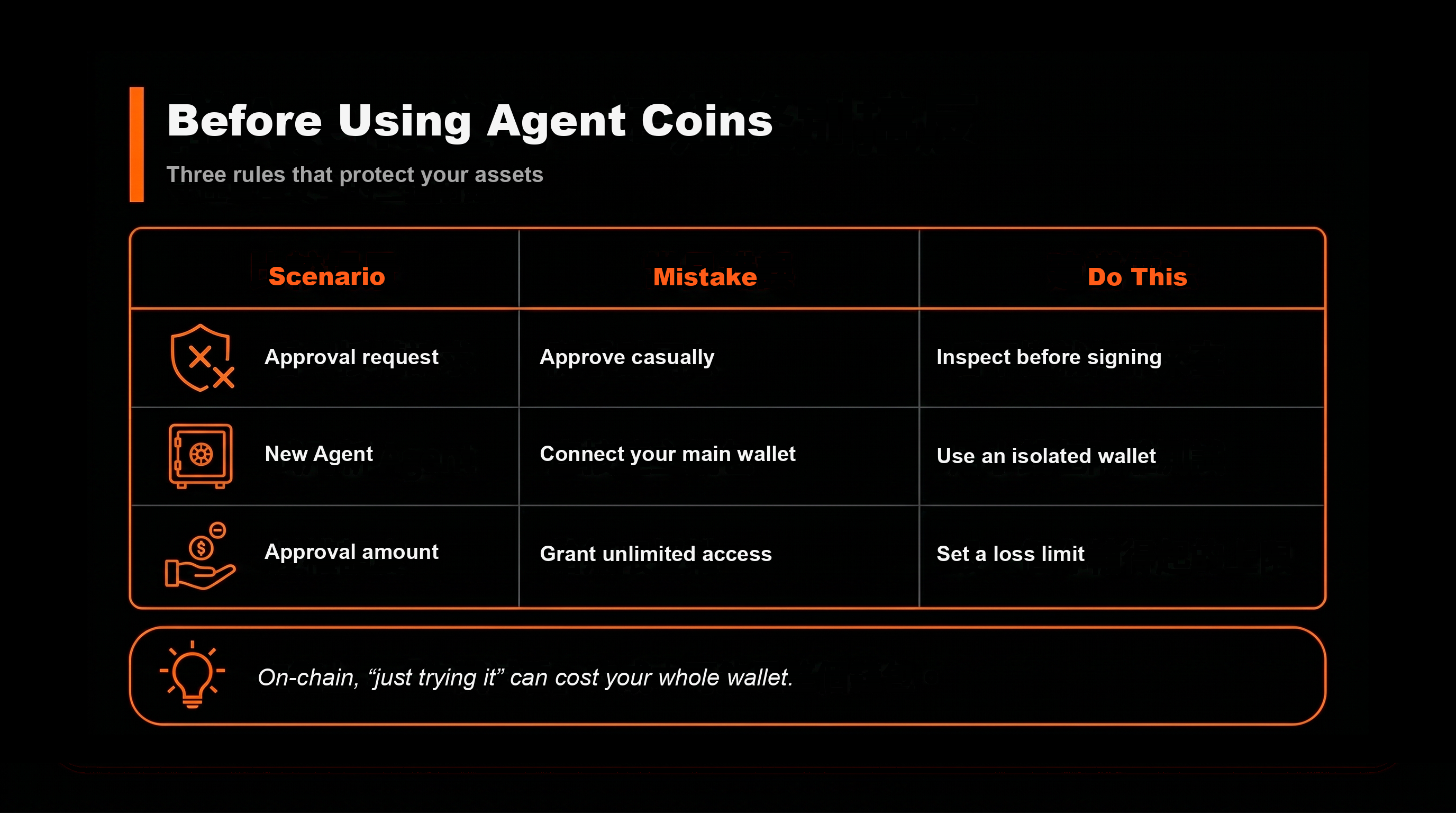
First understand one concept: when you let an Agent move your on-chain assets, you usually have to “approve” it first, and that approval is essentially handing over part of the right to move certain assets in your wallet.
This is a bit different from using a centralized platform. On-chain, approvals are written into a contract, and once you sign, the Agent has the right to move your assets within the approved scope — and often that permission doesn’t expire on its own. The problem is, what you hand over is control, but you’re still the one who bears the consequences: if it has a vulnerability and gets hacked, or is simply a malicious contract dressed in AI clothing, your coins could be drained clean without you ever noticing. So I treat “signing an approval” as seriously as “lending someone the keys to your house” — not something to click through casually.
Don’t sign an approval whose purpose you don’t understand
Once you understand the weight of an approval, the next principle is natural: if you don’t understand an approval or aren’t clear on its purpose, don’t sign it. This is the hard line beginners most need to hold.
In practice, many people lose money not because they read the market wrong, but because they casually clicked “agree” or “approve” on some interface without ever seeing clearly what they approved or how large an allowance they granted. Some malicious projects exploit exactly this, dressing an approval that will empty your wallet up as a harmless-looking ordinary action. My approach: as long as I don’t understand what an approval specifically does or how much of my assets it will move, I’d rather take the trouble to stop and check than sign first and ask later. On-chain, the cost of “let me just try it” can be your entire wallet, which is nothing like casually tapping “agree” on terms in an app. Signing one fewer approval you don’t understand is often more important than making one more trade.
Use a small wallet, cap the allowance, and lock risk in a cage
The last principle is leaving yourself a way out: don’t connect an unfamiliar Agent directly to your main wallet holding large assets. Lock the potential loss, in advance, into a cage you can afford to lose.
More concretely, when you really want to try an Agent you’re not familiar with yet, the safer move is to use a separate small wallet holding only a little money to connect and approve. Even if it does blow up, all that gets drained is this small amount you’d already prepared yourself to lose, and it won’t hurt your main assets. Where you can set an approval limit, set a small cap and don’t grant infinite approval. I treat this “isolated test” as the standard move for touching anything new, because you can never be 100% sure a new project is safe, so rather than betting it’s fine, assume it might have problems, then box in the worst-case outcome with position size and limits. protecting asset security always comes before convenience and returns.
Conclusion
This piece helped you take AI Agent coins apart, and the takeaway really isn’t complicated: it’s not a single category — AI infrastructure, trading Agents, and wallet Agents are three things with completely different value and risk, so don’t lump them together. The myth most worth breaking is “AI makes money for you on autopilot” — no matter how smart the AI, it can’t change the uncertainty baked into the market, and that high-return packaging often hides cherry-picked performance, black-box strategies, and invisible high volatility. If you really want to get involved, first use the yardsticks of real usage, whether AI is the real core, and whether the team and its promises are reasonable to filter out the hype-chasers; then hold the approval line — don’t sign what you don’t understand, and don’t connect your big wallet to what you’re not familiar with. separating hype from reality and understanding before you decide is far steadier — and far safer — than chasing something the moment you see the letters AI.


