

Do you see that XLM and XRP are both cross-border payment coins and figure it barely matters which one you buy — so when one pumps, you chase the other?This article won't draw an equals sign between them. Instead, it first helps you understand why these two coins keep getting lumped together, how their positioning and target markets differ, and how their technical uses diverge. Finally, it tells you what beginners should watch during a rotation-driven spike and how to fit them into your own allocation.
What Are XLM and XRP? Why Are They Always Lumped Together
"Why are these two coins always discussed together, rising and falling in sync?"Because their relationship isn't just about similar themes — even their roots are genuinely connected.Let's get this shared origin and their common ground clear first, so that when we look at the differences later, you won't confuse 'similar' with 'the same'. In this section we'll first fully explain why they're tied together.
Same origin: the two projects actually 'split' from one root
First, some background many beginners don't know: XLM and XRP didn't grow up independently — there's a bloodline between them. An engineer named Jed McCaleb helped co-found Ripple in its early days — the project behind XRP. Later, because he couldn't agree with the team on direction and philosophy, he chose to leave and founded Stellar, whose token is XLM.So you can think of it this way: XLM 'split off' from the XRP line. The two started from highly similar starting points, but took different paths after the split.
This shared origin matters because it explains a common source of confusion: why the narratives of these two coins sound so alike. Both originally wanted to solve the same old problem — traditional cross-border remittances being slow and expensive — they just later arrived at different answers about 'who to solve it for and how.' When I look at a project, I make a habit of first understanding its background and what it's trying to solve, because that often tells you more about where it's headed than short-term price does. XLM and XRP sharing a common origin is the starting point for understanding every difference that follows.
Common ground: both want to make cross-border payments faster and cheaper
Setting origins aside, the big goal these two projects put on the table really is the same one. Traditional cross-border remittances often have to pass through several banks, take days, and charge fees that make you wince. XLM and XRP essentially both want to bypass this inefficient old pipeline, letting money cross borders in a near-instant, ultra-low-cost way. They both position themselves as cross-border payment infrastructure, using their respective tokens as a bridge asset or settlement medium in the transaction process.
It's precisely because of this shared big goal that the market habitually compares them as the 'same kind,' and why you get that phenomenon of 'the moment the cross-border payment theme heats up, both get named at once.' But I want to remind you: the same goal doesn't mean the same approach, and it certainly doesn't mean it's all the same which one you buy.Many beginners stop at the level of 'they're both cross-border payment coins' and end up mixing up the two coins' stories. The common ground is the reason they get grouped together, but what really decides whether you should pay attention — and to which one — is the differences we're about to cover.
Why you get 'one rises, the other follows'
Since the themes are so alike and they share an origin, a phenomenon often shows up in the market: one suddenly spikes, and not long after money names the other and it rises too, as if they're tied together. Behind this is actually 'theme rotation' at work — when the market's attention turns to the cross-border payment narrative, money first pumps the most representative one, and once the heat builds, it naturally goes looking for a 'catch-up play' in the same theme that hasn't risen yet. XLM and XRP being each other's shadow works exactly this way.
Understanding this linkage has two practical implications for beginners. First, you shouldn't assume that just because XRP pumps hard, XLM is bound to follow, and rush to chase it — that's just the market's habitual association, not a certainty. Second, this kind of follow-on rise driven by thematic association tends to be more fragile and pull back faster than the first one that rose, because it lacks its own substantive good news to support it. When I see this kind of 'one dragging the other along' price action, I stay especially calm, because it's usually the moment when rotation sentiment is thickest — and when it's easiest to chase in right at the top.
Key Difference One: Completely Different Positioning and Target Markets
"Since they're so alike, isn't it basically the same which one I buy?" This is the biggest misunderstanding.Their most fundamental divergence lies in 'who exactly they're meant to serve' — and that choice all but determines every development path and source of good news that follows. In this section we'll lay out this most crucial difference clearly.
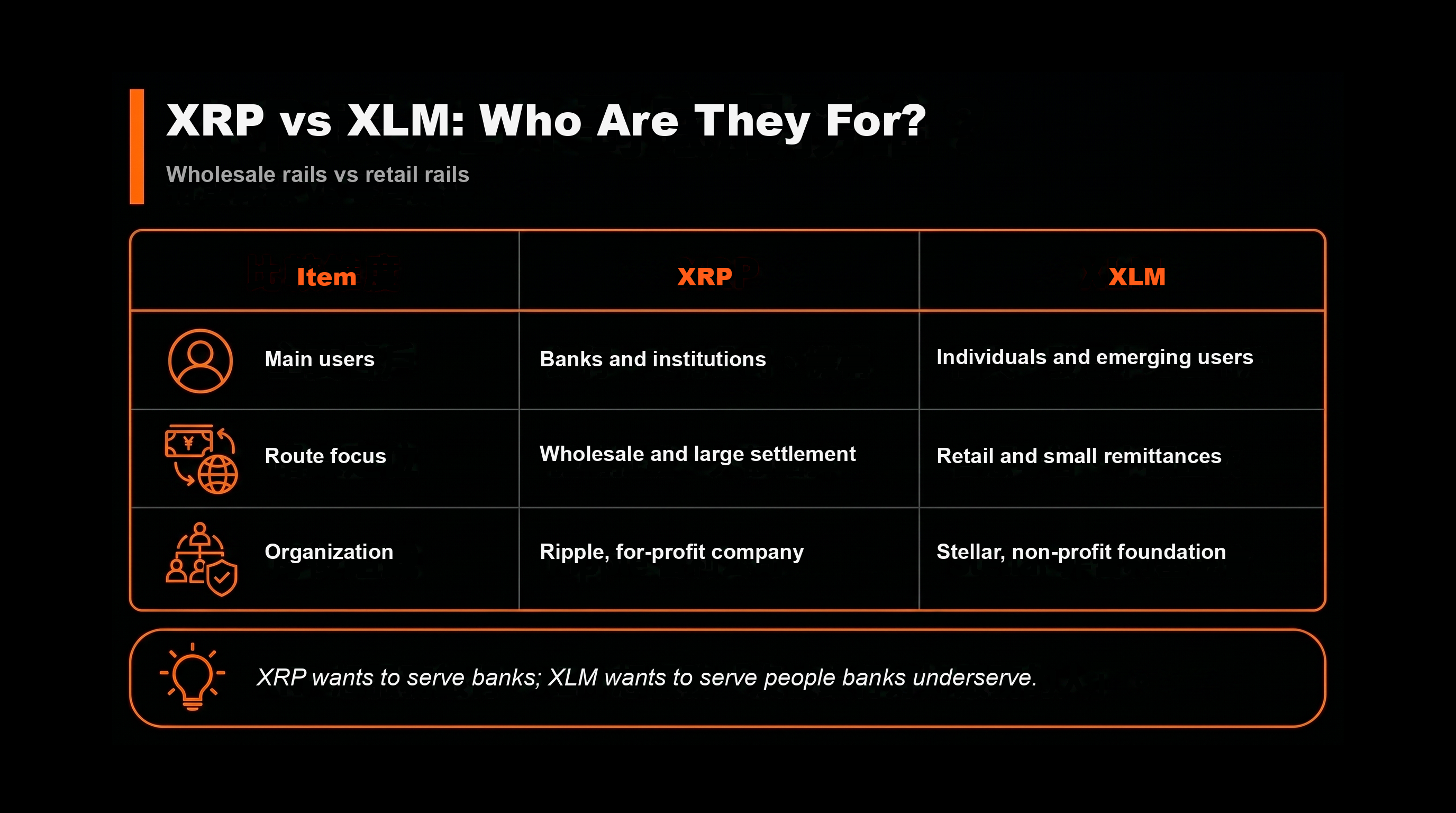
XRP: the 'wholesale route' targeting institutions and banks
XRP's Ripple follows a very clear institutional route: the customers it targets are banks, payment companies, and large financial institutions. Its ambition is to become the standard tool for cross-border settlement among these institutions, and its core selling point is providing them with fast, large-scale cross-border liquidity — letting a large sum that would otherwise be locked in the pipeline for days move across borders in a very short time. In this story, XRP's role is more like a 'bridge asset' between financial institutions — a B2B role doing bulk, wholesale business.
This positioning also determines what XRP's fate is tied to. Its growth story depends heavily on the progress of cooperation with the traditional financial system — which bank it just signed, which region's payment channel is now live, whether the relevant regulations are becoming friendlier or stricter. For beginners, this means when you follow XRP, what your eyes should really be on is the institutional-adoption and regulation line, not whether ordinary people use it day to day. Here's how I remember it: XRP wants to be the highway between financial institutions — which isn't actually that close to the everyday transfers of retail folks like you and me.
XLM: the 'retail route' leaning toward individuals and financial inclusion
XLM's Stellar took another path — the financial-inclusion route. It's more oriented toward individuals, especially people who are underserved or even completely unserved by the traditional banking system. Common scenarios include small cross-border remittances in developing regions, or migrant workers sending money back home. What it wants to do is connect directly to ordinary people, support low-cost exchange between multiple currencies, and position itself toward peer-to-peer small transfers and bridging fiat currency with the blockchain world. In recent years it has also increasingly extended toward being infrastructure for tokenized assets, attracting some fairly weighty institutional partnerships.
The difference in organizational form is very telling too: Ripple is a for-profit company whose clear goal is to grow the cross-border settlement business; while behind Stellar is a non-profit foundation, with a tone that emphasizes inclusion and public benefit more. One line of comparison makes it clear: XRP wants to serve banks, XLM wants to serve 'the people banks don't serve well.' Once you grasp this retail-versus-wholesale distinction, you've caught the core dividing line between them.
What this difference means for how you judge good news
Why break the positioning down this finely? Because it directly determines how you should read news and judge 'who exactly this good news relates to.' XRP's good news mostly revolves around institutional cooperation, regulatory progress, and large-scale settlement adoption; while XLM's good news more often relates to real-world payment adoption, tokenized assets, and ecosystem partnership expansion. The very same 'new progress in cross-border payments' news can carry completely different weight and meaning for these two coins.
The practical value for beginners is that it helps you avoid a very common mistake — seeing A's good news but going to chase B. For example, if a big bank announces it's adopting some institutional settlement solution, that's more likely the story on the XRP line. If you go chase XLM because of it, you're mixing the two coins' narratives and betting on the wrong target. When I look at payment-coin news, my first step is always to ask, 'Is this progress happening on the institutional side or the retail-inclusion side?' Only when the positioning matches does the news actually relate to the corresponding coin. Get 'whose growth relies on which story' clear first, and you won't be dazzled during rotation rallies.
Key Difference Two: Divergence in Network Structure and Technical Use
"I get that the positioning is different, but is the underlying technology different too?" Yes — and this difference is more substantive than many assume. Who runs the network, what role the token plays in the system — these technical choices actually echo their respective positioning. In this section we'll dig a bit deeper into the technology, but we'll try to put it in plain language you can follow.
Who runs the network: relatively centralized vs. relatively open
First, an often-overlooked but crucial difference: these two networks take different routes on 'who validates transactions and who can take part in maintenance.' XRP's network has a higher barrier to validation and node participation, and overall has a tighter relationship with Ripple the company. Outsiders often describe its governance as 'relatively centralized' — which has its upsides in scenarios that pursue efficiency and interfacing with institutions, since institutions often care more about speed, compliance, and a clear party to hold accountable.
XLM's Stellar network is relatively more open, encouraging communities and different organizations to take part in running nodes, with a tone closer to its 'inclusive, open to everyone' positioning. Here I want to specially remind beginners: don't rush to judge with a black-and-white standard like 'centralized is bad, decentralized is good.' Centralized and open each involve trade-offs. The former may buy efficiency and institutional trust; the latter may buy broader participation. What matters is whether it fits what that project is trying to do, not applying one universal right-or-wrong standard.
What role the token actually plays in the system
Next, look at what the token itself is used for — this is also where beginners most easily gloss over. In both systems, one of the token's core functions is to act as a 'bridge asset' — put simply, when you want to convert country A's currency into country B's currency, the system can first swap A's currency into this token, then swap the token into B's currency, using it as the intermediary crossing medium, sparing the hassle of there being no direct exchange channel between the two currencies. Beyond that, the token is usually also used to pay transaction fees on the network, keeping the whole system running.
But because their positioning differs, the bridge's 'use context' differs. XRP's bridge role is more meant for large-scale settlement between institutions; XLM's token more often shows up in scenarios of small personal exchanges and moving fiat in and out of the blockchain. I'm flagging this point because many beginners think 'the token has a use' equals 'the price is bound to rise' — those are two different things. Whether a token has real usage demand is about whether it's genuinely used frequently to bridge within the system, driven by how much actual business volume — not what the project team says it 'can' be used for. Separate 'functional design' from 'real demand', and you won't be swept off your feet by the vision in a whitepaper.
Technical differences ultimately come down to the yardstick of 'real adoption'
Having covered network structure and token use, I finally want to bring these technical differences down to a more practical criterion: for beginners, rather than digging into whose consensus mechanism is more elegant, better to keep your eye on a harder-to-fake metric — real adoption. The value of a payment network ultimately depends on how many transactions actually run on it and how much real money flows through it, not on how pretty its technical specs are. Technology is just a means; whether it can be widely used is the final yardstick for evaluating it.
For these two coins specifically, you can observe their real adoption from different angles: XRP's line — watch whether its actual usage volume in institutional cross-border settlement is growing; XLM's line — watch whether it's landing real, weighty partnerships in small-payment adoption and tokenized-asset infrastructure. These 'is anyone actually using it' signals are far more honest than short-term price swings. When I evaluate this kind of infrastructure project, I deliberately shift my attention from 'how much the price has risen' to 'whether business volume is genuinely growing,' because the former can fool you for a moment, the latter can't fool you over the long run. Without adoption, even the most advanced technology is just empty talk for the price.
What Beginners Should Watch Most During a Rotation Spike
"When I see XLM or XRP suddenly pump, should I chase it or not?" In this section I won't hand you a hot tip or predict who will rise. I'll focus on one thing only: what traps these same-theme payment coins hide during a rotation spike — the ones most likely to hurt beginners — to help you avoid being the one who chases in at the top and becomes exit liquidity.
Rotation moves often come fast and pull back just as fast
First, recognize the temperament of these coins. Same-theme payment coins that move in linkage have a classic price pattern of 'money taking turns pumping' — the market's hot money finishes pumping this one and moves to that one, and the theme's heat is like a gust of wind: while it blows, prices rise fast and hard, but the moment the wind stops, they fall back quickly. The problem is, the spike you see as a retail trader may already be the late stage of the rotation — the stage where the hot money is about to take profits and prepare to move to the next target. By the time the news is everywhere, community sentiment is at its most euphoric, and even people around you who don't follow crypto are talking about it, if you chase in then, you often land right on the eve of a pullback.
This isn't to scare you off touching it, but to have you keep some wariness toward 'spikes.' When I see a payment coin suddenly pump, my reflex isn't to want to follow — it's to first calmly ask: is this rise because it genuinely has substantive fundamental progress, or is it purely rotation sentiment, money using the theme as an excuse to push it up? The 'gold content' of these two kinds of spikes differs greatly — the former may have staying power, the latter is very likely just a long green candle pumped up for others to catch. Chasing without telling them apart is treating luck as judgment. Etch 'rotation moves come fast and leave fast' into your mind, and you'll have an extra layer of protection when you see a spike.
Tell 'substantive news' apart from 'thematic hype'
XLM and XRP both often pump on a single piece of news, but the weight of one piece of news versus another differs enormously. Some are genuine substantive progress — say, a real large-scale adoption going live, a key lawsuit reaching a clear result, a region's payment channel actually going live. But more often, the so-called good news is just 'thematic association' — for instance, a big direction being mentioned, a still very early partnership intention, or even just some celebrity giving it a shout-out. The mistake beginners most easily make is treating every rise as 'good news materializing,' assuming that as long as it rose, something good must have happened.
In reality, many spikes are just short-term money using the theme as an excuse; the news itself doesn't hold up to scrutiny, and when sentiment cools, the price falls right back to where it was. So when I see a spike, I force myself to ask first: is what's holding up this move real, verifiable progress, or another round of vague thematic hype? The method of judging isn't hard — what can be pinned down to something concrete and where you can find specific details is more like substantive progress; the more something sounds huge yet can't explain the specifics, the more you should be wary that it's sentiment being hyped.Weigh the news first, and you won't be paying for other people's stories every time.
Don't chase the top — think through what to do on a pullback first
The last point, and the most practical: these coins have extreme short-term volatility, and the worst thing to do is chase in with a heavy position when sentiment is hottest and the price is highest. My own principle is simple — rather than chasing that already sky-high green candle, flip the order around first: 'If I buy it and it pulls back right after, can I hold on? Where do I set my stop-loss? What share of my portfolio does this position take?' Think these worst cases through first, and you'll naturally have a calmer answer on whether to chase and how much. Being able to think of the risk before the urge to chase the top already puts you ahead of most people.
There's also a more fundamental reminder: if what you genuinely believe in is its long-term payment narrative, then there's even less need to rush and chase this short-term high. Being bullish long-term and chasing a short-term top are two completely different things — with the former you can calmly lay out your position in batches according to a plan; the latter is gambling on sentiment and timing. Beginners often equate 'I'm bullish on this project' with 'I have to chase in right now,' and end up buying the biggest position at the most expensive moment. I strictly separate these two things: being bullish is being bullish; timing and position size belong to risk management. Get your position size and mindset under control first, put 'survive, don't get swept out by a single pullback' ahead of 'making this one move,' and then talk about participating — that's how you'll stand firm in a rotation rally.
How to Pick, How to Place: Putting XLM and XRP Back into Your Allocation
"I get all the reasoning, but in practice which one should I actually pick, and how much should I buy?" This section won't make the decision for you, but it will give you a framework to think through before you act, separating the two matters of choice and position size so you no longer buy randomly on a feeling.
First get clear on which story line you're bullish on
Before picking which one, don't ask 'which will rise' — ask 'which growth story am I actually bullish on.' As we broke down earlier, XRP's story is tied to adoption by institutions and banks, while XLM's story bets on individual financial inclusion and tokenized-asset infrastructure. The conditions for these two narratives to hold, their growth pace, and even the risks they face all differ — you have to first figure out which one you believe in, then look at the corresponding coin, rather than chasing whichever has risen harder lately.
I'd suggest beginners examine it in a very plain way: say out loud to yourself, in one sentence, 'what each coin relies on to grow.' If you can't say it, or can only say 'because everyone says it'll rise,' that actually means you don't understand it yet, and any buying and selling in that state is essentially following the crowd rather than judgment. Being bullish on a story line means you can clearly state what progress needs to be seen for it to hold, and under what circumstances you'd consider the story broken. Being able to articulate these gives your holding real conviction, and keeps you from panicking on a pullback.
When you understand neither, don't force yourself to pick one
Here we need to bust a myth: many beginners think that when facing a contrasting theme like XLM and XRP, they 'must pick one to bet on.' Actually, no. If you haven't genuinely understood either story line, the best choice is often to 'not bet heavily on either' — put them on your watchlist and observe slowly, rather than forcing yourself to pick one to bet on without understanding it.Investing isn't an exam; no rule says you have to hand in an answer sheet; forcing yourself to participate without understanding is what most easily loses money.
When facing any contrasting target I can't see through, my principle is always 'participate only as far as you understand.' Participate only as far as you understand' — if I can't understand it at all, I only watch and don't move; if I understand a little but am unsure, I use a very small position I wouldn't mind losing to personally feel out its volatility; only once I truly understand it and have thought through the risk do I consider adding to the weight. The benefit of this rhythm is that you'll never bet heavily when you're not ready just because you're 'afraid of missing out.' Cross-border payment coins aren't just XLM and XRP — the market never lacks opportunities either, and skipping one unfamiliar rotation is far more worthwhile than getting hurt with a heavy position on a target you don't understand. Keep 'not choosing is also a choice' in mind, and you won't be held hostage by the pick-one-of-two framing.
A self-check list to run through before you act
No matter whether you finally decide to buy XLM, buy XRP, buy both, or hold off on both, I'd suggest you quickly run through the following questions before placing an order, so you don't get carried away by a momentary spike or community sentiment:
- Which story line am I bullish on? Institutional adoption (XRP), or individual inclusion and tokenization (XLM)? Can I explain in one sentence what it relies on to grow?
- Do I want to buy now because I understand its value, or just because it has pumped hard lately and I'm afraid of missing out?
- If it pulls back a big chunk right after I buy, can I hold on? Where's my stop-loss, and what share of my portfolio does this position take?
- Behind this rise, is it verifiable substantive progress or vague thematic hype? Am I using leverage to magnify this bet?
If you can answer all four questions crisply and then decide how to act, that'll be far steadier than staring at a single candle and chasing pumps and dumping on dumps along with the rotation headlines. The quality of your judgment often doesn't come from how accurately you predict, but from whether you questioned yourself clearly before acting. Make this checklist a habit before every order, and you'll naturally step on far fewer traps in these high-volatility payment-coin rotations.
Conclusion
This article walked you through comparing XLM and XRP point by point: they share an origin and both want to make cross-border payments faster and cheaper, so they often get tied together, showing that rotation phenomenon where one rises and the other follows. But dig one layer down and their differences are actually clear — XRP mainly targets institutions and banks, taking a relatively centralized wholesale route; XLM leans toward individuals and inclusion, taking a relatively open retail route, and even their sources of good news each have their own story. Understand this layer of difference, and you won't see A's news and go chase B. And more important than 'which to pick,' these payment coins most often see rotation spikes, so what beginners should hold onto most is: don't chase at the sentiment peak, first tell whether the news is substantive progress or thematic hype, and don't force a pick-one-of-two when you don't understand. See their differences clearly, keep your position size and mindset under control, and you'll go steadier and further than chasing whoever rises.


