

Did seeing TON change back to Gram make you worry about whether you need to do something, whether you'll miss out, or whether you'll get burned by fake news?This piece won't hype the rename up. Instead it walks you through what actually changed this time, Gram's SEC history behind the name, why scammers love to piggyback on a rename, and finally, how a beginner should judge a message like this — and why you don't need to rush to do anything at all.
TON Changed Back to Gram — What Actually Changed?
"Is this rename a brand-new coin, or just a change of name?" A lot of beginners get stuck exactly because they don't first get clear on what kind of event this is, so the more they think, the more anxious they get.In this section we'll first make crystal clear what the rename did change and what it didn't, because this is the foundation for everything that follows — the judgment and the scam defense. Once the foundation is solid, you'll see through those scary messages at a glance.
What Changed Is the Token Name, Not a Swap to a New Coin
Let's nail the most important point first: this change renames the native token on the TON network from Toncoin back to its earliest name, Gram. In nature it's a branding-level rename, not the issuance of a brand-new coin. The chain's own name hasn't changed — it's still called The Open Network, still abbreviated to TON. All that changed is how that token is displayed on exchanges and in wallets.There's no token swap, no technical migration, and no new asset being issued for you to claim.
Whenever I see this kind of "rename" news, my first reflex isn't to guess where the price is going — it's to ask one question: does this require me to do anything by hand?This time the answer is dead simple — no.The number of coins you hold won't change, and their value won't magically go up or down because of a rename. It just swapped the name tag it wears. Once you lock down the true nature of this, none of those fancy scripts can fool you.
The Chain Name, Contract, and Balance Are All Unaffected
Dig one layer deeper and you might worry: with the name changed, will my contract address, my balance, my past transaction records get scrambled too? On this you can relax. A pure brand rename means the entire underlying technical structure stays exactly the same — the chain is still the same chain, the token contract hasn't changed, and the balance recorded in your wallet won't need to be recalculated or moved just because the name changed.
Here's an everyday analogy: it's more like a shop switching its sign from its newer name back to its old established brand. The shop is still the same shop, the goods are still the same goods, your membership still stands — the only thing that changed is the sign out front. So when you open your wallet and see the displayed name possibly change from Toncoin to Gram, don't panic. That's not your assets going wrong — it's just each platform gradually swapping over the name tag it displays.What you really need to watch out for are the messages telling you "something will go wrong if you don't redo an operation." Those are the ones out to scam you.
A Short-Term Price Pop and Whether You Should Chase It Are Two Different Things
When the rename news broke, the token price popped for a stretch, and a lot of beginners see the green candles and get itchy, wondering if they should chase the move. Here I want to pour some cold water: a rally driven by a branding talking point and the project's own fundamentals are two different things. Treating a rename as a reason to bet big carries real risk.
An emotion-driven move like this, lit up by narratives like the "Telegram angle" or "returning to its roots," tends to come fast and can leave just as fast. It reflects a momentary spike in market attention, not any real increase in the project's value. When I look at a move like this, I deliberately separate "the news is interesting" from "worth adding to my position." Changing the name back didn't give the network any new revenue or users — what's rising is expectation and emotion. If you chase in on top of a rename headline, you can easily buy at the hottest emotional point, and be left with regret once the heat fades. For a beginner, understanding that this is a rename and knowing you don't need to act is often a better deal than rushing to join this pop.
The Name Gram Carries an SEC History Behind It
"It's just a name change, how big a deal can it be?"The risk isn't in the act of renaming itself, but in the fact that the word Gram once caused big trouble.This section walks you through that past that the SEC once shut down. Understand this background and you'll better see why you should stay a little more alert around related topics — and better appreciate the label this name carries.
The 2018 Fundraise and the SEC Shutdown
Gram isn't actually a new name that just appeared this time — it was the project's earliest token name. Rewind to 2018: Telegram was planning to build its own blockchain network and raise funds through a private sale for this token called Gram, drawing in a large number of institutions and investors. The amount raised was quite substantial — one of the most closely watched fundraises in crypto that year.
But things didn't go as planned. The U.S. Securities and Exchange Commission — the SEC we often hear about — determined that this token sale was an unregistered securities offering, and stepped in to halt it in 2019, forcing the whole issuance plan to stop. For investors who were full of anticipation at the time, it was an abrupt, unexpected slam on the brakes. This episode matters because it tied the name Gram from the very start to the words "regulatory controversy", and that label won't automatically disappear just because the name is being reused today.
It Ended in Refunds — Gram Never Officially Launched
SEC After the halt, the story ended in a withdrawal.Telegram returned most of the money it had raised from investors that year and announced it was withdrawing from the ongoing development of this blockchain. That Gram token that had originally been planned never officially launched. In other words, the original version of Gram was a story that never got to finish.
So where did today's TON come from? After the official team pulled out, a community of independent developers took over, got the network running again, and renamed the token Toncoin to distance it from that controversy. Understanding this thread matters: Gram, Toncoin, and now back to Gram are actually names for different stages along the same main storyline.My advice to beginners is to look at the "brand story" and the "actual risk" separately. Don't just get swept up in the romance of the "returning to its roots" narrative and overlook the not-so-easy past beneath the name.
Why This Old Story Matters to You Now
You might think this all happened years ago — what does it have to do with me, someone who just got into crypto? The connection is more direct than you'd think. A name that was once deemed an unregistered security by the SEC and triggered large-scale refunds being brought back is itself a reminder: the regulatory uncertainty attached to this brand hasn't fully turned the page.
This isn't to tell you to panic or write the project off entirely. It's to hope you keep a little more clarity when facing any related hype. When the market pushes emotions higher with imagined pictures like "Telegram's huge user base" or "a whole new brand era," this history is exactly the bucket of water to cool you down. My own habit is: the more a narrative sounds full of story and the easier it is to get excited about, the more I turn back and ask, "is there any overlooked risk in here?" For a beginner, just knowing that the name Gram has a past like this is enough to give you one extra layer of guard when facing related messages.
The Biggest Risk of the Rename: Scammers Are Piggybacking On It
"So with this rename, what should a beginner guard against most?"The answer isn't the price, nor that history, but the scams popping up to ride the wave of attention.Every time there's a theme like "rename, upgrade, migration," scammers get especially busy, because confusion and uncertainty are their best cover. In this section we'll lay out these common scam tactics.
"Claim Gram, Convert TON" Is Almost Always a Scam
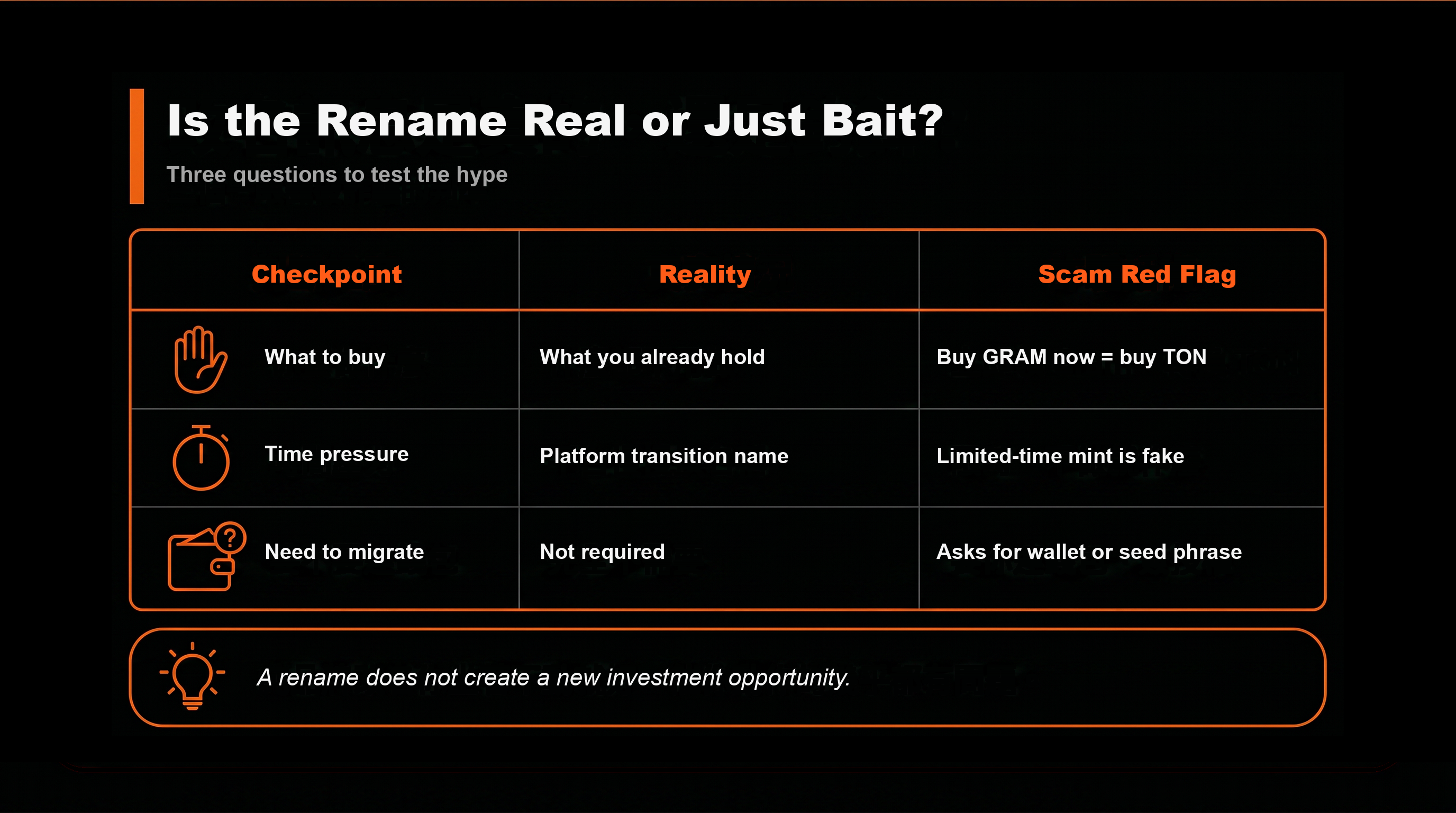
This is the judgment rule to burn into memory: since this rename requires you to do nothing at all, any message that comes to you telling you to "take action" is almost certainly a problem.When someone urges you to immediately claim Gram, claims there's a free Gram airdrop waiting for you, or says your TON "will be voided if you don't convert it," these urgent-and-tempting-sounding claims are all bait set up using the rename topic.
The logic here is actually clean: a genuine pure brand rename is the platform swapping the displayed name for you in the background. You just sit tight — there is simply no step that "requires the user to manually claim or convert."So whenever the core of a message is pushing you to do some action, especially wrapped in "limited time, free, you lose out if you don't" scripts, you can go ahead and file it under suspicious. When I see a message like this, I won't even click it, because just the "asking me to act" part already doesn't line up with the facts.
Pause Before Connecting a Wallet or Signing an Approval
The most common — and most deadly — closing move for a scam is luring you to connect your wallet and sign an approval you don't understand. These sites posing as "upgrade pages" or "migration tools" make their interface look very official, guide you through it step by step, and end up getting you to approve a malicious contract.Once you sign, they may have permission to transfer the assets in your wallet away one by one, and this kind of loss is often very hard to recover.
So I set myself an iron rule, and I'll share it with you: any page that, in the name of "upgrade, migration, claiming coins," asks me to connect my wallet or sign an approval — I treat it as a scam from the start, stop, and go back to the official channels I know to verify whether it's real, and only proceed once I've confirmed.Spending those extra few minutes to pause and check is a very worthwhile price compared to having your assets transferred away afterward and running around for help but never getting them back. In the crypto world, the weight of the act of signing an approval is far heavier than beginners imagine.
Trust Only Official Sources — Verify the Entrance Before the Content
To guard against this whole category of tricks that scam in the chaos, there's actually one simplest and most effective habit: only verify news from official sources. For any change concerning TON or Gram, go by the official website and official social account announcements. Don't click links people slide into your DMs, and don't trust the shady, look-alike-but-actually-fake sites in search results.
I like to break this action into two steps: verify the entrance first, then look at the content. Meaning, when I want to learn about something, the first step is confirming whether the site or account I'm on right now is actually official. If it doesn't pass this step, I won't believe it no matter how great the content reads. Many beginners do the opposite — they get hooked by "free" or "limited time" in the content first, then follow the link the other side gave them, which flips the whole order of judgment around.Put verifying the entrance first, and you'll block the vast majority of traps set up on the back of a rename topic.
Why Is This Rename Tied to Telegram?
"Why abandon the perfectly fine Toncoin and insist on going back to that old name that caused trouble?" There's actually a branding calculation behind this. In this section we'll talk about the motive for the rename, along with that often-cited "huge user base" imagination, to help you separate the marketing narrative from the real value, so you don't get led around by the story.
Returning to Its Roots, Borrowing Telegram's Brand Power
One very direct motive for this rename is wanting to tie the network more tightly to the Telegram brand.Gram, being the project's earliest name, carries a symbolic sense of "returning to its roots," going back to the starting point, while also making it easier for the outside world to associate it directly with Telegram. For a network wanting to expand its influence, borrowing the brand power of a globally known messaging app is a very sensible play.
When I look at this kind of branding move, I remind myself of one thing: a brand tie-in can bring attention, but attention doesn't equal value landing in reality.Making the name more recognizable and easier to associate with a big platform can indeed bring talking points and traffic in the short term, and that's good for promotion. But in essence it's a marketing-and-positioning move. Whether that attention ultimately converts into real usage and demand is another question that takes time to verify, and shouldn't be treated as already cashed in just because the name got louder.
The "Huge User Base" Is Imagination, Not Demand That Has Landed
Every time the Telegram angle comes up, someone trots out the "it has hundreds of millions of users" number, as if all those users will one day automatically turn into demand for the token. I have to poke a hole in that imagination for you: there's an enormous distance between a messaging app's user count and the number of people willing to hold and use a token — the former is an existing fact, the latter is a vision not yet realized.
Someone using Telegram to message every day doesn't mean they'll go buy Gram, hold it as an asset, or use it for payments. That requires real use cases and trust to happen, and none of it can be achieved instantly by changing a name. A huge user base is indeed a potential advantage with room for imagination, but right now it's more like a check that hasn't been cashed. The mistake beginners most easily make is pricing in a "potential possibility" directly as a "good news that has already happened," paying too high a price for an expectation still at the story stage.Keep imagination as imagination and landing as landing, and you won't get swept away by the grand narrative.
A Rename Can't Change the Fundamentals — Don't Treat the Narrative as Good News
By this point, we can boil it down to a judgment rule that's very practical for beginners: a rename can change a project's "look" and "story," but it can't change the underlying fundamentals.A token's value ultimately comes back to hard metrics like how many people actually use this chain, whether there's real demand and cash flow — and none of that changes just because the name went from Toncoin to Gram.
So when the market whips up heat around a rename, I deliberately ask two questions separately: is this attractive enough as a narrative? And has it actually improved the project's fundamentals? Many times you'll find the former is very lively while the latter hasn't changed much. See this clearly and you won't reflexively assume every loud branding move is good news to chase. For beginners who want to participate in the crypto market long term, building the habit of "looking at the narrative and the fundamentals separately" is worth more than remembering any single news story. It helps you avoid, time and again, the emotional traps that rise on a story and hurt when the tide goes out.
Getting a Rename-Related Message as a Beginner — What Should You Do?
"I roughly get the logic, but when I actually get a message about a TON rename telling me to claim Gram, how should I react?" In this section I won't lecture. I'll give you a judgment process you can follow directly when something comes up, so that in the uncertain moment, you know what to do next and what not to do.
First Confirm: Does This Require Me to Act?
For any message about a rename, upgrade, or claiming coins, the first reflex I suggest you build is to first ask yourself: does this actually require me to do anything by hand? For this TON rename, the answer was already made clear earlier — it's a pure brand rename, the coins in your hand need no operation, and the platform will swap the displayed name over on its own.
Treating this question as your first filter has an upside: it helps you triage quickly. If something inherently requires no action from the user, then any message urging you to act instantly becomes very suspicious. When I handle this kind of news, I first go back to the origin of "what is the true nature of this," rather than following the emotion inside the message. Confirm whether action is needed first, and you won't be led by the other side into doing something you shouldn't before you even understand the situation. This step looks simple, but it blocks most of the trouble.
For a Suspicious Message — Stop, Don't Click, Go Back to Official to Verify
If you've already received a suspicious message — say someone DMs you a link to "claim Gram now" — the most important thing at this point isn't to study whether it's real, but to stop first.Don't click that link, don't follow its instructions, and definitely don't connect your wallet or enter any private information on the page it leads to. Make these "don'ts" muscle memory, and they'll help you hold the line when emotions run high.
After stopping, the correct next step is to bypass this message and proactively go back to official channels to verify yourself. Open the official website or official community you normally trust, see if there's a corresponding announcement, and check the message in your hand against the official word. I'd compare this process to getting a call from a stranger saying there's a problem with your account: what you should do isn't follow the instructions on the phone, but hang up and dial the official support line yourself to confirm. Once the order is right, the scammer's carefully crafted script loses its grip.
A Self-Check Checklist to Run Before You Act
Finally, whether you want to participate or are just rattled by a message, I suggest you quickly run through these questions before taking any action, to avoid being led by momentary emotion or a script:
- What is the true nature of this? Is it a pure brand rename, or does it really require me to do something?
- Is this message asking me to "take action"? Is it urging me to connect a wallet, claim coins, or convert within a time limit?
- Have I gone back to the official website or official account to verify, rather than trusting the link the other side gave me?
- If I'm feeling excited or panicked right now, can I pause first and decide once I've calmed down?
Once you can answer all four questions, then decide whether to act — that's far steadier than reacting the moment you see a piece of news. Facing the endless stream of rename, upgrade, and airdrop topics in the crypto world, what protects you is often not how much technology you know, but whether you're willing to stop before acting and ask yourself clearly.
Conclusion
This piece has made the TON-back-to-Gram event clear for you: it's basically just switching the token name from Toncoin back to its earliest name, Gram. The chain, contract, and balance are all unaffected, and most people really don't need to do anything. What's actually worth remembering isn't that short-term pop, but the history behind this name — halted by the SEC, ended in refunds — and the most real-world risk of all: some people are using "rename, claim Gram" as bait to lure you into connecting your wallet and signing an approval. So when facing this kind of topic, first confirm whether it requires you to act, stop and don't click when you get a suspicious message and go back to official to verify, and put verifying the entrance first.A rename can't change the fundamentals — don't treat a lively narrative as good news worth chasing. Understand these few things, and the next time an upgrade, migration, or coin-claiming topic pops up, you'll be able to steadily tell which ones to bother with and which to skip outright.


