

Have you seen tokenized U.S. stocks for sale on an exchange and assumed that owning them equals owning that company's real shares?This piece won't put an equals sign there for you. Instead, it first helps you understand exactly which rights you're buying, the three models for buying U.S. stocks on-chain, and why voting rights and dividends are so often misunderstood. Then it reminds you what invisible things to check before you jump in, and finally helps you decide whether to use a tokenized stock or just open a brokerage account.
Are tokenized stocks real shares? First understand which rights you're buying
"This token I'm buying — does it represent the stock itself, a claim certificate on the stock, or just a product that tracks the price?"A lot of people get hung up on whether they can buy it and how easily they can sell it, but I ask this more fundamental question first. The rights attached to these three things are worlds apart. Sort out the rights hierarchy first, and later, when we talk about voting rights and dividends, you won't get confused about what you're actually holding.
Tokenized stocks aren't just U.S. shares "moved onto the chain"
A lot of beginners assume a tokenized stock is simply a real U.S. share "moved" onto a blockchain, so owning it means owning the stock indirectly. In reality it's not that direct. Mainstream tokenized stocks are mostly created when the issuer first buys the corresponding share in the traditional market as a reserve, then issues a matching token to you on-chain. What you get is exposure to that stock's price; as for the share registered on the shareholder registerit isn't in your name — it sits under the issuer or a custodian it designates.
That puts several checkpoints in between — the issuer, the custodian, the trading platform — and the longer this chain, the further you are from the real share, and trouble at any link feeds back into the token's value. So the essence to remember first is this: what you hold is a layer of claim certificate,not ownership of the company itself.
The price tracking the stock doesn't mean the rights track it too
The most misleading thing about tokenized stocks is the price. It usually hugs the real stock closely, so many people intuitively conclude: same price, so the rights should be the same too, right?That's exactly the misconception you most need to knock down. Look at the two things separately: on one side is price exposure — when the stock rises your token mostly rises too, and most products can deliver this; on the other side are shareholder rights — voting, shareholder meetings, how dividends are paid, and your claim priority in a liquidation — and this part often gets watered down, or is missing entirely.
The difference is that price linkage is technically easy to implement, but moving an entire legal shareholder status onto the chain is far harder, and many products never intended to do it at all.So what you're buying is more like a financial product that moves with the stock price, and this gap is by design, not a defect. Keep it in mind, and in a moment when we look at dividends and voting rights, you won't feel "how is this so different from what I imagined?"
Before you jump in, ask yourself: what rights can I actually claim?
Before I hit buy, I make a habit of asking myself: if this stock runs into trouble, or the company makes a major decision, what can this token of mine actually claim? You can self-check in three directions: voting rights — can I take part in company votes? For most tokenized stocks the answer is no; dividends — how are they paid, in cash, in stablecoins, or swapped directly into more tokens; and who to seek recourse from — if something really goes wrong, do I go to the trading platform, the issuer, or the custodian?
Where these three parties' responsibilities begin and end is something nobody usually spells out for you.If you can't answer even one of these three questions, it means you don't yet understand the product in your hands, so don't rush to place an order. Tokenized stocks are of course fine to touch — it's just that they take traditional share ownership apart and reassemble it into something else, so you need to know first which rights you're getting in exchange and which you're giving up.
What kinds of on-chain U.S.-stock buying are there? Tokenized, direct broker access, and perps differ a lot
"They all say you can buy U.S. stocks, so where's the actual difference between these products?" This section is the most crucial judgment in the whole piece. They all fly the same "buy U.S. stocks" banner, but the structures behind them differ a lot, and the structure directly determines your rights, your risks, and who you seek recourse from when things go wrong. Below we compare the three most common models — learn to tell which one the thing in front of you is first, then decide whether to touch it.
Tokenized mapping — you're buying an on-chain claim certificate, not that share
This is the mainstream approach for products like xStocks and BStocks: the issuer buys the real stock in the traditional market as a reserve, then issues a token to you on-chain that corresponds 1:1. One thing worth flagging: some on-chain assets with very similar names are actually different underlying targets — for example, Ondo early on focused on tokenized U.S. Treasuries, which isn't quite the same as a tokenized stock, so when you see a similar-sounding name don't rush to lump it in; get clear on the underlying target before you enter.
What you should check with this model is whether a few underlying things hold up: whether the reserve exists and can be verified, whether there's third-party custody and public proof of reserves; who the issuer is and where it's regulated; and how much the token is worth if the platform delists it or the issuer hits trouble. Its advantages are real: low barrier, you can use stablecoins, 24-hour trading. But the trade-off is that what you actually trust is the "issuer plus custodian" chain, not the listed company itself — you're trading away part of your rights for trading convenience,and you haven't actually bought that share.
Direct broker access — the key is whether there's a genuine stock account
Some platforms lead with "direct broker access," where behind the scenes they open a genuine stock account for you at a compliant broker and buy real stock, and under this model you're closer to owning shares in the traditional sense. The key to judging it is the account structure: is the stock registered in your personal name, or held under the platform's omnibus account — this decides whether the assets still count as yours if the platform fails; which country's regulator oversees the broker and whether there's an investor-protection scheme; and whether deposits/withdrawals, tax reporting, and delistings run through a proper broker process.
If what you want is full shareholder rights and clear tax documents, this kind of model fits your needs better than tokenized mapping, because what you're buying is the real stock. But the trade-off is usually stricter KYC, a more cumbersome account-opening process, and it may not support crypto deposits.So figure out first whether you want rights or convenience, because these two models run in almost opposite directions.
Perpetuals / contracts for difference — you're only trading price movements
The third kind is the easiest to mistake for buying stock, but it actually has nothing to do with stock. With products like perpetual contracts or contracts for difference (CFDs), what you're buying and selling is only the stock's price movement, and from start to finish there's no real share behind it at all. Several of its features are landmines for beginners: it usually comes with built-in leverage, which amplifies gains but also losses; there's a funding rate and the risk of forced liquidation, so holding it a long time lets fees eat into your cost and your position can get liquidated out; and most crucially, there are no shareholder rights at all and no underlying asset — voting, dividends, and recourse don't even come into it.
I treat this kind of product as completely separate from the first two. Tokenized mapping and direct broker access still have some connection to a real share, but perps and CFDs are essentially high-risk short-term trading tools, suited to people who clearly know they're doing leveraged trading and can withstand the risk of liquidation.If you originally wanted to hold U.S. stocks long term but accidentally bought into a leveraged perpetual contract, then you've gone completely the wrong direction. So before you place an order, confirming the product type matters more than picking which stock.
You may not be a shareholder: the most misunderstood voting rights and shareholder rights
"The price tracks Apple and Tesla, so do I count as a shareholder of theirs?"No matter how closely the price moves, you won't become a shareholder of that company because of it. What this section unpacks is the part beginners most often overlook yet that most affects your rights: whether you can vote, whether you'll get shareholder-meeting notices, and who to seek recourse from when things go wrong. Let's draw a clear line between "holding a product" and "holding a stock."
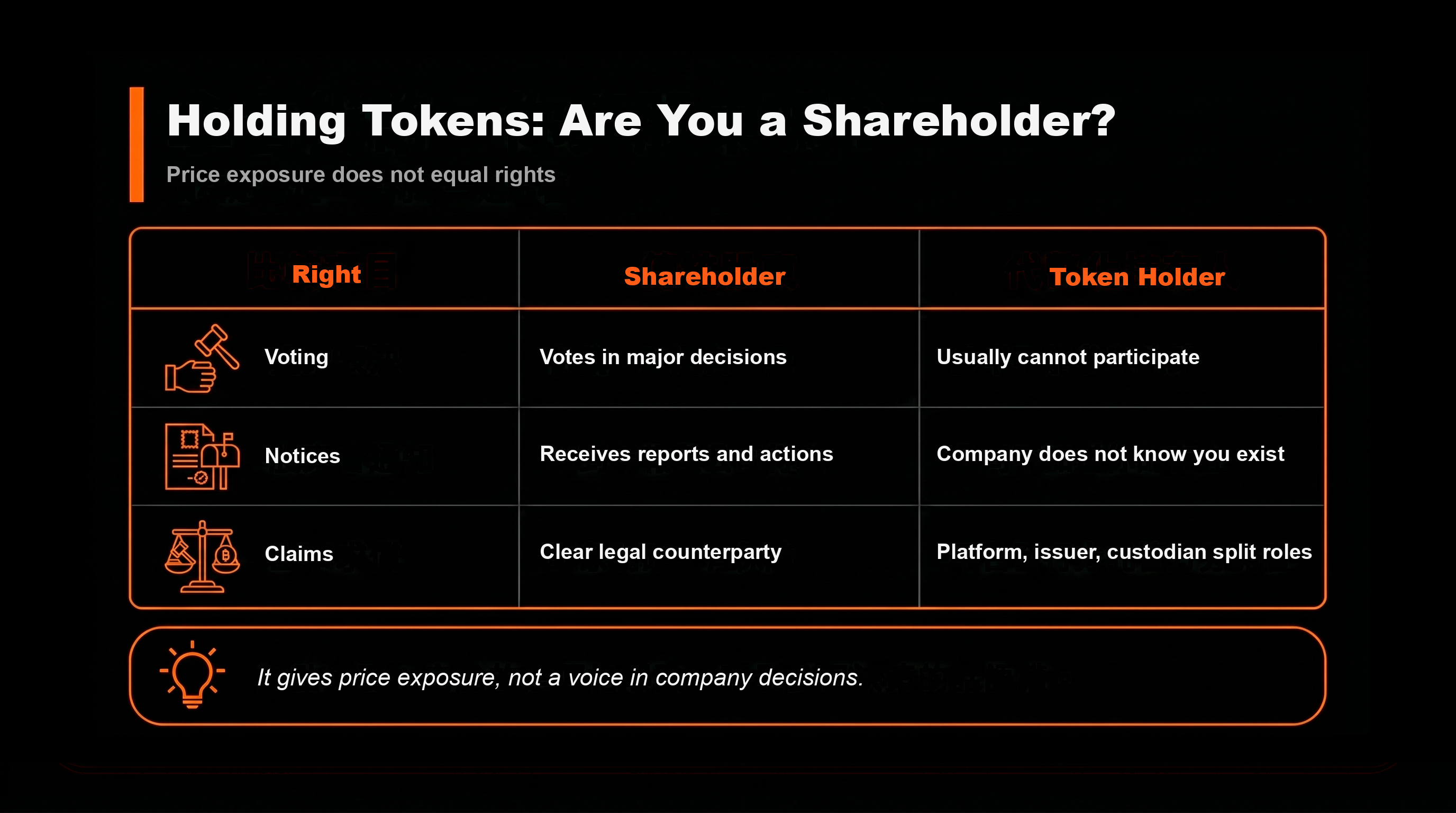
Voting rights — you mostly can't take part in company decisions
Traditional share ownership comes with an often-overlooked right: the shareholder vote. When a company is doing a merger, re-electing directors, or passing a major resolution, the vote in a shareholder's hands carries weight. But most tokenized stocks don't grant this right, for the reason covered earlier: what's recorded on the shareholder register is the issuer or a custodian it designates, while the token you hold usually only tracks the economic interest, not the voting right.The one who can vote at the shareholder meeting is the institution upstream on the chain, not you holding the token, and that's the common design of these products.
So if what you value is participating in a company and exercising shareholder rights, tokenized stocks mostly can't give you that; what they give is price exposure, not a say in the company's decisions. For a beginner who just wants to ride the stock price for the spread, having no voting rights may not matter, but if you mistakenly think you bought a full shareholder status, that gap in understanding will surface sooner or later.
Shareholder meetings and notices — you're often just passively holding a product
Traditional shareholders get first-hand information when the company acts: annual reports, shareholder-meeting notices, and announcements of corporate actions like stock dividends, splits, and mergers, and they can decide accordingly whether to add to their position or speak up. But holders of tokenized stocks mostly don't have this channel. You're more like someone holding a product that tracks the stock; the company doesn't even know you exist, and won't notify you as a shareholder; and how a company's major action gets reflected in the token is decided by the issuer's rules, so all you can usually do is passively accept it.
So in practice, I go dig into the issuer's terms first, to see clearly how the token is handled in a stock split, merger, or delisting — proportional adjustment, suspended trading, or a straight liquidation and refund — because it differs from one issuer to the next.These rules are the "instruction manual" you should read first. A lot of beginners only look at the price and the fees and never open the terms, and only discover they've been left in the dark when the handling turns out different from what they expected.
Recourse when things go wrong — treat the platform, the issuer, and the custodian separately
This is the part that most calls for a level head. When something really goes wrong, you first need to figure out: which party are you actually a creditor of? Three roles need to be looked at separately. The trading platform handles your orders and account; if the platform collapses or gets hacked, it affects your access to your assets. The issuer handles the token's issuance and reserve design; if the issuer runs into trouble, the 1:1 promisecan turn into a bad check; the custodian actually safekeeps the underlying stock, and if the custody link fails, gets misappropriated, or goes bankrupt, the so-called full reserve may not hold up.
Sort out these three lines and you'll know clearly which risks your money is actually exposed to, instead of vaguely feeling "there's a reserve, so it's safe." A product where all three parties are regulated and the reserve can be verified, versus one where the three parties' relationships are unclear and the terms are vague, are two entirely different orders of risk.If it can't even tell me who to turn to when things go wrong, no amount of convenience gets me to touch it.
How are dividends paid? Why they may turn into tokens or auto-reinvest
"The stock paid a dividend — will the money land in my account automatically like it does at a broker?" This is the detail most often overlooked with tokenized stocks. It's all called a dividend, but some pay cash or stablecoins, while others swap it directly into more tokens or auto-reinvest it, and the way you calculate your cost and your actual take-home return is completely different.If you only look at the yield, it's easy to overestimate what you'll actually receive.
A dividend doesn't necessarily mean cash landing directly in your account
Many beginners expect: the stock pays a dividend, and cash lands automatically like at a traditional broker.Tokenized stocks don't necessarily work this way. A few common ways of handling it: one is cash or stablecoins landing in your account, which is closest to the traditional dividend experience; one is automatically swapping it into more tokens, effectively reinvesting the dividend for you, so what you get extra on your balance is a token quantity, not cash you can spend directly; and another is reflecting it in the token's price or net value, so you won't see "a dividend payment" but rather the value embedded inside the token.
Which one is better has no standard answer — it depends on whether you want cash flow or compounding accumulation, and the key is knowing first which one you're holding. I'd suggest going straight to the issuer's dividend rules and dropping the assumption that "I'll get cash." Many beginners only go back to check after the dividend date passes and they see no cash, and only then discover it was spelled out in the terms all along.Read the rules first, then calculate the return — don't do it in the reverse order.
Swapping into tokens or reinvesting changes how you calculate your cost
If the dividend gets automatically swapped into tokens, things get more complex than you'd think. Your holding cost and quantity keep changing, so you can no longer look at your return with the simplest method of "current price minus original purchase price." Specifically, you run into a few things: your holding quantity keeps increasing, so the cost basis shifts with each reinvestment; each reinvestment may be a taxable or valuation point in time, so the bookkeeping is actually far more complex; and the meaning of "yield" is different too — a traditional cash dividend really lands in your pocket, whereas here it's more like rolling the return back into the principal and letting money keep making money.
I personally treat this kind of auto-reinvesting product as "a position that slowly grows on its own" for bookkeeping, rather than a tool that pays a fixed dividend, recording the timing and quantity of each dividend instead of tallying it all up at the very end. Get this wrong at the start, and when you go to settle your return or file taxes the numbers won't add up easily.The dividend method in turn determines how you should keep your books.
Taxes, fees, and exchange rates also quietly eat into your actual return
The dividend or gain you see on paper is never equal to the number you finally take home. In between sit several costs that quietly dock points, mainly from three areas: taxes — how different regions tax crypto assets and dividends varies a lot, so confirm your own filing obligations first; fees — trading, conversion, and deposits/withdrawals may each take a cut, and added up they gnaw off a chunk of your return; and exchange rates — priced in stablecoins or foreign currency, converting back to New Taiwan dollars costs you another layer.
I treat these three costs as "friction costs" to be deducted by default, taking a haircut on my return estimate up front, instead of looking at the on-paper number and assuming that's what lands in my pocket. Especially when the dividend is swapped into tokens and cross-currency pricing is added on top, the math is quite a bit more complex than a traditional broker.Rather than being surprised afterward that you took home less than you thought, factor these costs in before you jump in.
Verification and risk control: which "invisible" things to confirm before you jump in
"The product interface looks perfectly normal, so does that mean it's safe?"A pretty interface and a price that hugs the stock are just the surface; what determines how high the risk is are the things hidden in the terms and the proof of reserves — the things you have to go check for yourself to see. In this section we lay out these "invisible" parts that are often the dividing line between fine and disaster.
Proof of reserves and custody: don't just take the issuer's word for it
Tokenized mapping products' most core safety assumption is that "every token on-chain has a corresponding real stock behind it as a reserve."The problem is you can't just take the issuer's own word for this assumption; it needs verifiable evidence behind it. I look at a few things: whether the underlying reserve is held by an independent third-party custodian, or whether the issuer is both referee and player; and whether there are regular, public proofs of reserves or audit reports that let you check whether the total on-chain token supply matches the underlying stock quantity.
The reasoning behind this is very plain: transparency is itself a form of risk control. A product willing to be publicly examined raises the cost of misbehavior, so it's relatively less likely to act recklessly; conversely, anything that plays up returns but is vague about reserves and custody, I automatically bump the risk up a notch. Rather than guessing whether this outfit is reliable, just look at whether it's willing to show you the most crucial thing — the proof of reserves.
Regulation and the issuer's background: where you stand when things go wrong
The second "invisible" thing to check is whether this product and its issuer are regulated at all, and where. You can't feel this at all in normal times, but at the moment things go wrong, it decides whether you stand in a protected position or a position with no recourse. A regulatory gap won't make the product any less smooth to use — the interface is still pretty, the trading still fluid — so beginners easily overlook it; but the point of regulation is whether, when the issuer breaks the rules, absconds with the money, or collapses, there's a mechanism that can step in and give you a chance to recover part of your losses.
Of course, being regulated doesn't equal absolute safety — even the most legitimate institution can run into trouble, and that has to be faced honestly. But "whether anyone can regulate it" is still a very important threshold for screening products. My principle is simple: if I can't even find out who the issuer is or who regulates it, I cross it off no matter how tempting the returns look.Making "if you can't verify it, don't touch it" a hard rule helps you avoid a large share of the landmines.
Don't let listings, airdrops, and community hype carry you along
The last risk-control point has nothing to do with the product's structure and everything to do with your own emotions. New things like tokenized stocks often come with new listings, airdrop campaigns, and communities flooding your feed, which easily makes people rush in before they understand it. My experience is: the stronger the "get on board now or it's too late" atmosphere, the more you should force yourself to slow down: a listing doesn't mean the product has been thoroughly vetted, an airdrop doesn't mean it's safe, and the people shilling in the community don't necessarily share your interests — some have even set the trap in advance and are waiting for you to take over the bag.
So I give myself a simple discipline: any order I want to place out of "fear of missing out," I sit on for a night first. An opportunity that only holds up in an atmosphere rushing you to hurry mostly can't survive a level-headed look. Tokenized stocks are a neutral tool in themselves; what usually gets a beginner burned is not the tool, but the self who is pushed along by the hype and piles in heavily before understanding the rights and risks.
Should you use a tokenized stock, or just open a broker account to buy U.S. stocks?
"I've gone through the rights, the models, and the risks — so does this way of buying actually suit me?" Finally we return to the most practical question.There's no standard answer; it depends on what you want. Someone who wants to use crypto, wants 24-hour trading, and is located outside the U.S. needs a completely different tool from someone who wants full shareholder rights and clear tax documents. This section maps out the axes of the choice for you, then attaches a pre-order checklist.
The kind of person tokenized stocks suit better
If you fit the following situations, tokenized stocks will be more valuable to you: you're already used to using crypto or stablecoins and don't want to open a cross-border brokerage account just to buy a little U.S. stock; you want the flexibility of 24-hour trading unconstrained by market hours; you're located outside the U.S., where opening a proper U.S. brokerage account is relatively troublesome; and what you mainly want is price exposure, without caring much about voting rights and shareholder status.For those who fit, what they're buying is really "convenience" and "moving with the stock price."
But there are two prerequisites, and you can't skip either: you've accepted the rights gaps covered earlier — knowing you won't get voting rights, that dividends may turn into tokens, and that the recourse chain is long when things go wrong; and you've picked a product where the reserve, the issuer, and the custodian can all be clearly verified. If deep down you still want the full rights of that one share and just think buying with crypto is faster, then this tool is actually misaligned with your needs.
The kind of person a traditional broker suits better
Conversely, if you fit the following points, I'd suggest giving a proper broker priority: you value full shareholder rights, including voting, shareholder-meeting notices, and clear dividends; you need clear tax documents; you care more about asset protection and want an investor-protection scheme as a backstop; or you plan to hold long term and in large amounts, where the value of regulation and protection is clearly magnified.What these needs have in common is that what you want isn't just price exposure, but a complete, protected, and fully-fledged shareholding relationship.
A traditional broker may be a hassle to open, have strict KYC, and mostly not support crypto deposits, but what you get in exchange is more complete rights and clearer protection, and for someone who plans to run U.S. stocks as a long-term asset, those "inconveniences" are a price worth paying. My judgment is blunt: the longer the money sits, the larger the amount, and the more you care about whether you can recover it if something goes wrong, the more weight a traditional broker should get.So neither is definitively better — it all comes down to what this money is for.
A checklist to run through before you jump in
Whatever you finally choose, before you place an order I'd suggest running through the following checklist from top to bottom, so you don't get carried along by listings, airdrops, or community hype.Being able to answer these questions before you decide whether to buy and which kind to buy is far steadier than just staring at price and hype:
- Which kind is this product? Is it tokenized mapping, direct broker access, or a perpetual / contract for difference?
- How are dividends and voting rights handled? Is the dividend cash, stablecoins, or swapped into tokens? Is there any voting right?
- Who are the platform, the issuer, and the custodian, respectively? Where are they regulated, and can the reserve be verified?
- In the worst case, who do I turn to and how much can I get back? Are the rules for handling a delisting or a platform failure spelled out clearly?
- Have you accounted for the hidden costs? Are taxes, fees, and exchange rates all factored in?
The core of these five questions is really forcing you back to the same thing: what exactly you bought, what you gave up, and how much you can bear in the worst case.Answer these questions clearly and you're no longer a beginner chasing the hype, but someone who understands what they're buying. Whether to buy, and which kind, you can decide at that point — and you'll feel a lot more settled about it.
Conclusion
This piece has first helped you sort out the nature of tokenized stocks, the three models for buying U.S. stocks on-chain, and the most commonly misunderstood rights — voting, shareholder meetings, dividends, and recourse. The point was never whether this kind of tool is good or bad, but whether, before you jump in, you first understood whether what you're buying is a stock, a claim certificate, or just a derivative that tracks the price.The price tracking U.S. stocks doesn't mean you're a shareholder of that company; the convenience of being able to order with just stablecoins may come at the cost of voting rights, clear dividends, and a clear recourse chain. Keep that checklist above at hand — get clear on the product type, the reserve and custody, and how dividends and rights are handled — then decide whether to use a tokenized stock or a traditional broker. Stop treating it like a real share; understand it first, then jump in, so you don't buy into something completely different from what you imagined.


