

Have you seen that Restaking lets the same ETH earn an extra layer of yield, and figured it's a sure-win deal you should jump into right away?This piece won't hype up the yield for you. Instead, it first helps you understand what Restaking actually does, where that extra layer of yield comes from, and who carries the slashing and stacked risks. Then it sorts out the difference between LST and LRT, and finally gives you a framework to judge whether you should touch it at all.
What Is Restaking? First Get Clear on What It Actually Does
"Restaking — does it mean staking the same money twice?" That's roughly the idea, but the devil is in the details, and those details decide how much risk you carry.In this section, we won't rush to talk about yield. We'll get its most basic operating logic fully clear, so that when we later discuss money and risk, we're not building on a misunderstanding.
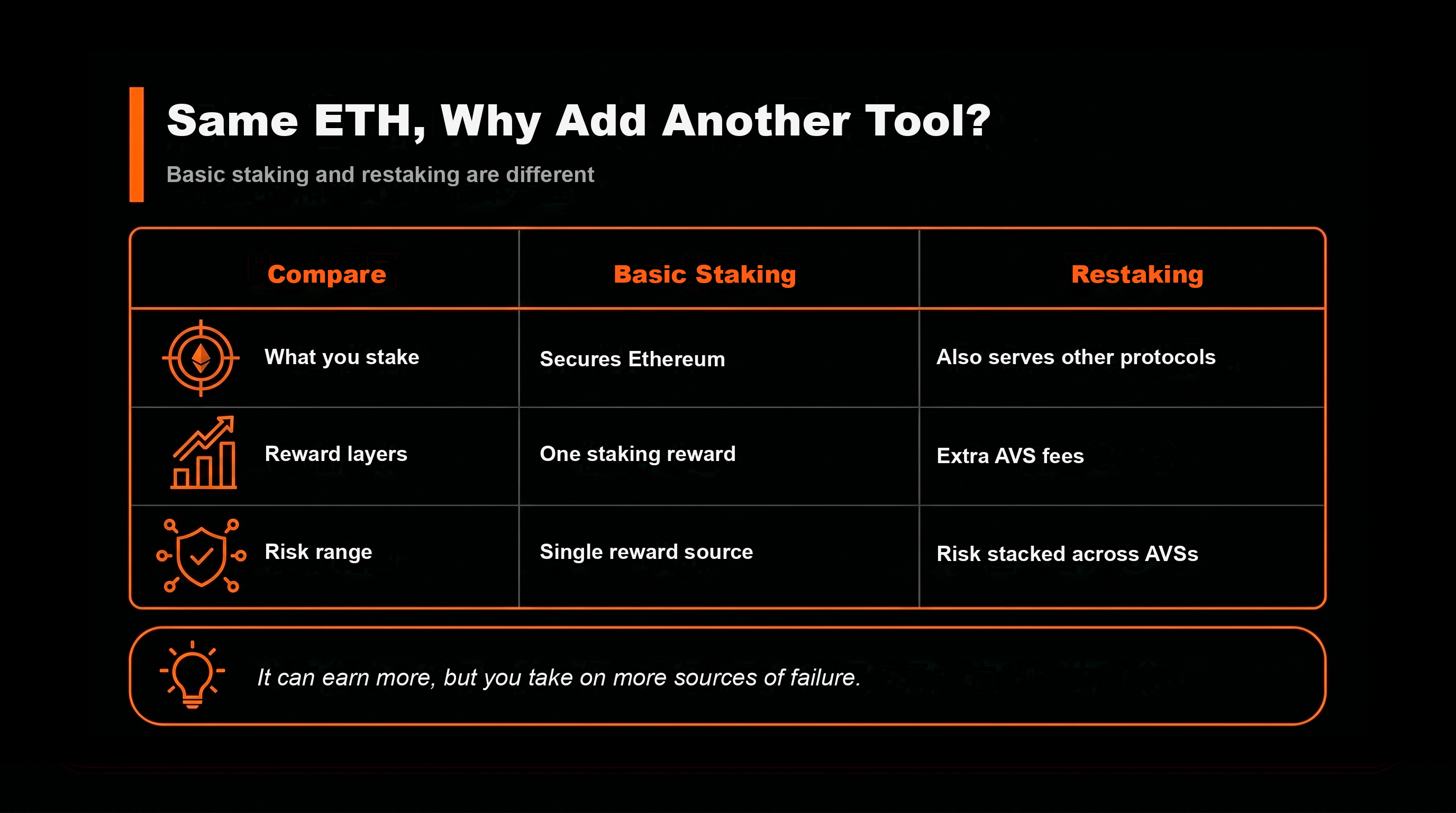
A Quick Recap — What Regular Staking Does
To understand restaking, you first have to be clear on regular staking, or it's easy to muddle the two later. Staking means locking the ETH you hold into the Ethereum network to help validate transactions and keep the whole chain running securely; in return, the network pays you staking rewards proportional to your stake. You can think of it as putting money into a fixed deposit that also does work — except the money you deposit isn't just sitting there earning interest; it's actually taking part in the network's security work.
There's a key point to remember first: the yield you get from staking is essentially the reward for "providing security," not interest that appears out of thin air.If you, or the node you delegate to, break the rules, this deposit can be penalized. I stress this point because the entire logic of restaking is built by stacking another layer on top of this foundation of "capital for security, security for reward." You have to plant your feet firmly on this base first, so you don't get dizzy from fancy jargon later.
Restaking — Putting the Same ETH to Work One More Time
Once you understand regular staking, restaking is easy to grasp. Restaking's core move is taking your "already-staked ETH" — or the certificate that represents that stake — and using it to simultaneously secure other services or protocols, earning an extra layer of yield on top of the original staking rewards. In other words, the same ETH isn't sitting idle: it's securing Ethereum on one side while being lent out to secure something else on the other, collecting rewards from both.
The selling point of this approach is what the industry calls "capital efficiency." It means you don't have to put up extra principal — just by reusing your existing staked assets, you can make them work two jobs for you. By now you've probably sensed something feels off: where in the world does one pile of principal safely earn two paychecks? It doesn't, really. The only way it earns more is by securing one more thing — which means taking on more risk if that thing goes wrong. So the true nature of restaking is not a free lunch; it's a trade of "higher risk for higher yield." Hold on to this understanding from start to finish.
Why Anyone Would Want to Restake
If earning more just means carrying more risk, why do so many people keep piling into restaking? The reason isn't complicated: the lure of yield, plus a marginal cost that looks very low. For someone who already holds ETH long-term and is already staking, restaking those assets feels like "the money's locked up there anyway, might as well earn a bit more on the side," and this feeling of adding yield without putting up extra money makes it especially easy to let your guard down.
Another push is that the whole ecosystem, in its early days, tends to use relatively high rewards to attract capital, so you'll see one eye-catching APR screenshot after another in the community. My reminder: the more something looks like "easy extra earnings on the side," the more you need to coolly do the math and ask yourself whether this yield is built on real demand or is just a number propped up by early subsidies. Many beginners trip up not because they aren't smart enough, but because that "the money's there anyway" thought makes them skip the risk assessment they should have done.Restaking isn't off-limits, but it should absolutely not be your first stop into staking.
EigenLayer and AVS — How Shared Security Works
"So who exactly are these services that restaking secures, and how did they get tangled up with my ETH?" To answer that, you need to get to know the flagship project of this whole restaking approach, EigenLayer, and the core concept it introduced: "shared security." This section breaks down that supply chain so you can see what your ETH is actually being used for.
Shared Security — Lending Out Ethereum's Security
EigenLayer's most central idea is called "shared security." To understand it, first consider a real-world problem: a brand-new protocol that wants enough security to earn people's trust traditionally has to build its own node network from scratch and issue its own token to incentivize validators — which is expensive and slow, a barrier high enough to lock many small projects with good ideas out.
Shared security lets these new protocols skip building their own safety net and instead directly "rent" the existing ETH security on Ethereum that restakers have already staked in. For restakers, it's like lending out the security of the ETH in their hands; for new protocols, it's like paying rent to borrow a ready-made, trustworthy security guarantee. This is the underlying logic that runs the entire restaking ecosystem — it's essentially a "rental market for security": on one side are the people lending out security, on the other are the protocols renting it — and if you restake, you're playing the role of the lender.
What AVS Is — The Services Renting Security From You
In EigenLayer's world, the protocols or middleware that come to rent security have a specific name: AVS (Actively Validated Services). You don't have to memorize the term — just grasp its role: AVS is the party that "rents security from restakers and pays rewards for it."
AVS actually comes in a wide range: from data availability layers, cross-chain bridges, and oracles to all kinds of middleware that need decentralized verification. What they share is that they all need a trustworthy security mechanism but don't want to raise their own army of validators from scratch, so they choose to rent from EigenLayer. For you as a restaker, every additional AVS you take part in is, in theory, one more source of yield. But please take in the other half too: every additional AVS you secure means binding yourself to one more set of its rules and exposing yourself to one more chance of it going wrong. AVS: more of them means yield and risk growing together, it's never just the yield growing alone.
What Actually Happens to Your ETH Along This Chain
Put the two previous pieces together and you can see the whole journey your ETH takes through this supply chain. At the start, you stake it into Ethereum — that's the first layer of work. Then, through EigenLayer, you delegate that stake's security again, and it gets lent to one or more AVS — that's the second, third, or even more layers of work. Every layer is earning money for you, but every layer is also piling up an obligation for you.
I like to use an image to help beginners remember: your ETH is like an employee you've sent out to work many jobs. Each extra job means one more paycheck, but if any single one of those jobs involves a serious blunder, the penalty comes out of that same person's principal. This image instantly exposes the truth about restaking that's most easily overlooked — you think you're diversifying, when in fact all the risk ultimately converges back onto the same pile of ETH.Once you understand this chain, the next section can calmly work out how that yield actually lands in your pocket.
Where Does the Yield Come From? Why You Can Earn That Extra Layer
"After all this talk, who is actually paying me this extra money in cold, hard cash?" This is the key to judging whether restaking is worth taking part in. If you can't even explain where a yield comes from, it's very likely unsustainable.In this section, I'll walk you through the source of the money, why it holds up, and how unstable it is, one point at a time.
What the Extra Yield Really Is — "Security Rent" Paid by AVS
Let's make the most central point clear first: the extra layer of yield from restaking is essentially the rent those AVS pay you to "rent" the security of your ETH. It's not interest, not a dividend, and certainly not some perk a platform hands you out of thin air — it's a service fee with a clear quid pro quo — you provide security, it pays, that simple.
See through this and your judgment about restaking gets a lot clearer. Because once you know the yield comes from the rent AVS pay, you'll naturally start asking: just how many AVS are willing to pay, how long can they afford it, and is it real demand or just hype-chasing? For you as the lender, the marginal cost really is low — the same ETH taking on one more AVS means one more stream of rent, which is exactly the "high capital efficiency" selling point. But whether the rent lasts depends on the real demand on the tenant's side, not on how badly you want to earn.Put yourself in the shoes of the party paying, and you won't be blinded by your own desire.
The Yield Isn't Fixed Interest — It Floats and It's Uncertain
The biggest misunderstanding many beginners have is imagining restaking yield as the kind of fixed interest you get from a bank deposit — and this misunderstanding is dangerous. In reality, restaking returns float and swing dramatically with market conditions. The high APR you see right now is by no means guaranteed to still be there next month.It's driven by at least a few shifting factors, which I've listed out here for easy reference:
- How many AVS are currently paying rewards, and how much each is willing to pay — this directly determines the size of the rent pool.
- How many people are crowding in to restake alongside you, and how many slices the pie gets cut into — the more people sharing, the less each one gets.
- AVS's reward tokens themselves are worth, and whether the market wants them — if the token price drops, your real yield shrinks along with it.
Put these factors together and you'll understand why restaking's APR is essentially an uncertain, floating number. When it's high it can be very tempting, but that high point often rests on conditions like "right now there are lots of AVS, subsidies are generous, and not too many people are sharing yet" — and the moment those conditions change, the number can drop in a heartbeat. When I see a very high restaking yield, my first reaction is never to rush in, but to first ask one question: Is this built on sustainable, real demand, or is it just a pretty number stacked up by early subsidies?That one question can often filter out most of the impulse.
How to Tell "Real Demand" From "Early Subsidies"
Since whether a yield lasts depends on whether it's real demand or subsidies, how should a beginner roughly tell them apart? There's no 100%-accurate formula here, but a few directions can help you build an instinct for judging. I remind myself that subsidy-driven yields usually share a few traits: the numbers are unreasonably high, they're propped up mainly by the issuing project's own token, and they often come wrapped in an "early bird" or "limited time" atmosphere that pressures you to jump in fast.
Conversely, yields that look more like they're backed by real demand usually come from AVS that genuinely have users, have business volume, and are willing to pay long-term to rent security — maybe not as flashy, but relatively solid. Rather than chasing the highest number, it's better to understand who's actually paying behind this yield and how long they can keep paying.After all, early subsidies always exit one day; when the subsidies stop and the numbers fall back, those who jumped in only for the high APR often discover the risk they carried far outweighed the returns they actually got.
Who Carries the Risk? This Section Is the Heart of the Whole Piece
"So what about the risk? If I earn one extra layer, does that mean I can also lose one extra layer?" Exactly — and it's more complicated than you think. If you remember only one section of this whole piece, I hope it's this one. What most needs to be spelled out about restaking is never how high the yield is, but how the risk stacks up layer by layer and, in the end, all falls back onto that one pile of ETH of yours.
Slashing — Breaking the Rules Can Cut Straight Into Your Principal
Let's start with the most hardcore risk: what's known as slashing. Staking has this mechanism built in: if you — or the node you delegate to — break the protocol's rules, such as going offline too long, signing something you shouldn't have, or acting maliciously, then your staked ETH will be "partially or fully confiscated" as a penalty. Note that what's cut here is not your interest, but your principal, and this is what makes staking most different from ordinary money management — and most deserving of being taken seriously.
In regular staking, this is relatively simple: you only need to follow Ethereum's one set of rules, and the risk surface is contained. But restaking sends the same ETH to secure multiple AVS at the same time. This means you now have to follow several different sets of rules simultaneously, and if any one AVS's rules are violated, it can trigger slashing against your principal. In other words, your risk is no longer from a single source — it's spread across several protocols you may not fully understand. This is the most fundamental difference in the nature of risk between restaking and ordinary staking — and the part most easily glossed over by the sales talk of "double yield."
Stacked Risk — One Pile of ETH Bearing the Risk of Multiple Services
The reason slashing is especially frightening in restaking is that it "stacks," a point worth stressing in a whole paragraph of its own, because it's most often overshadowed by the halo of yield. Under restaking's design, the more AVS your ETH secures, the more rent it can collect, of course — but the "surface" it exposes to slashing risk expands proportionally too. You're not putting a separate pile of money into each AVS, each bearing its own risk; instead, you're using the same principal to absorb the risk of all the AVS.
This leads to a very counterintuitive but deadly result: as long as any single one of the AVS you take part in runs into trouble, the one that gets hurt is that same pile of ETH of yours. Unlike diversification, where risks can offset one another, this wires multiple independent risk sources all onto the same principal. So that line "earn an extra layer of yield," put plainly, means "carry an extra layer of risk that could wipe out your principal" — the two are bound tight together.My advice is practical: if you really are going to restake, keep the number of AVS you secure conservative, and pick the ones you understand — don't take on everything just to push your APR higher. The extra few you take on earn limited rent, but what they can cost you is everything.
Smart Contract, Liquidity, and Early-Ecosystem Risks
Beyond slashing and its stacking effect, restaking quietly piles on several other layers of risk that beginners easily overlook while fixating on yield. I've organized these commonly missed risks into a list, but you should treat each one as something that really can happen, not as polite boilerplate written into a disclaimer:
- Smart contract risk: EigenLayer itself and each AVS's contracts, if they contain vulnerabilities or get attacked, can directly damage your assets — and this has nothing to do with whether you followed the rules.
- Liquidity risk: your ETH is locked in restaking, and when you want to exit you can't necessarily get it back immediately or without loss — especially painful when the market swings violently.
- Early-ecosystem risk: many AVS are still very new, haven't been live long, and haven't been fully battle-tested by the market, so their potential problems haven't been fully exposed yet.
Looking at these risks alongside the earlier slashing and stacked risk, I hope what you come away with is calm awareness, not fear: restaking is a tool that magnifies yield and risk at the same time. It's not a scam, but it's absolutely not a beginner's first dish.If you're not even comfortable with the most basic regular staking and haven't yet experienced what slashing is, you really shouldn't chase a high APR right off the bat just for a few extra percentage points of yield. Plant your feet on the basics first, understand the risks, and then talk about whether to go advanced — this order can't be reversed.
LST, LRT, and Regular Staking — How They Differ and Which Suits You
"I often hear LST, LRT — how do these acronyms relate to restaking?" These terms look intimidating, but once you understand the earlier logic they're not hard to grasp. This section lines them up against regular staking to help you see clearly which part of the risk spectrum you're standing on.
From Regular Staking to Liquid Staking (LST)
Let's fill in the middle piece of the puzzle. Regular staking has one inconvenience: once your ETH is staked in, it's locked up; during that time it can't be moved or used, meaning you sacrifice the flexibility of your funds. To solve this pain point, the market developed "liquid staking," which is the LST (liquid staking token) you often see. Here's how it works: after you stake ETH, you receive a certificate token representing that stake, and this certificate can freely circulate and trade on the market, or even be used elsewhere.
This effectively lets you "stake and keep liquidity at the same time." It sounds convenient, and it really does solve the problem of funds being locked up. But you should have learned by now to view things through this piece's lens — one extra layer of convenience often means one extra layer of risk. LST stacks on an extra layer of smart contract risk from the issuing protocol, and the market price of that certificate token can sometimes de-peg from the value of the ETH it represents. It's a useful tool, but it's not a free upgrade without a cost; you need this understanding up front.
LRT — Wrapping Liquid Restaking In Too
Once you understand LST, LRT is just one more layer stacked on top. LRT stands for "liquid restaking token." As the name suggests, it combines the two things we discussed earlier — "restaking" and "liquidity certificate": you restake, and then likewise receive a tradable certificate token. What it aims to give you is that extra layer of restaking yield, plus the convenience of keeping liquidity — it sounds like it's collected every benefit.
But by now you should be very clear that while it collects every benefit, it collects every risk too. LRT essentially stacks all the risks we've discussed together: slashing from the underlying regular staking, the multiple AVS slashing and stacking from restaking, the smart contract and de-peg risk of the liquidity certificate itself, plus the risk of the protocol issuing the LRT. This is a structure nested layer upon layer out of several smart contracts and several sets of rules, and trouble in any one layer can propagate down onto you. I'm not saying LRT can't be used — I just want you to be clear-eyed: the little bit of extra convenience and yield you get sits on top of a far more complex risk structure, and it's not something a beginner should casually touch.
Comparing Them Side by Side — Which Part Suits You Now
Line these up side by side and your inner ruler gets its markings. From lowest to highest risk, the spectrum roughly goes like this: self-custody and doing regular staking step by step is the simplest in risk; using LST to gain liquidity adds one layer of protocol risk; restaking to earn AVS rent adds multiple slashing and stacking risks; using LRT to wrap all of these together sits at the top of complexity and risk. Each step up, you might earn a bit more, but what you have to understand and bear grows with it.
So rather than asking which one earns the most, honestly ask yourself which step you can stand firmly on right now. My guidance for beginners is simple: if you don't even fully understand regular staking's slashing mechanism, then the place for you is the far-left end of the spectrum — honestly build a solid foundation. Only once you truly understand what each layer of risk is and what happens when things go wrong should you decide whether to take a step to the right. When it comes to investing, moving forward steadily within what you understand goes far further than sprinting after the highest number.
Should a Beginner Touch It at All? Here's a Framework to Judge
"I get the reasoning, so should I — a beginner — touch restaking or not?" In this section I won't hand you a straight should-or-shouldn't answer, because that depends on your own situation; but I'll give you a framework to ask yourself before you act, so your decision is one you've thought through, not one dragged along by a high APR.
First Check How Solid Your Foundation Is
The first thing is to honestly assess your own foundation. Restaking is an advanced play; it assumes you're already very familiar with the basic concepts covered earlier. If you can't quite answer the questions below, then the answer is already obvious — now is not the time for you to touch restaking. I'd suggest you first ask yourself these fundamentals clearly:
- Do I clearly know what regular staking does and where the yield comes from?
- Can I explain what slashing is, and whether it cuts interest or principal?
- Do I understand that restaking yield is rent paid by AVS, and that it floats?
- Do I get that when the same ETH secures multiple AVS, the risk stacks rather than diversifies?
If any of these questions is fuzzy for you, or you have to flip back to earlier sections to answer, that means your foundation isn't solid enough yet. Restaking won't disappear just because you touch it a little later, but your principal will be exposed to risks you don't yet understand if you touch it too early. Building a foundation has no shortcuts and can't be rushed; get hands-on comfortable with regular staking first, think through every risk, and then consider going advanced — for a beginner, this order is protection, not restriction.
The Role of the Money and the Loss You Can Withstand
The second thing is to think clearly about what role the money you'd put into restaking plays in your overall assets. Restaking can cause major losses to your principal through slashing or a contract incident, so the money you use for this should absolutely not be your survival money, living expenses, or funds you'll need in the short term. What you use must be the kind of spare money that, even if it really runs into big trouble or even goes to zero, won't disrupt your life or other plans.
Whenever I evaluate any high-risk tool, I first make a simple but useful assumption: suppose this money gets a big chunk slashed tomorrow because of some AVS going wrong — would I lose sleep, would it affect the rent and bills I have to pay? If the answer is yes, then the amount is too large: either bring it down, or don't put it in at all. Controlling the ceiling on the loss you can bear matters far more than predicting how high the yield will be, because the yield is decided by others, but how much you can bear is something you control. Hold this bottom line, and even if you do step on a landmine, you're still at the table.
Rather Than Chasing the Highest APR, Understand It Before You Act
The third thing, and the one line I most want to leave you with: when it comes to restaking, understanding it matters far more than earning a lot.There will always be a higher APR out there than the one you've seen, and there will always be someone posting a more tempting screenshot. If your only standard for judgment is which number is biggest, then sooner or later you'll be pulled toward the option you understand least and that carries the most risk — because it's often the one using the biggest subsidies to shout the biggest number.
I'd rather you hold a relatively modest plan where you fully understand where the money comes from and where the risk lies, than have you rush blindly into a pool with an APR so unreasonably high that you can't even say who's paying behind it. Restaking itself is a neutral tool; it magnifies yield and risk together — used well, it's a sharp weapon in an advanced player's hands; used badly, it's a meat grinder for a beginner's principal, and the difference isn't in the tool but in whether the person wielding it understands it. So before you act, please make sure you can first pass the test of "I can clearly explain where this yield comes from and what the risks are" — if you can't, don't touch it yet.
Conclusion
This piece has walked through Restaking from start to finish: it lets your same pile of ETH, through EigenLayer, secure a few more AVS and earn an extra layer of yield — and the true identity of that yield is the rent those AVS pay to rent your security, which floats and isn't guaranteed to last. But what I really want you to take away is its other side — the extra layer of yield you earn corresponds exactly to the extra layer of risk you bear: slashing cuts straight into your principal, risk stacks up on the same pile of ETH, and smart contract and liquidity worries nest layer upon layer — and by the time you reach LRT, they're all wrapped up together. So don't just stare at an eye-catching APR; first ask clearly where the yield comes from and who carries the risk, then honestly assess your own foundation and the loss you can bear. Understand it, be able to bear it, and then decide whether to step in — that's the posture a beginner should have in front of restaking.


