

Do you see that an exchange lets you buy ANTHROPICUSDT — a Pre-IPO perp — and assume you’ve bought a pre-listing stock ahead of time?This piece won’t draw that equals sign for you. Instead, it first helps you understand how a Pre-IPO perp differs from buying stock, how its price is actually calculated when there’s no public share price, and the three risks you most need to grasp before ordering — then tells you how far it is from real equity and how a beginner should judge it.
What is a Pre-IPO perp? And how does it differ from “buying stock”
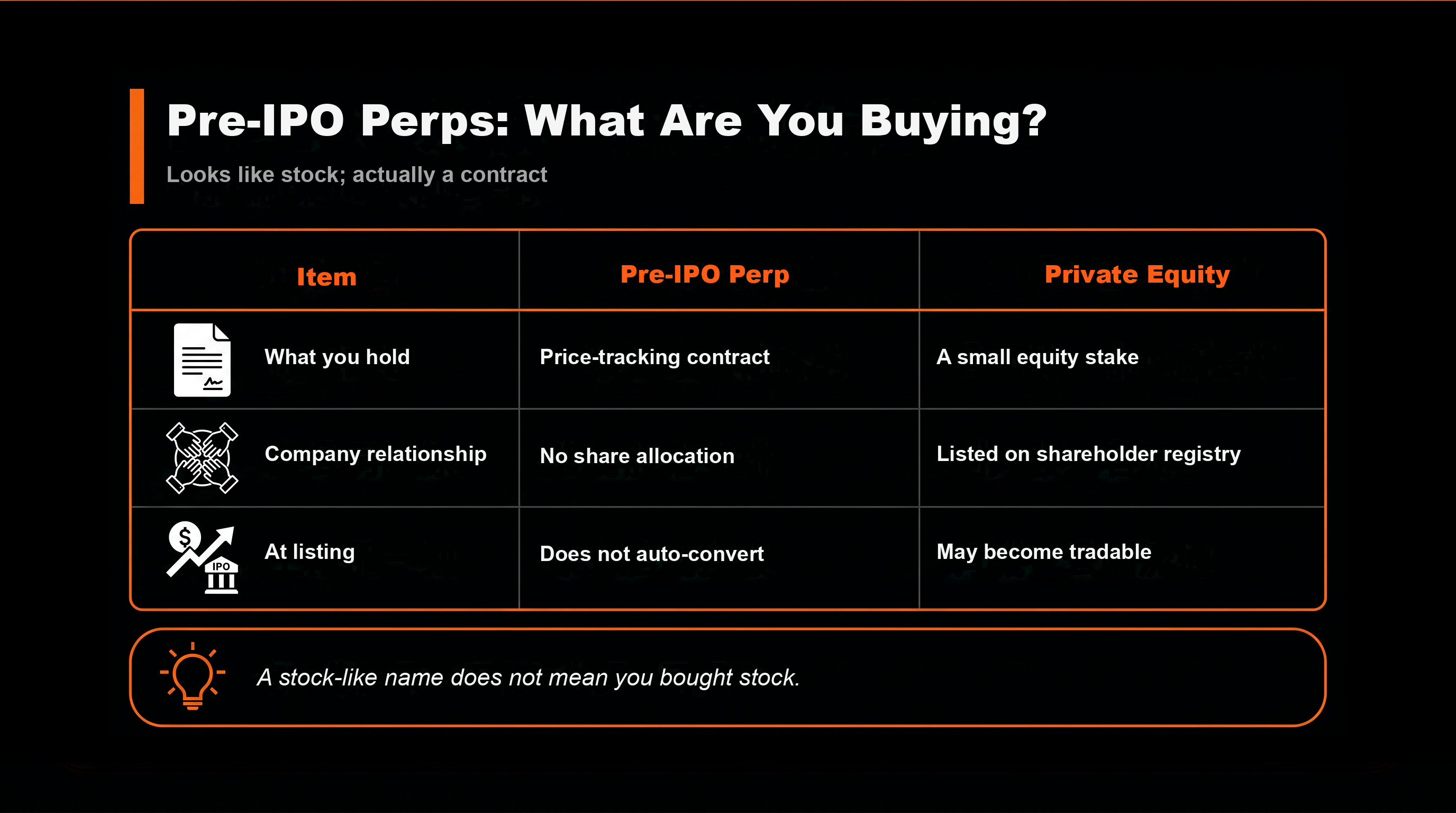
What you buy is a contract, not company equity
Let’s take the term apart. A Pre-IPO perp is essentially a perpetual contract whose underlying is the “expected share price” of a company that hasn’t listed yet — say Anthropic or OpenAI. Buying it doesn’t register your name on the company’s shareholder roll; it opens a position betting whether that expected number goes up or down.
This is a separate thing from actually holding equity. Holding equity means you own a small slice of the company, with a chance to convert it into publicly tradable stock after it lists later; whereas holding a Pre-IPO perp means all you hold is a contract that tracks a price, with no equity relationship to the company itself. I use one line to anchor myself: a name that looks like a stock doesn’t mean you bought a stock. What you’re really betting on is the rise and fall of the number “what the market currently thinks this company will be worth” — not any part of the company. Nail this distinction down and a lot of later misunderstandings won’t happen.
Why it doesn’t count as “getting into the IPO early”
Many people jump straight from “I bought a Pre-IPO perp” to “I got into this company’s IPO early, and once it lists I can convert to shares.” It sounds smooth, but in most cases that path doesn’t exist — and it’s the misconception I most want to dismantle for you first.
The reason is that these contracts are, in the vast majority of cases, products the exchange or a broker designed themselves, with no formal equity arrangement between them and that company. When the company lists, it won’t automatically turn your contract into stock, let alone register you as an early shareholder. What it actually addresses is the need “I want to bet on the price trend of a pre-listing company,” not the need “I want to legally hold pre-listing equity in this company.” These two needs sound close, but in reality a gulf of law and product structure separates them. Lumping them together is exactly where wrong expectations come from — you think you’re queuing to buy founder shares, but you’re really just placing a bet in a derivatives market.
Want the “real equity”? That path can be even dirtier
At this point you might think: so why not skip the contract and go straight to a channel selling “real Pre-IPO equity”? Here I need to add a fact that’s crucial yet often overlooked by beginners: the real-equity path is sometimes even dirtier on risk.
There are indeed channels on the market claiming to sell you pre-listing company equity, commonly packaged through an SPV, a forward contract, or even a tokenized security. But companies like Anthropic and OpenAI have publicly stressed that unauthorized equity transfers may violate the company charter, be deemed void from the start, or in serious cases involve fraud. In other words, you think you bought real equity, but you may end up with a piece of paper the company doesn’t recognize and that could go to zero at any time. So the conclusion here isn’t “derivatives are safer than real equity”; it’s that both paths have their own pitfalls: the contract path is high volatility plus leverage, and the real-equity path may be compliance and authenticity. For beginners, the line most worth remembering is — “being able to buy it” never equals “buying it right”.
With no public share price, how is the price actually calculated?
“For a company that hasn’t listed and has no publicly traded share price, who sets the Pre-IPO perp price, and how?” This is probably the part of the whole product you most need to understand first, yet the part fewest people talk about seriously. Let me give you the conclusion up front: this price doesn’t come from real stock trades but from market expectations, propped up together with the perpetual contract’s mechanics. See through this layer and you won’t be fooled by that flickering number into thinking it represents a real valuation.
The price comes from “market expectations,” not a real valuation
A pre-listing company has no publicly traded share price to reference in the first place. So the price of a Pre-IPO perp is essentially the result of market participants collectively “guessing what it’s worth.” Everyone bids based on news, funding rumors, and industry hype, and the number that buyers and sellers get matched at becomes the current contract price.
This has a big difference from a mature underlying: a mature stock has real trades, financials, and public information as an anchor, so however much the price swings, there’s a kind of gravity pulling it. A Pre-IPO perp has no such anchor; it’s more easily dragged around by emotion, news, and concentrated positions, and its swings are often far more violent than an ordinary underlying. One bullish rumor can push it very high in a short time, and one bearish piece of news can dump it deep. So when you see this price, remind yourself: it reflects “the market’s current emotion and expectations,” not what this company is “really worth”. On a theme like Pre-IPO, the gap between the two can be shockingly large.
Funding rate: the mechanism that keeps the contract price hugging expectations
Perpetual contracts have a key design called the funding rate. Its purpose is to keep the contract price from drifting too far from the underlying it’s meant to track — like a rubber band pulling the contract price back toward the expected price. For a Pre-IPO perp, this rubber band directly affects your cost of holding.
The mechanism isn’t hard to understand: when too many people go long and push the price too high, the longs periodically pay a fee to the shorts; conversely, when too many go short, the shorts pay the longs. This money is continuously deducted from, or added to, your position. The problem is that for a Pre-IPO perp — a high-emotion, one-sided, concentrated underlying — the funding rate is often very high, and the cost of holding it long-term is nothing to take lightly — sometimes you get the direction right, yet the funding rate nibbles away your profit bit by bit. So before I enter, I take a glance at what the current funding rate is and which side it leans toward, and factor in this hidden cost, rather than only watching the price go up and down.
Thin liquidity makes the price easier to whip around
Beyond expectations and the funding rate, there’s another factor beginners easily overlook but that’s often the real root of losses: liquidity. Pre-IPO perps usually have far thinner volume than mainstream coins, with sparse orders on the book, and when liquidity is poor, it amplifies at least two problems.
The first is slippage. You want to fill at a certain price, but because the order book isn’t deep enough, your actual fill can be off by a fair bit from what you expected — especially with large orders. The second is wicks. When liquidity is thin, the price is easily punched through in an instant by a single large order, pulling out a long, sharp wick and then snapping back — and that instant is often enough to sweep out a batch of positions that set stop-losses or used leverage. Put these two together and you’ll see that thin liquidity plus high leverage is exactly the combination that most easily leaves beginners eating quiet losses on this kind of underlying: you aren’t knocked out by the trend, but casually carried off by a single wick. So facing a thin-liquidity underlying, I’d rather size smaller and use lower leverage than expose myself to the range of a single wick.
The three risks you most need to grasp before ordering ANTHROPICUSDT
“After all that, can I actually play, and what landmines will I step on?” This section doesn’t give entry signals or guess direction; it just lays out the three risks you most need to grasp before ordering. Understand the worst case first, then decide whether to touch it — that order matters especially for beginners.
It carries leverage, can be liquidated, and can even go to zero
The point to see most clearly first: a Pre-IPO perp is a leveraged contract, which means it can be liquidated just like any other perp. Leverage is a double-edged sword — it amplifies your profit and loss in sync. When you win it’s fast, but when you lose it’s just as fast, often too fast for you to react.
Worse is forced liquidation. When the price moves against your position to a certain degree and your margin isn’t enough to hold it, the exchange liquidates you outright, and in that moment the margin you put in can go straight to zero. And a Pre-IPO perp happens to be a high-volatility underlying — the expected share price can change on a dime, and the thin liquidity mentioned earlier makes it even more prone to wicks, where one long wick can sweep your position out. So I have a rigid principle: the more an underlying sounds like “if I don’t buy now I’ll miss out,” the more I first work out the worst case — if it instantly reverses, will this money be entirely gone, and will it affect my life? Get that answer clear first, then talk about whether to enter.
The product rules are the platform’s call
The second risk isn’t in the price but in the rules. These products are mostly designed by the platform itself, so how the contract settles, what index prices it, whether it can be delisted early, and whether the rules can be changed on short notice are basically all in the platform’s hands, not some open, transparent market mechanism.
This means what you’re really signing is the set of terms the platform wrote, not that enticing company name. So before ordering I spend some time reading up a few things clearly: exactly how the contract settles, how the platform will handle your position if that company really does list one day, and whether the platform reserves the right to delist or change the rules at any time. These terms sound dull, but they decide your fate in extreme situations. The mistake beginners make most easily is being drawn in by the company name and ordering without even reading the settlement and delisting rules — only to find, when something goes wrong, that the rules of the game were written there all along and they just didn’t read them. Reading the terms isn’t a hassle; it’s the cheapest step you can take to protect yourself.
Don’t treat it as a “sure-thing way to get in early”
The third risk hides in your mindset, and it’s the one I think most deserves a reminder. A Pre-IPO perp is often packaged as a rare chance to “position yourself in a star company early,” which makes people itch the moment they hear it, feeling that miss this time and you can never buy it again. This narrative is very contagious, and that’s exactly what makes it most dangerous.
String the earlier sections together and it’s clear: it’s a derivative that’s high-volatility, leveraged, thin on liquidity, and with rules the platform decides. Something like this has its uses — it suits people who clearly know what they’re doing and can stomach large swings, to speculate with. But for beginners, reading it as a “sure-thing way to get in early” pretty much shoves all the risk into a blind spot. I’d suggest you position it from the start as a high-risk speculative tool, not an early-bird ticket to wealth — when you view it with the caution you’d give a high-risk tool, your size naturally shrinks, your leverage naturally drops, and your expectations of it return to something closer to reality. Getting your mindset right protects your capital better than guessing direction right.
How far apart are Pre-IPO perps and “real pre-listing equity,” really
“Since both get me exposure to a pre-listing company, is the difference between a Pre-IPO perp and real equity really that big?” In this section I put the two paths side by side, because it’s exactly this difference beginners can’t tell apart that leads them to hold wrong expectations about their position. The difference isn’t just a little; from what you own to the outcome after listing, almost everything is different.
What you own differs: a price vs. equity
The most fundamental difference is what you’re actually holding. Holding real pre-listing equity, you own a small slice of the company’s ownership; in theory you’re in the same boat as the founders and early investors, and the value of the company’s growth has a chance to reach you. Whereas holding a Pre-IPO perp, what you hold is just a contract that tracks a price. How much the company earns and how much its valuation rises relate to you only through “does the contract price move along with it.”
This difference runs through your rights and outcomes. An equity holder typically involves shareholder-related arrangements, with value bound to the company itself; whereas a contract holder is just one wagering position in the market, and your counterparty isn’t the company but the people on the other side betting the opposite. So even for the same “bullish on this company,” what these two approaches carry is worlds apart: one is participating in the company’s long-term growth, the other is betting on the short-term rise and fall of a number in a derivatives market. Figure out which one you’re holding, and you’ll know what mindset and time frame to treat it with.
The outcome after listing is completely different
The second key difference happens the moment that company actually lists. If what you hold is compliantly acquired real equity, listing usually means your shares have a chance to circulate and be cashed out on the public market — which is the core expectation many people have for pre-listing investment.
But if you’re holding a Pre-IPO perp, listing won’t automatically turn the contract into stock for you. As said before, these contracts are products the platform designed, and how it’s handled after the company lists depends entirely on the terms the platform wrote in advance — it might settle at a certain price, switch to a different underlying, or have some other arrangement, but “automatic conversion to shares” is almost never the default option. In other words, your assumed “I’ll profit once it lists” is, in the world of contracts, something you have to confirm in the terms rather than take for granted. I treat this as a must-check before ordering: figure out first what this contract becomes in a listing scenario, then decide whether to bet on a listing that hasn’t happened yet.
The risks of the two paths are different in nature
The third thing to note is that the risks of the two paths aren’t as simple as “which is more dangerous”; they’re fundamentally different in nature and have to be defended against in different ways.A Pre-IPO perp’s main risks are market-based: high volatility, leveraged liquidation, funding rate costs, and liquidity wicks — all of which you face during trading.
The real pre-listing equity path, as mentioned earlier, has more of its risk falling on compliance and authenticity: equity acquired through an SPV, a forward contract, a tokenized security, and the like may be unauthorized by the company, deemed void, or even involve fraud, and what you face is the fundamental question of “does this equity even count.” One is “will the market wash me out,” the other is “is the thing even real”. I’d sum it up for beginners this way: if you can’t even tell apart the nature of these two risks, then whichever path you pick, don’t rush to put money in. Understanding first which kind of pit you’re facing, then thinking about how to avoid it, is always far cheaper than charging in and only then discovering you stepped in the wrong pit.
How should a beginner judge and respond? A self-check before ordering
“I get the reasoning, so when I actually run into an underlying like ANTHROPICUSDT, what should I do?” This section won’t give you an entry point or call a direction; it just gives you a few principles to question yourself on before acting, plus a checklist. For a high-volatility underlying like this, the quality of your judgment often doesn’t come from how accurately you guess, but from whether you thought it through before ordering.
Confirm the role of this money first, then talk about whether to buy
The first thing is always to think clearly about what kind of money you’re using to touch this underlying. Is it money you can afford to lose entirely without affecting your life, spare money purely for taking on high risk — or did you actually dip into funds you shouldn’t have, money with other uses? This question looks basic, yet it’s the step most people skip and the step most people get hurt over.
My habit is that for something high-volatility and capable of going to zero like a Pre-IPO perp, I only use the small slice of capital I’ve explicitly marked as “can lose entirely.” The reason is simple: as said before, it carries leverage, can be liquidated, and is thin on liquidity, which means “losing a big chunk in an instant” isn’t an extreme scenario but the everyday reality of this kind of underlying. If you’re using living expenses, someone else’s money, or funds with a fixed purpose, then once it reverses, what you bear isn’t just a financial loss but the pressure of being forced to make decisions at the worst possible time. Set the role of the money first, and all your later moves have a stable foundation.
Think first “the swings will be huge,” instead of rushing to guess direction
The second principle: facing an underlying like a Pre-IPO perp, put your mind first on the certain fact that “its swings will be huge,” rather than rushing to guess whether it goes up or down next. For an underlying with no real share price as an anchor, driven by emotion and news, what’s most certain is never the direction, but the uncertainty itself.
This means that rather than asking “should I go long or short,” better to first ask “can my current position stomach it swinging wildly up and down within a single day.” One funding rumor, one remark from an executive, can make this high-emotion underlying lurch violently in a short time — even experienced people struggle to guess right consistently. So facing this kind of underlying, my first reaction is to proactively shrink the position and cut leverage very low or skip it entirely, so that even if I read the direction wrong, it’s only a small wound rather than being knocked out. When you can’t see clearly, controlling the range of swings you can withstand is always more practical than predicting the market — and more likely to keep you alive until the day you truly understand it.
A self-check list to run through before ordering
Finally, whatever you ultimately decide — to touch it or not, and how much — I’d suggest quickly running through the following questions before ordering. Not to scare you, but to pull back in front of you the key points that a moment of emotion easily papers over:
- Am I clear that I’m buying a contract, not a stock, and not real pre-listing equity?
- Is this money spare money I can lose entirely, or funds with other uses that I shouldn’t touch?
- Have I read how this contract settles, how it’s handled after listing, and the platform’s right to delist and change the rules?
- Am I stacking leverage on this high-volatility underlying? Can I lower the leverage and shrink the position first?
If you can clearly answer all four questions before deciding how to act, you’ll be far steadier than being pushed along by a star company name and a “get in early” narrative. A Pre-IPO perp isn’t untouchable; it’s that from its essence to its risks, it’s not what your intuition assumes. Questioning yourself clearly and working out the worst case first is the step you should learn earliest when facing this kind of high-risk new theme.
Conclusion
From start to finish, this piece only wants to help you see one thing clearly: when you order ANTHROPICUSDT — a Pre-IPO perp — what you buy isn’t Anthropic stock, nor its pre-listing equity, but a leveraged, high-volatility contract tracking an “expected market share price.” Its price comes from expectations rather than a real valuation, hugs along via the funding rate, and is easily whipped around by wicks because of thin liquidity; and it’s completely different from real equity, from what you own to the outcome after listing. Grasp these essentials and the risks — liquidation, going to zero, and rules set by the platform — up front, then decide whether to get involved and with how small a position, and you’ll be far steadier than charging in just because a familiar company name drew you. Understanding what you’re buying first is always the most cost-effective first step when facing a new theme.


