

"Are you looking for an exchange with lots of features, or for an entry point you can actually understand and use without making mistakes?" Learning OKX, people get spun around by terms like "exchange," "wallet," "DEX," "deposit," "withdrawal," "referral code" — it seems to have everything, but that makes it harder to judge whether you should actually use it. This article first introduces OKX, then pulls out the key points newcomers most need to see clearly — and walks you through registration, deposits and withdrawals, Wallet, and common traps.
What Is OKX? It's More Than Just Buying Coins
"You think OKX is just a platform for buying and selling crypto?" If you treat it as nothing more than an exchange, a lot of features will only confuse you the further you go. This section first separates out the three roles — OKX Exchange, OKX Wallet, and OKX DEX — so you build the correct mental map before reading on, instead of getting them tangled later.
What's the Difference Between OKX Exchange, OKX Wallet, and OKX DEX
The three of them feel similar at a glance, but they're actually different things. Think of it like this: the OKX Exchange is the platform account, focused on trading, deposits, withdrawals, and asset management; OKX Wallet is the wallet, focused on managing your on-chain assets yourself and connecting to various applications; OKX DEX is the decentralized exchange, letting you swap directly on-chain using your wallet — instead of handing the coins to a centralized platform to match. In plainer terms:
- OKX Exchange:Like an in-platform trading desk — suitable for spot buying and selling, deposits, and withdrawals.
- OKX Wallet:Like your own on-chain keyring — the point is self-custody, not platform custody.
- OKX DEX:Like using your wallet to swap directly on-chain — you'll run into approvals, slippage, on-chain fees, and more.
What OKX Mainly Lets You Do, and Which Features Newcomers Shouldn't Rush Into
If you're just starting to use OKX, I'd treat it as a "trading + deposit/withdrawal + basic management" platform first — don't open all the features from day one. For newcomers, the things on OKX most commonly used — and most worth understanding first — are really just a few:
- Registration and account security setup: basic protection like passwords and 2FA (two-factor authentication).
- Spot trading: straightforward buying and selling of major coins — what most people touch first.
- Deposits and withdrawals: moving funds into the platform, or moving coins out to other addresses.
- Asset viewing and management: confirming what coins you hold, which account they sit in, and whether you can withdraw them.
Get these few items down, and you can already handle most basic needs. What trips a lot of people up is letting "lots of features" pull their attention — opening things they're not ready for too early, like:
- Futures:It involves leverage, liquidation, and margin — knowing how to buy coins doesn't mean you can jump straight in.
- Strategy trading:Like grid bots, copy-trading, and automation tools — looks convenient, but the risk and parameter judgment is much harder than it appears.
- On-chain features:DEX, DeFi, approvals, cross-chain — the threshold for judgment is much higher than in-platform trading.
- Various campaign pages and earn pages:It's not that you can't look — just don't make them your top priority right after registering.
My own recommendation: newcomers should narrow the path down to the simplest version — secure the account first, then get comfortable with spot, deposits, withdrawals, and where the assets sit. Once you actually know what you want to do next, then move to advanced features. That's much safer than trying everything from day one.
My first month using OKX, I didn't touch futures, cop…

Who Should Start With OKX, and Who Maybe Shouldn't
If your need is clear — you want a platform where you can sign up, deposit, buy major coins, and slowly explore more features later — OKX is generally a reasonable starting point. Especially if you already know you won't just be watching prices and will eventually want wallet, on-chain transfer, or DEX features, learning within one ecosystem makes the path cleaner.
People who tend to do well starting with OKX usually fall into a few groups:
- People who want to start with spot trading but don't mind exploring more tools later.
- People willing to spend a little time understanding the difference between exchanges, wallets, and on-chain operations.
- People who proactively set up basic security, and won't casually transfer just because the interface looks usable.
But if right now you only want to do something very simple — buy a small amount of major coins, get comfortable with the trading flow — or you're genuinely worried about too many interfaces and too many features, OKX isn't necessarily the easiest first stop for every newcomer. The features are many, which is great for future expansion, but the downside is that distraction comes easily early on — and you might end up clicking into features you haven't actually understood.
My take: OKX suits newcomers willing to learn and wanting room to expand later. If right now you just want to get the basics of buying and depositing/withdrawing steady, don't assume that just because the platform has many features, you need to use all of them from day one. Looking at what problem you're solving right now matters more than looking at how big the platform is.
Newcomers Checking OKX — 2 Things First
"Does having lots of features mean an exchange suits newcomers more?" Not necessarily. For people just starting out in crypto, what you should actually look at first isn't the feature count, but what need you're currently trying to solve, and whether you can use those features safely and correctly. This section lays out the two key points from the article title clearly.
First Key Point — Do You Want a Trading Entry Point or On-Chain Operational Ability?
This is the thing I think newcomers looking at OKX should separate out first. A lot of people start by saying they just want to use OKX to buy coins — but in reality, those needs are actually two different layers. Some people want a trading entry point — the focus is registration, deposits, buying major coins, and being able to withdraw smoothly later. Others actually want on-chain operational ability — using a wallet to receive coins, connecting to a DEX, joining DeFi, or doing on-chain transfers. These two needs both look like they're about OKX, but the operational logic and risk level are very different.
If you want a trading entry point, I'd focus your attention on these things first:
- Whether your account security is set up first
- Whether you understand the deposit and withdrawal flow
- Whether you can place a spot order
- Which account your assets sit in, and whether you can withdraw them smoothly
But if you want on-chain operational ability, you can't just know in-platform buying and selling — you also need to start understanding:
- What a wallet address is
- You can't transfer carelessly between different chains
- What approvals, on-chain fees, and slippage are
- What "self-custody" means, and what "managing your own private key risk" means
What usually goes wrong isn't a lack of features — it's when you only needed a simple trading entry point but rushed into on-chain tools too early; or the reverse: you actually want to do on-chain operations, but you're still treating the exchange account as a universal tool.
Second Key Point — Whether Your Security Habits Keep Up With the Platform's Feature Complexity
A lot of newcomers, when choosing an exchange, only look at how many features it has and how smooth the interface is — without checking something more real: whether your security habits can support the risk those features bring. The more features a platform has, the more things you can do, the more transfer scenarios you face — and you might even lose track of whether you're currently operating in-platform or on-chain.
I usually start with a few very basic questions:
- Have you set up 2FA, withdrawal verification, and device security
- Do you actually check the official URL instead of clicking any link you see
- Before transferring, do you cross-check chain, address, and coin type
- When you see campaigns, airdrops, or DMs from strangers, do you pause before deciding
If those habits aren't in place yet, a platform with too many features isn't necessarily good for you. Because the issue isn't that you can't handle the features — it's that you thought you were "just trying something out," and ended up touching features you hadn't understood. Things like confusing the exchange account with the wallet, casually clicking fake-support links, or picking the wrong chain at withdrawal — these aren't theoretical issues. They're where assets actually disappear.
So the second key point isn't "are OKX's features strong enough?" — it's whether your current security habits can put those features in the right places. If they can't yet, shore up the basic defenses and operational discipline first. Then moving further in becomes much steadier.
Why Looking Only at OKX Rankings, Campaigns, or Referral Codes Misleads Your Judgment Easily
When sizing up an exchange, what most easily pulls you off course are three pieces of information: rankings, campaigns, and referral codes. These aren't completely off-limits to look at — but if you treat them as your main basis for judgment, direction gets distorted very early on. Because what they answer usually isn't "is this platform right for you," but "does it look attractive enough right now."
Rankings first. Rankings can quickly tell you a platform's visibility, trading volume, or market presence, but they don't answer the questions that actually matter to you: whether you can read the interface, whether you'll use those features, and whether the deposit/withdrawal flow feels right for you. Next, campaigns. Campaigns make people feel signing up now is a deal — but what many people overlook is whether they've even set up basic security. As for referral codes, at most they affect some fee discounts or signup bonuses. They don't change the platform's underlying risk structure, and they don't suddenly make a platform that's wrong for you the right fit.
I put this kind of information at the end — not the front. What you should look at first is whether you want a trading entry point or on-chain operational ability, and whether your security habits keep up with the platform's feature complexity. Without thinking these two through first, no matter how high the ranking, how good the campaigns, or how appealing the referral code, they're only pushing you faster into a decision you haven't actually judged.
Is OKX Safe? It's Your Mistakes, Not the Platform
"Are you worried the platform itself is unsafe, or that you'll mess up a step during usage?" A lot of people, when looking up "is OKX safe," just want a single-sentence verdict. But what actually trips newcomers up is usually not the platform's size — it's misreading the official URL, picking the wrong chain, mistaking fake support for the real thing, or storing assets long-term somewhere they haven't actually understood.
Common OKX Scam Scenarios — Fake Official Sites, Fake Support, Fake Airdrops, Fake Communities
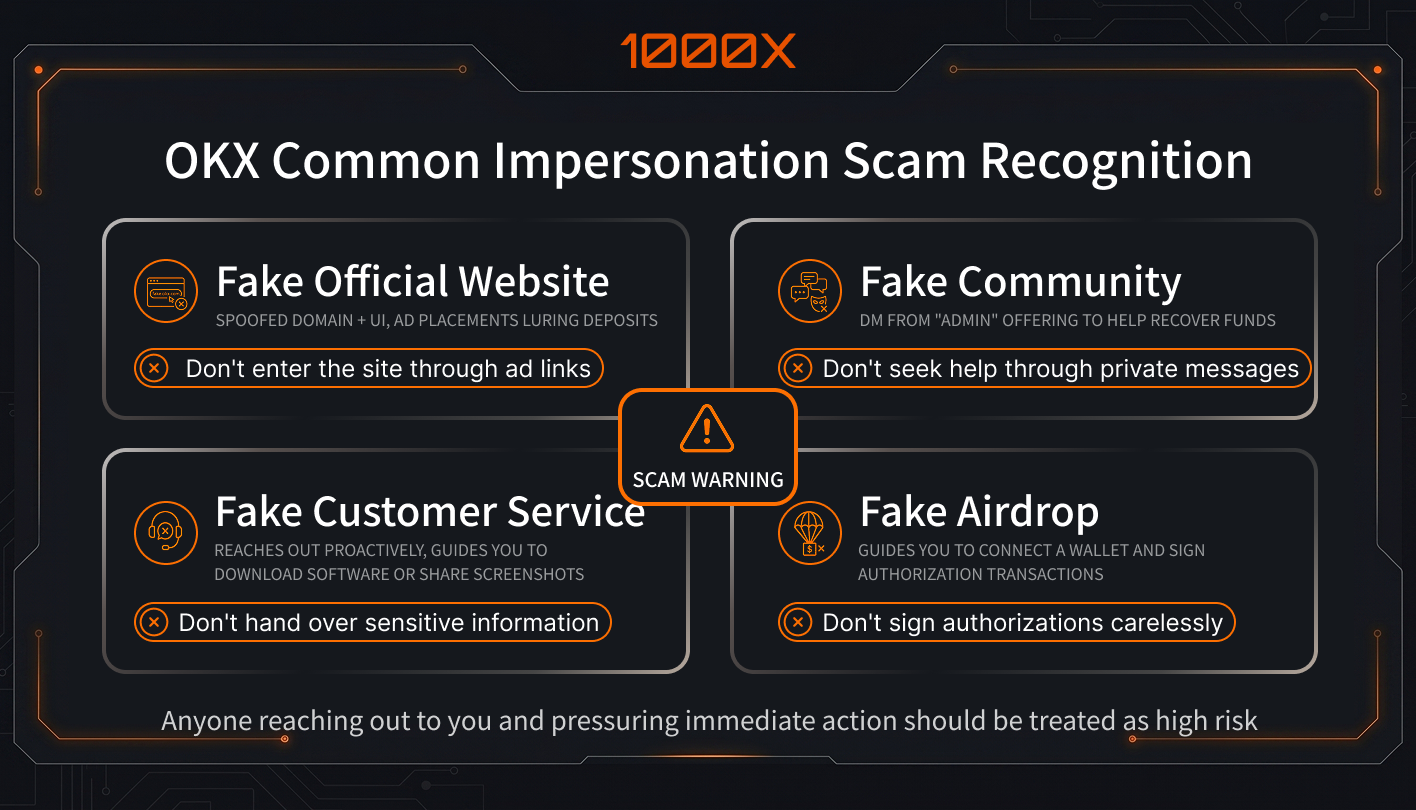
When people talk about "OKX scams," the issue more often isn't the platform itself — it's that scammers impersonate OKX to deceive you. In other words: the risk isn't necessarily because you registered for OKX. It's that you thought you were dealing with OKX, when what you actually encountered was a fake site, fake support, or a fake campaign page.
The most common scenarios usually look like this:
- Fake official site: the URL looks very similar, off by one or two characters, or you got pushed to a fake page via ads or social posts. The moment you log in, your credentials may already be stolen.
- Fake support: someone claims to be official support, says your account has an anomaly, a failed withdrawal, or needs verification — then asks you to provide a code, a screenshot, or even guides you to transfer money.
- Fake airdrop: disguised as an OKX partnership campaign, a coin reward, or a limited-time offer — asking you to click a link, connect your wallet, or sign an approval.
- Fake community: "official-looking" groups that pop up in Line, Telegram, or Discord — where someone pretends to walk you through operations or "help unlock your account," then leads you to a fake link.
Remember one simple principle: anyone who reaches out to you, pressures you to act now, or asks you to hand over verification info — treat them as high-risk first. What gets newcomers caught isn't how clever the scam is — it's that you got rushed and skipped the steps you should've checked. Confirming the URL, not casually clicking DM links, not giving your verification code to anyone — these look basic, but they're what actually blocks most scam scenarios.
The Most Common Failure Points in Deposits and Withdrawals: Address, Chain, Coin Type, and Memo
What goes wrong most on OKX isn't the trading itself…
What's most easy to mess up on deposits and withdrawals is usually those few pieces of pre-transfer info that look "about the same" but actually can't be confused. Same for the chain and coin-name — you assume you can just transfer, and the asset can get stuck, sometimes irrecoverable. This part can be locked down by watching these things:
- Address: whether the receiving address is correct — pasted wrong, missing characters, or accidentally copied from another address.
- Chain: the same coin may support different chains — for example, USDT commonly runs on more than one network. Picking the wrong chain is the most painful situation.
- Coin type: which coin you're sending, and whether the destination address even accepts that coin — don't just go by similar-sounding names.
- Memo info: some platforms or wallets require Memo, Tag, or memo codes — leave them out and the deposit may not land correctly.
A safer approach isn't to rush through the transfer in one shot — it's to build this sequence first:
- Confirm first that the receiving platform or wallet supports this coin and this chain.
- Then cross-check the receiving address and memo info.
- For a first transfer, send a small test amount.
- Once it's confirmed received, send the full amount.
A lot of people think this is troublesome, but on-chain transfers aren't like normal bank wires — in many situations, you can't just make a phone call to reverse a mistaken transfer. The real steady approach is: put the checks before you submit, don't put the hope after you submit.
Exchange Risk vs. Personal Operational Risk — What You Can't Lump Together
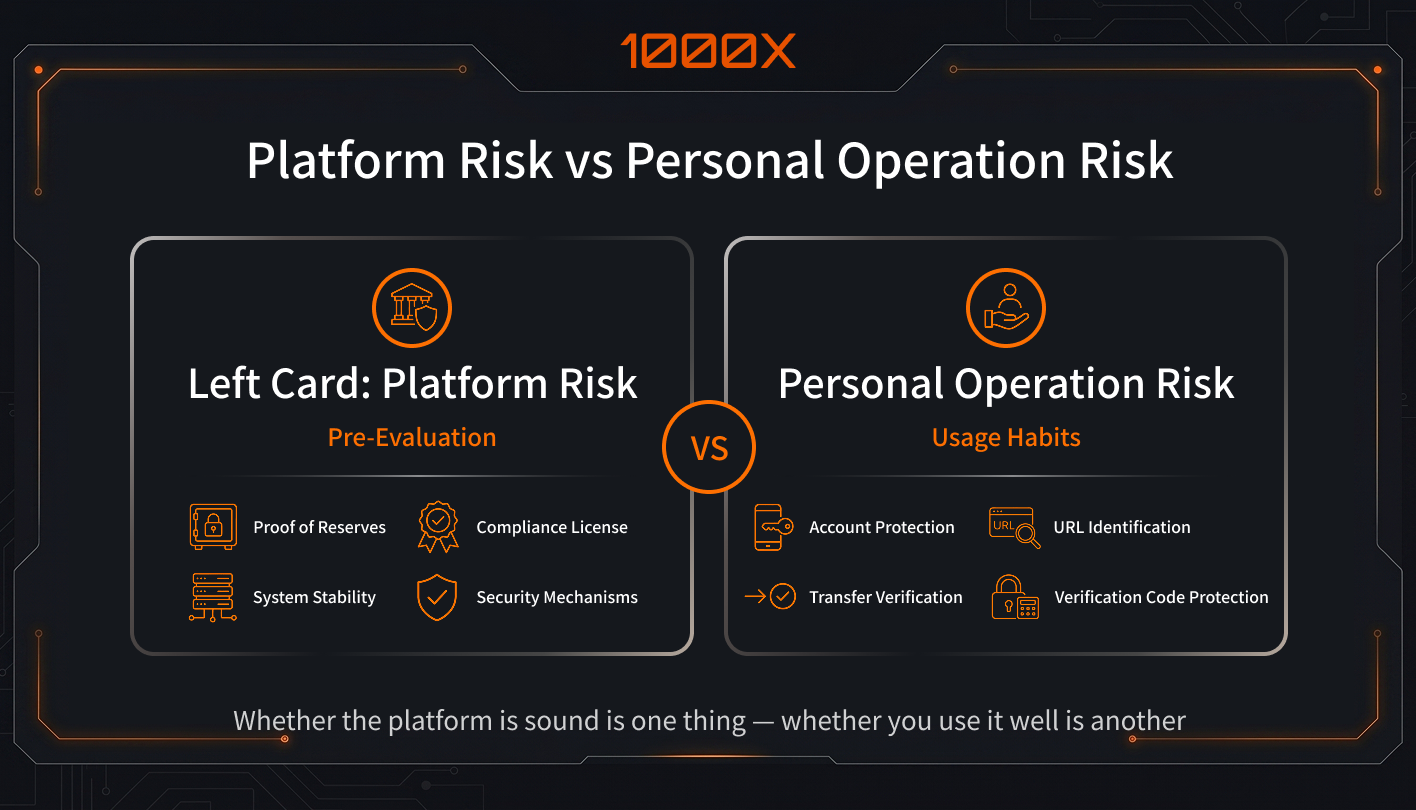
A lot of people, the moment they hear someone "had an issue," instinctively ask "is OKX unsafe?" — but here's an important concept to separate first: exchange risk and personal operational risk are not the same thing. Both kinds of risk can affect your assets, but they belong to different layers — if you mix them up, your judgment goes off easily.
First, exchange risk. This kind of risk is more at the platform level — asset management, system stability, regulatory standing, withdrawal mechanisms, or overall operational risk. This is the part you evaluate before choosing a platform. But what newcomers actually run into more often is risk caused by personal operational errors, like:
- Walking into a fake official site yourself
- Handing your verification code to fake support
- Choosing the wrong chain when withdrawing
- Confusing your exchange account with a wallet address
- Starting operations before setting up 2FA
A larger platform doesn't automatically shield you from these, because the error happens before you submit the action. In other words: whether the platform itself is worth using is one question — whether you're using it correctly is another.
Platform risk relies on up-front evaluation; operational risk relies on usage habits. The former is about whether the exchange you chose is right. The latter is about whether you've done basic checks, verifications, and security setup. Once you separate these, you won't just blame the platform when something goes wrong — and miss what you could've actually fixed first: your own operational flow.
OKX Sign-Up, Deposit, Withdrawal — The Newcomer Path
"If you've decided to try OKX, where do you even start?" This section isn't about turning every button into a long tutorial. It's about giving you a reading path that's harder to get lost on: from registration and ID verification, to what to confirm before depositing and withdrawing — so you know the purpose of each step, not just clicking along.
Before OKX Registration and Identity Verification — Confirm the Official Site, the Device, and Account Security First
A lot of newcomers, the moment they decide to "try OKX," rush straight into opening an account and doing ID verification — but what actually decides whether something goes wrong isn't the registration flow itself. It's whether the place you're currently entering is right, and whether the device in your hand is safe. Don't mind the extra step — confirm these things:
- First Confirm the OKX Official URL:Don't click in from unknown DMs, sketchy ads, or random group links. Best practice is to type it yourself or enter through a trusted source.
- Confirm the Device Is One You're Familiar :With: and Clean:Don't register on public computers, borrowed phones, or browsers loaded with unknown extensions. Those situations are where credentials and verification info leak most easily.
- Think Through Account Security Settings Upfront:After registering, at minimum set a strong password and enable 2FA. Don't rely on just SMS codes or a plain password to start operating.
- Submit ID Verification Documents Only Through the Official Flow:ID documents, selfies, verification screens — never submit them through support DMs, social messages, or third-party forms.
A lot of people think "isn't this just registration steps, why so much fuss" — but actually no. Entry-point judgment before registration and ID verification is often the first dividing line. Lock down the official site, the device, and account security first — only then does the rest of the flow have a foundation to keep going.
Before Depositing on OKX, Understand This First — Fiat, On-Chain Transfers, and Receiving Addresses
Before depositing on OKX, I split the path into two views first: fiat coin-buying, and on-chain transfer-in. Both look like "deposits," but what you cross-check is completely different. The fiat route is more like completing a purchase through the platform's built-in coin-buying entry. On-chain transfer means moving coins from an external wallet or another exchange into the OKX receiving address. The OKX official deposit flow also has you pick the coin first, then the corresponding network — only then does it show the receiving address; if that coin uses a tag/memo, the system shows it as well.
My recommendation: for a first-time deposit don't rush to send a large amount in directly. Sort out first whether you're fiat-buying or doing an on-chain transfer. If it's on-chain, cross-check the address, the chain, and the tag/memo in one pass. What goes wrong isn't one of these two methods on its own — it's mixing the two deposit methods up and applying the wrong checking logic.
The Last Check Before OKX Withdrawal — Chain, Fees, and Whether the Destination Platform Supports It
Before withdrawing from OKX, what I care about most isn't whether you filled in all the fields — it's whether you ran one last cross-check. OKX's official withdrawal flow itself asks you to pick the coin, the network, and the address, then displays the fee and minimum withdrawal limit; for supported in-platform transfers between OKX users, there may even be zero fees, but standard on-chain withdrawals charge different fees by coin and network. Before withdrawing, sort out these things first:
- Whether the chain is picked correctly: the same coin often has more than one network. OKX also reminds you — before withdrawing, confirm whether the receiving platform or wallet supports the network you picked. Some platforms don't support certain networks, and you can't just push through with the cheaper fee.
- Whether the fee is acceptable: OKX's withdrawal fees vary by asset and network, and they're shown on the page before you submit. Don't just look at which chain is cheaper — also look at whether the destination side accepts it, and whether the overall transfer is worth it.
- Whether the destination platform actually supports it: this is the most-overlooked point. OKX officially states — before withdrawing, confirm the receiving platform or wallet supports the coin, the address type, and the network; otherwise you may need to ask the destination platform for help, and in the worst case, the funds can't be recovered.
If this is your first withdrawal, I'd recommend not sending the entire balance at once. Confirm the destination supports it first, cross-check chain, address, tag/memo, and fee, and when needed, send a small test amount first. What most often goes wrong isn't the chain not being available — it's mistaking "you can pick it" for "they'll definitely receive it".
Is OKX Wallet Worth It? When You Actually Need DEX
"Do you need an exchange account, or have you reached the stage where you actually need to use a wallet yourself?" Many newcomers see "OKX Wallet" and assume it's part of registering for the exchange — but it's actually a different usage layer. This section helps you tell them apart: who can get by with the exchange first, and what situations call for stepping further into Wallet and DEX.
If You Only Want to Buy Major Coins, Transfer, or Deposit/Withdraw — Is the Exchange Alone Enough?
If your current need is very simple — you just want to buy major coins, do basic transfers, or get comfortable with the deposit/withdrawal flow — I'd say: the exchange alone is usually enough. Because at this stage what you need to solve isn't how advanced your on-chain operations are — it's getting comfortable with account security, the trade flow, where assets sit, and the withdrawal logic. Jumping into OKX Wallet or DEX too early actually complicates what should be simple. The benefits of starting with the exchange are direct:
- The interface is relatively centralized — buy, sell, deposit, withdraw all happen in one place.
- You don't have to manage your own private key or seed phrase from day one.
- For people only touching major coins, most needs can be solved inside the platform first.
If right now you just want to get buying, transferring, and depositing/withdrawing steady, focus on getting comfortable with the exchange. When you actually need on-chain applications, then go study wallets — the learning order stays much cleaner.
If You Want to Touch On-Chain Airdrops, DeFi, or DEX, Studying the Wallet Later Isn't Too Late
If what you want to do next isn't just buying major coins, but starting to touch on-chain airdrops, DeFi, or DEX — then it makes sense to study wallets at that point. Because the common thread for these operations is: you can't complete them with just an exchange account. Most of the time, you need your own wallet to connect to sites, sign transactions, or interact directly on-chain.
But I'd remind you: don't interpret "you should learn Wallet" as "now go connect, approve, and test everything." The risk isn't in studying the wallet itself — it's in clicking around before you've understood these basic questions:
- Whether this site is the official entry point
- What you're signing after connecting your wallet
- Whether the approval is a one-time action or a long-term permission
- Whether this transaction will burn gas fee (on-chain network fee)
- After you're done, whether the asset stays on the exchange or has moved into the wallet
So a steadier order isn't to charge straight into on-chain from day one — it's to get comfortable with in-exchange buying, selling, deposits, and withdrawals first, then study wallet custody, connections, and approval logic. By the time you actually start touching on-chain applications, picking up wallets isn't late at all — and you're much less likely to scale up the risk.
Common Misconceptions From Confusing the Exchange Account With a Self-Custody Wallet
Newcomers get the most confused about OKX Wallet not because the features are hard, but because they treat the exchange account and the self-custody wallet as the same thing from the start. The core difference between the two: the exchange account is custody held by the platform on your behalf; the self-custody wallet is held by you. Without separating that premise, a lot of later judgments get scrambled. The most common misconceptions usually look like:
OKX Wallet and the exchange account are two different…
- Thinking Coins on the Exchange and Coins in the Wallet Are the Same Kind of Custody:They're not. On the exchange, the focus is account security. In a self-custody wallet, the focus is the private key and seed phrase — and those are entirely on you.
- Thinking That Signing Up for the Exchange Means You Already Know How to Use a Wallet:Exchange operations and wallet operations are actually two separate logics. The former leans toward in-platform trading and withdrawal. The latter involves addresses, approvals, signatures, and on-chain interactions.
- Thinking the Wallet Is Just an Exchange Add-on, With Roughly the Same Risk:Also wrong. Once a self-custody wallet has a bad approval, a wrong signature, or a leaked seed phrase, the way the risk lands on you is completely different from an exchange account.
- Thinking Moving Assets :From: the Exchange to a Wallet Is Automatically Safer:Not necessarily. Safety isn't only about where they sit — it's about whether you have the ability to manage that kind of custody. For newcomers still unfamiliar with private keys and approvals, moving all assets into a self-custody wallet too early can actually increase operational risk.
My recommendation is to treat the two as two different responsibility models from the start: the exchange is custody by the platform, the self-custody wallet is on you. Once you draw that line clearly, when you look at wallets, withdrawals, and on-chain approvals later, you won't mix risks from different layers together.
Conclusion
When it comes to OKX, the issue for many people isn't that they don't understand the features. The issue is that the more material they read, the harder it gets to judge: is this even right for me, should I start with the exchange first, or jump straight to the wallet stage. This article isn't just here to introduce OKX — it's to make the easy-to-confuse, easy-to-mess-up parts clear first. If after reading you're still not sure how to choose, where to start, or you still have questions about the exchange, the wallet, or the deposit/withdrawal flow, you can also contact us directly. Compared to looking things up over and getting more confused, having someone help you sort out the direction is usually the better shortcut.


