

Do you often see people talking about Hyperliquid and HYPE, but can't quite figure out what it actually is or whether it's worth getting involved in?This piece won't pitch HYPE as the next 100x coin; instead it first helps you understand what Hyperliquid is doing, whether HYPE's value is real, why “unlocks” are the variable you most need to watch, and finally tells you what beginners should sort out before getting involved and which landmines to avoid.
What is Hyperliquid? And why are so many people talking about it this cycle
“Isn't it just another exchange? Why is everyone so excited about it?” The difference is that it isn't built on someone else's chain — it built its own L1 to run perpetual trading, with speed and experience close to a centralized exchange, while settlement stays entirely on-chain.This section gets its positioning completely straight first, because everything we discuss later about HYPE's value and unlock sell pressure is built on your first understanding what this platform actually does.
In one sentence: a decentralized perpetual exchange running on its own L1
Hyperliquid, put simply, is a decentralized perpetual contract exchange — insiders often call it a perp DEX, but what makes it most special is this: it runs on a Layer 1 blockchain it built entirely itself, rather than piggybacking on someone else's chain.
This sentence hides three points worth remembering. The first is perpetual contracts — meaning what you trade isn't the spot asset itself but a contract that settles with price moves, and you can open leverage to amplify your position. The second is decentralization: placing orders, matching, and settlement all happen on-chain, not handed to some company's back office to keep the books for you. The third is its own L1: it isn't built on Ethereum or another existing chain but a chain built specifically for trading, which is why speed can be pushed so high and you don't pay the per-transaction Gas fees of ordinary on-chain operations. For beginners, just keep one sentence in mind: what it wants to do is give you, on-chain, the same smooth experience as a centralized exchange, while keeping control of your assets in your own hands as much as possible.That ambition is the starting point for all the discussion it's gotten this cycle.
How it differs from regular exchanges and other perp DEXs
Many beginners ask straight out: how is this different from the exchange I normally use?I'm used to telling them apart by one crucial line: “who exactly is holding your assets.”
First, compared to centralized exchanges. When you place an order on a platform like Binance or Bybit, your coins are actually held by the exchange, which custodies them for you — convenient, sure, but you bear the risk of it blowing up. On Hyperliquid, assets and orders in principle stay on-chain, and you don't need to hand your coins entirely into one company's pocket — that's the most fundamental divide between it and a centralized exchange. Compared to other perp DEXs, most early decentralized perpetual exchanges got stuck on the same pain point: slow speed and thin liquidity, where placing and canceling orders felt like waiting at a red light, so experienced traders couldn't stand using them. Hyperliquid uses its own L1 to bring matching close to near-instant, and the order book feels more like a centralized exchange — which is exactly why it gets noticed. So to sum up in one line: it wants to capture both “on-chain autonomy” and “centralized smoothness,” two things that used to be hard to have at once.But there's no free lunch: the price is that this whole experience is locked to its own chain, and that chain's security and stability become a premise you have to accept before getting involved.
Why it captured most of the perpetual trading volume this cycle
What surprised the market most about Hyperliquid this cycle is that it took a sizable chunk of the decentralized perpetual market's trading volume, and among the crowd of perp DEXs it's clearly the leader of this cycle.Why it, and not rivals who've been shouting about it for longer?
The reasons roughly boil down to three. First, the experience is smooth enough: as mentioned, its speed, liquidity, and the feel of placing and canceling orders are all close to a centralized exchange, which is a real draw for experienced traders used to smooth operation, making them willing to move funds over. Second, the narrative its fee structure produces: the platform's fee revenue flows back to HYPE through mechanisms like buybacks, forming a self-reinforcing story of “the more people use the platform, the more the token is needed,” a narrative that ferments especially easily in a bull market. Third, it prides itself on not taking venture-capital money, and this “no VC baggage” label itself became fuel for heated community discussion. But I have to tap the brakes here: high trading volume only proves the platform is being used heavily and is a popular business; as for whether HYPE the coin rises along with it, that's an entirely different matter, so never put an equals sign between the two at this step — in the next section we'll take this line apart.
What kind of coin is HYPE? Is its value actually real?
“The platform is so strong, so isn't buying HYPE a safe bet?” Don't rush to draw an equals sign. Whether the platform is red-hot and whether the token is worth buying are two questions you must ask separately.In this section I'll walk you through exactly what HYPE's value is actually built on, which parts are backed by real, hard cash flow, and which are really just narratives not yet cashed in — once you tell them apart, you'll know what you're actually buying.
HYPE's role in the system
HYPE is the native token of the entire Hyperliquid system. To judge whether it's worth touching, the key isn't how much it's risen lately but “what it's used for” — that is, whether it holds an indispensable place in this mechanism.
Its uses can be broken into a few pieces. One is fee discounts: holding or staking HYPE earns you trading-fee discounts, which gives frequent traders a real reason to hold it. Another is staking and governance: staking HYPE lets you take part in running the network and obtain related rights, tying the token to the platform's security and decision-making. A third is Gas payment: in its extended HyperEVM environment, HYPE is used to pay Gas fees, effectively the fuel that runs this chain. There's a simple piece of judgment logic to remember here: the more uses a platform token has — and the more those uses are things the platform simply can't run without — the more its demand has real support.Conversely, if a coin has no use beyond speculation, its price can only be propped up by emotion. Measure HYPE with this yardstick and you'll be far clearer-headed than just staring at the candles.
Fee buybacks and real yield — how they differ from a pure-narrative coin
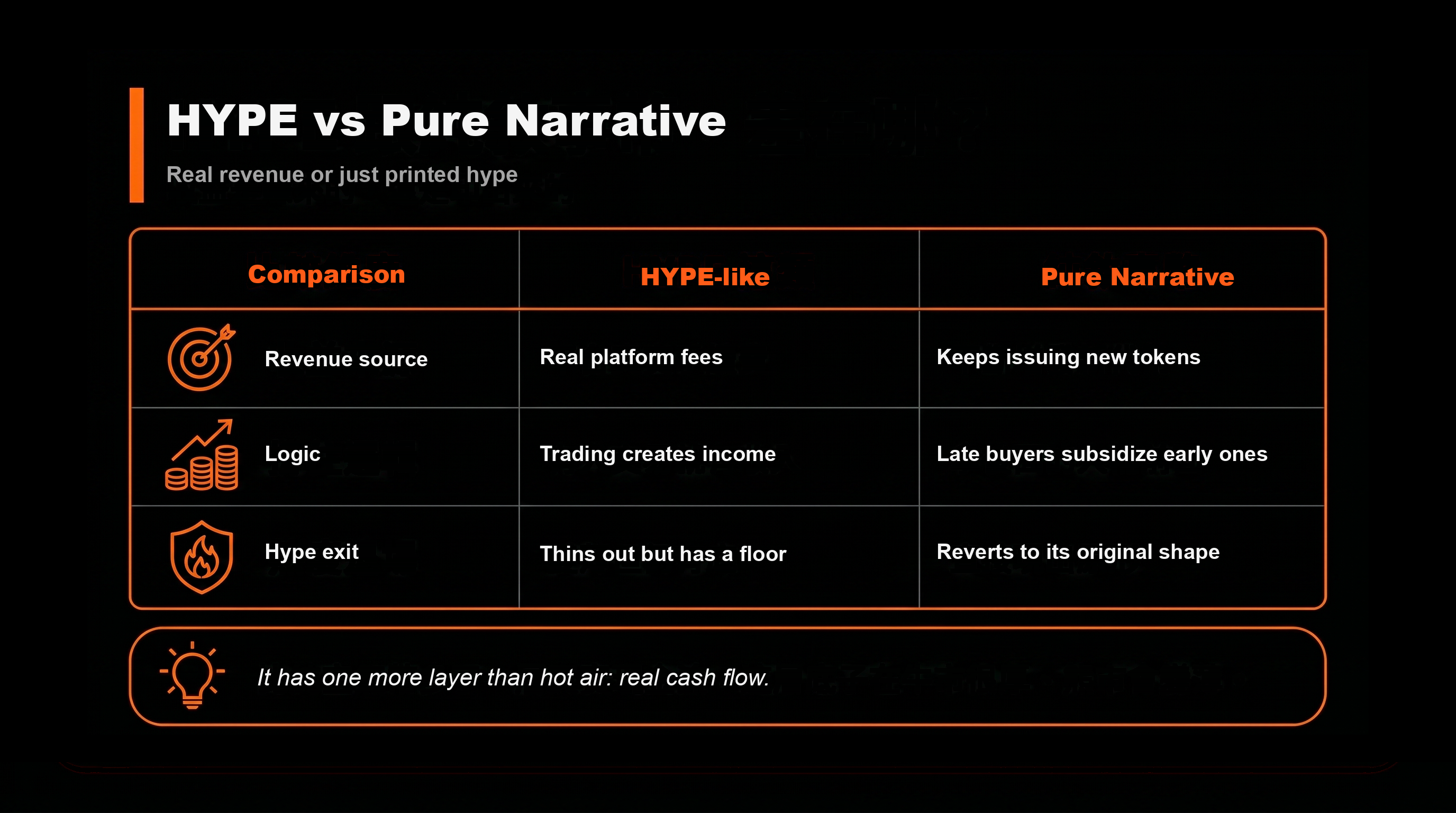
HYPE is relatively recognized by the market for one key reason: its yield comes from the platform's real fee revenue, not from constantly issuing new tokens to subsidize participants.This difference sounds subtle, but over the long run it's a world apart.
A comparison will make it clear. Many so-called pure-narrative coins give you high yields that are actually newly printed tokens — put bluntly, taking money from people who enter later to subsidize those who came earlier. This model looks beautiful while the hype lasts, but it fundamentally can't hold up, and shows its true form the moment the hype fades. Whereas HYPE is more like this: as long as people trade on the platform, fees are generated, and this real incoming money is then returned to the token through buybacks, staking rewards, and the like — logically closer to “this business really does make money, and then distributes what it earns to shareholders.” Sounds a lot more solid, doesn't it? But I have to add an important reminder: the premise of this virtuous cycle is that trading volume holds up. Once the overall market turns cold and volume shrinks sharply, fees and buybacks naturally shrink too, and the cash flow once treated as hard support visibly softens. So HYPE is hardly a sure thing — it just has one layer of real cash-flow foundation more than a pure vaporware coin, and that foundation is thick in a bull market and thins out in a bear market, so you have to view it together with the market cycle.
Taking no VC money — good or bad for the token supply structure?
Hyperliquid's most talked-about feature is that the founding team deliberately took no venture capital — that is, no VC money. In the community this is passed around almost as a pure positive, but for beginners, I think it has two sides, and you need to see both clearly.
First the good side. No VC means the supply structure lacks a batch of early whales with “ultra-low cost who rush to cash out the moment tokens unlock.” Such low-cost supply has always been one of the heaviest sources of sell pressure after many projects launch, because they acquired large amounts of tokens at extremely low prices very early, and once the unlock hits, selling at any price is profit — a very strong motive. Without this block, HYPE's sell-pressure structure is indeed a bit cleaner, which is a genuine plus. But the other side to watch is this: no VC absolutely doesn't mean no unlocks. The core team and early contributors also hold quite a large amount of tokens, and these will likewise unlock and flow into the market over the coming years. So I'd remind you: “taking no VC money” can be a plus, but never misread it as “HYPE has no sell pressure” — the distance between the two is exactly what the next section will carefully take apart.
What is an unlock? And why is it the variable to watch most for HYPE
“Everyone says to be careful of unlocks, so what actually happens at an unlock?”This is the variable to watch most closely for HYPE over the short to medium term, and it's precisely the part beginners most easily skip entirely.In this section I'll first help you understand why unlocks bring sell pressure, then look at how HYPE's unlocks are roughly scheduled, and finally bust one myth, so you don't naively enter at the wrong moment.
Why token unlocks create sell pressure
A token unlock, in plain terms, is when tokens that were locked by a contract and couldn't be moved get released at an agreed time, and can from then on be sold on the market.Why it's so often linked to price drops comes down to two concepts you must know.
The first is circulating supply. An unlock increases the coins actually sellable on the market — the most direct increase in supply — and if demand doesn't grow at the same time, the extra sell orders weigh on the price. The second is FDV, or fully diluted valuation — the total market cap counting in all tokens not yet unlocked. This number matters, because if a coin's current price is a pretty figure propped up by “a small circulating supply right now,” then once large amounts unlock in the future and circulating supply surges, the market may reprice its valuation back toward something closer to reality. So every time I see a coin pumping hard right now, my first move is never to rush in chasing but to first check what proportion of tokens is still unlocked and when they unlock, so I don't happen to catch the bag right before unlock sell pressure erupts.This habit is simple, but it helps you dodge quite a few big pitfalls.
How HYPE's unlocks are scheduled
Back to HYPE itself. As said, it has no VC, but core contributors hold quite a high proportion, and this is precisely the main source of its unlock sell pressure — beginners especially need to keep this block in view.
A few points to remember. Core contributors' tokens roughly begin linear unlocking only after a full year from genesis, and are released in batches, continuously, over the following years — not all dumped into the market at once on some single day. The words “linear, in batches” are key here, they mean HYPE's unlock sell pressure isn't the event of a single scary day but a long-term, slow, ever-present background pressure, which you have to understand on a longer time scale.I also want to stress: the specific unlock timing and release amounts can change. This article states broad principles; when you actually make a decision, be sure to go by official information and the latest data on dedicated token-unlock tracking tools, and never decide based on one article or an old chart drawn who-knows-when. My own habit is: before I plan to add to a position, I first glance at an unlock tracker to see whether any larger releases are scheduled soon, and put that timing explicitly into my judgment rather than going by feel.
An unlock doesn't necessarily crash the price — what to actually look at
Here I want to bust a very common myth: an unlock doesn't equal a guaranteed drop.In fact, HYPE's several sizable unlocks in the past didn't crash the price that same day. If you panic-sell everything the moment you hear “it's about to unlock,” or conversely rush to short, you're actually quite likely to get it wrong.
So what should you actually look at? I watch three things. First, the unlock amount as a share of circulating supply: if this release is only a small slice relative to existing circulating supply, its real impact is usually limited; only when the share is large enough do you truly need to raise your guard. Second, whether the market has reacted in advance: information moves fast in crypto, and much unlock sell pressure is actually digested slowly once the news is out, or even earlier, so by the actual unlock day the price is calm and unmoved. Third, whether there's enough demand to absorb it: in the same period, is new money or a new narrative entering to take up this batch of released supply? Judging these three together is far more rational and accurate than just getting scared off or shorting the moment you hear “it's about to unlock.” Remember, an unlock is something that requires “looking at the numbers and the context,” not a label you can scare yourself with by intuition.
The landmines beginners most easily step on before getting into HYPE
“After all this, can I actually buy, and how do I get involved without getting burned?” This section won't give you a buy signal or a hot tip; it just picks out the landmines beginners most often step on and most easily lose real money to. Learn to avoid these pitfalls first, then talk about how to get involved — get the order right and your odds go up.
Treating “a strong platform” directly as “a coin that steadily rises”
This is the most common — and most fatal — misconception beginners make: seeing high platform volume, a good experience, and everyone using it, they intuitively assume HYPE the coin is bound to rise.But between these two things lies a very long distance.
A red-hot platform proves at most one thing: “this business really works and people pay for it.” But a token's price is never decided by how good the platform is alone; it's pulled at the same time by factors like supply structure, unlock pace, and overall market sentiment. A platform with a great business can absolutely see its token drop for a stretch due to unlock sell pressure or the broad market turning bearish. So when facing any platform token, I deliberately split it into two independent questions: first, “am I bullish on this platform's long-term development”; second, “at this price right now, is it worth entering to buy its coin.” The answers to these two questions can be completely different — a platform being worth using long-term is one thing; whether this price right now is suitable for buying, or whether it's already overheated, is another thing entirely.Conflating these two is the first lesson beginners only learn after paying tuition — I hope you can dodge it in advance.
The risk of chasing the top around unlocks and news peaks
The second landmine is that beginners are especially prone to charging in when “the news is hottest and the crowd is loudest,” and that moment is often precisely the most dangerous spot on the short-term chart.This sounds counterintuitive, but it's a script the market plays out again and again.
Think about it: by the time a major piece of good news lands, a listing on some big exchange happens, or an unlock topic is being hyped hot, the price has usually already risen a stretch beforehand. If you only react and chase in after seeing the news headline, what you're picking up is very likely the order handed to you by those who positioned themselves earlier and now want to offload on the good news. Especially for a “known future event” like an unlock, you should write the timing into your plan in advance rather than naively waiting until the day to scramble. Here's a very practical simple principle: the more the market is in a frenzy and everyone is shouting buy, the more you should calm down first and ask yourself, “if this bet is wrong, how much will I lose, and can I take it.”Once you've thought through your maximum loss in advance, you're less likely to be pushed by emotion into the worst decision at the very top.
The liquidation risk of playing HYPE with perps and leverage
The third landmine relates directly to Hyperliquid's very nature. It is itself a perpetual contract trading platform, which means beginners can all too easily and smoothly open a leveraged contract — and that's precisely the highest-risk step in the whole process.
Let me spell out the risk. Perpetual contracts carry leverage, meaning that while they amplify your gains they amplify your losses in equal proportion — great when you're winning, doubly painful when you're losing. More dangerous is the forced-liquidation mechanism: the moment the price wicks against you and touches the liquidation line, your position can be liquidated outright and your principal wiped to zero, without even a chance to react. And the unlocks and major data releases mentioned earlier are exactly when the market is most volatile — the moments you're most easily swept out by a single wick. So if you're still a beginner and haven't truly grasped how mechanisms like the funding rate and liquidation line work, my honest advice is: use spot first to understand this coin and feel its volatility, and don't rush to open leverage right off the bat. Remember one line: risk management always comes before dreams of returns — survive and stay at the table first, and only then do you have a chance to win later.
A few things beginners should sort out before getting into HYPE
“I get the logic, so before I actually act, which basic questions do I need to clear up first?” This section isn't about buy/sell signals; it thoroughly covers the few things beginners most need to confirm before actually getting involved: how to buy, whether KYC is needed, and whether assets are safe. Get these basics straight and you won't muddle your money in before you even understand the rules.
How to buy HYPE, and whether you need KYC
Let's start with the most practical question: HYPE — where exactly to buy it and whether the process is a hassle. This is where beginners most often get stuck, but it's actually not that complicated; the key is first thinking through which kind of participation you want.
Broadly, you'll encounter two paths. One is buying and selling through a centralized exchange that supports HYPE, a path that usually requires completing KYC — uploading your documents for identity verification. The upside is a familiar interface and easy deposits and withdrawals, which is friendlier for complete beginners. The other is participating directly in Hyperliquid's on-chain environment with a wallet, a path closer to its decentralized intent that usually doesn't require KYC in the traditional sense — but you first have to learn to use a wallet and manage a private key, so the barrier is a bit higher. My advice to beginners is this: if you're not even comfortable using a wallet yet, start with an exchange you're familiar with and that's compliant, get the process smooth and get a clear feel for this coin's volatility, and only then consider whether to move further on-chain.Don't force it before you're ready just to chase “maximum decentralization”; the cost of losing your private key or bridging to the wrong chain is often far higher than the little bit of fees you save.
Where to check the unlock schedule, and whether to short
The second thing is how to check unlocks yourself, and whether beginners should short just because they fear an unlock. These two questions are actually tied together.
First, checking unlocks. As stressed repeatedly, the specific unlock timing and amounts can change, so the most reliable approach is to look at the officially published token-allocation information and cross-check it against dedicated token-unlock tracking tools on the market — not to trust some old chart drawn who-knows-when. Making this verification a fixed habit before adding to a position is more solid than listening to anyone shilling. As for shorting, I have to bluntly talk most beginners out of it: opening a short because you “expect the unlock to crash the price” is something that sounds reasonable but is in practice extremely hard to get right.As said, an unlock doesn't necessarily drop on the day, and sell pressure is often digested in advance; if your timing bet is even slightly off, you could get squeezed to liquidation in a bounce. For beginners who haven't grasped the mechanics, rather than betting on the direction of an unlock, put your energy into the more controllable thing of “not chasing the top at the wrong moment.”
Is it safe to keep assets on Hyperliquid?
The third thing, and the one beginners should most keep in mind: whether keeping assets on Hyperliquid is actually safe. This question has no black-and-white answer, but there are a few premises you must recognize first.
Its decentralized design does mean you don't have to hand your coins entirely to a single company for custody the way you do on a centralized exchange, which is an advantage against risks like “the company runs off or misappropriates customer assets.” But don't therefore assume it's zero-risk. It runs on its own L1, and that chain's own security and stability, whether the related smart contracts have vulnerabilities, and your own custody of your wallet's private key are all new risk points. In other words, you've merely swapped the risk of “trusting a company” for the risk of “trusting a chain and a set of contracts, plus managing your own private key,” not eliminated the risk.So my advice is practical: when you're just starting out, don't pile in more money than you can bear all at once; use a small amount first to get familiar with the whole process and experience, and meanwhile keep things like your private key and seed phrase safe. On security, the platform carries part of it for you, but a large part of the rest is on you.
Conclusion
This piece first got three things straight for you: Hyperliquid why it's gotten so much attention this cycle, HYPE whether its value is actually real, and how the unlock — the variable to watch most — affects the coin price. From running on its own L1 and using a smooth experience to capture most of the perpetual trading volume, to HYPE being backed by real fee revenue while still having core contributors' long-term unlocks weighing on it, it all points back to the same key idea: whether the platform is strong and whether the coin rises are two questions you must ask separately.So before you get involved, the best thing to do isn't to charge in with the hype but to first separate “a strong platform” from “a coin that steadily rises,” put the unlock timing into your judgment, and avoid chasing the top or casually adding leverage when things are hottest. Seeing the risk first, then deciding whether and how to get involved, is always steadier than following your emotions.


