

Have you seen that Dogecoin is now on PayPal’s payment network and figured meme coins can finally be used to buy things and are about to take off? This article won’t cheer along with the hype. Instead, it first lays out the facts of this partnership, meme coins whether they can actually be used for payments, how a beginner should judge things when a “payment catalyst” appears, and finally why this still matters and where it’s most easily misunderstood.
What is this partnership, exactly? Let’s get the facts straight first
“Isn’t this just PayPal starting to accept Dogecoin?” It’s not that direct. Many people read just the headline and assume PayPal personally jumped in to promote DOGE, but the actual structure of the partnership is very different from that picture. In this section, I’ll first make clear the players behind this integration, which layer it happens at, and what it actually opens up, so you won’t let the headline run your imagination and mistake a road that’s just been paved for a busy, traffic-filled avenue.
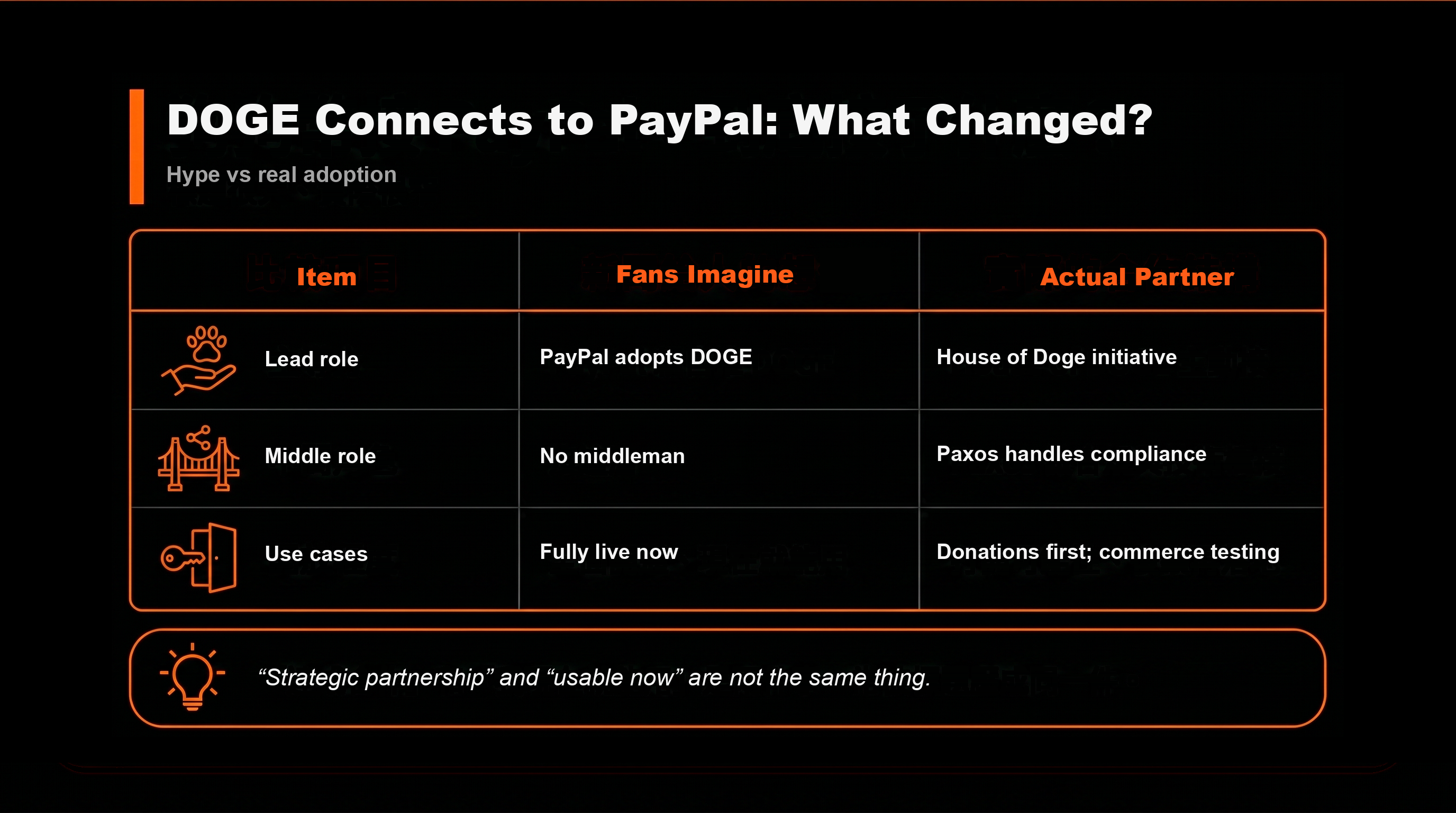
The main players are House of DOGE and Paxos, not PayPal itself
Let’s identify the main players first. The two key parties in this partnership are actually the regulated crypto infrastructure provider Paxos, and Dogecoin Foundation’s official company, House of DOGE — not PayPal personally stepping in to push Dogecoin.Put simply, Paxos sits in the middle handling the compliance and technical bridging, giving Dogecoin a chance to plug into the same payment network used by PayPal, Venmo, Interactive Brokers, and Mercado Libre, spanning multiple countries.
Why draw this distinction first? Because “PayPal actively supporting DOGE” and “an infrastructure provider connecting DOGE to the network that PayPal sits on” feel completely different. The former makes it seem like this meme coin has been endorsed by a giant; the latter is actually closer to the truth: House of DOGE reached out to the infrastructure, and Paxos provided the pipe. I make a habit of pinning down the subject of a news story, because who the subject is often determines just how much weight the story really carries.
The point is the “infrastructure-layer” connection, not stores opening for sales
Now look at which layer this integration happens at. It’s an “infrastructure-layer” connection — that is, plugging Dogecoin into the underlying plumbing of the payment network, not PayPal adding a “pay with Dogecoin” checkout button inside the app you open.These two things are easily conflated, but the difference is crucial.
Here’s an analogy: an infrastructure-layer connection is more like two telecom carriers linking up their lines, but whether you can actually place the call on your phone, what it costs, and which regions go live first are separate matters. The technical pipe being connected is the premise, not the finish line. When I see this kind of “integrated with such-and-such network” news, I first ask: is this the underlying layer being connected, or can consumers actually use it now? Most of the time, the answer is the former.Get this layer straight and you won’t misread a piece of infrastructure news as “PayPal stores are already selling Dogecoin.”
It represents a “possibility,” not “fully live already”
This is the most easily misunderstood part of the whole thing, and the first point I want to correct for you: plugging into a payment network opens up a “possibility,” not “fully live already”.It’s more like paving a road, which isn’t the same as cars already filling it.Once the road is open, it still comes down to whether merchants get on board, how far the features roll out, and when each region is cleared.
So how much actually opens up, which features work, which regions are supported, and when it goes live usually depend on later execution, and what the news gives you in the moment is often just a starting point. When I see this kind of news, I deliberately treat “a deal was reached” and “I can use it right now” as two separate things: the former is news, an expectation; the latter is what you actually care about and what will actually affect you.Lumping the two together is where beginners most often start to misjudge.
Can meme coins really be used to pay now?
“So can I actually use DOGE to pay?” My answer: it’s heading that way, but don’t treat it as already real. In this section I want to unpack the gap between the ideal and reality, because between “technically able to integrate” and “genuinely usable and widely adopted” lies a distance longer than you’d think. Understand this distance, and your expectations for meme coin payments will sit in a more realistic place.
Payment use cases have always been what meme coins want to prove
First, why the community gets especially excited every time there’s a payment partnership. Dogecoin started as a joke coin and has grown into a huge community, even accepted by some well-known companies, but “can it really be used to pay, does it have real utility” has long been the question it wants to answer to shed its purely speculative label. For many Dogecoin supporters, payment use cases are pretty much the key battleground for whether this coin can “go legit.”
So you’ll notice that every time there’s payment-related partnership news, the community reacts strongly, because it hits meme coins right where it hurts: does it actually have real utility, or will it forever just be a speculative play. Plugging into a mainstream payment network this time really is a step toward “having utility,” and I think that deserves credit. But crediting the direction and believing it has already reached the finish line are two things that need to be kept separate, and this next part is where the gap lies.
“Able to pay” and “usable and widely adopted” are two different things
Here’s what I most want to remind you: there’s a long way between being technically able to integrate and it actually being usable and widely accepted. Between “able” and “widely adopted” often lie several years of habit-building. Whether merchants are willing to accept it and whether consumers are willing to actively use it don’t happen automatically just because the pipe is connected.
I think this is clearer if we look at a few realities side by side:
- Merchant side: whether they’ll accept it takes time to develop; connecting the pipe doesn’t mean anyone will take it.
- Consumer side: whether people will actively pay with DOGE instead of just swiping a credit card also has to be nurtured over time.
- Features and regions: the features actually enabled and regions covered may be far smaller than the news leads you to imagine.
So on the question of “meme coins can be used to pay now,” my view is clear: the road is being paved and the direction is right, but don’t treat it as an already-widespread reality. If you assume today, because of this news, that you can immediately use DOGE to spend everywhere, you’ll most likely be disappointed.
The price swings hard, which makes it inconvenient as a “payment tool”
There’s another, more fundamental and often-overlooked issue: Dogecoin’s price is very volatile, which actually makes it quite inconvenient to use as a “payment tool.” Something you pay with is best when its value is stable, but meme coins are exactly the opposite.
Imagine you pay for a coffee today with some DOGE, and then tomorrow that same DOGE could be worth 20% more, or 20% less. That’s a headache for both sides. The merchant who accepts it doesn’t know whether to convert it to fiat right away, and the consumer who spent it kicks themselves thinking “I should’ve held on.” This is exactly why what actually gets used for everyday payments is mostly fiat-pegged stablecoins, not highly volatile speculative assets. So here’s how I read it: DOGE plugging into a payment network is a narrative-level advance, but the very trait of “high volatility” means it’s still a fair distance from becoming a smooth everyday payment tool.
When you see payment good news, how should a beginner judge it?
“So how exactly should I view this kind of bullish news?” In this section I’m not telling you to chase it, nor telling you not to — that’s your own call. What I want to give you is a framework that helps you calm down, so you avoid one of the most common mistakes: treating narrative hype directly as fundamentals, and making the most impulsive move at peak emotion. Once you can tell news from adoption and hype from value, your eye for this kind of news gets a lot steadier.
Distinguish “partnership news” from “actual adoption”
The first and most important habit: separate “partnership news” from “actual adoption.” A lot of so-called bullish news in crypto is essentially the “a deal was reached, a memorandum was signed” kind of announcement, which is actually still far from real execution and real usage volume. News is intent; adoption is the result.
When I see this kind of news, I habitually ask first: is this announcement “we’re going to do it,” or “people are already using it and there’s real data to look at”? The former is expectation; the latter is adoption. A blunt reality: many coins’ prices surge the moment of the “announcement,” then go quiet when execution actually arrives, and can even pull back in a “buy the rumor, sell the news” fashion, because everyone who was going to get excited already bought when the news dropped, then took profit. Keep the two apart, and you won’t mistake buying at the peak of expectation for buying at the start of adoption.
Don’t treat narrative hype as fundamentals
Second reminder: don’t treat the hype a narrative brings as the coin’s fundamentals. Meme coin prices are inherently highly dependent on emotion and buzz, and a piece of payment good news is easily amplified by the market into fuel for short-term speculation, but what’s left after the fuel burns out is the question you should be asking.
When I see this kind of news, I don’t instinctively assume the price should rise and I should chase just because “it’s about to be usable for payments.” The gains a narrative brings and whether the coin has long-term value are two separate lines — they can overlap in the short term but often diverge over the long term. Especially with meme coins, these narrative-driven plays, the risk of chasing at peak emotion and getting stuck holding is especially high, because they fall just as fast as they rise. So when I look at meme coin good news, I deliberately remind myself: this is buzz, not valuation, and don’t mistake momentary excitement for a support of value.
If you want in, start with an amount you can afford to lose
Third, if after reading all this you’re still bullish on Dogecoin’s payment narrative and want to get a little involved, then my most practical reminder is one line: control your amount and your mindset, play with money you can afford to lose. This isn’t throwing cold water on you; it’s the precondition for staying in this high-volatility game a little longer.
Meme coins are volatile by nature, with narratives that come and go fast — today’s hot theme may be forgotten next month. Get involved with small money you can afford to lose, and treat it clearly as a high-risk speculative bet rather than a stable allocation in your portfolio, so that even if a narrative fades and the price gets cut in half, it won’t hurt your life or your other plans. Before you commit, I’d suggest thinking through the worst case: if this money went to zero tomorrow, would my life still go on just fine? Get clear on that before deciding how much to put in, and you’ll be far steadier than someone who goes all-in the moment they see good news.
Why is DOGE plugging into payments still worth watching?
“Given all these reservations, is this partnership basically meaningless?” Not so. Pulling expectations back to reality doesn’t mean the thing isn’t important. In this section I want to switch angles and talk about why, even if you can’t use it in the short term, this kind of progress still matters for Dogecoin and for meme coins as a whole, and why it’s worth keeping on your watchlist — just with a watching mindset, not a chasing mindset.
Let me set one premise clear: this section is about building a long-term perspective on this kind of progress, and doesn’t involve any time-sensitive price call.
The long-term meaning of moving from “pure speculation” toward “having real use”
The first point worth watching is the direction itself. Dogecoin has long been labeled “pure speculation, no real utility,” and every attempt to move toward real use cases, whether it ultimately succeeds or not, is a response to that doubt. Plugging into a mainstream payment network at least, on the narrative level, pushes DOGE one step from “only good for speculation” toward “maybe usable.”
The meaning of this direction is long-term, not immediate. It won’t let you use DOGE to buy things tomorrow, but if this road really does open up over time and merchants and users gradually grow, then today’s step will be looked back on as a starting point. My attitude is: stay attentive to the direction, but stay patient about the progress, and don’t let “the direction is right” trick you into imagining that “the progress has arrived” too. Being bullish on a narrative and judging where it stands right now must always be kept separate.
A regulated infrastructure provider being involved is a relatively positive signal
The second relatively positive signal is that behind this partnership is the regulated crypto infrastructure provider Paxos doing the bridging. Compared with some shady “partnerships” pushed purely by shilling, a connection involving compliant infrastructure is, at least in credibility and ability to deliver, the more solid kind.
This doesn’t mean it’s guaranteed to succeed, nor that you should feel “a big name is involved, so it’s safe.” But for a beginner, learning to distinguish “progress backed by legitimate infrastructure” from “vaporware news driven purely by community hype” is a very useful skill. The former means at least someone is doing the hard work of tech and compliance; the latter is often just an emotional amplifier. When I look at meme coin good news, I use “who’s doing it and how” as an important filter, and this time, with a player like Paxos involved, it’s relatively on the more grounded side.
Treat it as “worth watching,” not “a signal to chase”
Finally, the point where I most want to set your mindset straight: worth watching doesn’t mean worth chasing. A development can be both “worth watching long-term for its direction” and “not something to chase in the short term,” and these two aren’t contradictory — in fact, that’s the mature way to view news.
To be concrete, I put this kind of news on a “watchlist,” not a “buy list”: I keep watching whether it actually gets executed, whether there’s real usage data, and whether merchants and users grow, using real progress over time to validate the narrative, rather than rushing to a decision the moment the news drops. For Dogecoin, a high-emotion, high-volatility play, being able to resist chasing right away is itself an advantage. Treat it as a story worth watching over the long term rather than a signal that pays off tomorrow, and you’ll see more clearly and walk more steadily.
The things beginners most easily misunderstand about Dogecoin payments
“I think I got the earlier parts, but there are still a few spots I keep mixing up — can you clear them up again?” In this section I take the misconceptions beginners most easily fall into on the topic of Dogecoin payments and unpack them one by one. Correct these ideas, and the next time you see similar payment good news, you’ll be able to make a steadier judgment on your own, instead of being led by the headline all over again.
“Integrated” doesn’t mean “usable right now”
The most common first misconception is reading “integrated” directly as “usable right now.” Seeing “Dogecoin integrates with PayPal,” the picture that pops into many people’s heads is: I open PayPal and can pick DOGE to pay. But as covered earlier, this is an infrastructure-layer connection; what it opens up is a possibility, not a full consumer-side rollout.
I’d suggest building a habit: whenever you see any “some coin integrates with some platform” news, unpack the word “integrate” first and ask whether it’s connecting the underlying plumbing or a user-facing feature. Most of the time, the first wave of news is about the former. Build this habit and you won’t keep overestimating how much you can immediately use at the moment of the news, and you won’t get disappointed or impulsive because you “thought you could use it but couldn’t.”
Payment good news ≠ the price will definitely rise
The second misconception is equating payment good news with a price rise, thinking “there’s good news, so the price should go up and I should chase.” But the market’s reaction is far more complex than that. Often the good news is already bought while the rumor is brewing, and the official announcement instead becomes the moment to take profit — the classic “buy the rumor, sell the news.”
More importantly, meme coin prices are heavily driven by emotion; a piece of good news might send it flying briefly, or it might be all thunder and no rain. You can’t jump from “this is good news” straight to “so it’ll rise,” and you certainly can’t assume chasing in is safe. What I do myself is look at whether the news is good or bad separately from its actual impact on price, always assuming the market may have already priced it in, or simply isn’t buying it. With this mindset, you’re less likely to chase the top on good news.
Being bullish on a meme coin doesn’t mean betting big on it
The third misconception, and the riskiest one: equating “being bullish on a meme coin” directly with “you should bet big on it.” These two things can be completely separated. You can appreciate Dogecoin’s community culture and be bullish on its move toward real use, while in your actual allocation putting in only a small amount you can afford to lose.
Meme coins are volatile and highly uncertain by nature, and even the most bullish narrative can get cut in half in a single emotional downturn. Tying being bullish to betting big is where beginners most easily take heavy damage, because once the narrative cools off, the ones with big positions often can’t hold on. My principle is simple: appreciation is one thing, allocation is another; you can be firmly bullish, but always bet with an amount you can afford to lose. Only by separating the two can you, in meme coins, this high-risk arena, both take part and avoid getting flattened by a single move.
Conclusion
This article helps you get a clear picture of “Dogecoin integrates with PayPal’s payment network”: it’s an infrastructure connection done through the regulated Paxos, initiated by House of DOGE, which opens up the possibility of Dogecoin being used on these platforms, but it doesn’t mean you can now use DOGE to pay across the board. Meme coins’ payment road is indeed being paved and the direction is worth watching long-term, but it’s still a distance from real widespread adoption, and with the coin’s high volatility, it’s also a way off from becoming a smooth everyday payment tool. So when you see this kind of payment good news, the best thing to do isn’t to get excited and chase in, but first to distinguish “partnership news” from “actual adoption,” not to treat narrative hype as fundamentals, to put it on a watchlist rather than a buy list, and — if you really want in — to use only money you can afford to lose. Separate direction from progress, and separate being bullish from betting big, and you won’t, in the next round of payment good news, mistake a story that’s just getting started for a signal that pays off tomorrow.


