

The PUMP token unlock that the market had been buzzing about for weeks finally landed on July 12. Were you also caught in the middle — afraid of buying in before the unlock and getting stuck, but also afraid of missing the so-called "bad news priced in" rebound?This articlewon't dress up the buyback as some magic tool that reliably offsets sell pressure. Instead, it first walks you through the real unlock size, price action, and the true strength of the buyback and burn, then tells you whether the fact that "it didn't crash" is actually a valid entry signal.
What Did This Unlock Actually Release? Reviewing the Key Numbers From July 12
How big was the July 12 unlock, exactly, and who walked away with these tokens? Before we can judge whether the price will crash,we need to get the baseline right first — the number of tokens involved in this unlock, who received them, the bearish arguments circulating before the unlock, and whether this batch of tokens is large relative to Pump.fun's normal trading volume all need to be nailed down before we can talk about whether the supply-demand imbalance actually played out.
8.25 Billion PUMP Tokens Unlocked — How Much Did the Team and Early Investors Each Receive?
The number of PUMP tokens unlocked on July 12 was confirmed at 8.25 billion, accounting for about 29% of current circulating supply. This batch was split into two parts: the team received 50 billion tokens, and early investors received 32.5 billion tokens.Converted at the unlock-time price, this comes out to roughly $125 million to $135 million in value — not a small amount, butnot large enough to single-handedly crush the entire trading market.
The team and early investors don't have identical incentives to sell. The team has to consider the project's long-term development and how the market perceives it, so it's unlikely to dump a huge amount on day one of the unlock. Early investors, on the other hand, have a much lower cost basis, so as long as the price holds some basic support, they have a stronger incentive to take profits.When analyzing an unlock event, you can't just look at the total amount — you also need to ask who's holding these tokens and what their motivation for holding is.
The Bearish Case Before the Unlock (41% of Supply, Insider Sell-Off Concerns, Buyback Policy Cut in Half)
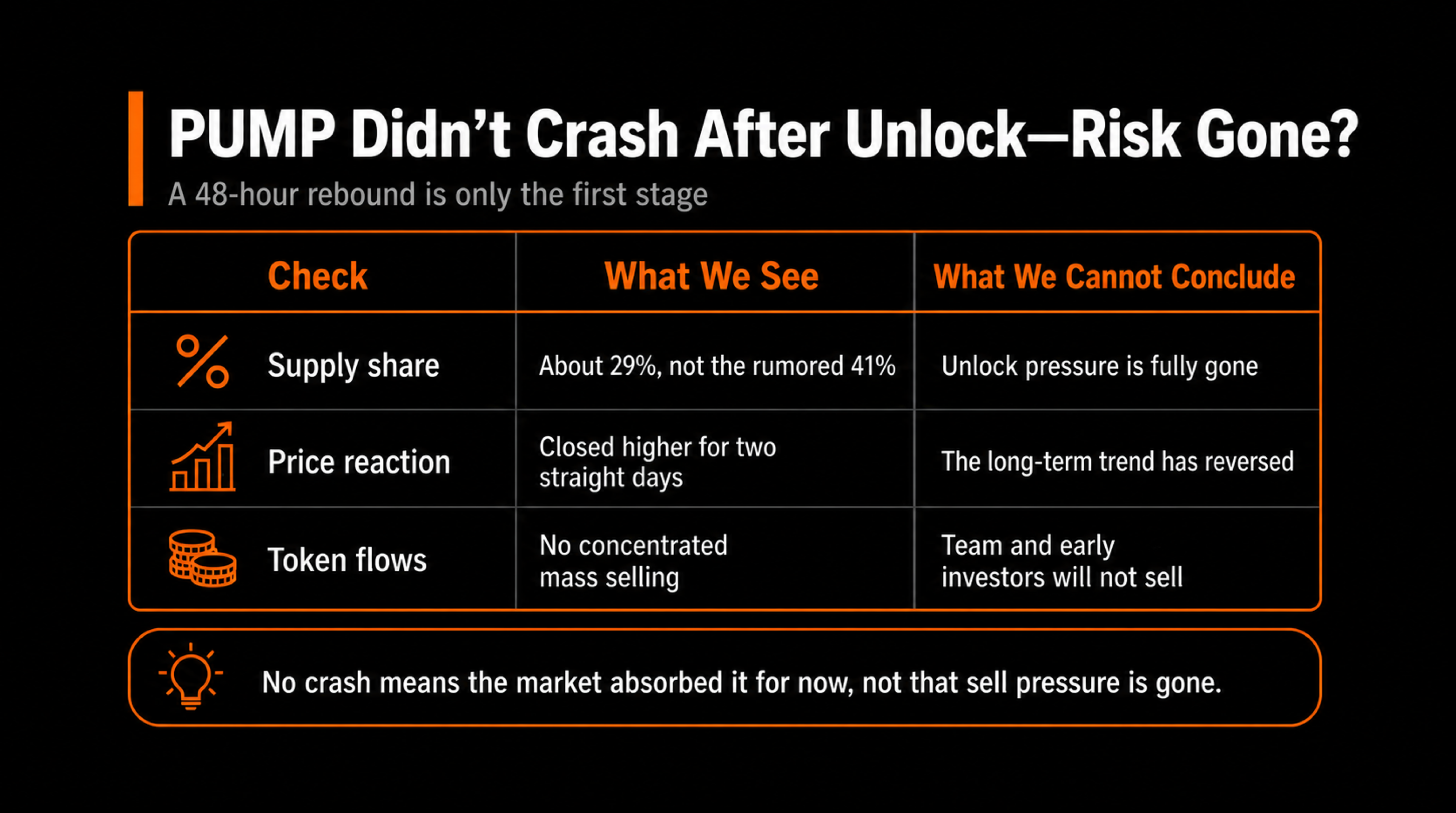
The most widely circulated claim before the unlock was that this round would release as much as 41% of supply, combined with worries that the team and early investors might use the opportunity to dump tokens, plus the fact that the buyback policy had already been cut in April from 100% of revenue to 50%. With these three pieces of bad news stacked together, quite a few people rushed to hedge ahead of time.But when you check against the exchange's publicly disclosed circulating supply, the 8.25 billion tokens actually unlocked this time works out to closer to 29%,a clear gap from the 41% figure that had been circulating in the market.
This gap mostly comes down to a difference in what's being measured: the 41% figure likely refers to the total allocation share held by the team and early investors combined, not the share actually flowing into the market this time. Mixing up these two different metrics naturally amplified the pre-unlock panic.For retail investors, this is a practical reminder: when you see a percentage in a bearish unlock argument, first ask whether it's the "share of total vested allocation" or the "share actually unlocked this time" — otherwise it's easy to get scared more than the actual situation warrants.
Unlock Size vs. Daily Trading Volume — Why Analysts Call This a Liquidity Stress Test
Whether the market can smoothly absorb 8.25 billion PUMP tokens hitting the open market all at once depends not on the unlock total itself, but on how it compares to Pump.fun's normal trading volume.That's why quite a few analysts describe this event as a "liquidity stress test" — it's not testing the token's technicals, but whether the market is willing to absorb this large batch of new supply at a reasonable price, or whether buyers will suddenly pull back and sell pressure will find no one to absorb it.
This framing also points to the logic behind evaluating unlock events: unlocking several billion tokens in an active market with deep buy-side liquidity may have limited impact, while the same unlock number in a market where trading heat has already cooled off could cause noticeably more price volatility.When looking at this PUMP unlock, you can't just look at the absolute number of 8.25 billion tokens — you also need to check it against recent market activity to judge whether the market actually passed this test, or just barely held on.
What Did PUMP's Price Actually Do in the 48 Hours After the Unlock?
In the 48 hours after the unlock, did PUMP drop as expected, or did it hold up against the sell pressure?No matter how loud the bearish arguments were before the unlock, they ultimately have to be checked against the actual price chart. Let's lay out the actual gains and losses from July 13 to July 14, compare them to the trend from the week before the unlock, and then think about why the retail-investor gut instinct that "unlock equals crash" didn't hold up this time.
Actual Price Moves From July 13 to July 14
Looking at the actual numbers, after the unlock PUMPdidn't drop as expected — instead, it closed green for two straight days.On July 13, it rose 6.29% for the day, bringing the price to about $0.001487; the next day, July 14, it rose another 4.56%, reaching about $0.00149. Different data sources may show slight discrepancies a few decimal places out, which is common for low-priced tokens — the sampling time varies, so small differences in the trailing digits are normal. There's no need to fixate on the fourth or fifth decimal place; what matters is that the direction and magnitude of the move are consistent.
Two straight days of gains stand in stark contrast to the panic that had been spreading through the market before the unlock.If the unlock had really triggered mass selling, the price should, in theory, have shown a clear decline in the first day or two after the unlock. But what actually played out was a mild rebound pattern instead.This doesn't mean the unlock had no impact at all — it just means the immediate price reaction didn't match the "crash the moment it unlocks" script that had been circulating beforehand.
Comparing With the Week Before the Unlock — Was This Panic Selling or a Stabilizing Rebound?
Zooming out to the week before the unlock, PUMP actually fell by a cumulative 8.2%. But this decline needs to be understood separately — it mostly happened before the unlock, reflecting the market pre-digesting sell pressure ahead of the upcoming unlock, rather than panic selling that erupted at the moment of the unlock itself.The truly tense periodwas the anticipation beforehand, not the moment of the unlock itself.
By the time the unlock actually happened, the price instead rose for two straight days. This pattern — bad news getting priced in ahead of time, followed by stabilization once the event actually occurs — isn't unusual for unlock-type events. The market often prices in future risk in advance, and once the event lands, as long as there's no worse-than-expected news, tokens tend to see a "the other shoe has dropped" style stabilization or even a small rebound.To judge the impact of an unlock, you can't just stare at the price on the day of the unlock — you also need to look back at how much it had already dropped in the week beforehand, so you don't mistake anticipatory decline for an actual crash.
Why the "Unlock Equals Crash" Instinct Didn't Hold Up This Time
Retail investors' most instinctive reaction to an unlock event is usually "unlock = more tokens = price will fall." The logic itself isn't wrong, but it ignores two other variables: how much buying power there is to absorb the supply, and how willing sellers actually are to sell.The fact that PUMP's price rose instead of falling after this unlock shows that, at least in the first 48 hours after the unlock, market buying was enough to absorb the psychological pressure released by the unlock, and the team and early investors holding these tokens didn't dump them all at once right away either.
But here's a reminder:the fact that it didn't play out doesn't mean the instinct itself is wrong — it just means the timing and magnitude didn't line up this time.The unlocked tokens still exist in theory — they simply haven't shown up as sell orders on the order book yet. Jumping straight from "it didn't crash this time" to "the bad news from the unlock is over" is an oversimplified reading. Next, we need to break down the buyback mechanism and the underlying revenue concerns, to see whether they can really hold up this surface-level picture.
Did the Buyback Mechanism Really Hold Up the Market?
Can this discounted buyback really hold up against the supply pressure from 8.25 billion new tokens?Since the price didn't crash, many people immediately credit the buyback mechanism. But the buyback policy was just cut in half this April, from 100% of revenue to 50%. Let's break down the actual scale of the buyback and burn and compare it side by side with the size of this unlock.
What Does It Mean That the Buyback Policy Was Cut From 100% to 50% of Revenue?
Pump.fun's buyback mechanism was originally designed to take 100% of the platform's revenue and use it to buy back and burn PUMP on the open market — meaning that whatever the platform earned, an equal amount of buying flowed back into the market to support the price.But this April, the policy was cut in half, changing it so that only 50% of revenue goes toward the buyback, with the other half staying with the platform,directly cutting the ceiling on buyback buying power in half.
The signal sent by this cut is actually more worth paying attention to than the number itself — when a platform lowers its buyback ratio, it usually reflects other considerations about how to use its cash flow. It might need to keep funds on hand for operational fluctuations, or it might have concluded that a 100% buyback isn't the most efficient use of capital.Whatever the reason, for PUMP holders, at the same level of revenue, the amount of money actually flowing back into the market to buy back tokens is now half of what it used to be. This underlying change is a premise you need to factor in first when evaluating how much support the buyback can provide.
Is Cumulative Buyback and Burn of About 42% of Circulating Supply Enough to Offset the New Unlock Supply?
As of now, the cumulative amount of PUMP that Pump.fun has bought back and burned accounts for about 42% of circulating supply — a substantial amount that's been building up over an extended period.Looking at the number alone, a cumulative burn ratio of 42% is indeed larger than this unlock's 8.25 billion tokens, or about 29% of circulating supply — at first glance, the buyback firepower looks sufficient to offset it.
But there's a timing issue that can't be ignored: that 42% is the result of accumulation over an extended period, while the 8.25 billion token unlock was released all at once, concentrated on a single day.Buyback and burn is buying that happens continuously in batches, while the unlock releases supply that can be listed for sale instantly — the two happen on asymmetric timelines.Even if the long-term cumulative burn is large enough, that doesn't mean buyback buying power can simultaneously offset the tokens the unlock holders want to sell in the days right around the unlock. To assess how well the buyback actually supports the price, you can't just look at the cumulative burn ratio as a headline number — you also need to look at the actual pace of buyback purchases in the days before and after the unlock.
Buyback Support vs. Treating the Symptom, Not the Cause — How Long Can This Buying Power Last?
The buyback mechanism did play a role in this unlock event — at least judging by the outcome, the price didn't see a panic-driven collapse.But the source of buyback buying power is ultimately platform revenue, not ongoing external capital injections. Once revenue declines, the buyback's ammunition shrinks along with it — this way of supporting the price is, at its core,more like treating the symptom rather than solving the underlying supply-demand structural problem.
Whether the buyback can keep holding up doesn't depend on how good this unlock's results look — it depends on whether the platform's future revenue can be sustained.If revenue keeps weakening, buying power that's already been cut in half will only keep getting thinner. When the next unlock comes around, or if market sentiment turns weaker, whether the buyback can still play the same cushioning role becomes questionable. The next question to address is whether the underlying concern about declining revenue has worsened since the unlock — this directly affects how much longer this buyback line of defense can hold.
Has the Revenue Decline Concern Gotten Worse Since the Unlock?
Buyback buying power ultimately comes from platform revenue, so has this revenue line of defense weakened further around the unlock? Different data sources give quite different estimates of how steep the decline is,and rather than manufacture a number that sounds precise but doesn't hold up under cross-checking, we'll be upfront about the qualitative conclusion — a significant decline — and discuss what that means for the buyback's ammunition and the business model as a whole.
The Real Scale of the Year-Over-Year Revenue Decline
Pump.fun's revenue this year has clearly declined compared to the same period last year — every data source agrees on the direction, but the specific percentage decline varies quite a bit between sources, with some estimates more conservative and others more dramatic.Rather than force out a percentage that looks precise but doesn't survive cross-checking, I'd rather be upfront and say: this is a substantial decline,not hand you a falsely precise number that could mislead you.
Part of the reason for the discrepancy is that different platforms calculate revenue differently — some count all fees, while others only count revenue from specific business lines. Another part of the reason is that the time windows used differ; comparing one month vs. one quarter naturally produces different year-over-year numbers.For readers, the point isn't to memorize some precise percentage — it's to understand the broader direction that revenue is clearly shrinking. That's more worth factoring into your judgment than a number that different sources can't even agree on.
How Shrinking Revenue Drags Down the Buyback's Ammunition
The funding source for the buyback mechanism is directly tied to 50% of platform revenue,which means shrinking revenue shows up in buyback buying power immediately — there's no extra transmission mechanism needed; the two move in near lockstep.The more clearly revenue declines, the less funding there is available to buy back and burn PUMP, and the buyback's ability to support the price naturally weakens as a result.
This also creates a cycle worth watching out for: cooling trading activity in the market reduces the platform's fee income, which shrinks buyback buying power; shrinking buyback buying power removes an important source of price support, and once the price weakens, trading appetite may decline further, putting pressure on revenue all over again.The fact that this unlock didn't immediately trigger a wave of selling is, to some extent, because the buyback is still holding up. But if the revenue decline trend continues, the next time there's an unlock or market sentiment turns bearish,the cushioning role the buyback can play will likely become more and more limited.
Is This Short-Term Volatility, or a Sign That the Casino Model Has Peaked?
Pump.fun's business model relies heavily on trading activity and speculative behavior on the platform. This revenue structure, with its strong casino-like nature,can surge dramatically when things are going up, but when the tide turns, revenue tends to fall just as quickly.As for whether this is just short-term volatility or the entire model has already peaked, one or two quarters of revenue data alone can't settle the question — after all, the crypto market has its own busy and slow seasons, and trading activity naturally fluctuates with market sentiment.
What can be said for certain is this: if the revenue decline is just a one-off seasonal slowdown, buyback buying power will eventually recover as the market warms back up. But if the decline reflects users losing their initial excitement for this kind of speculative platform, then the revenue drop won't just be temporary — it'll be a structural, trend-driven problem. For anyone holding PUMP or considering an entry, rather than rushing to a conclusion, it's better to treat the next few quarters' revenue numbers as the key indicator for whether the model can keep holding up, and keep tracking it — don't assume the model is fine just because it didn't crash this time.
Have the Tokens Received in the Unlock Actually Been Sold?
Just because the price didn't crash and the buyback is still holding up — does that mean these unlocked tokens really haven't been sold?Honestly, when it comes to this question, right now wecan't give a definitive answer.What on-chain data can and can't show, and which misreading trap retail investors are most likely to fall into here, are worth laying out clearly — rather than casually concluding it's either safe or dangerous.
What On-Chain Data Can and Can't Show Right Now
On-chain data can relatively clearly show one thing: in the days after the unlock, the market showed a pattern of gradual decline or mild gains,with no sign of a single, concentrated wave of massive selling. Market observers also noted scattered large buys, though these buys didn't form a sustained pattern of accumulation.These are clues that can be indirectly observed through price and volume behavior.
But there's currently no specific on-chain tracking report targeting the wallets that received the unlock. In other words, there's no way to clearly say how much of the team's 50 billion tokens has been transferred out to exchanges, or how much of the early investors' 32.5 billion tokens has been sold. This kind of wallet-level position tracking requires specialized on-chain analysis tools and ongoing monitoring, and there's currently no such specific, verifiable report to cite.Rather than pretend there's precise tracking data, it's more honest to admit: at this stage, all we can point to is indirect evidence from market behavior, not direct wallet-level evidence.
Why No Massive Sell-Off at the Time of the Unlock Doesn't Mean It Won't Be Sold in the Future
There could be many reasons why no massive sell-off has appeared in the days since the unlock, and it doesn't necessarily mean the holders of these tokens plan to hold long-term without selling. The team and early investors could very well choose to unload their tokens gradually, in batches, rather than dumping everything on the day of the unlock — that approach actually makes it easier to avoid tanking the price themselves and selling at the bottom."No concentrated sell-off at the moment of the unlock" and "these tokens will never enter market circulation"are two completely different things and shouldn't be treated as equivalent.
Based on experience with other token unlocks in the past, selling in batches is often stretched out over several weeks or even months, with sell pressure typically lasting a long time, continuously and slowly seeping into everyday sell orders, gradually wearing down the market's ability to absorb buying. A more reasonable way to view this PUMP unlock is:the price reaction at the moment of the unlock is only the first stage of observation — the price and volume trends over the coming weeks are the real key window for verifying whether these tokens are actually being absorbed over time.
The Trap Retail Investors Most Easily Fall Into (No Whale Sell-Off Seen = Safe)
The trap retail investors most easily fall into here is directly interpreting "no evidence of whale selling seen so far" as "these tokens are safe, and no one is going to sell." These two statements sound similar, but logically they're completely different things — the former just describes a state that can't currently be observed, while the latter makes an unfounded guarantee about the future.Absence of evidence doesn't equal evidence of absence, and that principle is especially important when it comes to unlock events.
A more practical approach is to treat the fact that no massive sell-off has been seen this time as a neutral observation, not a reason to enter a position. What you should keep watching are large on-chain transfers, exchange deposit volumes, and whether trading volume abnormally spikes over the coming weeks — these are the concrete signals for judging whether the tokens are gradually flowing into the market.Until this data provides confirmation, the claim that "this unlock is safe" is just an optimistic guess built on an information gap, not a conclusion that can withstand verification.
What Does This After-the-Fact Verification Teach Retail Investors About Reading Unlock Events?
Now that we've broken this down, do we have an answer for whether this PUMP unlock counts as "bad news priced in" or "crying wolf"?Idon't intend to give a black-and-white conclusion. Instead, I'll turn this after-the-fact verification into a repeatable analysis method, so the next time you run into a similar unlock event, you can break it down yourself using the same logic, instead of being swept along by market sentiment every time.
An Unlock Is Neither "Bad News Priced In" Nor "Crying Wolf"
PUMP's price performance after this unlock proves one thing:the instinct that "unlock equals crash" doesn't necessarily hold, but it equally hasn't proven that "unlock equals bad news fully priced in."Both of these extreme readings actually make the same mistake — treating a one-time price reaction as the final verdict on the entire event. What actually happened is that the anticipatory decline before the unlock had already absorbed part of the sell pressure, buyback buying power held up the market at the moment of the unlock, and whether the tokens gradually flow into the market still needs time to verify.
Simplifying this outcome into either extreme is a lazy way of reading the situation.A more honest way to put it is: as of July 14, the short-term price reaction after the unlock has been positive, but whether the supply-demand imbalance actually materializes depends on the combined outcome of buyback buying power, revenue performance, and how the tokens actually flow over the coming weeks —it's not something that can be settled within 48 hours of the unlock.
3 Checkpoints for Reading Unlock Impact (Supply Share, Volume, Buyback/Funding)
If we condense the experience from this breakdown into a reusable checklist, it comes down to roughly three checkpoints, each corresponding to something actually verified in this PUMP unlock.
- Supply share: First confirm the actual percentage the unlock represents of circulating supply, and be clear about whether the percentage circulating in the market refers to the total vested allocation or the share actually released this time —the gap between 41% and 29% this time is a real-life example of exactly that.
- Volume: compare the unlock size against recent actual trading volume —whether volume is deep enough determines whether the market can smoothly absorb this new supply,not just how large the absolute unlock number is.
- Buyback/funding: confirm whether the funding source supporting the price is stable, whether the buyback ratio has been cut, and whether platform revenue is trending up or down —how strong or weak this funding line of defense is directly determines how long the price can hold up.
No Short-Term Crash Doesn't Mean a Long-Term Trend Reversal — Don't Rush to Treat This as an Entry Signal
Seeing PUMP close green for two straight days after the unlock can easily create the illusion that the bad news has passed and that it might be a good time to jump in and buy the dip.But no short-term crashand a long-term trend reversal are two completely different levels of question — the former is just the immediate reaction to this event, while the latter needs much more time and data to confirm.
If you're considering entering just because this unlock turned out fine, it's better to apply the three checkpoints mentioned earlier to the actual data over the coming weeks — check whether revenue has stabilized, whether buyback buying power has recovered, and whether large on-chain transfers into exchanges are starting to appear — rather than simply treating the fact that it didn't crash as an entry signal.Verifying an unlock eventis never something that wraps up in 48 hours — for PUMP, this is only the first stage, and there's a much longer road ahead to keep watching.
Conclusion
Back to the question we started with: after PUMP's buyback ran up against a 41% token unlock, did the supply-demand imbalance actually materialize? The answer is: right now there's no sign that it has, but it's also too early to say the risk is gone. 8.25 billion tokens have indeed unlocked, and the buyback has indeed held up the price in the 48 hours since — but the underlying concern about declining revenue hasn't gone away, and there's still no solid on-chain evidence either way on whether the tokens are gradually flowing into the market.What this after-the-fact verification leaves us withisn't some bragging-rights story about how "the unlock turned out fine" — it's a method for reading unlock events by checking supply share, volume, and funding. Next time you run into a similar situation, run through these checkpoints first before deciding whether to follow the market's short-term reaction.


