

"Was the LUNA crash just bad luck, or were there signs before the collapse?" If you came to crypto later and want to understand what actually happened, the point isn't just how badly LUNA crashed — it's that , overlooking how mechanism risk, confidence risk, and bad judgment compounded. I'll walk you through how the collapse happened, then pull out the danger signals you should actually have caught before buying.
How LUNA Actually Collapsed
"Why do so many treat the LUNA event as just a black swan?" Because looking only at the outcome makes it seem like it went to zero overnight; LUNA, the arbitrage mechanism, and market sentiment form three interlocking layers. Untangling them first lets you see the structural risk later.
How UST and LUNA Were Bound Together
UST's binding to LUNA wasn't "a real dollar sits behind each one" — it was an algorithmic mint/burn mechanism holding the price. Simply put, Terra's protocol allowed mint/burn between UST and LUNA: 1 UST could theoretically swap for $1 worth of LUNA.If UST traded above $1, the market would burn LUNA to mint UST and earn the spread; if UST dropped below $1, the market would buy discounted UST and swap it for $1 worth of LUNA.
What newcomers really need to understand: UST's stability didn't exist independently — it was bound to market confidence in LUNA. Because when UST dropped below $1, the system didn't catch with real dollars — it minted more LUNA to absorb the swap demand. As long as the market still believed LUNA had value, the mechanism barely held
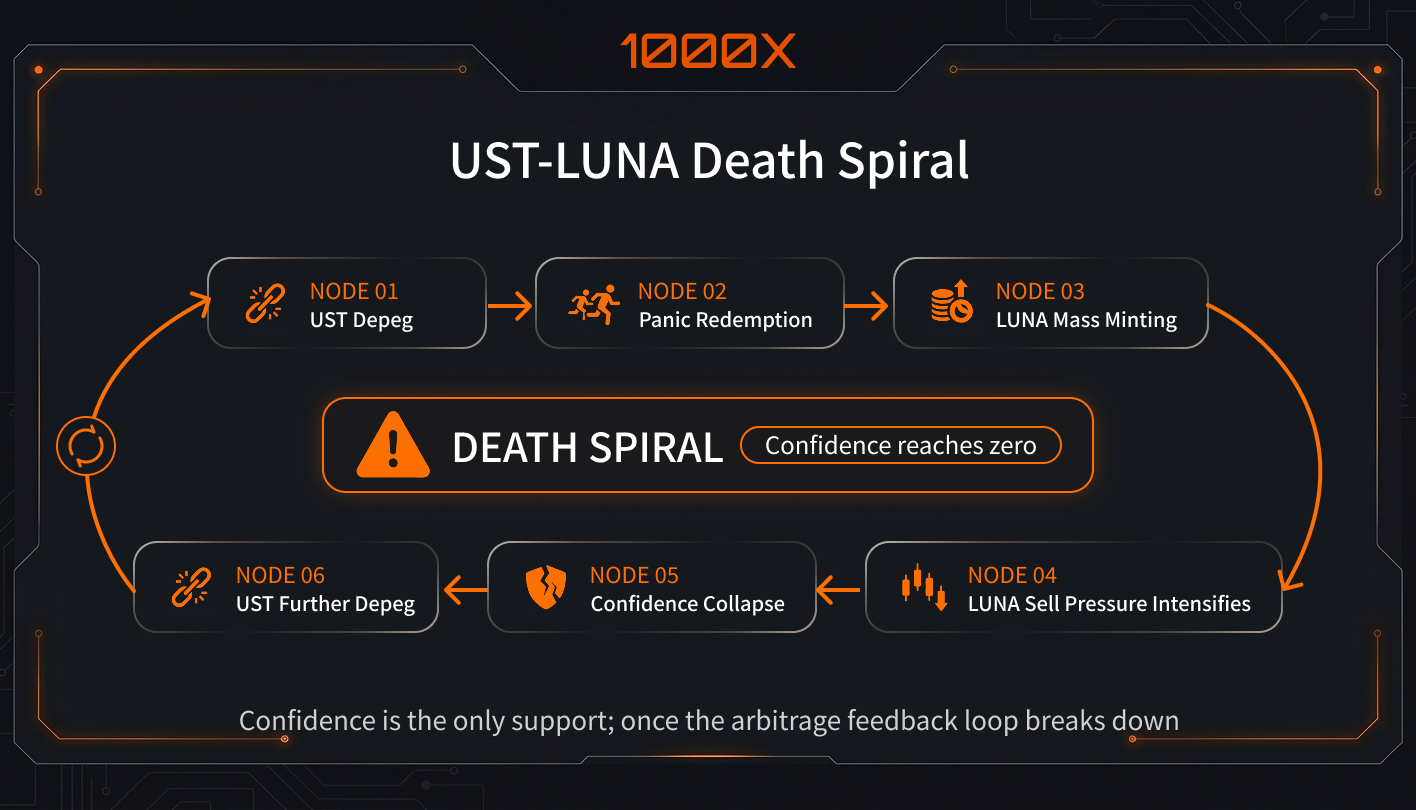
Why a De-Peg Triggers a Death Spiral
Once UST drops below $1, the problem isn't "price slightly off" — it's the whole stability mechanism starting to amplify risk instead. Now arbitrageurs would buy discounted UST and swap it through the protocol for $1 worth of LUNA, putting heavy selling pressure on LUNA. The more pressure, the more LUNA the system has to mint.
Once heavy selling pushed LUNA down, the system had to mint even more LUNA to absorb the same UST volume. That made the market lose faith faster — and the mechanism that was supposed to stabilize prices became, in panic, the engine accelerating the collapse.
What Killed LUNA Wasn't the Drop — It Was Confidence Collapsing With It
A price drop alone doesn't always kill a project. What's lethal is when the market stops believing the mechanism can absorb pressure. As Terra/LUNA's collapse unfolded, the question wasn't just where the price was going — it was: could UST holders still swap out, would LUNA absorb the redemption, did anyone outside the system still have confidence. Once this belief loosens, reactions shift from "wait and see" to "exit immediately."
As a newcomer, remember: many projects don't die from price first — they die from no one believing the redemption will happen, the catch will hold. Research has framed Terra as a textbook "run," ; when the market judged LUNA's volatility too large and Terra's algorithm unable to absorb pressure, redemption was no longer a calm "sell at fair value" — it became "get out before they don't honor it." This stability looked structured, but had no real foundation underneath.
3 Danger Signals Before the LUNA Crash
"If you were watching LUNA back then, where should you have paused?" The real lesson isn't predicting the crash in hindsight — it's noticing which signals before the event indicate the structure may not be as stable as it looks. This section pulls out the 3 most often overlooked danger signs.
When the Yield Looks Too Pretty, First Question What's Sustaining It
Whenever I see a DeFi product offering over 20% APY,…

When you see a high-yield product, the instinct is "this looks like a real opportunity"; but what you should ask first is: what's actually sustaining this yield? Take Terra's most attractive product at the time — Anchor. It offered Anchor as the prime example, around 20% yield on UST deposits. The problem isn't whether the number is high — it's that the yield didn't come from stable, real cash-generating business; it largely depended on subsidies, sustained inflows, and bullish market sentiment.
When seeing a similar project as a newcomer, I check:
- Is the yield from real
- If market heat drops, can this yield still be paid out.
- For newcomers losing money, it's that you mistake "high return" for "strong backing." The most direct lesson from the LUNA event for newcomers:
For newcomers losing money, it's that you mistake "high return" for "strong backing." The most direct lesson from the LUNA event for newcomers: when a yield looks too pretty to be normal market return, don't let the number convince you first — first check if it relies on subsidies, leverage, or sustained inflow of new capital.
If a Stablecoin Holds Its Price via Internal Mechanism, the Risk Is Usually Bigger Than You Think
When I judge whether a stablecoin is trustworthy, I o…
A lot of people, when they see "stablecoin," instinctively treat it as "probably stable"; but I separate first whether it has external reserve backing, or just maintains price through its own token and algorithm. UST belonged to the latter type — held by code rather than 1:1 cash reserves.
"Price stability" was built on the assumption that "liquidity is always there, confidence won't disappear together." Analyses of Terra at the time pointed out this design overlooked the moment of stress that markets actually face — in calm conditions you see a set of rules; in crisis, you discover the rules need someone able to keep executing them.
Many people see price hold near the peg and mistake it for "the system is still holding." For structures like LUNA, the real danger comes when the mechanism itself starts relying purely on confidence to maintain the peg — not on underlying reserves or stable demand.
Many people see price hold near the peg and mistake it for "the system is still holding." For structures like LUNA, the most dangerous moment is often not the big drop, but when the market starts to hold price solely on "someone else still willing to catch" in. Because UST's stability fundamentally depended on arbitrageurs entering and executing the mint/burn — once the path itself feels risky, that capacity drops sharply, and price holding becomes increasingly fragile.
Think of this risk as a simple judgment:
- Is the price backed by real reserves or cash flow.
- Or primarily by the market believing nothing will go wrong.
The first at least has external support during volatility; the latter, once panic hits, has confidence draining faster than liquidity. The Terra event was lethal because it sat squarely in the second category.
4 Pre-Buy Checks for Similar Projects
"If a new project today claims stability, high yield, and lots of bullish chatter, what should you check first?" The real value of the LUNA case is turning it into pre-purchase checks — not just memorizing what happened.
First Check Where the Yield Comes From — Don't Just Look at APR
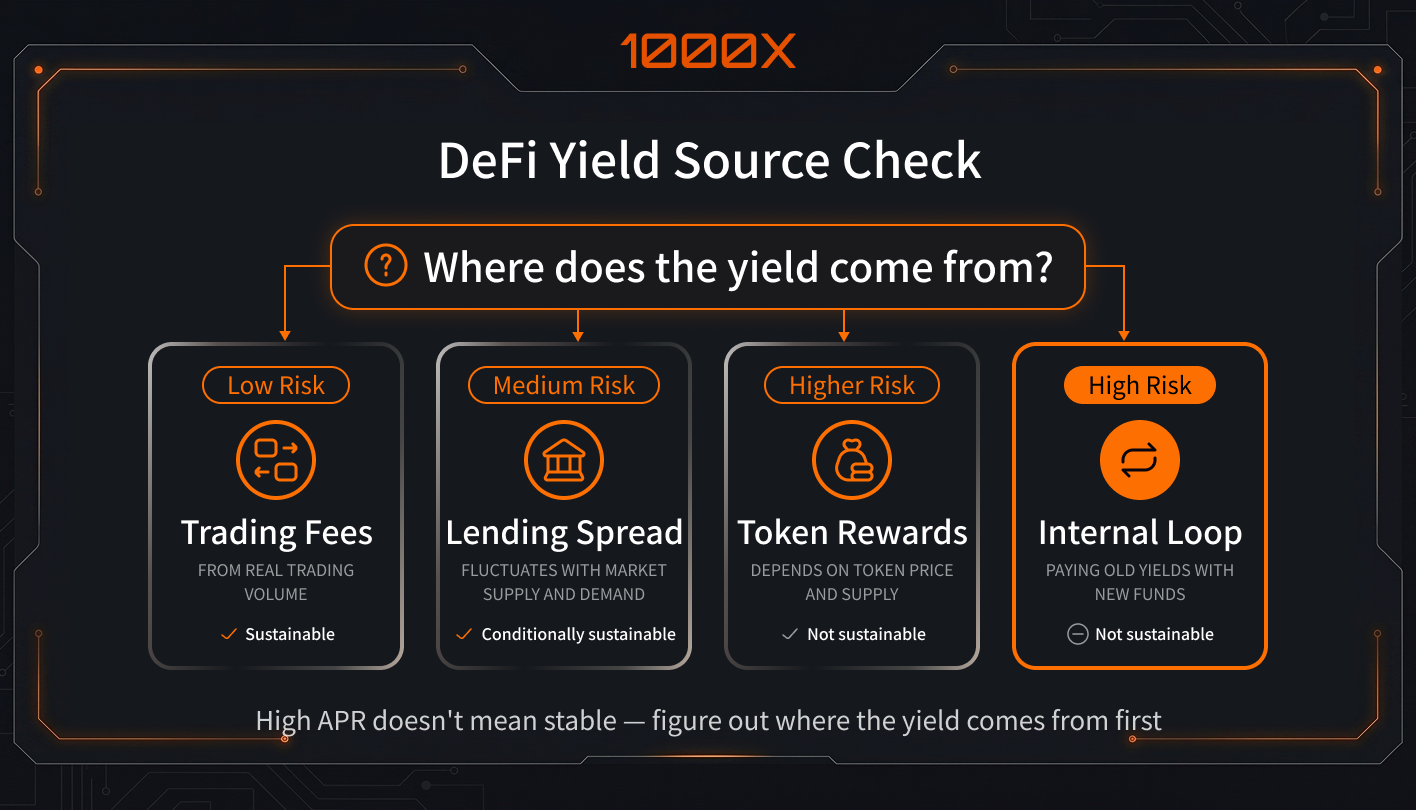
Many newcomers see high APR and feel "the return is good"; my first question: where does this yield come from? A big reason Terra's ecosystem attracted users at the time was Anchor offering around 20% yield; the catch is much of that yield relied on subsidies and sustained inflow, not on real lending demand or business revenue.
So when seeing a similar project, don't just look at APR — first check:
- Is the yield from real kept up by subsidies.
- When newcomers lose, it's mistaking "high return" for "this thing is stable." The most practical lesson from the LUNA event: when a yield looks too pretty to be normal can the yield still be paid.
- If everyone wants out at once, can the system absorb it.
When newcomers lose, it's mistaking "high return" for "this thing is stable." The most practical lesson from the LUNA event: when a yield looks too pretty to be normal
Check if Backing Assets Are Real External Assets, Not Just Internal Loops
Many newcomers get convinced by the mechanism first — "there are rules, redemption works, it can run" — and assume there's backing. What I care more about: whether there are real external assets cushioning underneath. UST's problem was exactly this — it wasn't a fiat-reserve-style stablecoin holding actual dollars or short-term Treasuries; it primarily relied on its sibling token LUNA and algorithmic mint/burn rules.
Think of it plainly: real external assets are a safety cushion, internal loops are mutual support. In good times, internal loops appear to run; the mutually-supporting structure can collapse together. The Terra event was a textbook case.
So
Finally, Check Liquidity, Redemption Mechanism, and Whether Panic Breaks Everything Together
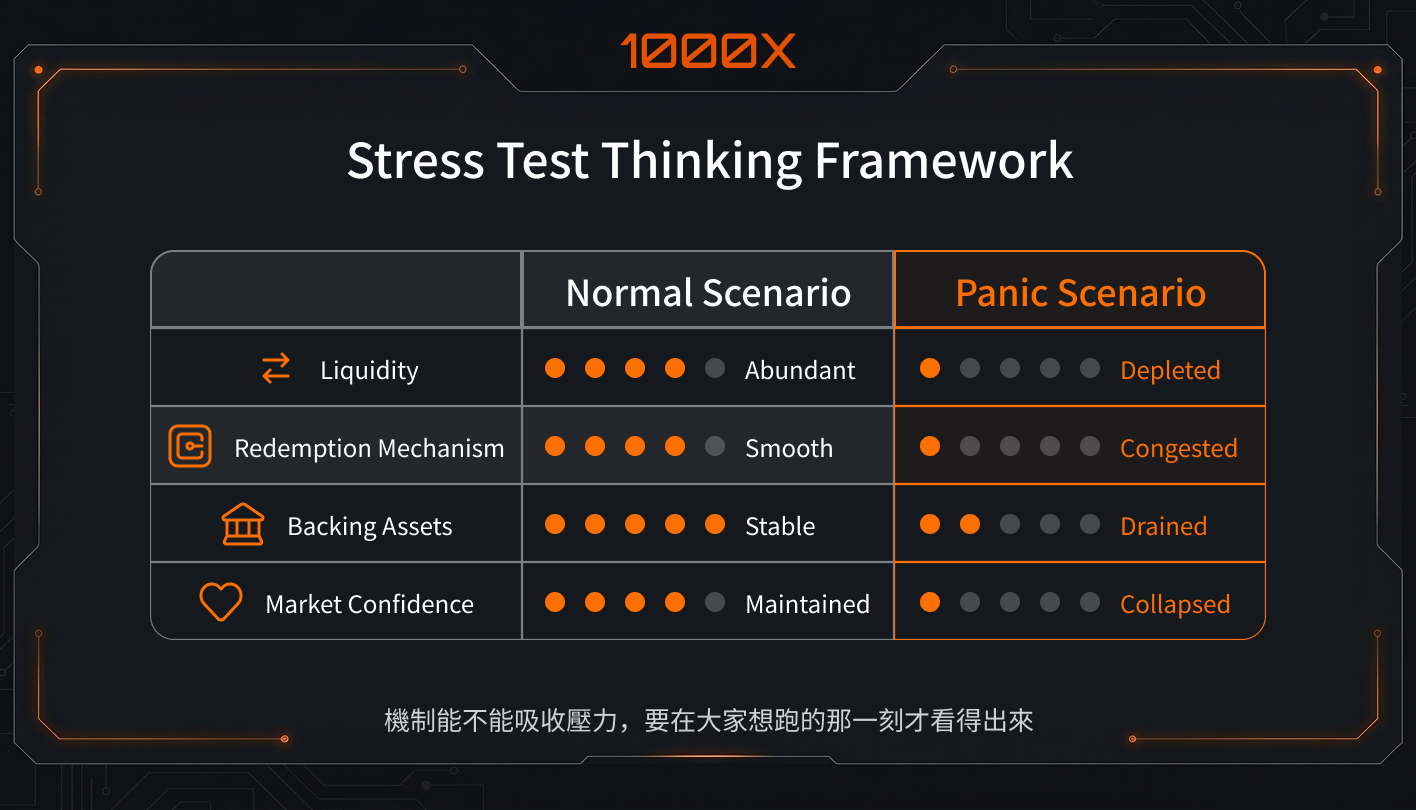
Once you've passed those two checks, add a critical last one: this thing running in normal conditions doesn't mean it runs in crisis. LUNAUST's stability mechanism depended on arbitrageurs willing to swap UST for LUNA; this kind of design works on the premise that the market trusts LUNA's market cap and liquidity enough to absorb redemption.
- Sufficient liquidity. When mass selling hits, are there enough buyers to absorb.
- Will the redemption mechanism jam. Not what the whitepaper writes — what actually executes under stress.
- Will panic make swaps worse. If every redemption creates more selling pressure, that's not recovery — that's accelerated collapse.
Terra's situation was exactly this: when UST got massively redeemed, the system kept minting LUNA, LUNA's price drop weakened absorption capacity, and finally even Terra's own protocol couldn't catch the cascade.
Soif the market all wants out at once, does this mechanism absorb pressure or amplify it? Without this check, no matter how high the yield or how complete the narrative — in calm times it looks like it works, in crisis it might compound the collapse.
When the market sees a beaten-down coin, the instinct is to check rebound, narrative, volume return
"When you ask if LUNA still this section isn't investment advice — it's helping you frame the question correctly.
Why "LUNA's Future" Can't Be Answered by Price Alone
When the market sees a beaten-down coin, the instinct is to check rebound, narrative, volume return, not backing. After Terra's collapse, the market's core question wasn't just "could it Terra's ecosystem, fundamentally, has it kept the bounce" — what sustainable use cases remain, what governance capacity, what trust can be rebuilt.
If you only watch price, you'll easily mix short-term volatility with long-term sustainability. The former may be driven by news, liquidity, or sentiment; the , and when the market discovered the mechanism couldn't hold, confidence and absorption capacity disappeared together. Discussing LUNA's future by only watching price misses the structural question entirely.
Chasing the Rebound vs. Making Long-Term Judgments — Completely Different Risk
When I see a coin crash and bounce, my first reaction…
Many conflate the two, but they're not the same logic. Chasing a rebound captures short-term sentiment, liquidity, and volatility — short-term technicals + news matter. Long-term judgment is about whether the structure has self-healing capacity, whether ecosystem use exists, whether trust can be rebuilt.
LUNA is especially worth showing newcomers: a short-term bounce doesn't mean long-term risk is gone. Terra's collapse core was Anchor's high yield, UST's algorithm, and LUNA's price reinforcing each other.
Sochasing a rebound is closer to a trading problem; long-term is closer to a structural problem. Get the former wrong, usually it's that volatility is bigger than you thought; get the latter wrong, you might be holding a structure that fundamentally can't sustain.
If You Just Want to Avoid the Trap, What to Remember from the LUNA Event
If you take away one practical lesson, mine is: don't mistake "looks like it runs" for "real backing." LUNA/UST before the event wasn't lacking mechanism or narrative — they had Anchor, the algorithm, an ecosystem, but when a system primarily relies on internal loops, arbitrage mechanism, and market confidence, in a crisis it can compound risk faster than absorbing it.
I compress LUNA into one pre-buy question: if everyone wants to exit at once, what catches this thing? If the answer is real external assets, the design at least has cushion. If the answer is more circulation and trust within its own ecosystem, the risk is much higher. Terra's official docs still describe LUNA as Terra protocol's native asset, but for newcomers , learning to check backing before yield, exit pressure before narrative, is what matters.
Conclusion
The LUNA event is so memorable not just because it crashed fast, but because it reminded everyone: many seemingly-complete, popular, persuasive projects may not have real backing — and might run smoothly only until the moment they don't. This article isn't about the past news event — it's helping you build judgment habits for when you next see a similar high-yield project, a fragile stablecoin, or a story-heavy ecosystem. More judgment, fewer traps. The article builds baseline ideas, but real progress comes from continuing to ask the right questions yourself.


