

"Do you also see a coin with very high APR and intuitively use the Rule of 72 to estimate how long until it doubles?" That's natural — but where many people trip up is mistaking a quick compounding-estimate tool for a judgment basis for high-volatility assets. Especially in crypto, short-term gains, APR/APY, bull-market returns, and actual risk often aren't the same thing. This article walks you through what the 72 Rule formula is showing, which situations you can reference it for, and organizes common newcomer misreads and checkpoints.
What the Rule of 72 Really Tells You
"Is the 72 Rule calculating doubling, or predicting investment outcomes?" Many newcomers, the moment they see this formula, treat its result as a definitive answer. But the 72 Rule is an estimation tool — not a return guarantee, and not a reason to enter. First separate what it can help you see vs. what it can't decide for you.
What Is the Rule of 72? Why Use 72 Divided by Return Rate
The Rule of 72 in one line: use 72 ÷ annual return rate, and roughly estimate how many years until capital doubles. For example, if the annual return is 8%, 72 ÷ 8=9, meaning about 9 years to double.
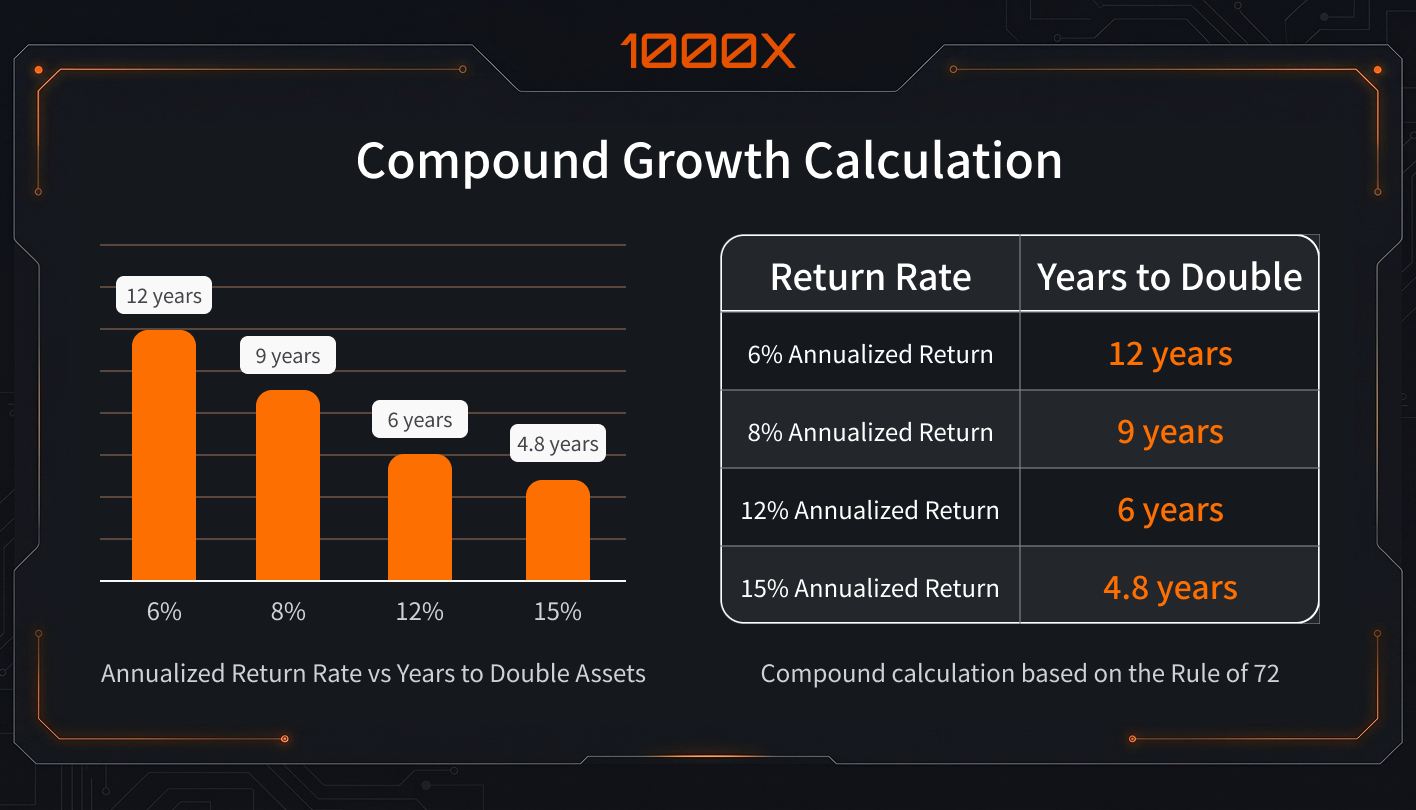
A common newcomer question: why 72? Because it's closely related to compounding math — 72 can be divided by 2, 3, 4, 6, 8, 9, 12 evenly, so mental math is easy — which is why it became a common tool in the investment world for quick judgments. But "easy" doesn't mean "accurate."
How to Read the Rule of 72 Formula — Doubling Time Is an Estimate, Not an Answer
The Rule of 72 has a key word: estimate. When you use 72 divided by annual return, the result is closer to "if the return rate stays stable long-term, capital roughly has a chance to double in this many years."
But "stable long-term" is often the hardest assumption to validate. Especially in crypto, many numbers look beautiful but may only reflect a specific market phase. If you take those moments' returns and plug them into
So I think of the Rule of 72 as a directional aid. It suits quickly building intuition — e,g., 6% vs. 12% difference has a big effect on doubling time. But it isn't for guaranteeing what will happen.
When I use the Rule of 72, I always treat it only as…

It Can See Compounding — Not Volatility, Drawdowns, or Risk
What the Rule of 72 helps you see — under a fixed return assumption — is how long compounding may take to double assets; but it can't see whether your return rate has volatility, whether you'll hit a big drawdown first, whether the return is sustainable — these things sit outside the formula.
This is especially obvious in crypto. 15% APR from a stable long-term return vs. from a high-volatility coin going through big ups and downs — the risk structure isn't the same thing. Looking only at the rate easily overestimates feasibility.
So this is the most important takeaway: don't treat the Rule of 72 as a complete tool. It can help you understand compounding speed, but can't tell you whether the path will be bumpy. Always pair it with volatility, drawdown, and risk assessment.
Using the 72 Rule Without Overestimating Returns
"When seeing a very high annual return, can you directly use the 72 Rule to calculate?" Not always. Especially in crypto, many "returns" are short-term gains or platform display numbers — not really compoundable annual returns. Get the source clear first, and your calculation has reference value.
First Separate Annual Return, Short-Term Gains, and Platform-Promoted Numbers
When seeing a return number, the first thing you should ask is: what kind of return is this? Whether "20%", "80%", or "200%" — is it long-term annualized, short-term gains, or a platform's display number for attention — these are completely different things.
Only the long-term annualized return is what the Rule of 72 wants to handle. But even with annualized, you have to first see how this number came to be — is it a long-term average, or extrapolated from short-term performance. These are key questions before plugging numbers in.
When seeing reported returns, check these things first:
- Is this a one-year average return, or short-term performance extrapolated?
- Is this number a historical result, or a platform estimate?
- Is this yield relatively stable, or will it change quickly with the market?
Once you separate these, your Rule of 72 calculation has actual reference value — instead of plugging in whatever rate you saw.
APR, APY and 72 Rule — Which Can Directly Compare
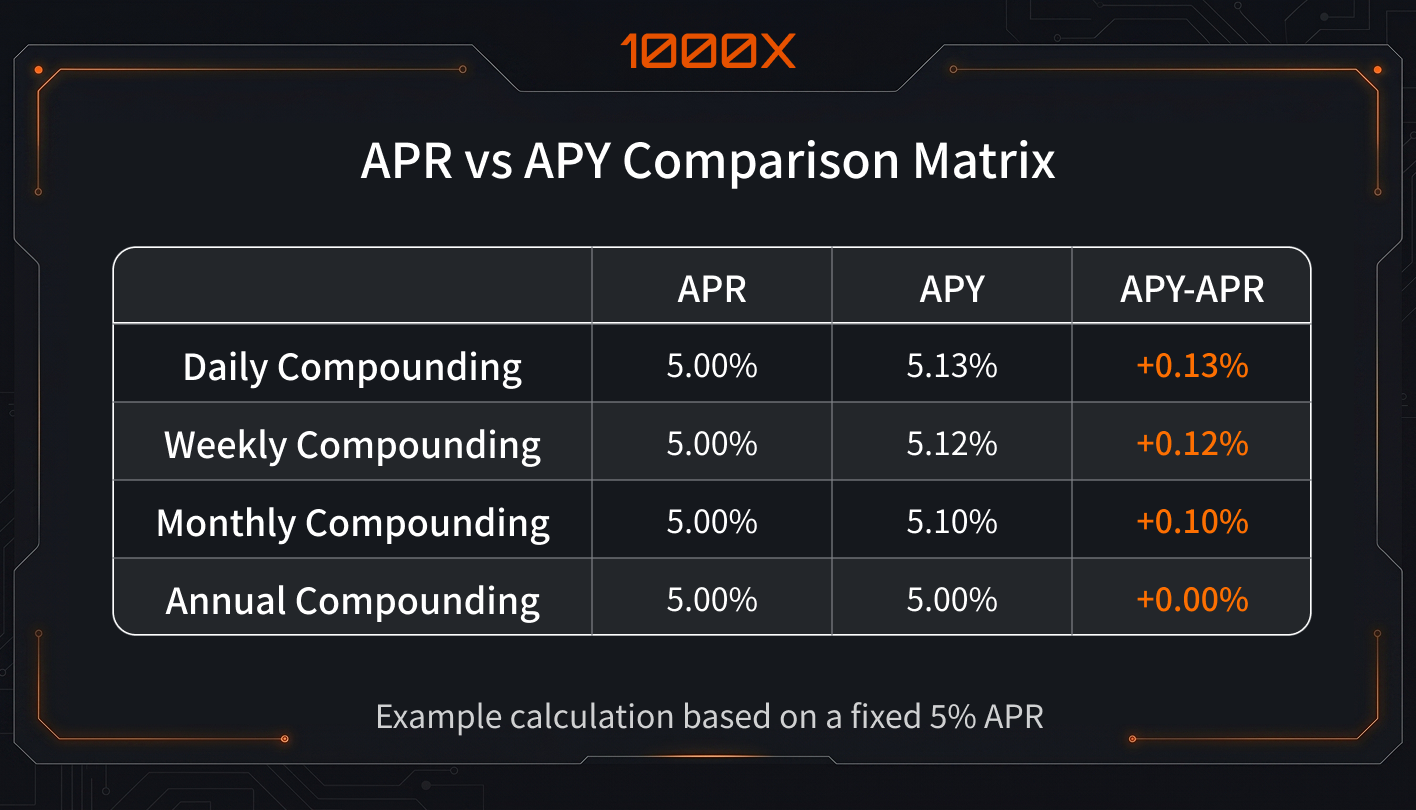
APR and APY look like return rates, but when applied to the 72 Rule, they aren't the same thing. APR is the simple annualized rate, ignoring compounding; APY includes compounding effects. And the 72 Rule itself estimates doubling time under compounding, so if you must compare, APY is usually closer to APR in matching 72 Rule's logic.
But that doesn't mean using APY directly is automatically right. Many platforms' APY doesn't actually mean you can stably get that annualized return — it can fluctuate quickly with coin price, pool size, reward mechanisms, or market hype.
My understanding:
- APR: can be used for rough estimation but know it doesn't auto-include compounding.
- APY: theoretically more suited for the 72 Rule but presumes the yield mechanism is relatively stable.
- Floating-reward type yields: even if it's labeled APY, don't plug it straight into the formula.
In other words: APR/APY is just one input; what really matters is whether the underlying yield source is stable. If the source is volatile, no matter how pretty the calculated doubling time, it doesn't mean much.
In practice, when I look at DeFi yields, the first th…
After Calculating the Doubling Time, What Else to Check
After using the 72 Rule to calculate doubling time, the work isn't done. Because the formula only tells you "if return is stable, roughly how long to double" — but what distorts results in reality usually hides outside the formula. Check several more things:
- How Long Can This Return Rate Be Maintained:A short spike in returns doesn't mean it can sustain for a year, let alone last until doubling.
- Can I Withstand the Volatility and Drawdowns:The path that doubles in 9 years may have a 30% pullback in between — can your capital hold through that, and can you hold mentally through it.
- What's the Yield Source:Is it long-term holding's historical performance, fixed-mechanism yield, or numbers from platform campaigns, token rewards, or bull-market runs? Different sources have different sustainability.
- Is Risk and Liquidity Ignored:If the asset is illiquid or has wide spreads when entering and exiting, the calculated doubling time can look pretty — but actual experience can be very different.
The Rule of 72 is just an estimation tool — it's not the conclusion. What you should care about isn't just "doubles in how many years," but whether this path is walkable.
When the Rule of 72 Doesn't Apply
"Why, for the same return rate, are some scenarios in crypto especially bad for plugging into the 72 Rule?" Because the formula presumes "stable return," but actual market dynamics often break this premise. Especially high-volatility coins, bull-market trends, leveraged products, or staking yields, have return-stability issues that don't match the formula's assumptions.
Treating Bull-Market Gains as Long-Term Average Most Easily Distorts Doubling Time
72 Rule's most common misuse: treating one segment of a bull-market gain as long-term average. For example, a coin gains 3 months 60% in a market run, some people directly extrapolate that to an annualized number and even plug it into the 72 Rule, feeling doubling looks fast. But this kind of estimate is built on a quickly broken premise.
This kind of misjudgment makes doubling time look unusually optimistic. For crypto, this issue is especially obvious — prices are volatile, cycles switch fast — a beautiful gain segment doesn't mean the return structure is stable.
High-Volatility Coins, Meme Coins, and Small Caps — Why They're Less Suited for Forced Plugging
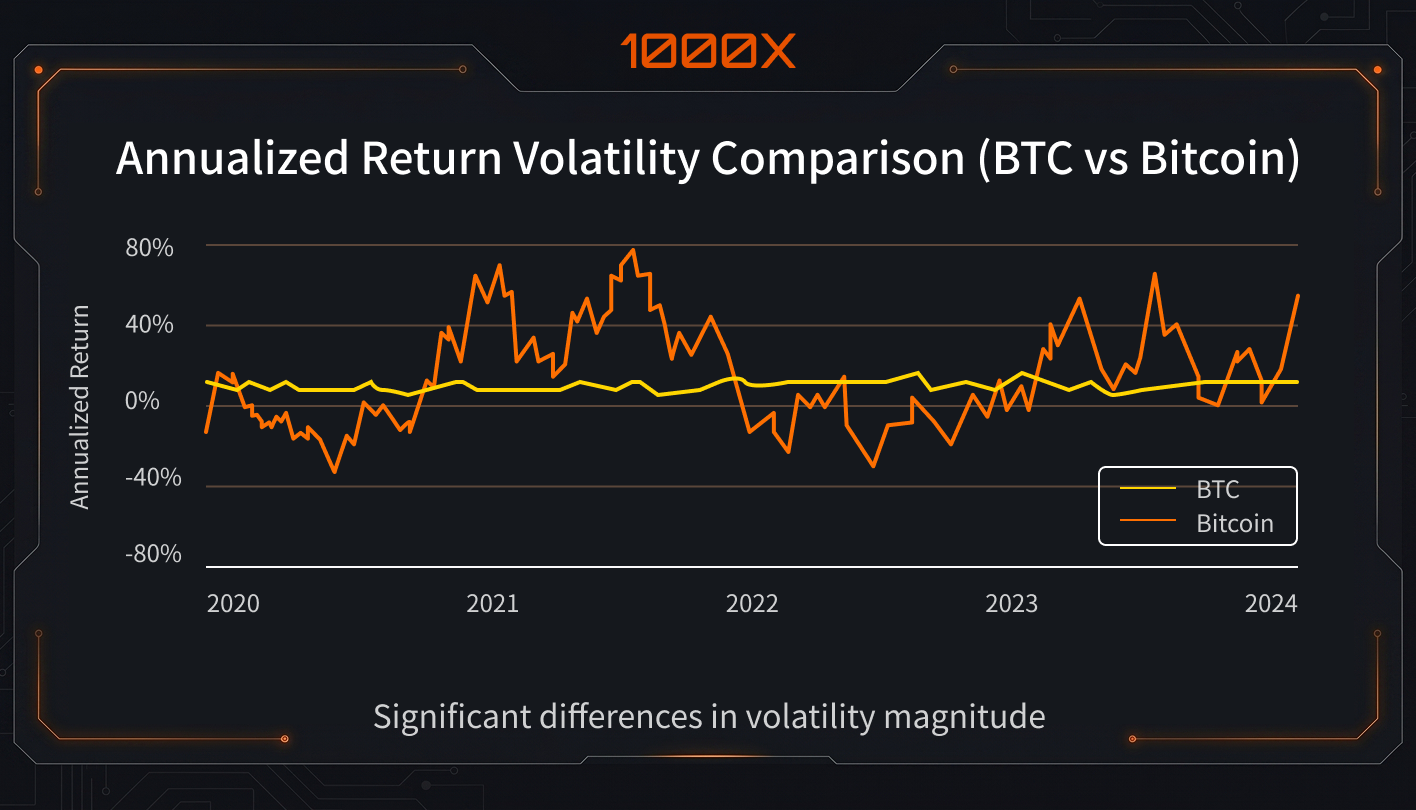
High-volatility coins, meme coins, and small caps are categories where the Rule of 72 is most prone to distortion. 72 Rule's underlying assumption is "return can roughly sustain," but these types of coins inherently have high volatility — sustainability is the issue.
Especially meme coins and small caps, where prices are often driven by community sentiment, theme hype, single-news events, or whale capital. The gains you see are often more like brief sprints — not stable compounding paths. Using the 72 Rule here easily creates false expectations.
Special reminder here:
- Big volatility doesn't mean high compounding efficiency.
- Rising fast doesn't mean it can sustain.
- Small caps with poor liquidity and deep drawdowns — risk often deserves attention before return.
What you should ask first isn't "how many years to double" — it's "can I withstand the path."
I've seen too many people plug a memecoin's 300% week…
Leverage, Futures, and Staking Yields — Don't Just Look at Surface Returns
Leverage, futures, and staking yields can all show very high returns on the surface, but these 3 are the most easily misread by newcomers, especially when the underlying risk mechanism is very different — you can't just take one percentage and plug it into the 72 Rule.
Leverage and futures first. The high return you see isn't inherent return — it's the result of amplified position size, with corresponding amplified loss and liquidation risk. Under these conditions, the 72 Rule has almost no reference value, because you may not even reach the compounding effect — the position could get washed out by the market first.
Then staking yields. These look like fixed-yield products on the surface, but real returns also depend on the underlying asset's price changes. Because even with high staking APY, if the coin price drops a lot, actual asset performance
The 3 Most Common Newcomer Mistakes
"The formula isn't hard — so why do so many people make wrong judgments because of the 72 Rule?"
For newcomers, looking at returns is a habit, but turning the Rule of 72 from a quick-estimate tool into a decision tool is risky. This section organizes the 3 most common misuses, so you avoid making mistakes when applying it.
Treating Doubling Time as a Reason to Enter Rather Than an Estimation Tool
A common newcomer mistake: seeing the doubling time calculation come out and feeling that since the time isn't too long, buying now seems reasonable. But the Rule of 72 doesn't tell you anything about the right entry timing — it only does math.
Entering isn't just about return rate — it also includes where you're buying, how big the volatility is, whether your capital can withstand drawdowns, and whether the return assumption is stable. These dimensions all sit outside the formula. Without thinking through them, the doubling time is just a comforting calculation.
A more practical approach: when you see a return that looks attractive, after running the formula, ask: is this return rate reasonably grounded? Can I withstand this asset's risk? If it first drops a big chunk in between, can I hold it? These questions matter more than the doubling number.
Only Looking at Returns, Ignoring Whether You Can Withstand Volatility
Some people see high returns and think "higher rate, faster doubling," ignoring that the path to that doubling can have significant volatility. Return rate is one number; volatility tolerance is another.
Same 15% APR — placed on different assets, the experience can be completely different. Some assets walk steadily, others might first drop 30% to 50%, then slowly rebound. Looking only at return — without thinking about drawdown — easily makes doubling look easier than it is, but the actual experience can be very painful.
For some people, paper returns look like the doubling line — but real drawdowns might mean you can't stay until that day. Returns and tolerable risk are two things, and the Rule of 72 only handles the former.
Seeing High APR/APY and Assuming Compound Yield Will Definitely Persist
When seeing high APR/APY, a lot of people instantly plug them into the 72 Rule, feeling that if this yield can sustain, doubling time looks tempting. But APR/APY in crypto is often floating — they can vary with the underlying mechanism. You can't take the moment's number as a stable rate to plug in for years.
Especially in crypto, many APR/APY are inherently floating. They can vary with pool size, token price, participant count, platform subsidies, reward policies. Seeing 30% today doesn't mean 30% next month; seeing 80% doesn't mean a year later you can still accumulate at that rate. Using the 72 Rule here easily overestimates feasibility.
So when looking at APR/APY, you can't only look at the moment's number — also look at the mechanism: where does this yield come from, will it adjust, what conditions affect it. These all directly affect whether the 72 Rule estimate is meaningful. Without thinking through the source, doubling time is just a comforting number.
Conclusion
What this article wants to convey isn't just how the 72 Rule is calculated — it's, in a high-volatility market like crypto, which numbers you can look at and which formulas can't be forced. Most newcomers don't lose because the formula is hard — they lose because they put a quick estimate tool into the wrong situation, getting more confident the more they look, while their direction drifts. If you want learning to not just stop at "understanding" but slowly become real judgment ability that avoids pitfalls — you're welcome to join us, and walk this path more steadily together.


