

Have you seen headlines like “CLARITY Act is finally about to pass, and trillions in capital are getting ready to pour in” and felt the urge to jump in first?This article won't dress up the bill's progress as a sure-win signal. Instead, it walks you through exactly where the Senate vote count, the House hearing, and the stablecoin yield provision each stand, then tells you how far “trillions flooding in overnight” really is from the facts, and whether it's actually worth adjusting your position over.
What Are the Three Sticking Points Holding Up the CLARITY Act Right Now?
“Didn't the bill already pass the House? Why hasn't the Senate voted yet?”The House and the Senate follow different legislative logic. Clearing one chamber is just the entry ticket — what's really holding things up is the Senate's internal vote math and three unresolved, disputed provisions.Once you understand where these three knots are stuck, you'll be able to read what every headline over the next three weeks actually means.
The House Has Passed It — Where Is the Senate Stuck?
The House version of the digital asset market structure bill — known as the CLARITY Act — already passed a vote last year. The ball is now in the Senate's court, and the Senate runs on an entirely different set of hurdles.On May 14 this year, the Senate Banking Committee voted 15-9 to send the draft out of committee and onto the floor for a full vote. That's a major step, but it's still a clear distance away from passing the full chamber.
Republicans, the Senate majority party, hold 53 seats. But to pass the bill and avoid getting stuck in a filibuster, they need to reach the 60-vote threshold — meaning they need to pull in at least 7 or more Democratic senators.Right now, only 2 have publicly signaled support. The bill's current status is best described as “out of committee, but whether it can clear the full chamber is still unknown.”
Three Unresolved Disputes: The Ethics Provisions, Section 604 Developer Protections, and Section 404 Stablecoin Yield
What's holding up the vote count isn't abstract partisan positioning — it's three concrete provisions in dispute.The first is the ethics provisions: an amendment from Senator Van Hollen that would impose enforceable limits on government officials' crypto holdings was voted down in committee 11-13, and the White House has explicitly opposed any provision targeting the president's own crypto income. There's no consensus here yet.
The second is Section 604 developer protections, which covers whether non-custodial software developers can be exempted from money-transmission licensing and anti-money-laundering reporting obligations. Supporters say it protects engineers who never touch customer assets, while opponents — including prosecutors' associations and other law enforcement groups — worry it will make it harder to trace counterparties in criminal investigations.The third is the stablecoin yield provision in Section 404, which has the biggest commercial stakes of all — we'll break that down for you later.
Why the August 7 Recess Deadline Is Being Called the Last Real Chance
The Senate's original internal target was to lock down a version around July 4, but that fell through — the new target has slipped to before the August 7 summer recess.Analysts broadly agree this date is a rare window in the rest of 2026's session calendar that satisfies both conditions at once: the Senate actually has bandwidth, and pre-election political risk hasn't yet peaked.
If they miss August 7, the bill will either have to compete for time against other priority legislation in the fall session, or get swept into the political calendar of a midterm election year — at which point both parties will be even more reluctant to take a public stance, and the odds of passage will only keep dropping.That's also why, even though the July 4 target came and went, the market and lobbying groups are still treating August 7 as a hard deadline — not as a soft target that can be pushed back indefinitely.
Now That the Senate Is Back in Session as of July 13, Are the Votes and the Time Actually There?
“Now that they're back in session, doesn't that mean a vote is coming soon?”Time and vote count are two separate things — reconvening only answers the question of “is the Senate in session,” not “can the bill get onto the agenda” or “can they scrape together the votes.”After the Senate ended its recess and returned to Washington on July 13, the window left for this bill is tighter than most people assume. Let's break it into two pieces: scheduling and vote count.
Less Than Three Weeks Since Reconvening — What's Already on the Schedule?
Between the Senate reconvening and the August 7 recess, once you strip out weekends and routine procedural business, there are actually fewer than three working weeks available for legislating. During this window, the CLARITY Act is not the only priority — the defense authorization bill, a number of nomination confirmations, and other bills that both parties are under pressure to resolve before the recess are all competing for the same slice of agenda time.
The result of this scheduling crunch is that even if party leadership wants to bring the bill to a vote, they still have to coordinate around the other priority bills' timelines — and if debate on any one of them runs long, it could push this bill back further.For retail investors, what's worth watching over the next few weeks is whether leadership formally places the bill on the floor calendar — the fine print of the bill itself is, for now, secondary.
Counting the Votes: Republicans Hold 53 Seats, But Hawley and Paul May Vote No
Republicans hold 53 seats in the Senate — in theory, party unity alone gets them close to a majority, but breaking a filibuster and forcing a floor vote requires 60 votes. That means Republicans can't afford many defections, and they still need to pull votes from across the aisle. Right now, the biggest wildcards are Republican senators Hawley and Paul, who are widely thought to potentially vote no — not for reasons of party affiliation, but because they have genuine substantive concerns about the provisions themselves.
This means that even the optimistic assumption of all 53 Republican votes holding is unreliable — the number the party can actually count on solidly might land somewhere just above 50, leaving a bigger gap to the 60-vote threshold than a simple seat count would suggest.When I read analysts discussing the vote count, they rarely say “Republicans' 53 seats have this locked up” — they usually emphasize that the key variable is whether the other side is willing to cooperate.
Only 2 Democratic Senators Have Signaled Support — How Many Votes Short Are They?
At the committee vote stage, only 2 Democratic senators were willing to side with Republicans. That number doesn't mean simple arithmetic like “we already have 2, only 5 more to go” — committee votes and full-chamber votes run on two different sets of political calculations. Letting a bill move forward at the committee stage and actually supporting its provisions on the full floor are two different things.
Even treating these 2 votes as a stable base, there's still a clear gap to cross the 60-vote threshold — and that's before subtracting the potential defections from Hawley and Paul on the Republican side.The bill's current vote status is best summed up as “there's progress, but it's nowhere near locked in.” Any claim that the bill has “already secured passage” is skipping over this unresolved gap — and that's exactly the point you should stay level-headed about when you see a headline running hot.
What Is the House's July 17 New York Hearing Actually About, and Does It Have Anything to Do With the Bill Passing?
When you see headlines about “the House holding a hearing on July 17,” a lot of people instinctively think “does that mean there's another vote coming?” But a hearing and a vote are two completely different things.The House version of the bill already passed long ago. This hearing is being held at a sensitive moment while the Senate is stuck — its purpose and significance are worth unpacking separately, so you don't mistake it for actual progress.
Why Was New York Chosen for a Hearing Themed “Building the Future of Finance”?
The House Financial Services Committee left Washington this time to hold a field hearing in New York themed “Building the Future of Finance.” Choosing New York wasn't random.New York is the physical heart of the finance industry. Holding the hearing there effectively takes the narrative of “bridging crypto and traditional finance” straight to Wall Street, in front of the industry and the media — the symbolic significance here far outweighs any procedural significance.
This kind of field hearing isn't a required step in the legislative process — the House version of the bill already passed its vote long ago, so in theory there's no procedural need for another hearing.The committee choosing to hold an extra session at this particular time and place looks much more like an attempt to reinforce the narrative that “the finance industry supports this framework,” generating buzz for a bill that's stuck in the Senate — it has little to do with any pre-vote procedural requirement.
This Isn't a Vote — Is It Momentum-Building or Pressure Tactics?
A field hearing doesn't produce any voting outcome — witness testimony and the soundbites the media quotes don't convert directly into a single Senate vote.This hearing is a communications event. Its purpose is to let the finance industry, the media, and the public see that “even New York's financial circles support this framework,” and to use that to apply public-opinion pressure on senators who are still on the fence — especially wavering Democrats.
This kind of maneuver is common in Congress, especially when a bill is stuck in the other chamber and your own chamber has nothing left to do on it — holding a hearing to build momentum is one of the few ways left to keep an issue in the news.I'd read this as a carefully staged PR event, not an actual step forward in the legislative process — that way, when you see the headline, you won't mistake “a hearing happened” for “the bill is about to pass.”
What Real Effect Does This Have on Reconciling the Senate's Version?
No matter how successful this hearing turns out to be, it has almost no direct influence on the Senate's internal vote math. The House and the Senate are independent political bodies — the content of a House committee hearing doesn't automatically become part of Senate debate. Before the two chambers' versions can be reconciled into a single bill, the Senate has to pass its own version first; only then does the reconciliation process begin.
The more realistic effect is that this hearing may raise media attention on the issue, indirectly making the Senate feel that “people are watching.” But that kind of pressure is soft political atmosphere — it's not a hard metric that converts directly into a specific number of votes.When you see this kind of news, the more practical stance is to treat it as just one data point to watch — don't rush to translate “a hearing happened” straight into “the bill is about to pass.”
What's the Fight Over Stablecoin Yield (Section 404) Really About? JPMorgan's and Coinbase's Business Calculus
Of the three disputed provisions, the one with the most direct commercial stakes is the stablecoin yield rule in Section 404.This provision determines whether the stablecoin you hold can earn interest the way a bank deposit does, and it touches the real, dollars-and-cents business models of both the banking and crypto industries. Understanding what this fight is really about is what lets you understand why traditional banks and the crypto industry have ended up on completely opposite sides this time.
What Section 404 Actually Says: No Interest for Simply Holding, But Activity Rewards Are Allowed
Section 404's core rule bans service providers from paying interest or yield directly just because a user “holds” a given stablecoin — that path is now blocked.But the provision leaves another space open: providers can still reward users for their “activity,” including behaviors tied to engaging with the ecosystem — trading, payments, transfers, platform usage, loyalty programs, liquidity provision, staking collateral, governance, and the like.
In other words, the line the bill draws isn't “stablecoins can never earn yield at all” — it's “you don't get paid just for sitting on it, but if you're willing to use it and engage with the ecosystem, you can earn rewards.”This design might look like a mere wording distinction, but it actually determines the shape of the entire stablecoin yield market going forward.
Why Dimon Says Banks Will Never Accept It
If stablecoins could earn yield comparable to bank deposit rates just from being held, that would be a structural threat to traditional banks, because the core banking business model runs on taking deposits and lending them out at a spread.Once customers' idle funds start moving en masse into stablecoins offering more attractive yield, the pool of funds banks can lend out gets diluted, which in turn affects the whole credit-creation chain.
JPMorgan CEO Dimon has publicly stated multiple times that the banking industry will never accept a version where stablecoins can earn yield unconditionally — and behind that stance is the mobilization of the entire bank lobbying apparatus.Section 404 ultimately landing on the compromise version — “activity rewards allowed, unconditional holding-yield blocked” — is, in a sense, exactly the mark that bank lobbying power left on the text of the provision. That's also why the banking industry's acceptance of this current version has clearly improved.
Why Coinbase and Circle Are Backing This Version
On the crypto industry's side, Coinbase and stablecoin issuer Circle have instead come out in support of the current version of Section 404 — which looks counterintuitive at first glance, since the provision restricts the space for direct yield. But look closely at the text and you'll find the “activity rewards” carve-out is left wide enough that things like trading fee rebates, liquidity rewards, and loyalty programs can all be packaged into incentives that come close to a yield effect, without crossing the actual line.
For Coinbase and Circle, rather than colliding head-on with the banks, it makes more sense to accept a compromise version that still leaves room to operate — get the bill passed first to lock in a clear regulatory framework and legal certainty, then use product design to squeeze commercial value out of activity rewards. It's the classic “get it done first, optimize later” calculation.
What Are Institutions Actually Doing Right Now? A Look at the Real Timeline Through Tokenized Money Market Funds
“The bill hasn't passed yet, so are institutions all still sitting on the sidelines?” The actual situation doesn't quite match that intuition. In the tokenized money market fund space, institutions have long since gotten to work, and the scale has grown bigger every year.Looking at the progress of a few flagship funds, you can see that institutions' timeline isn't entirely tied to the bill's progress.
Where Do BlackRock's BUIDL, JPMorgan's JLTXX, and Franklin's BENJI Stand?
BlackRock's BUIDL fund has already expanded to 8 public blockchains, with assets nearing $3 billion; JPMorgan launched MONY late last year and rolled out JLTXX this past May; Franklin Templeton's BENJI fund was one of the earliest entrants, launching on Stellar in 2021 and now expanded to Ethereum, Polygon, and Solana, with assets that have crossed $1 billion.
What these funds have in common is that they were launched as legal products under the current regulatory framework — they didn't wait for the bill to pass before starting operations.Institutions have spent the last few years expanding scale and chain coverage. What's held them back was never “whether it's allowed” — the key question is “how big can it scale, and can it be more broadly recognized as a qualifying asset.”
What Is the 300-Plus-Party Collaborative Test by GDF and ISDA Actually Testing?
Global Digital Finance (GDF) and the International Swaps and Derivatives Association (ISDA) are leading a collaborative test involving over 300 institutions. What it's actually testing is interoperability across different platforms and chains, and whether tokenized assets can be reliably used as collateral flowing between institutions — it has nothing directly to do with “whether the fund can make money”.
Over 60% of institutions surveyed plan to launch a tokenized money market fund by the end of 2027, and nearly 45% expect it to be usable as qualifying collateral.These numbers show that what institutions are actually busy with is wiring up the underlying infrastructure, so tokenized assets can flow smoothly through existing clearing, collateral, and settlement processes — which is far more pragmatic than “waiting for passage to cash in big.”
Are Institutions Building Positions in Stages, or Waiting to Go All-In Once the Bill Passes?
Put the previous two points together, and it's clear institutions' current moves are staged positioning, not holding their breath waiting for the exact moment the bill passes before going all-in.Pilots, scale-ups, and interoperability tests that are possible under the current regulatory framework — institutions have long since been doing them, and the scale has grown year after year. That tells you institutions' risk-reward logic doesn't put all its chips on a single piece of legislation.
The CLARITY Act can solve one thing for institutions: the certainty question of “can tokenized assets be clearly recognized as qualifying assets.” “Whether it's possible to start” stopped being institutions' starting-point question a long time ago.News headlines often translate “institutions are testing” into “institutions have already gone all-in”, but the actual pace of positioning is far more cautious and drawn-out than this kind of all-at-once narrative suggests.
What's Wrong With the Claim That “Trillions Will Flood In Overnight”?
Every time the CLARITY Act has new progress, there's always a headline saying “trillions in capital are about to flood in” — a number that sounds weighty, but if you dig into it, you'll find these figures often aren't even measuring the same thing, and reading them as one lump number makes it very easy to form the wrong expectations about what will actually happen once the bill passes.
The Trillion-Dollar Figures in the Headlines Are Actually Calculated by Different Institutions Under Different Scenarios
The several trillion-dollar figures circulating in the market come from different sources entirely.Galaxy Digital projects roughly $1 trillion in institutional capital inflows — an optimistic-scenario estimate. The banking industry's estimate of deposit-outflow risk falls between $65 billion and $1 trillion — a worst-case worry scenario. The Treasury's assessment of $6.6 trillion in deposits at risk is a much broader stress-test baseline figure, not a statement that “this money will flow into crypto”.
These three figures differ in time horizon and scenario assumptions. When the media splices them together into a single headline like “trillions are about to flood in,” they've already stripped away the original conditions those numbers were based on.When you see this kind of reporting, it's worth building the habit of tracing the number back to its original source — who calculated it, and under what scenario.
Even If It Passes, How Would the Money Actually Be Released Over Time?
Stepping back — even if the bill really does pass smoothly before August 7, the money won't come flooding into the market all at once on the day it's signed.After the bill passes, regulators still need to write the implementing rules, the House and Senate versions still need to go through reconciliation, and the president still needs to sign it into law. Regulators would then also need to publish implementation guidance and transition-period arrangements before institutions gradually adjust their allocations according to the new rules.
Looking at how similar financial legislation has played out in the past, this kind of capital reallocation typically happens in batches over quarters or even years — it's rare for money to show up on the day a law passes.When institutions rebalance large asset allocations, they naturally factor in liquidity impact, internal risk-control processes, and board decision-making timelines. These real-world constraints create a clear gap between the fantasy of “passage equals instant money” and what actually happens.
Where's the Risk for Retail Investors Chasing the Rally?
For retail investors, the most common mistake when seeing a headline like “trillions are about to flood in” is treating it as a signal to chase the price right now — a lot of these projections are really talking points that institutions and lobbying groups use to build momentum, not facts that have already happened or are certain to happen.When I see this kind of news myself, my first instinct is usually to check the source. If you're entering after the news just broke and the price has already had one round to react, what you're usually picking up is expectations that everyone else has already priced in.
The more practical approach is to treat this kind of news as an indicator to track — keep following the vote count and any timeline changes, and don't impulsively adjust your position just because you saw a big number.Crypto markets usually react to policy news very quickly. By the time you see the headline, the market price has very likely already priced in the optimistic scenario. Chasing the price at that point exposes you to more downside risk than you probably expect.
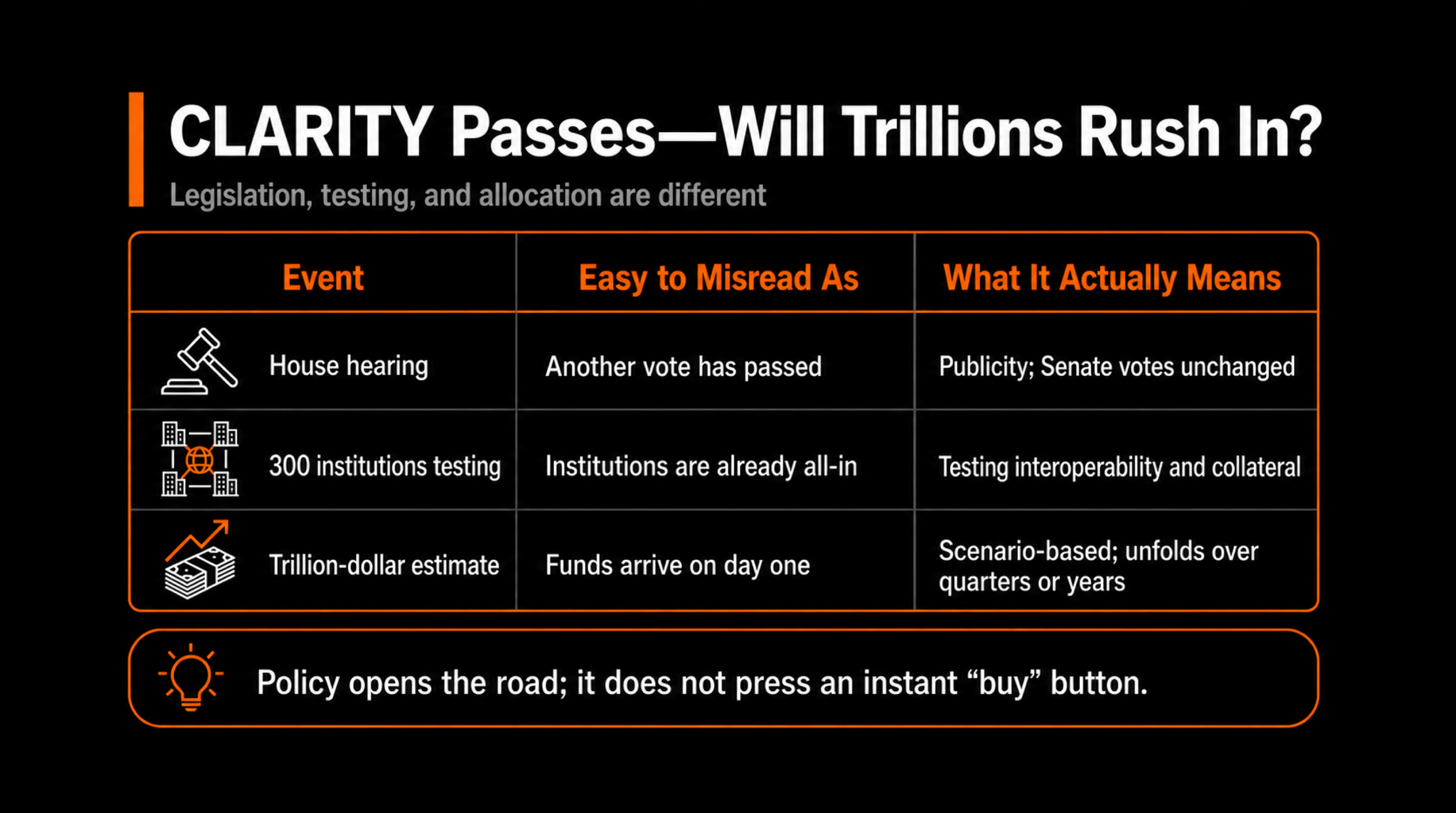
What Are the Biggest Judgment Traps for Taiwan Retail Investors Following This News?
The biggest risk with international policy news isn't having too little information — it's mixing up events of a different nature and misreading the actual progress.Looking back over the six sections above, here are the three most common judgment traps for Taiwan retail investors following this story, so the next time a related headline shows up, you can grasp what matters faster instead of getting pulled along by it.
Mistaking a Hearing for a Vote, and Misreading the Progress
The most common misreading is seeing “House hearing on July 17” and instinctively assuming “the bill just took another big step forward.”But this hearing is a field session held by the House Financial Services Committee, and the House version of the bill already passed its vote long ago — this hearing won't produce any new vote outcome, and it won't directly change the Senate's vote math either.
If you rush to adjust your position every time you see news like this, you're essentially mistaking a PR momentum-building event for real legislative progress.The safer approach is to clearly separate that “a hearing” and “a vote” are events at completely different levels — only when the Senate actually schedules a full-chamber vote does the progress actually change substantively. A hearing is, at most, an early warning signal.
Mistaking Institutional Testing for Institutions Already Going All-In
The second easy trap is seeing “over 300 institutions participating in a tokenized-fund collaborative test” and assuming institutions have already made a massive commitment of capital.But the core of this kind of test is technical validation of interoperability and collateral usability — what's being tested is whether the infrastructure can hold up. It's not the case that once the test is done, large sums of money get poured in — there are still several more gates to pass through in between, like regulatory clarity and product launches.
Institutions' current pace is staged, gradual scaling — completely different from the script retail investors imagine, where “news breaks and money shows up instantly.”Treating test-related news as a signal for a major capital commitment can lead you to overestimate how much actual capital inflow will show up in the short term, which in turn leads to position decisions disconnected from the fundamentals — and that gap is often bigger than you'd expect.
Treating the Possibility of the Bill Passing as a Reason to Buy, Directly and Immediately
The third trap — and probably the one most likely to actually cost you money — is translating “there's a chance the bill passes before August 7” directly into “you should buy right now.”The details of the bill's text, its effective timeline, and the follow-on administrative rulemaking all still have variables at every stage. Even if the bill passes smoothly, the money would still be released gradually over years, not as a one-shot market move.
Treating policy progress as your only reason to buy is essentially handing the decision-making power over your position management to a legislative process you can't control and can't accurately predict the timing of. I'd personally suggest treating CLARITY Act progress as background information for long-term monitoring — your entry and exit decisions should still come back to your own risk tolerance and position-sizing discipline. Don't let a single headline push you around.
Conclusion
The CLARITY Act's tug-of-war ultimately comes down to three knots that still haven't been untied.The Senate reconvening created an opportunity, but the vote gap and the agenda timeline haven't substantively changed; the House's New York hearing is momentum-building, not a vote; and institutions' positioning is running on its own timeline. As for “trillions flooding in overnight” — that's nothing more than a story stitched together from several estimates with different assumptions.Over the next three weeks, what's worth watching is whether the Senate gets the bill onto the floor for a vote, and whether the vote gap gets closed.


