

If you're holding ETH and you see Vitalik saying the core of Ethereum is going to be “rewritten” over the next 3 to 4 years, doesn't your heart skip a beat, wondering whether you should hedge by moving to another chain early?This article won't dress up Lean Ethereum as some magical transformation story. It first breaks down exactly which foundational components this rebuild touches and how it differs from Glamsterdam, and then tells you what to watch right now and what not to panic about.
What Exactly Is Lean Ethereum? How Is It Different From Ethereum's Past Major Upgrades?
Every time Ethereum has a major development, the first thought that pops into a newcomer's head is usually “should I move my coins somewhere else?”Let's put the answer up front: Lean Ethereum is not a chain migration, and it's not something happening tomorrow — it's a 3-to-4-year protocol rebuild blueprint.To understand how unusual this is, you first need to look at Ethereum's two past structural transformations, then compare how this one differs in scale. When I first saw this announcement myself, that was the first thing I checked too.
Ethereum's Three Major Iterations: From Proof of Work to Proof of Stake to Lean Ethereum
Since Ethereum launched in 2015, there have only really been two transformations that deserve to be called “structural.” The first was the Merge in 2022, which swapped the consensus mechanism from proof of work to proof of stake — miners exited, validators took over, energy consumption dropped by over 90%, and users barely noticed a thing.The second was the subsequent data availability upgrades, which kept pushing transaction data-processing capacity outward, paving the way for Layer2.
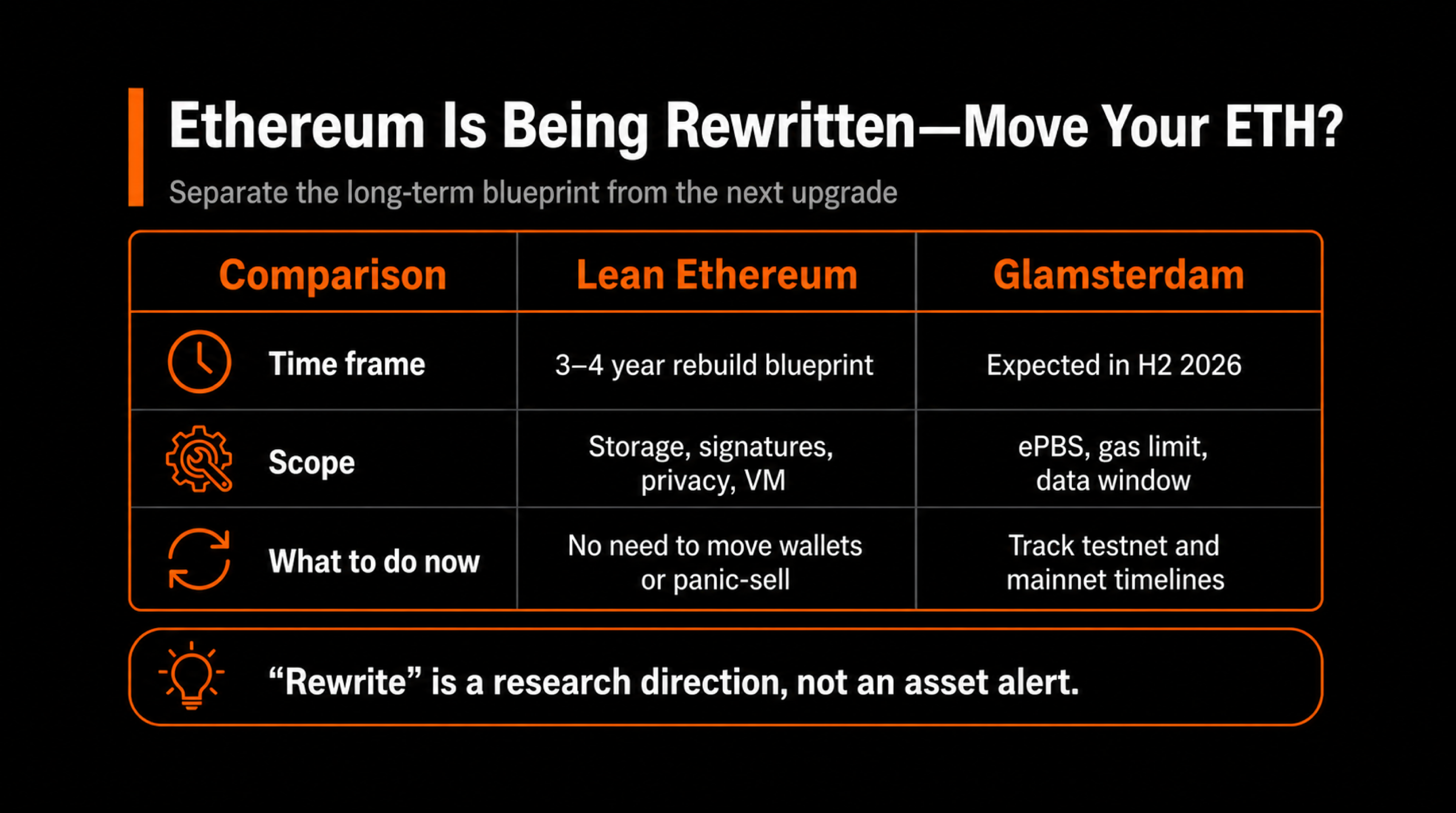
Lean Ethereum is positioned as the third iteration, described in scale as the biggest rebuild since the Merge. The difference is that the first two touched just one piece — either the consensus layer or the data layer — while this one involves storage mechanisms, signature algorithms, and even the virtual machine itself, putting nearly every major component on the list to be overhauled.This is “foundation work”-level planning, but while construction is underway, the assets in your wallet keep working exactly as before.
How Does Lean Ethereum's Scale Differ From a Regular EIP Upgrade?
Ethereum's regular upgrades — the hard forks that show up every six months to a year or so — typically bundle a dozen or so EIPs (Ethereum Improvement Proposals), adjusting gas pricing, adding opcodes, or loosening restrictions on some feature.These upgrades have a narrow scope and validate quickly — the community can test for a few months and ship to mainnet, with users barely noticing.
Lean Ethereum is an entirely different animal — it's a directional document spanning multiple future upgrade cycles, naming storage redesign, quantum-resistant signatures, privacy design, and a new virtual machine, each of which is substantial enough to be its own major upgrade on its own.A regular EIP upgrade adjusts the muscle on an existing skeleton; this one is discussing whether to swap out part of the skeleton itself, and understanding this distinction is what keeps you from mixing up a long-term research direction with a feature that's shipping next month.
The 3-to-4-Year Timeline — What Roughly Happens at Each Stage?
Vitalik has broken the rebuild into roughly 3 to 4 years, advancing in stages.The early stage focuses on research and spec-writing, including selecting the quantum-resistant cryptography scheme and prototyping the storage architecture — during this period, there's almost no change on the wallet side.Only in the middle stage does it move into testnet validation and gradual rollout, with compatibility confirmed before anything gets scheduled for a mainnet fork.
This blueprint and the Glamsterdam upgrade already underway are two parallel timelines: Glamsterdam has entered its final development stage and is expected to launch in the second half of 2026, while Lean Ethereum is longer-term, more foundational research.What's actually worth paying attention to in the near term is Glamsterdam's progress — there's no need to rush to guess at technical choices that won't even be finalized for another 3 years.
What Core Components Is This Rewrite Actually Replacing?
“Rewriting the protocol” sounds alarming, but what's actually being replaced? This section breaks down the three most frequently mentioned changes: storage mechanisms, signature algorithms, and the virtual machine and privacy design, so you know what problem each of these terms actually corresponds to, instead of staying stuck at the vague impression of “I heard there's a big overhaul coming.”
Reshaping the Storage Mechanism: Vitalik Calls It the Most Disruptive Step
Vitalik has described the redesign of the storage architecture as the most disruptive piece of the entire blueprint. Ethereum's current state-storage method requires every node to keep the complete account balances and contract data, and as on-chain activity accumulates, the state data only keeps growing, which over the long run raises the bar for running a node, making self-hosted node operation increasingly concentrated in the hands of a small number of well-resourced institutions.
The direction for the new storage design is to have nodes switch to using recursive cryptographic proofs to confirm that state is correct when verifying transactions, instead of re-executing every single computation — in theory, the compute and storage needed to verify future blocks could become decoupled from total on-chain activity.This won't change the balance display in your wallet, but over the long run it's tied to whether Ethereum can keep its core promise that “ordinary people can still afford to verify for themselves.”
Why Quantum-Resistant Signatures Just Got a Massive Priority Bump
Ethereum's current signature scheme is based on elliptic curve cryptography — a mathematical problem that's practically unbreakable on classical computers. But if a quantum computer with enough processing power ever arrives, it could theoretically be able to reverse-engineer a private key from it — which is exactly why the priority shift this time is so large.The industry has generally treated this as a risk that's still far off, but this time, Lean Ethereum moves quantum resistance to the very top of the priority list, with a goal of completing quantum-resistant upgrades to core components by 2029.
This shift comes partly because the cryptography community now assesses quantum computing progress as moving faster than expected, and partly because for a foundational component like signatures, the earlier a migration path is planned, the smaller the compatibility impact on existing wallets will be.This is a research-and-migration-planning phase — you don't need to switch to some quantum-resistant wallet right now, but this will genuinely be one of the focal points of protocol research over the next few years.
Privacy Design and the New Virtual Machine: RISC-V vs. leanISA
Lean Ethereum also elevates privacy from being an add-on feature each application has to figure out for itself, into a protocol-level design goal, so that transfers and interactions with built-in privacy protection, requiring no intermediary, become a capability Ethereum can offer natively, without needing to rely on third-party mixing tools.
Another topic drawing attention is the long-term evolution of the virtual machine. The Ethereum Virtual Machine has been in use for nearly a decade, and Vitalik believes a higher-performance new architecture will be needed going forward. Two candidate approaches are currently competing: the open-source RISC-V instruction set architecture, or leanISA, built specifically for Ethereum.Both options are still in the evaluation stage. Even once one is chosen, the existing virtual machine will be kept as a compatibility layer so existing contracts keep working, without requiring developers to rewrite their code.
The Step Right in Front of You: Where Does the Glamsterdam Upgrade Stand?
Where exactly has the Glamsterdam upgrade gotten to, and will it end up affecting you sooner than long-term research that won't be finalized for another 3 to 4 years?I've noticed a lot of people's attention gets pulled entirely toward the word “rewrite,” and they end up missing this much closer-to-home upgrade — which is directly tied to block production, fees, and even the confirmation speed of the wallet you use every day. This section walks you through exactly where things stand and when it'll actually show up in your day-to-day experience.
What Is ePBS, and Why Separate Block Production From Verification?
ePBS stands for “enshrined Proposer-Builder Separation.” Its core idea is to clearly split, at the protocol level, the two jobs of “who packages transactions into a block” and “who submits the block on-chain.” Under the current setup, these two roles already have a market-level division of labor, but they still rely on off-chain coordination and trust assumptions to connect, and if something goes wrong there, it can be exploited to manipulate transaction ordering or front-run trades — commonly known as the MEV problem.
Writing this division of labor directly into the protocol's rules, instead of leaving it to off-chain negotiation, makes the rules openly transparent and verifiable, gives clearer responsibility for building and verifying blocks, and reduces the risk of validators having their bargaining power hijacked by a handful of large builders.Glamsterdam is the key step where this topic finally gets put into practice — it's tied to whether your transactions become easier or harder to jump the queue on, so it's not something to glance at and forget.
What Do the 200M Gas Limit and the Larger Data-Transmission Window Actually Mean?
Another closely watched goal for Glamsterdam is raising the block gas limit to 200 million — roughly triple the current level. The gas limit determines how much computation and transaction volume a single block can hold, and raising it means higher overall network throughput, with a chance to ease fee competition during peak hours — a relatively direct, tangible improvement for everyday transfers and contract interactions.
This same batch of upgrades also includes expanding the data-transmission window, letting Layer2 networks write transaction data back to the mainnet more cheaply and in greater volume — this is actually one of the key foundations propping up the low fees across the entire Layer2 ecosystem.Raising the limit isn't free — the amount of data nodes need to process increases in tandem, which is also why parameter changes always have to run through validation on multiple testnets first before being scheduled for mainnet.
The Current Development Stage and Expected Mainnet Timing
Based on currently public progress, Glamsterdam has already reached the final devnet testing stage, meaning the roughly dozen EIPs included in this upgrade have already been finalized and bundled, with the next step being repeated validation of stability and compatibility across multiple testnets.This stage usually lasts several months. If unexpected issues turn up on a testnet along the way, the timeline may get fine-tuned, but the overall direction is unlikely to be scrapped and restarted.
According to the plan, testnet validation is expected to be completed in Q3-Q4 2026, and the mainnet launch window also falls within that range.That means Glamsterdam isn't a distant hypothetical — it's an upgrade that will actually happen within this half-year.If you want to track the real progress, going straight to the official blog or the developer call notes is far more reliable than secondhand relays on social media.
The Things Everyday Investors Most Commonly Misunderstand About This News
When the words “Ethereum is being rewritten” spread through the retail crowd, doesn't it make your skin crawl a little too, even making you wonder whether you've missed some major crisis and should get ahead of it?This section lays out several common misunderstandings clearly upfront, so that after being scared by the headline, you don't end up making a decision disconnected from the facts.
Mistakenly Believing a Protocol Rewrite Means Your ETH or Wallet Assets Are at Risk
The most common misunderstanding is jumping straight from “protocol rewrite” to “my assets might disappear, I need to move my coins somewhere else right now.” This leap skips several steps: Lean Ethereum is still in the research and spec-writing stage. Even the concrete testnet implementation hasn't been fully finalized yet, let alone anything that would affect the balance of any existing wallet address in the near term.
Ethereum's past major upgrades — including something as significant as the Merge, a full replacement of the consensus mechanism — landed with a completely seamless transition for users' assets: balances unchanged, private keys unchanged, addresses unchanged.Jumping from “rewrite” to “asset safety” actually conflates the long-term evolution of the technical architecture with the security of the private key in your wallet. I'd remind friends around me that, at this stage, these are two completely different levels of concern.
Mistaking a Narrative Losing Its Voice for Fundamentals Deteriorating
Another common direction of misunderstanding is equating “Ethereum's narrative volume is falling behind Solana's” directly with “Ethereum's fundamentals have weakened.” These two things are not the same: narrative volume compares how much discussion is happening on social media, while fundamentals look at the actual scale of capital carried, the degree of institutional adoption, and network usage intensity.
Ethereum is currently still the main battlefield for real-world asset tokenization and stablecoin settlement — the vast majority of mainstream stablecoin issuance and large-scale settlement still choose the Ethereum mainnet, or chains that inherit its security, as their underlying infrastructure.Narrative heat rises and falls with topic cycles. Being unfashionable today doesn't mean a structural loss of position. The reasonable approach is to treat it as a signal worth continuing to watch, rather than rushing to apply the much more serious conclusion of “fundamentals deteriorating.”
Mistakenly Thinking Change Is 3 to 4 Years Away, Overlooking That Glamsterdam Is Already Underway
The third common misunderstanding is putting all your attention on the distant “3 to 4 years from now” point in time, while overlooking the Glamsterdam upgrade that's already advancing right now and is much closer to your actual day-to-day experience.This kind of perception gap usually comes from media headlines that only emphasize the two sensational keywords “rewrite” and “3 to 4 years,” without clearly separating the two timelines of Lean Ethereum and Glamsterdam.
Glamsterdam has already entered final devnet testing and is expected to actually launch on mainnet in the second half of 2026, and for your transaction costs and confirmation speed, this is a change right around the corner, not something that has to wait several years to happen.If you fixate only on the rewrite plan several years out, you might actually miss this closer, more worth-watching upgrade milestone that will affect your wallet experience much sooner.
Will Rivals Overtake Ethereum During the Rebuild? What Is This Debate Actually About?
Ethereum is going to spend several years rebuilding itself, while rival chains like Solana keep generating buzz at the same time — does that mean Ethereum risks getting overtaken during the rebuild, or even losing its top position, dragging down the value of your position along with it?This section walks you through the actual data and the focal points of the debate, rather than just the emotional conclusions.
The Data Gap Between Solana's Developer Growth and Ethereum's Developer Attrition
The data set discussed most often lately is the shift in developer market share. Solana's share of global blockchain developers has climbed to around 23%, a clear jump from the single-digit level it held back in 2020. Ethereum's developer share, by contrast, has dropped below the 35% threshold it held for years, down to around 31%.Looking at just this number, it's easy to jump to the intuitive conclusion that “Ethereum is losing developers.”
But interpreting this data requires caution: market share reflects the relative shift in where newly arriving developers choose to build. Ethereum's ecosystem is simply much larger to begin with, so a declining share doesn't mean the absolute number is shrinking in lockstep.This growth is also tied to Solana's intensive investment in user experience and developer tooling in recent years — it's worth continuing to watch, but treating it in isolation as evidence that “Ethereum is finished” is stretching the data too far.
The Debate Over Whether the Layer2 Ecosystem Is Diluting Attention on the Mainnet
The second focal point of the debate is whether Ethereum's own Layer2 strategy has ended up diluting attention and capital-concentration effects on the mainnet itself. Over the past few years, Ethereum has moved large amounts of transaction activity onto various Layer2 networks, while the mainnet has focused on security and data availability, and one cost of that is that users' attention gets split across a dozen or more Layer2 networks, diluting the presence of the “Ethereum” brand itself.
Supporters of this strategy argue it's a necessary growing pain — the more Layer2 flourishes, the more it ultimately depends on the mainnet for final settlement, which remains a positive cycle for Ethereum long-term. Critics argue this division of labor has cost Ethereum its narrative dominance in directly facing end users.This debate has no standard answer, but understanding it can help you see that “Ethereum rarely trends” doesn't necessarily mean “the ecosystem is shrinking”.
How to Objectively Judge Whether Ethereum Is Being Marginalized
Facing this kind of narrative war where it's hard to tell truth from noise, the more practical approach is to pick a few hard metrics you can track over the long term as anchor points for observation, rather than re-evaluating your position every time you see a sensational headline.Metrics worth watching on an ongoing basis include: the actual change in capital locked up across the mainnet and various Layer2 networks, the total issuance and circulation of stablecoins within the Ethereum ecosystem, which chain institutional-level asset-tokenization programs choose to launch on, and developer retention rates.
If these hard metrics all show a trend of deterioration at the same time — for example, sustained net capital outflows or a clear shrinkage in stablecoin settlement volume — that's when “marginalization” gets closer to being something you should seriously consider.The more accurate description of the current situation is “a more intense competitive landscape, with narrative volume waxing and waning between players,” not yet at the point where Ethereum can be said to have been marginalized.
The Controversy That Erupted After the Announcement — How Should Holders Filter the Noise?
After Lean Ethereum's announcement, waves of criticism and waves of support erupted almost simultaneously — everything from accusations of copying to complaints that progress is too slow. Who should you believe, and what should you let go in one ear and out the other?This section helps you sort through this noise, understand who's arguing about what, which parts should actually be taken seriously, and which can be set aside.
The Full Story Behind Hoskinson's Accusation That It Copies Cardano's EUTXO Model
One line of controversy comes from Cardano founder Charles Hoskinson.He publicly pointed out that a ledger-model piece of research the Ethereum research team recently put forward is conceptually highly similar to the EUTXO model Cardano spent over a decade refining — tracking funds through unspent outputs, unlike Ethereum's current account-balance model.Hoskinson believes the Ethereum community dismissed this approach for years, only to quietly borrow a similar concept now without giving it the credit it deserves.
To some extent, this controversy reflects the long-standing rivalry between blockchains over design direction, rather than being purely a copying accusation.The Ethereum team has also publicly responded, explaining that the research in question was developed independently, based on its own technical evaluation path. This kind of “who thought of it first” debate over direction is usually very hard to settle objectively. Even if there's outside disagreement over the design's origins, this research is currently still just at the discussion stage, and it doesn't affect your actual holdings right now.
The Underlying Concern That the Developer Community Agrees With the Direction but Thinks It's Too Slow
Compared to the external rivalry over direction, the reaction inside Ethereum's own developer community is more worth paying attention to. On the whole, core developers broadly agree with the major directions Lean Ethereum proposes — quantum resistance, privacy, and storage simplification — and consider these genuinely long-term technical debt that has to be addressed.But quite a few voices also believe the 3-to-4-year timeline is too conservative, giving rival chains more room to grab market narrative and developer resources instead.
This internal tension of “agreeing with the direction but questioning the speed” is more worth continuing to watch than the external rivalry over design origins, because it touches on the execution ability of the Ethereum Foundation and the core development team themselves. This year the Foundation has also seen several senior executives depart one after another, so outside concerns about execution pace aren't coming from nowhere.There's still a gap that will take time to verify between a technical blueprint written on paper and whether it can actually be delivered on schedule — worth continuing to track, not something to glance at and forget.
How the Bull-Bear Tug-of-War Among KOLs Like Tom Lee Affects Retail Psychology
The third source of noise is the bull-bear tug-of-war among various opinion leaders in the market. The bullish camp, represented by Tom Lee, remains upbeat on Ethereum, with arguments centered on institutional-level adoption, arguing that JPMorgan, Robinhood, Circle, and other mainstream institutions, still prioritize Ethereum's stability and long-term reliability when choosing an underlying blockchain, rather than simply chasing whichever chain is fastest.At the same time, some opinion leaders are bullish on Solana instead.
This kind of bull-bear tug-of-war among KOLs is, at its core, a clash of sharply defined market opinions, but its effect on retail psychology is very direct: bullish today and you feel reassured, bearish tomorrow and the anxiety kicks back in, with your emotions getting dragged along.The healthier approach is to treat these opinions as one reference angle among several, not as the basis for a decision — what I personally go back and check are the hard metrics mentioned earlier.
As an ETH Holder or Someone Following This, What Should You Do Now, and What Shouldn't You Do?
Having broken down the concepts, the progress, and the controversy, let's come back to the most practical question: having read this news, what specific adjustments should you make today, and what shouldn't you do impulsively, so you don't end up paying needless tuition or getting swept along by noise?This section boils it down to three things: what you don't need to do, what's worth tracking, and how to avoid being misled by bad information.
What You Don't Need to Do: Move Wallets, Switch Chains, or Panic-Sell
Let's start with what you don't need to do. Lean Ethereum is still in the early stage of research and spec-writing — there is no finalized change that requires you to move your assets to a different wallet, switch to a different chain, or panic-sell your ETH because of this news.This kind of “hear big news, sell first as a courtesy” reaction is, at its core, being led around by how sensational the headline sounds, rather than being a judgment based on an actual change that affects the safety of your assets.
Looking back at every major upgrade Ethereum has actually shipped, the guiding principle for handling user assets has always been compatibility and a smooth transition, never exposing you to asset risk. From what I've seen, Ethereum has always been careful on this front. If seeing the word “rewrite” makes you want to take emergency action, it's worth first checking: does this change have a concrete mainnet launch date, and is there an official announcement requiring you to do anything?Right now, the answer to both is no, and acting prematurely will only expose you to unnecessary operational risk and wasted fees.
Signals Worth Continuing to Track: ePBS Launch Timing, Quantum-Security Progress, and Developer Retention Data
The counterpart to “what you don't need to do” is “what's worth keeping an eye on.”The first signal is the actual launch timing of ePBS within Glamsterdam, which ties directly into whether your transaction-ordering fairness and the MEV problem see real improvement — it's the observation metric closest to your day-to-day experience in the near term.The second signal is concrete progress on quantum-resistance research — once there's a clear, publicly announced technical choice, that signals this blueprint is moving from research toward implementation.
The third signal is the developer-retention data mentioned earlier — not just looking at the number of new developers, but whether the existing developers keep staying in the ecosystem to build.These three signals reflect Ethereum's actual health far better than any single article or KOL post. Treating them as a fixed checklist for long-term monitoring is far more efficient than chasing news headlines every day.
How to Track Official Progress and Avoid Being Misled by Bad Information
Finally, let's talk methodology. If you want to keep track of real progress, the most reliable approach is to follow the Ethereum Foundation's official blog directly, along with the core developers' biweekly call notes — these channels clearly mark which proposals are finalized and which are still under discussion, without the exaggeration or oversimplification of a secondhand retelling.By contrast, short posts on social media, chasing attention, often write a research direction as if it's about to happen — that gap can easily mislead holders.
Build the habit of going back to check primary sources whenever you see a sensational headline. Not adjusting your position directly based on a headline is the most practical way to protect your own judgment.Ethereum is going to spend 3 to 4 years rewriting itself. You don't need to watch this progress closely every single day — keeping a steady observation rhythm matters far more than chasing the emotional swings of every headline.
Conclusion
Lean Ethereum isn't something that will change your wallet balance tomorrow — it's a protocol rebuild direction spanning 3 to 4 years, running on a parallel timeline alongside the Glamsterdam upgrade that's already in its final testing stage right now.When you see the word “rewrite,” don't rush to move your assets or sell, Putting hard metrics like the ePBS launch timeline, quantum-resistance progress, and developer-retention data on your watchlist will do far more to help you judge where Ethereum actually stands in this race against rivals for time than chasing every sensational headline will.


